The Tool Desk
Outbyte Driver Updater FREEFix the driver behind crashes, sound loss and screen glitchesFind Drivers →Outbyte PC Repair FREEClear out junk files and repair common Windows errorsFree Scan →A workplace noise assessment is a decision process: identify who may be exposed, estimate their exposure during real work, compare it with the rules that apply in your location, and choose controls and follow-up. It does not always require a new measurement campaign. In the United States, OSHA’s guidance says monitoring is not necessary for every employer; in the United Kingdom, the Health and Safety Executive (HSE) says measurements may be unnecessary when other reliable information is enough to estimate exposure.
Why assess workplace noise?
Noise can damage hearing, and an assessment helps an employer determine whether workers face a risk and what action is needed. It is not simply a collection of sound readings: the result should connect exposure estimates to affected people, work activities, controls, and review.
The Centers for Disease Control and Prevention estimates that 22 million workers are exposed to potentially damaging noise at work each year, according to OSHA’s overview. The OSHA page does not state the year of the underlying estimate, so the figure should not be read as a dated annual measurement. OSHA: Occupational Noise Exposure – Overview
When is an assessment or measurement needed?
Investigate when workers report noise or difficulty hearing, when normal conversation is difficult, or when machinery, processes, or the nature of a task suggest potentially harmful exposure. OSHA’s monitoring appendix says measurement is not necessary for every employer, while HSE allows a reliable estimate based on other information. The key is whether the available evidence can represent actual worker exposure well enough to decide what action is needed.
Quick wins for a faster PC:
Scan for outdated or missing drivers - takes under a minuteDriver Scan →Clear out junk files and repair common Windows errorsFree Scan →Fix the driver behind crashes, sound loss and screen glitchesFind Drivers →#1 Best Overall

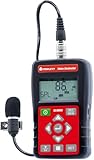
- 2.25-inch LCD Screen with Backlight: This TS-501B sound level meter is measured noise levels are expressed in decibels and displayed on the 2.25-inch LCD screen, it easy to read on a big display design. Long press the backlight button to turn on a backlight, making it easy to view even in dim light
- Decibel Meter with A/C Weighting: TopTes TS-501B decibel meter uses a precise condenser microphone to capture sound. It’s equipped with A-weighting and C-weighting facilities that measure noise levels from 30 to 130 dB with an accuracy of 1.5 dB, Frequency from 30 to 8000Hz. Perfect for monitoring noise levels in communities, home theaters, audio systems, automobiles, workshops, schools, offices, factories
- MAX/MIN Measurement: The sound pressure level (SPL) meter has Max or Min measurement values to represent the maximum/minimum (high/low peak) value of the sound produced within a certain time, and the data hold function can freeze the current reading based on the sound measurement according to individual needs
- Easy Use and Feature Packed: The non-slip side design ensures that the portable noise meter fits easily in the hand. TS-501B SPL meter is a battery-operated noise meter that comes with three durable batteries and has an automatic power off function to extend battery life. A low battery indicator will appear on the screen when the battery is low to remind the user to replace the battery in time
- What’s in the Box: One TS-501B Decibel Meter, Three AAA Batteries, One User Manual, One Carry Case. The device has been factory calibrated to ensure high measurement accuracy and compliance with quality standards.
Possible evidence includes workplace measurements, data from comparable workplaces, or machinery supplier information. Whatever the source, check that it reflects how the equipment and process are actually used, including task duration, work methods, and variation between typical shifts or days. If it does not answer the exposure question reliably, obtain appropriate measurements or competent specialist support.
How to carry out the assessment
- Screen for likely risk. Review worker concerns, hearing-related difficulties, noisy tasks, machinery and process information, and whether normal conversation is difficult.
- Map people and work. Identify noisy areas, affected roles, tasks, shift patterns, work methods, and workers who move between locations. Note how exposure differs on typical days.
- Estimate representative exposure. Use reliable existing information where it applies to the real work; otherwise, plan measurements that capture the tasks and variation that matter.
- Choose a measurement approach if needed. Use an area survey, personal dosimetry, or competent external assessment according to worker mobility, noise variability, the purpose of the assessment, and applicable rules.
- Compare with the correct benchmark. Confirm jurisdiction, sector, metric, averaging period, and any applicable peak-noise requirements. Do not apply one country’s thresholds to another.
- Set controls and document action. Record findings, controls, responsible people, and deadlines. Follow up to check that actions have been completed and exposure has been addressed.
- Review when conditions change. Reassess after relevant changes to machinery, processes, production, controls, or working conditions, and conduct periodic reviews.
Which measurement method fits?
| Approach | What it tells you | Best suited to | Main limitation |
|---|---|---|---|
| Area survey with a sound level meter | Sound level at measured places and times; readings can help build a noise map. | Relatively stable noise and employees who mostly stay in one place. | Multiple readings and worker-location information may be needed to estimate an individual’s exposure over a workday. |
| Personal noise dosimeter | Integrated exposure over the period the device is worn. | Workers who move around or noise that changes during a shift. | It must be set up and worn appropriately, and results must be interpreted for the assessment and applicable rules. |
| Reliable estimate without new measurements | Estimated exposure drawn from representative measurements, comparable workplaces, or supplier data. | Cases where existing information reliably answers the risk question. | The information must represent actual work and its variation. |
| Competent external assessment | Specialist support with measurement, interpretation, and action planning. | Cases where internal competence or assessment capacity is insufficient. | The employer remains responsible for acting on and maintaining the assessment. |
Sound level meter or dosimeter?
A sound level meter measures sound at a place and time. It can be useful for mapping areas or assessing workers who remain in relatively stable noise. A personal dosimeter follows an individual and integrates exposure over the wear period. OSHA describes a dosimeter as a meter that stores readings and integrates them over time to provide an average exposure for a period such as an eight-hour workday. For mobile workers or fluctuating noise, OSHA says personal monitoring generally estimates individual exposure more accurately.
Rank #2

- Measures frequency weighted noise exposure and peak (C, Z) sound level
- Datalog's up to 999,999 readings when used as a sound level meter with sampling times between 1 second and 24 hours
- Sound level mode: displays sound level, min/max, time-averaged sound level (Leq), peak, and sound exposure level (SEL)
- Adjustable Criterion Level, Exchange Rate and Threshold
- One user-defined measurement setup
A dosimeter microphone is typically worn near the shoulder; a meter can be held near the worker’s head when taking a reading. The choice should answer the assessment question—not just produce a convenient number. OSHA Appendix G: Monitoring Noise Levels
Which noise thresholds apply?
Legal limits and action levels are jurisdiction-specific. The metric and averaging period matter, and peak noise may have separate requirements. Confirm the current rule for the location and sector before deciding what constitutes compliance.
Rank #3
- Measure total noise exposure (%dose) over an 8 hour period; Test noise exposure in accordance with OSHA, MSHS, DOD, ACGIH, ISO85, and ISO90 standards
- One user-programmable measurement setup; User settable SPL (dB) and Peak (dB) alarms
- Fast and easy on-site surveys help determine noise reduction requirements; SLM mode (sound level meter) with datalogging of up to 1000k readings
- A, C, Z frequency weighting; Fast, Slow, Impulse, Peak time weighting
- USB interface for setup and analysis of stored events
United States: OSHA general industry
For US general industry, OSHA requires a hearing conservation program when exposure equals or exceeds 85 dBA as an eight-hour time-weighted average (TWA). OSHA requires feasible engineering or administrative controls when exposure is above 90 dBA as an eight-hour TWA. These are distinct triggers, not interchangeable descriptions of one limit; construction has a separate regulatory context. Check the applicable standard for the workplace and sector. OSHA: Occupational Noise Exposure – Overview
United Kingdom: HSE guidance
In the UK, employers assess estimated exposure against the exposure action values and limit values in the Control of Noise at Work Regulations. The HSE assessment guidance directs employers to those values; consult the regulations for the applicable numeric thresholds rather than importing OSHA’s US figures. HSE uses dB(A) for average noise and dB(C) for peak, impact, or explosive noise. HSE: How do I assess the risks? HSE: Advice for employers – overview
Rank #4

- ✅【Decibel Meter Data Logger】DANOPLUS decibel meter is able to record up to 43,000 data, it could view on the main unit & PC, and also export data via excel file whlie connecting to PC
- ✅【Three-Color Light Alarm】The decibel meter sound level reader is equipped with 3-color light, alerts you with green, yellow, and red indicators for low, medium, and high noise levels, you may manually set the alarm threshold
- ✅【High Accuracy】 The noise decibel meter is measuring range from 30~130dB and +/-1.5dB accuracy, colored screen with line chart display with visual noise data changes, analog bars, date and time ( (year-month-day-hour-minute-second)
- ✅【A/C Frequency Weighting】The db meter can switch between bB A and C frequency with adjustable FAST / SLOW measuring response; and comes with DC output the noise value by voltage mode according to the proportion
- ✅【USB Charging & PC Connectivity】DANOPLUS sound meter is compatible with Windows 7, 10, and 11 for connecting, data exporting, analysis, and printing, it's about 1.5h charging in 1000mAh capacity
What should employers do about the risk?
Prioritize feasible ways to eliminate or reduce noise at its source or along its path. Administrative steps can reduce the time workers spend exposed, but hearing protection should not be treated as the sole response when more effective controls are feasible.
- Reduce noise at source: select lower-noise tools or machinery and maintain and lubricate equipment.
- Interrupt transmission: place barriers between the source and workers, or enclose or isolate noisy equipment where practical.
- Manage exposure: change work practices or schedules where appropriate to reduce exposure time.
- Use hearing protection appropriately: select and evaluate suitable protection as part of a wider noise-control and hearing-conservation approach. HSE guidance also covers information, training, and health surveillance where required.
OSHA describes hearing protective devices as less desirable than feasible engineering or administrative controls, while HSE directs employers to eliminate or reduce risk and provide appropriate protection and supporting measures. OSHA: Occupational Noise Exposure – Exposure & Controls HSE: Advice for employers – overview
Best Value

- Measures acceleration, velocity and displacement plus RPM and linear surface speed
- Remote vibration sensor with magnetic adapter on 39-Inch(1m) cable
- Wide frequency range of 10Hz to 1kHz
- RMS or peak value measurement modes
- Manual/auto store/recall up to 1000 readings
Keep the assessment current
Write down the exposure findings, the basis for the estimate, the people or roles affected, planned controls, action owners, and deadlines. HSE recommends regular review and says an assessment should not be left unchecked for more than about two years. OSHA Appendix G calls for remonitoring after significant changes likely to increase noise. Review sooner when changes to equipment, processes, production, controls, or working conditions could alter exposure. HSE: How do I assess the risks? OSHA Appendix G: Monitoring Noise Levels
Can a phone app assess workplace noise?
OSHA identifies the NIOSH Sound Level Meter App as a tool the public can download on mobile iOS devices for screening workplace sound levels. Screening can help flag a concern, but OSHA’s cited overview does not say that an app alone establishes regulatory compliance. Use a method and evidence appropriate to the assessment and applicable requirements. OSHA: Occupational Noise Exposure – Overview
Quick Recap
Product prices and availability are accurate as of the date/time indicated and are subject to change. Any price and availability information displayed on Amazon at the time of purchase will apply.




