Free tools Windows power users keep installed
One-click scans. No signup required.
Answer questions about a previous job with one truthful, specific example: briefly set the context, explain what you personally did, state the outcome or lesson, and connect it to the role you want. Keep the focus on the question rather than reciting your résumé or criticizing former colleagues.
What interviewers are looking for in a previous-job answer
Behavioral questions—such as “What did you do in your previous job?” or “Tell me about a time you made a mistake”—invite you to describe how you handled a real situation. Harvard FAS career guidance says such examples can help interviewers assess skills relevant to a position. That is a useful way to prepare, not a guarantee that every interviewer has the same aim.


A specific story lets you show how you approached work, rather than relying on broad claims such as “I’m a strong communicator.” Harvard FAS Mignone Center for Career Success advises candidates to have something specific to say and describe their own role and what they learned from the situation (Harvard FAS, “Interviewing”).
Use a simple structure for behavioral questions
Harvard FAS recommends Situation–Action–Result for behavioral answers. For a question about a mistake or failure, its guidance uses STAR: Situation, Task, Action, Result, with attention to what you learned. In practice, give the interviewer enough context to understand the example, then spend most of your answer on your own actions and the outcome.
#1 Best Overall
- Situation: Set the scene in a sentence or two: what was happening and when.
- Task: Clarify your responsibility or the challenge you needed to address.
- Action: Describe the specific steps you took. Be clear about your contribution rather than attributing every team action to yourself.
- Result: Explain what happened. If the question concerns a setback, include what you learned or changed afterward.
Not every question needs all four parts in equal detail. Keep context brief, answer the question asked, and stop once the result or lesson is clear.
Adapt this answer template to a real example
Use the following as a planning aid, not a script to memorize:
Rank #2
“In my previous role as [role], [brief context]. I was responsible for [specific responsibility]. When [challenge or opportunity], I [specific actions I took]. The result was [accurate outcome]. I learned [lesson or skill], which I can apply here by [connection to target role].”
Replace every bracket with details you can support. If you do not have a precise metric, describe the result accurately without inventing one. If the work was shared, use “I” for your own actions and “we” for the team outcome.
The Tool Desk
Outbyte Driver Updater FREEScan for outdated or missing drivers - takes under a minuteDriver Scan →Outbyte PC Repair FREEClear out junk files and repair common Windows errorsFree Scan →How to discuss accomplishments without overstating your role
Choose an accomplishment that is relevant to the prompt and the position. State what the team achieved, then separate that from what you personally contributed. For example, explain that the team completed a project and specify the part you handled, such as coordinating a handoff or resolving a particular issue. Avoid claiming that you led work you did not lead or taking sole credit for a group result.
Be ready to discuss experiences listed on your résumé. Your answer should add a concrete example to those claims and make the connection to the new role clear. Harvard FAS advises giving enough detail to be useful without being so brief that the answer lacks substance or so long that it rambles.
Rank #4
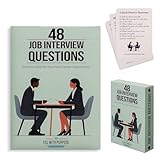
- Essential Phrases: Carefully selected flashcards feature common questions and advice to enhance your preparation and answers.
- Targeted Content: Curated by a career pathways and ESL instructor to help advanced language learners, as well as recent graduates and job seekers.
- Strategic Practice: Organized into 4 categories of relationship, knowledge, character, and leadership, allowing you to delve deep into each question and refine your responses.
- Insightful Guidance: The 8 tip cards such as the STAR method, along with what to ask the interviewer and more thoughtful ideas.
- Hiring Managers: Compact and portable, it provides a convenient resource to identify and draw out meaningful and honest responses.
How to answer questions about mistakes or difficult experiences
Choose a real situation you can explain calmly and professionally. State the challenge or mistake, your responsibility, how you responded, what happened, and what you learned or changed. Avoid blaming former colleagues or using the answer to revisit the conflict at length; keep the account centered on your decisions and response.
For example, if asked about a mistake, do not stop at “I learned to be more careful.” Explain what went wrong at a useful level of detail, what you did to address it, and what concrete practice you changed afterward. Do not imply that a problem was resolved or a result achieved if that is not what happened.
Best Value

- WHAT'S IN THE BOX: Meet the ultimate job interview prep system: a premium communication card deck featuring 54 interview flashcards, each pairing a key question or scenario with a high-impact answer, 100+ fill-in-the-blanks for authentic responses, and bonus access to 4.5 hours of video tutorials.
- EXPERT CRAFTED CARDS: Developed by Gorick Ng—Harvard career advisor, Wall Street Journal bestselling author, and career strategist—these 54 scenario-based interview flash cards teach you the proven response and storytelling frameworks for high-stakes interviews.
- BONUS VIDEO COACHING: Have Gorick Ng personally walk you through every card scenario and script. Simply use the included secret password to create an account and get instant access.
- MASTER LANDMINE QUESTIONS: Learn what to say—and what not to say—when facing the toughest questions that trip up 99% of candidates and turn high-stakes pressure into a job offer.
- COMPREHENSIVE INTERVIEW PREP: Covers both formal job interviews and informational coffee chats. Like a job hunter’s workbook meets flashcards, just draw a card, practice the framework, and walk in fully prepared.
How to answer “Why did you leave your previous job?”
Answer the departure question directly and briefly, then explain what you are seeking and why this position fits. The right explanation depends on your circumstances; there is no single wording that suits every departure. Keep the account truthful and professional, and do not offer a rehearsed explanation that does not match your situation.
Prepare and practice without sounding memorized
- Review your résumé and select a few real examples you can discuss in detail.
- For each example, note the situation, your responsibility, your actions, and the outcome or lesson.
- Check that your wording distinguishes your actions from the team’s work and that any figures or claims are accurate.
- Practice aloud or with another person. Focus on answering the prompt clearly, not reproducing a memorized paragraph.
- Adjust the final connection to the position so it shows why the experience is relevant, rather than forcing a connection where there is none.
Harvard FAS suggests practicing interview delivery and being prepared to discuss résumé experiences. Practice can help you keep the answer focused while still leaving room to respond naturally to follow-up questions.
Quick Recap
Product prices and availability are accurate as of the date/time indicated and are subject to change. Any price and availability information displayed on Amazon at the time of purchase will apply.




