For a basic energy calculation, efficiency is useful output divided by total input. Multiply that ratio by 100 to express it as a percentage: Efficiency (%) = (useful output ÷ total input) × 100. Compare like with like—such as joules with joules or watts with watts—and define which output is useful for the task.
What is the efficiency formula?
Use this formula for an introductory energy or work calculation:
Efficiency = useful output ÷ total input
To express the result as a percentage, multiply the ratio by 100. If the question asks only for the ratio, the decimal is also a valid answer. OpenStax defines efficiency in terms of useful energy or work output relative to total energy input; the University of Edinburgh’s physics glossary gives the percentage form.
OpenStax: Conservation of Energy · University of Edinburgh: Efficiency glossary
#1 Best Overall

- Profitability calculations; cash flow function Calculates NPV and IRR for uneven cash flows
- Time-value-of-money and Amortization keys solve problems including: pension calculations, loans, mortgages, etc.
- Ideal calculator for students, managers and statisticians
- Built-in functionality : List-based one- and two-variable statistics with four regression options: linear, logarithmic, exponential and power
- The BA II Plus calculator is approved for use on the following professional exams: Chartered Financial Analyst exam. GARP Financial Risk Manager (FRM) exam. Certified Management Accountants exam
How do you calculate percentage efficiency?
- Identify the total input to the system.
- Identify the output that performs the intended useful task.
- Divide useful output by total input, using comparable quantities and units.
- Multiply by 100 if the answer is required as a percentage.
For example, if a device receives 200 J of energy and delivers 150 J as useful output, then 150 J ÷ 200 J = 0.75. Multiply by 100 to get 75% efficiency. This is an arithmetic example, not a measured result for a particular device.
Rearranging the formula
- Useful output = efficiency as a decimal × total input.
- Total input = useful output ÷ efficiency as a decimal.
Use the decimal form in these rearranged equations: for example, 75% becomes 0.75.
Rank #2
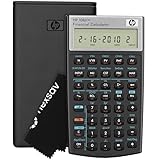
- HP 10BII+ FOR STUDENTS & PROFESSIONALS – This HP calculator is built for business, finance, accounting, and statistics courses. Perfect for learners and professionals who need to solve common financial problems quickly without memorizing formulas or relying on spreadsheets.
- 100+ FUNCTIONS FOR REAL WORLD MATH – Quickly solve time value of money, interest rates, loan payments, NPV, IRR, cash flows, and more. The 10bII+ also includes probability distributions for statistics courses—a feature not often found in financial calculators.
- ALGORITHMIC INPUT WITH DEDICATED KEYS – This high-school/college calculator uses algebraic and chain logic with minimal keystrokes. Layout appears the same as standard calculators for easy learning. Dedicated keys give quick access to commonly used financial and statistical functions
- APPROVED FOR MAJOR EXAMS – The HP 10bII+ algebra calculator is permitted for use on SAT, PSAT/NMSQT, and AP tests. An ideal statistics calculator and business calculator for school finance and accounting students preparing for class, coursework, or standardized exams.
- INCLUDES TRAVEL CASE, CLEANING CLOTH & BATTERIES– Slim, durable, and easy to keep on hand or store in a backpack or locker. Includes a protective case, cleaning cloth, and batteries so it’s ready out of the box. Large screen with clear contrast (non-backlit) is easy to read during exams or lectures.
What counts as useful output?
Efficiency measures the share of input that reaches the output chosen as useful for the task. Set that definition before calculating. A petrol engine, for example, converts chemical energy in fuel partly into kinetic energy and partly into other forms, including exhaust heat. If the task is to propel a vehicle, the kinetic energy is the useful output being counted; not every energy transfer automatically belongs in the numerator.
Energy is conserved even when some of it does not perform the intended job. It may be transferred into heat, sound, or another form outside the useful output being measured. As OpenStax explains, “Even though energy is conserved in an energy conversion process, the output of useful energy or work will be less than the energy input.”
Rank #3

- Solves time-value-of-money calculations such as annuities, mortgages, leases, savings, and more
- Performs cash-flow analysis for up to 32 uneven cash flows with up to 4-digit frequencies
- Calculates various financial functions: Net Future Value Net present Value Modified Internal Rate of Return Internal Rate of Return Modified Duration Payback Discounted Payback
- The Texas Instruments BAII Plus Professional features an Automatic Power Down (APD) function for extended battery life
- Prompted display guides you through financial calculations showing current variable and label. Ten-digit display
How should you interpret the result?
In a basic energy-conversion problem, efficiency is ordinarily a fraction from zero to one, or 0% to 100% when expressed as a percentage. A result above 100% is not a typical energy-conversion efficiency: check whether the measure is actually a coefficient of performance, uses a different accounting convention, or has an incorrect boundary or calculation.
Efficiency is not the same as power. Power is the rate of energy transfer; efficiency is a ratio of useful output to input. Nor is efficiency the same as energy intensity. The U.S. Department of Energy describes energy intensity as energy used per unit of output or activity, while its energy-efficiency framing concerns providing a given service with less energy or producing more service from a given input.
Rank #4

- Profit margin calculation
- Quick and easy tax calculation
- Square root, sign change, and memory keys
- Attractive metallic design
- 12 digits
U.S. Department of Energy: Energy Intensity Indicators terminology and definitions
Independent reader supportYour contribution helps us test, update, and keep practical guides available for everyone.How to compare efficiencies fairly
A percentage is meaningful only in context. When comparing systems, use the same useful job, system boundary, input basis, and definition of output. This matters especially when a system produces more than one useful output: changing what is counted can change the reported efficiency.
Best Value

- PROFESSIONAL FINANCIAL CALCULATOR : Built-in TVM, IRR, NPV. Engineered for business analysts, real estate investors, accountants, and finance students.
- ADVANCED CASH FLOW & AMORTIZATION : Execute time value of money, break-even analysis, depreciation schedules, and bond pricing. Trusted for professional exam prep", MBA coursework, and banking certifications.
- CATIGA CF-300 : Flip-open hard case with a snap-close design for a secure fit. Compact and portable: designed for daily professional use in office, classroom, or on-site.
- ALL-IN-ONE FOR PROFESSIONALS : From NPV/IRR for real estate analysis to statistical calculations for business analysts. Handles probability, linear regression, and complex financial formulas.
- MORTGAGE, LOAN & INVESTMENT CALCULATOR : Covers bond pricing, loan amortization, investment analysis, and exam-level computations. Your go-to accounting calculator, business calculator, and real estate calculator in one device.
Combined heat and power (CHP)
A CHP system produces electricity and useful thermal output from fuel. The U.S. Environmental Protection Agency’s total-system method adds net useful electrical output and net useful thermal output, then divides by total fuel energy input. That method treats electricity and thermal energy as equal in value, which may not reflect their different practical value. EPA also describes effective electric efficiency, which adjusts for thermal output that would otherwise have been produced by conventional technology.
EPA reports that total-system efficiencies for CHP systems typically reach 60% to 80%. Its typical effective electric efficiency ranges are 50% to 70% for combustion-turbine CHP systems and 70% to 85% for reciprocating-engine CHP systems. These are EPA’s contextual typical ranges, not universal targets or a current product comparison; the page’s publication date is not stated. EPA cautions that assumptions implicit in each method are not appropriate in every case. Choose the measure that fits the comparison and state the assumptions.
U.S. EPA: Methods for Calculating CHP Efficiency
Illustrative textbook values
OpenStax lists these illustrative efficiencies: gasoline engine, 30%; diesel engine, 35%; coal power plant, 42%; and electric motor, 98%. They are examples in a textbook table, not performance guarantees for every engine, plant, or motor; the source search result does not state a publication year.
Does the same formula apply outside physics?
Not automatically. “Efficiency” can have specialized meanings in business, computing, and economics. For those contexts, define the relevant output, input, and system boundary first, then use the measure appropriate to that field. The energy formula above applies when the quantities being compared are useful energy or work output and total energy input.
What’s actually slowing this PC down?
Pick the symptom - the matching free tool is one click away.
Quick Recap
Product prices and availability are accurate as of the date/time indicated and are subject to change. Any price and availability information displayed on Amazon at the time of purchase will apply.




