Outdated Drivers Are Slowing You Down
One free scan finds every outdated or missing driver and matches the right update for your exact hardware.Free scan · exact hardware matchPC Slower Than It Used to Be?
A free scan shows the junk files, broken settings and background clutter dragging Windows down - then fixes them in one click.Free scan · Windows 10 & 11Starting a fish farm can require tens of thousands of dollars for some small business models and hundreds of thousands for larger or intensive operations—but there is no universal startup price. Species, location, farm size, production system, existing land and water infrastructure, and the time until the first sale all affect how much money you need.
What do published fish-farm startup estimates show?
These figures illustrate different projects; they are not directly comparable quotes or a current nationwide price list.
| Project and scope | Published estimate | Source and qualification |
|---|---|---|
| Fee-fishing operation | $30,000–$50,000 initial investment | University of Missouri Extension, publication accessed 2026; U.S. north-central examples. |
| Bait minnow farm | $60,000–$80,000 initial investment | University of Missouri Extension, publication accessed 2026; U.S. north-central examples. |
| Trout farm intended to support an operator’s income | At least $200,000 | University of Missouri Extension, publication accessed 2026; U.S. north-central context. |
| Indoor fish facility producing 40,000–80,000 pounds per year | More than $300,000 to establish | University of Missouri Extension, publication accessed 2026; stated production range. |
| Smooth-bottomed fish pond construction | $2,000–$3,000 per surface acre | Oklahoma State University Extension, its publication context. |
| 0.1-hectare pond with inlets and outlets | RM 2,000–2,500 | Department of Fisheries Malaysia, accessed 2026. |
| Specified 500 m² cement tank with inlet and outlet | RM 8,000–10,000 | Department of Fisheries Malaysia, accessed 2026. |
The U.S. examples describe distinct business models; a fee-fishing operation is not the same project as an income-supporting trout farm or a high-output indoor facility. Missouri Extension also notes that smaller systems can have higher initial capital costs per pound of production, and that using an existing or rented building can change the capital required.
The Malaysia estimates are in Malaysian ringgit and reflect specified pond and tank designs. They should not be converted into a local build budget without accounting for location, date, design, and site conditions.
Recommended Free Tools
#1 Best Overall

- High-Quality Materials: Made with reinforced 0.9 mm triple-layer PVC scraper cloth and 1.2 mm high-transparency PVC, this canvas fish pond is durable, sun-resistant, and tear-resistant. It offers clear visibility and is wear-resistant and scratch-resistant, with a seamless design to avoid leaks.
- Sturdy Structure: The above-ground fish pond features high-strength stainless steel pipes that are rust-resistant and corrosion-resistant. Its strong, stable frame ensures that it remains intact and holds its shape, even when full of water, ensuring long-term durability.
- Quick Drainage: With a large drainage valve, this fish pond allows quick water release with a simple turn, saving time and making maintenance more convenient.
- Large Capacity: This PVC fish pond measures 78.7 x 55 x 23.6 in (2000 x 1400 x 600 mm) and holds up to 470 gallons, providing ample space for aquatic life. It is ideal for indoor and outdoor aquaculture.
- Wide Application: Designed to accommodate a variety of aquatic species, this pond is ideal for koi, goldfish, shrimp, crabs, and more, meeting the needs of diverse aquaculture environments.
What should your startup budget include?
Build two budgets: one for setup and one for the cash needed to operate until sales begin. A pond or tank’s construction price alone does not show whether the business can fund a full production cycle.
Capital and setup costs
- Land purchase or lease, site studies, design and engineering, permits, clearing, and earthwork.
- Ponds, embankments, tanks or raceways, buildings, water supply, drainage, and discharge works.
- Pumps, filters or other treatment equipment, oxygenation, electrical supply and backup, monitoring instruments, and installation.
- Nets, harvest and holding equipment, tools, and a contingency for site-specific work.
The FAO aquaculture planning guidance identifies design, clearing, earthwork, water systems, sluice gates, buildings, equipment, and tools among capital-cost elements.
Rank #2

- High-Quality Materials: Made with reinforced 0.9 mm triple-layer PVC scraper cloth and 1.2 mm high-transparency PVC, this canvas fish pond is durable, sun-resistant, and tear-resistant. It offers clear visibility and is wear-resistant and scratch-resistant, with a seamless design to avoid leaks.
- Sturdy Structure: The above-ground fish pond features high-strength stainless steel pipes that are rust-resistant and corrosion-resistant. Its strong, stable frame ensures that it remains intact and holds its shape, even when full of water, ensuring long-term durability.
- Quick Drainage: With a large drainage valve, this fish pond allows quick water release with a simple turn, saving time and making maintenance more convenient.
- Large Capacity: This PVC fish pond measures 59 x 39.4 x 27.6 in (1500 x 1000 x 700 mm) and holds up to 270 gallons, providing ample space for aquatic life. It is ideal for indoor and outdoor aquaculture.
- Wide Application: Designed to accommodate a variety of aquatic species, this pond is ideal for koi, goldfish, shrimp, crabs, and more, meeting the needs of diverse aquaculture environments.
Operating cash before revenue
- Fry or fingerlings, feed, fertilizer where used, labor, electricity, fuel, and supplies.
- Lease payments, interest, depreciation, routine maintenance, management wages, and other fixed expenses.
- Transport, processing, and other costs required to get harvested fish to buyers.
FAO distinguishes recurring variable inputs—such as fry, feed, labor, electricity, fuel, and supplies—from fixed costs such as lease, interest, depreciation, maintenance, and management wages. Include enough working capital to cover the production cycle before harvest revenue arrives. Business Queensland’s aquaculture guidance also emphasizes cash-flow planning because fish take time to reach market size and production can vary seasonally.
Estimate harvest volume and sale price conservatively. Account for mortality, feed use, labor, energy, and the route to market rather than assuming that all stocked fish become saleable product. Oklahoma State Extension advises deciding how the fish will be marketed during planning and including all production costs in an enterprise budget, not just feed and fingerlings.
Free tools Windows power users keep installed
One-click scans. No signup required.
Rank #3

- High-Quality Materials: Made from 0.9 mm thickened PVC scraper cloth, this canvas fish pond is corrosion-resistant, sun-resistant, wear-resistant, scratch-resistant, and secure. The seamless stitching ensures waterproof performance without leaks, ensuring secure use.
- Sturdy Structure: The above-ground fish pond features high-strength stainless steel pipes that are rust-resistant and corrosion-resistant. Its strong, stable frame ensures that it remains intact and holds its shape, even when full of water, ensuring long-term durability.
- Quick Drainage: With a large drainage valve, this fish pond allows quick water release with a simple turn, saving time and making maintenance more convenient.
- Large Capacity: This PVC fish pond measures 47 x 31.5 x 19.7 in (1200 x 800 x 500 mm) and holds up to 126.8 gallons, providing ample space for aquatic life. It is ideal for indoor and outdoor aquaculture.
- Wide Application: Designed to accommodate a variety of aquatic species, this pond is ideal for koi, goldfish, shrimp, crabs, and more, meeting the needs of diverse aquaculture environments.
How does the production system affect the cost?
Earthen ponds
Land suitability, soil, excavation, embankments, dependable water access, and drainage can drive the setup bill. Pond size and water supply also limit production. The Oklahoma estimate above is specific to its publication context; obtain local earthwork and water-infrastructure bids rather than treating it as a universal rate.
Cage culture
Cages may reduce startup costs when a suitable lake or reservoir is already available. Oklahoma State Extension says, “The major advantage of cage culture is that it requires much lower start-up costs than other production systems.” That is not a promise that cage farming is the cheapest choice for every site: water quality, stocking limits, disease risks, and the suitability of the water body still matter.
Rank #4
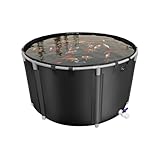
- 【Large capacity Aquaculture Pool/ koi pond】:Maximum capacity 450-1300 Gal,It can meet the needs of most fish farming. The spacious area allows the fish to move freely. Meanwhile, the large-capacity fish tank can better meet your fish farming requirements and is suitable for raising various types of fish.
- 【Wide-range in application】:The above ground outdoor fish pond is used for water storage, fish farming, shrimp farming,children's swimming pools, hydroponic plants, garden water storage, watering flowers, used for fish and shrimp breeding, pond water storage.
- 【Strong and Durable Material】:Tarpaulin is made of thick PVC coated waterproof fabric,which is safe,non-toxic,odorless,anti-aging,anti-static,sunscreen,anti-tear,easy to fold,durable.
- 【Pond Easy To Use】:Fish pond water container with faucet,can be connected to water pipe,very convenient to use,A drain is added to the bottom and a spill-proof port is added to the top.
- 【Easy to install and maintain】:7 support rods, 6 Circular tube,large and small mouth connection, easy to assemble, no need for complicated tools, easy to build your private fish pond,The excellent quality of the product enables the fishpond to be used for a long time.
Tanks, raceways, and recirculating systems
These systems can support controlled or intensive production, but the budget needs to account for tanks, pumps, plumbing, treatment or filtration, power, monitoring, and backup planning. Missouri Extension’s estimate of more than $300,000 to establish an indoor facility producing 40,000–80,000 pounds annually illustrates the capital involved in one specific scale and context.
Scale and cost per unit
Larger farms can spread construction and equipment costs over more production, but require more capital and management. A historical FAO chapter, citing a 1981 Hawaii freshwater-prawn case study, estimated construction plus equipment at about US$17,000 per pond for a 0.4-hectare farm and about US$7,200 per pond for a 40-hectare farm. Within those estimates, equipment was US$10,205 and US$814 per pond, respectively. These historical case-study amounts are not current purchase estimates.
The Tool Desk
Outbyte PC Repair FREEClear out junk files and repair common Windows errorsFree Scan →Outbyte Driver Updater FREEFix the driver behind crashes, sound loss and screen glitchesFind Drivers →How can you build a realistic local estimate?
- Choose the species and identify buyers. Species affects climate suitability, system choice, feed, harvest timing, and buyer requirements. Queensland’s aquaculture startup guidance notes that species selection determines the farm type, site requirements, and production system.
- Check the site and water supply. Assess land and soil, year-round water availability and quality, drainage or discharge, access, and energy. Malaysia’s Department of Fisheries lists suitable land, system selection, adequate water, and a constant water source among initial checks.
- Ask regulators about approvals before construction. Requirements depend on jurisdiction, species, system, and scale. Business Queensland states: “The approvals you need will depend on the type, scale and location of your aquaculture project.” Contact the relevant authority for the actual site before committing to construction.
- Map the time between spending and sales. Work out when stock can be harvested, how seasonal production affects cash flow, and how operating expenses will be paid before the first sale.
- Get local quotations. Request prices for excavation or buildings, water works, tanks and filtration, electrical service and backup, equipment, feed, fingerlings, labor, insurance, permits, and transport. Check grant or subsidy eligibility with local authorities; schemes do not automatically apply across jurisdictions.
- Test the business case. Use conservative assumptions for sale price and harvest, and include mortality, feed, labor, energy, transport, and processing. Confirm the sales channel can handle the expected output.
What equipment belongs in the estimate?
Monitoring and water movement are operating necessities, but equipment must match the farm’s system and scale. A water-quality meter capable of measuring dissolved oxygen and pH, a correctly sized pump, and system-dependent aeration equipment are categories to price during planning. FAO lists oxygen and pH meters among aquaculture equipment; extension guidance also stresses water-quality monitoring.
Ask suppliers or an aquaculture specialist to size equipment for the site, water volume, stocking plan, and backup requirements. A small aquarium meter or generic pump should not be assumed suitable for a commercial pond or production system.
Quick Recap
Product prices and availability are accurate as of the date/time indicated and are subject to change. Any price and availability information displayed on Amazon at the time of purchase will apply.




