Outdated Drivers Are Slowing You Down
One free scan finds every outdated or missing driver and matches the right update for your exact hardware.Free scan · exact hardware matchPC Slower Than It Used to Be?
A free scan shows the junk files, broken settings and background clutter dragging Windows down - then fixes them in one click.Free scan · Windows 10 & 11The claim is only partly true. Tesla said in May 2025 that more than 95% of the parts in Model 3 and refreshed Model Y vehicles built at its Shanghai factory came from Chinese suppliers. That is a statement about specific vehicles made in China—not about every Tesla, every market, or Tesla’s worldwide component supply.
For a U.S. buyer, government data points to a very different picture: 2026 Tesla models sold in the United States show between 60% and 75% U.S./Canadian content by value, with Mexico the only listed major foreign source in the reported figures.



Where the “95% made in China” figure comes from
On May 6, 2025, Tesla’s official Chinese social-media account said that more than 95% of the parts in each Model 3 and refreshed Model Y produced at Gigafactory Shanghai were made in China.
That figure describes:
- Vehicles manufactured at Tesla’s Shanghai plant;
- Specific Model 3 and refreshed Model Y production;
- Parts sourced from Chinese suppliers; and
- A localization rate for that factory’s supply chain.
It does not mean that 95% of the parts in every Tesla sold worldwide come from China. Tesla operates factories in the United States, China and Germany, and its annual report says it buys from thousands of suppliers globally.
Quick wins for a faster PC:
Fix the driver behind crashes, sound loss and screen glitchesFind Drivers →Repair Windows errors before they cause bigger problemsFix Now →#1 Best Overall
The distinction matters because a vehicle assembled in Shanghai can have a very different supply chain from one assembled in Texas, California or Berlin.
What the U.S. vehicle data shows
The National Highway Traffic Safety Administration’s American Automobile Labeling Act data gives a useful—though imperfect—view of the supply chain for vehicles sold in the United States. For model-year 2026 Teslas, the reported U.S./Canadian content by value is as follows:
| Model | U.S./Canadian content | Listed major foreign source | Final assembly |
|---|---|---|---|
| Model 3 RWD/AWD | 75% | Mexico, 20% | United States |
| Model 3 Performance | 70% | Mexico, 20% | United States |
| Model Y AWD/Performance | 70% | Mexico, 20% | United States |
| Model Y RWD/Long Range RWD | 70% | Mexico, 25% | United States |
| Cybertruck | 65% | Mexico, 25% | United States |
| Model S | 65% | Mexico, 25% | United States |
| Model X | 60% | Mexico, 25% | United States |
These figures do not establish that a U.S.-market Tesla contains no Chinese components. They do show that the vehicles are not “almost entirely made in China” under the government’s reported value-based content figures. The Tesla Model 3, for example, is listed with 75% U.S./Canadian content by value.
Why the percentages can be misunderstood
NHTSA’s numbers measure parts content by value, not the number of individual components. A vehicle could contain many inexpensive parts from one country and fewer, more expensive parts from another. The percentages therefore cannot be read as a literal count of every screw, sensor or electronic component.
The data also has several limits:
- Percentages are generally rounded to the nearest 5%.
- The figures are reported by carline and may not describe every individual vehicle.
- NHTSA lists countries contributing at least 15% of equipment content.
- The table identifies no more than two major foreign-source countries.
Consequently, the remaining content could include inputs from additional countries, including China. But the reported data does not support the idea that China dominates the parts content of these U.S.-market models.
Tesla’s factories are spread across several countries
Tesla’s manufacturing footprint further undermines the broad version of the claim. Its reported installed annual capacity in July 2025 included:
| Factory | Vehicles | Installed annual capacity |
|---|---|---|
| California | Model S/Model X | 100,000 |
| California | Model 3/Model Y | More than 550,000 |
| Shanghai | Model 3/Model Y | More than 950,000 |
| Berlin | Model Y | More than 375,000 |
| Texas | Model Y | More than 250,000 |
| Texas | Cybertruck | More than 125,000 |
Installed capacity is not the same as actual production or deliveries. Still, the locations show why a global “made in China” percentage cannot be inferred from Shanghai’s localization rate.
Shanghai is an especially important production and export hub. Chinese government reporting said the factory accounted for approximately 52% of Tesla’s global vehicle deliveries in 2025 and maintained a localization rate of about 95%. That means Shanghai supplied a large share of Tesla vehicles and used a highly localized Chinese supply chain. It does not mean that 52% of all Tesla components worldwide were made in China.
Rank #3
What this means for someone buying a Tesla
Country of origin can matter to buyers for several practical reasons: eligibility for tax incentives, tariff exposure, resale perceptions, repair-part availability and personal preferences about where products are manufactured.
However, the factory location is more useful than the Tesla badge alone. Two Model Ys sold in different countries—or even during different production periods—may have different batteries, suppliers and final-assembly locations.
Before buying, check the vehicle-specific information rather than relying on a social-media statistic:
- Ask where the vehicle was assembled. The dealer or Tesla delivery documentation may identify the production facility. The vehicle identification number and its records can also help establish origin.
- Check the applicable government labeling data. For U.S. purchases, NHTSA’s Part 583 American Automobile Labeling Act reports provide model-year content information.
- Confirm incentive rules separately. Tax-credit eligibility can depend on battery components, critical minerals, income, purchase price and other requirements—not simply on the percentage of parts made in one country.
- Compare the exact trim and model year. A Model 3 Performance and a Model 3 RWD can have different reported content, and a refreshed model may not share the same supply chain as an earlier version.
- Do not treat “U.S. content” as 100% domestic. The NHTSA figures include U.S. and Canadian content and identify major foreign sources; they are not a promise that every component was made in the United States.
The accurate version of the claim
A precise summary would be:
More than 95% of the parts used in certain Model 3 and refreshed Model Y vehicles built at Tesla’s Shanghai factory came from Chinese suppliers.
Free tools Windows power users keep installed
One-click scans. No signup required.
Special offer. See more information about Outbyte and uninstall instructions. Please review EULA and Privacy policy.Rank #4
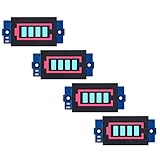 4PCS 2S 2 Series Lithium Battery Level Indicator Capacity Module Ni-MH 8.4V 4 Sections Blue LED Display Electric Vehicle Battery Power Tester Li-po Li-ion
- The 2S battery capacity indicator module can be used to display lithium battery, lead acid battery, and Ni-MH battery.
- Clear and bright display, outline red, display block Blue. The different electricity quantity will illuminate corresponding blocks electricity quantity.
- How to use it: Connect the positive and negative terminals of the display board to the positive and negative terminals of the battery under test. The digital tube displays the real-time battery power.Note : after connecting a few series of lithium batteries in series, it is necessary to connect t-i-n to the corresponding pads.For example if a 2S battery is measured (two 3.7V lithium batteries are connected in series), a short circuit on the pad corresponding to S2 of the board is required.
- Widely applications: Can be widely applied to portable mobile equipment, electro mobile, balance car, cleaning machine, measuring equipment etc. battery capacity indicator.
- Note: The electricity quantity parameter is a reference value, there will be about 2% error range; This model is not waterproof, the electronic components should be used in a dry environment; The number of corresponding battery strings and use them within the corresponding voltage range. Do not exceed a voltage of 4.3*N at most.(for example, if the t-i-n on the pad of S3 is selected, the maximum voltage detected by the module should not exceed 4.3*3=12.9 V).
The following broader statements are not supported:
- More than 95% of every Tesla’s parts are made in China.
- Teslas sold in the United States are almost entirely made in China.
- Tesla is a Chinese-made car company.
Tesla is a U.S. company with manufacturing in multiple countries. Its Shanghai operation does have an unusually high Chinese-localization rate, but that regional fact should not be presented as a global description of Tesla vehicles or components.
Independent reader supportYour contribution helps us test, update, and keep practical guides available for everyone.FAQ
Are Tesla cars made in China?
Some Tesla vehicles are made in China, particularly Model 3 and Model Y vehicles produced at Gigafactory Shanghai. Tesla also manufactures vehicles in the United States and Germany.
Are more than 95% of all Tesla parts made in China?
No. Tesla’s more-than-95% statement applied to parts in certain Model 3 and refreshed Model Y vehicles built at the Shanghai factory. It was not a global figure for every Tesla model or component.
Do these 3 things before closing this tab:
1Clear out junk files and repair common Windows errors2Scan for outdated or missing drivers - takes under a minute3Repair Windows errors before they cause bigger problemsHow much of a U.S.-market Tesla is made in North America?
For model-year 2026 vehicles, NHTSA lists U.S./Canadian content by value ranging from 60% for the Model X to 75% for the Model 3 RWD/AWD. The figures vary by model and trim.
Does a U.S.-content percentage prove a Tesla has no Chinese parts?
No. NHTSA measures content by value and lists only major sources meeting its reporting thresholds. The figures show the reported share of U.S./Canadian content, not the origin of every individual part.
The Bottom Line
Bottom line: The claim is accurate only when narrowed to certain Shanghai-built Model 3 and refreshed Model Y vehicles, for which Tesla reported more than 95% Chinese-sourced parts. It is misleading as a statement about all Teslas. U.S.-market model-year 2026 Teslas are reported with 60% to 75% U.S./Canadian content by value, and Tesla’s wider manufacturing and supplier network spans several countries.
Quick Recap
Product prices and availability are accurate as of the date/time indicated and are subject to change. Any price and availability information displayed on Amazon at the time of purchase will apply.
Recommended Free Tools




