Procter & Gamble’s AI strategy is best understood as a set of tools embedded in everyday decisions—not a fully autonomous supply chain. The company has described using machine learning to sense demand and flag stock-out risks, computer vision to inspect products and retail shelves, and digital systems to coordinate planning and warehouse activity. The key idea is to connect those signals to actions by supply-chain, sales, manufacturing, and retail teams.
The public account spans different periods: a 2021 discussion of pandemic-era forecasting and retail execution, followed by management commentary in 2025 about its Supply Chain 3.0 program. Those examples show the direction of P&G’s approach, but do not establish that every capability is deployed everywhere or that stated targets have been achieved.
Why P&G applied AI to supply-chain decisions
Consumer-goods supply chains must make many interdependent decisions: how much to produce, where to hold inventory, which products to send to each retailer, and how quickly to respond when demand or supply changes. Demand can vary by product, market, retailer, channel, and promotion. Even when a product is somewhere in the network, it may be absent from a store shelf or unavailable to an online shopper.
That makes “availability” a chain of conditions, not a single inventory number. A product might be in a distribution center but not yet delivered; it might be in a store’s back room but not on the shelf; or it might appear in an online listing but not be purchasable for a shopper’s location or delivery window. P&G’s described use cases address different points in this chain, from demand planning and manufacturing to shelf execution and warehousing.
Quick wins for a faster PC:
Clear out junk files and repair common Windows errorsFree Scan →Scan for outdated or missing drivers - takes under a minuteDriver Scan →Repair Windows errors before they cause bigger problemsFix Now →#1 Best Overall

- Built for Local AI Development: AMD Ryzen AI Halo is designed for local AI development and inference, featuring 128GB unified memory and support for up to 200B parameter models to build and run intensive AI workloads locally.
- 128GB Unified Memory: Features 128GB LPDDR5x unified memory at 8000 MT/s with 256 GB/s memory bandwidth, providing a shared memory pool across the CPU, GPU, and NPU to support larger AI models.
- AMD Ryzen AI Max+ 395 Processor: Features 16 cores, 32 threads, and Zen 5 architecture, paired with AMD Radeon 8060S integrated graphics featuring 40 RDNA 3.5 compute units and an AMD XDNA 2 NPU with up to 50 TOPS.
- Linux AI Developer Platform: Purpose-built for Linux-based AI development with full AMD ROCm software support and preloaded tools, models, and workflows optimized for local AI development.
- Compact, Connected Design: Includes a 2TB M.2 SSD, 10GbE LAN, Wi-Fi 7, Bluetooth 5.4, USB-C connectivity, and HDMI 2.1b.
The underlying business case is practical: at a large consumer-goods company, small improvements in availability, waste, production efficiency, or logistics can matter. But AI creates value only if a prediction reaches someone—or a system—that can act on it.
What the pandemic revealed about forecasting
Historical data can help predict routine demand, but the pandemic brought abrupt changes in buying patterns for products such as toilet paper and sanitizer. Models trained on earlier behavior could not simply assume that past relationships would continue. In a 2021 discussion, P&G’s then chief data and analytics officer, Guy Peri, described supplementing conventional historical information with signals such as raw-material inventories, public forecasts of consumer demand, and data about COVID response and market disruption. VentureBeat’s July 2021 account is a snapshot of that period, not a current inventory of all P&G systems.
The broader lesson is that a model can be technically sound and still fail when conditions move beyond the patterns it learned. Promotions, new products, retailer assortment changes, supply interruptions, and channel shifts can all make yesterday’s signal a poor guide to today’s decision. Demand sensing therefore needs current data, explicit assumptions, and a way for planners to recognize when the environment has changed.
How AI can connect retail signals to shelf action
Physical stores: observe, diagnose, act
P&G has described combining point-of-sale and retailer data with millions of shelf images to help analyze assortment and shelf design. In a separate 2021 Transform discussion, the company described applying algorithms to identify likely out-of-stock conditions and send alerts to supply-chain and sales teams. VentureBeat’s account of the session describes the operating model; it does not provide independently audited accuracy or service results.
Do these 3 things before closing this tab:
1Clear out junk files and repair common Windows errors2Fix the driver behind crashes, sound loss and screen glitches3Repair Windows errors before they cause bigger problemsThe useful loop is: observe sales or shelf conditions, detect a problem or opportunity, recommend a response, route it to the responsible team, and measure what happened. An image-recognition model by itself is not retail execution. A shelf image becomes operationally valuable when the signal can be connected to inventory, replenishment, assortment decisions, retailer constraints, and the workflow of the account or field team.
In 2025 management commentary, P&G again described using point-of-sale information and shelf imagery to inform retail execution. The transcript does not specify the deployment scope by retailer, market, or product category. The 2025 conference transcript should therefore be read as management’s description of capability, not a third-party evaluation.
Digital commerce: a related but distinct problem
Online retail execution includes product content, assortment, search visibility, and advertising—not just physical inventory. P&G has described tools for improving online product content and adjusting search-ad buying, as well as audience and frequency algorithms for media planning. These activities meet at the point of purchase, but their inputs, owners, controls, and success measures differ from those for replenishment or in-store shelf placement. An advertising optimization should not be treated as proof that a product is available to buy.
Rank #2

- EVOLUTION AMD RYZEN AI MAX+ 395 MINI PC - GMKtec EVO-X2 is the next evolution in AI mini PC Ryzen Strix Halo series. Thanks to AMD Simultaneous Multithreading (SMT) the core-count is effectively doubled, to 32 threads. Ryzen AI Max+ 395 has 64 MB of L3 cache and can boost up to 5.1 GHz, depending on the workload. The Ryzen AI Max+ 395 is currently rated as the "most powerful x86 APU" on the market for AI computing.
- AI NPU with XDNA 2 ARCHITECTURE - Powered by 16 “Zen 5” CPU cores, 50+ peak AI TOPS XDNA 2 NPU and a truly massive integrated GPU driven by 40 AMD RDNA 3.5 CUs, the Ryzen AI MAX+ 395 is a transformative upgrade and delivers a significant performance boost over the competition. The Ryzen AI Max+ 395 excels in consumer AI workloads like the llama.cpp-powered application: LM Studio. Shaping up to be the must-have app for client LLM workloads, LM Studio allows users to locally run the latest language model without any technical knowledge required and unleash their creativity and productivity.
- AMD RADEON 8090S iGPU GAMING PC - The AMD Radeon RX 8060S offers all 40 CUs with up to 2.9 GHz graphics clock and uses the new RDNA 3.5 architecture. The powerful iGPU is positioned between an RTX 4060 and 4070 laptop GPU and therefore enables gaming in FHD at maximum details in most demanding games. The 8060S can also utilize the full 64GB pool, which is perfect for running LLMs such as Deepseek 32B, which runs comfortably on this machine.
- EIGHT CHANNEL LPDDR5X - LPDDR5X is a new ground breaking memory small form factor installed on-board. With blazing speeds up to to 8000MT/s, it runs 1.5x faster than the DDR5 SODIMMs; 90% better performance over DDR5 SODIMMs in video conferencing and photo editing; 30% better performance in productivity apps; 4% better performance in digital content workloads.
- QUAD SCREEN 8K DISPLAY SUPPORT - EVO-X2 AI Mini PC support 4-screen 4K/8K output via HDMI 2.1 (8K@60Hz), DisplayPort 1.4 (4K@60Hz), and dual USB 4 40Gbps Transfer speed (supporting PD3.0/DP1.4/DATA). Ideal for gaming, video editing, and multitasking, it provides expansive and crisp multi-display support.
What Supply Chain 3.0 adds
In 2025, P&G management described its Supply Chain 3.0 effort as involving advanced supply-planning technology, data sharing with retailers and suppliers, manufacturing automation, and vision-based quality inspection. The stated ambition was 98% on-shelf and online availability. That is a company target or expectation; the public commentary does not define the product and market denominator, measurement period, or whether the target was achieved.
Management also cited potential annual gross productivity savings of up to $1.5 billion before tax. This is a stated productivity opportunity, not evidence that P&G has already realized that amount, that it recurs as net savings, or that AI alone would cause it. The figure should be evaluated alongside implementation costs, operating changes, and the scope of the program, details not established in the public transcript.
Computer vision in manufacturing and warehouses
Quality inspection on production lines
P&G management has described real-time vision cameras and algorithms for inspecting products during manufacturing. Compared with periodic manual checks, continuous image-based inspection can help identify defects sooner and reduce inspection risk. The public account does not disclose error rates, the share of production covered, the degree of human review, or independently verified savings. Vision systems also depend on suitable camera placement, consistent lighting, a defined defect taxonomy, and ongoing adjustment as packaging or processes change.
Coordinating warehouse activity
The same 2025 commentary described a European warehousing “orchestration room” coordinating activity across 50 distribution centers. The scope cited was Europe. Centralized visibility can help teams coordinate work and respond to constraints, while standardization may reduce duplicated administrative effort. It cannot make local knowledge irrelevant: site-level teams may know about labor, equipment, transport, or retailer constraints that are not visible in a central data feed.
The operating model matters as much as the algorithms
Peri’s 2021 comments emphasized data quality and organizational culture alongside technology. For a large consumer-goods operation, that means establishing common definitions and accountable processes before trusting a model’s recommendations. A useful foundation includes:
Recommended Free Tools
- Shared definitions: Agree on what counts as demand, inventory, an out-of-stock event, and on-shelf or online availability.
- Data stewardship: Assign owners for product, store, location, packaging, and inventory records, and monitor whether feeds arrive in time to act.
- Retailer collaboration: Define data-sharing rights, confidentiality safeguards, and responsibilities for correcting issues.
- Human accountability: Name who owns each alert, who can override it, and how exceptions are handled.
- Model monitoring: Track drift as consumer behavior, retail formats, packaging, and market conditions change.
- Feedback: Capture outcomes and human overrides so that operational learning can inform future recommendations.
- Auditability: Preserve enough information to explain why a recommendation was made when it affects service, inventory, or production.
P&G has described testing solutions in pilots before scaling. A well-designed pilot should establish a baseline, identify a business owner, and test whether the recommendation can be acted on—not just whether a model produces a prediction. Where feasible, intervention and comparison groups help distinguish the system’s incremental effect from promotions, distribution changes, or other concurrent factors.
Teams should also set a tolerable false-alert rate, measure time from alert to action, and evaluate benefits after adoption. If employees ignore the alerts, the model may be accurate on paper but ineffective in practice. A pilot should end with a clear decision to scale, redesign, or stop.
Rank #3
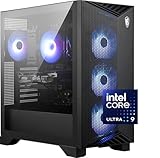
- Intel Core Ultra 9 285 Processor: Newly developed cores deliver ultra-smooth and responsive gameplay. AI accelerators prepare users for the next era of gaming on an AI PC.
- Simplistic Design: Enjoy the latest generation of Windows 11 Home for your everyday needs. *MSI recommends Windows 11 Pro for business use.
- NVIDIA GeForce RTX 5070 Ti GPU
- Cool While Gaming: In conjunction with an RGB CPU Air Cooler, the Aegis RS features four system cooling fans; three in the front and one in the rear to pull in cool air and push heat out of the PC.
- Turn on the Bright Lights: With the built-in RGB lighting, take your gaming experience to the next level by pressing the MSI LED button to cycle through lighting options. Customize lighting even further with MSI Center software.
Where this approach fits—and where it can fail
AI is a stronger fit for repeated, high-volume decisions when useful data is available, outcomes can be measured, and an actionable response exists. Examples include detecting likely stock-outs, prioritizing demand-planning exceptions, inspecting products, and coordinating warehouse activity.
It is a weaker fit when master data is unreliable, retailer information arrives too late, no team owns the recommendation, or the business cannot measure incremental value. A model cannot resolve a process that has no agreed owner, nor can a replenishment recommendation overcome a retailer contract, shelf constraint, labor shortage, or lack of transport capacity.
Free tools Windows power users keep installed
One-click scans. No signup required.
Common failure modes include promotion spikes mistaken for durable demand, little history for new products, cannibalization between products, phantom inventory, and shelf images obscured by lighting, camera angle, or packaging changes. Online availability can also be ambiguous if a listing is visible but not purchasable for a particular ZIP code, delivery slot, or seller. Long-tail products may be overlooked by models optimized around high-volume items.
Data latency and alert fatigue are operational risks: a signal that arrives too late may be useless, and too many low-value alerts can train staff to ignore all of them. Human overrides are not merely exceptions to suppress; they can reveal missing context, but only if they are captured and reviewed. Finally, a model proven in one retailer, category, or country may not transfer to another without adaptation.
What P&G’s public example does—and does not—establish
The available public accounts support a picture of algorithm-assisted planning, monitoring, recommendations, alerts, vision inspection, and orchestration. They do not establish a fully autonomous supply chain, the precise models or vendors involved, system-wide deployment, model accuracy, false-positive rates, or the percentage of decisions automated. Nor do they independently verify the stated availability ambition or productivity opportunity as achieved outcomes.
P&G’s 2025 discussion also linked digitization and automation to organizational redesign and planned reductions in nonmanufacturing roles. That is evidence that technology and workforce changes were discussed together, not proof that AI alone caused particular job reductions. Automation can reduce repetitive work and improve throughput, while also changing roles and creating reskilling needs.
Windows Errors? Fix Them Before They Spread
Repair common Windows errors and clear accumulated junk for a smoother, more stable PC - no reinstall needed.Free scan · no reinstallCrashes, No Sound, or Screen Glitches?
Random freezes, missing sound and display glitches usually trace back to one bad driver. Find and replace yours safely.Free scan · under a minuteQuick Recap
A practical playbook for consumer-goods teams
- Choose one decision to improve. Specify the operational problem, such as a stock-out risk or quality defect, rather than starting with a general AI mandate.
- Define the KPI and baseline. State the denominator, time period, product and market scope, and how performance is measured today.
- Audit data readiness. Check ownership, completeness, latency, and consistency across product, inventory, store, sales, and retailer data.
- Design the action workflow first. Decide who receives a signal, what they can do, how quickly they need to act, and how exceptions are escalated.
- Run a narrow pilot. Test in a bounded category, site, or retailer; use comparison groups where practical and set acceptable false-alert limits.
- Measure adoption and incremental effect. Track whether people act on recommendations and whether outcomes improve beyond other changes happening at the same time.
- Record overrides and failure cases. Use them to identify missing data, constraints, or model drift rather than treating every override as noncompliance.
- Scale only when the economics and operating process hold. Reassess data rights, local differences, integration needs, training, and monitoring before expanding to another market or category.
Product prices and availability are accurate as of the date/time indicated and are subject to change. Any price and availability information displayed on Amazon at the time of purchase will apply.




