Quick wins for a faster PC:
Repair Windows errors before they cause bigger problemsFix Now →Fix the driver behind crashes, sound loss and screen glitchesFind Drivers →Clear out junk files and repair common Windows errorsFree Scan →Intel’s “288-core Sierra Forest” announcement described a roadmap target—not the first Xeon 6 E-core processors that launched. Intel previewed Sierra Forest at up to 288 E-cores, but the first announced Xeon 6 E-core models, launched June 4, 2024, topped out at 144 cores per socket. The distinction matters: a roadmap maximum, a family-level specification and a particular shipping processor are not interchangeable.
What Intel announced—and when
In September 2023, Intel disclosed a Xeon roadmap that included a future Sierra Forest design with up to 288 cores. Contemporary coverage recorded the announcement as a planned processor, not a retail launch. Intel later described Sierra Forest as offering up to 288 E-cores on a chip in its February 2024 MWC announcement.
The product launch came on June 4, 2024: Intel introduced its first Xeon 6 processors with E-cores, the commercial family based on Sierra Forest. Intel’s launch announcement and Xeon 6 press kit identify the products as Xeon 6; Intel’s product pages use the E-core designation. The first launched 6700E models had as many as 144 cores per socket.
- Sierra Forest is the codename for Intel Xeon processors built with Efficient-cores, or E-cores.
- Granite Rapids is the corresponding Xeon 6 family built with Performance-cores, or P-cores.
- Birch Stream is the server platform associated with these Xeon generations.
- Xeon 6 is the commercial family name. It includes both E-core and P-core products; not every Xeon 6 processor is Sierra Forest.
Intel’s June 4, 2024 Computex announcement marks the launch of the first Xeon 6 E-core products. A launch is not the same as availability in every server maker’s catalogue, cloud region or reseller channel.
#1 Best Overall

- Intel Xeon E5-2699 V4 Docosa-core (22 Core) 2.20 Ghz Processor - Socket Lga 2011-v3 - 5.50 Mb - 55 Mb Cache - 64-bit Processing - 14 Nm - 145 W
What “288 cores” means
There are three different figures to keep separate: the 288-core roadmap announcement, Intel’s later family-level claim of up to 288 E-cores per socket, and the core count of a specific launched model. Intel’s Xeon 6 product brief advertises up to 288 E-cores per socket for the family. Intel’s initially launched 6700E models, however, go up to 144 cores per socket. The family claim alone does not establish that the originally discussed 288-core design was a shipping SKU at launch.
Nor should 288 be read as a hardware-thread count. The launched 144-core Xeon 6780E is listed with 144 threads, not 288; its specifications page gives both figures. A two-socket server populated with two 144-core processors can total 288 physical cores, but that is a two-processor system—not a 288-core processor.
For a purchase or performance comparison, use the exact processor model and server configuration. “288 cores” can describe a roadmap or family maximum, or the aggregate cores across two sockets; the phrase alone does not identify a processor that is shipping.
Rank #2
![Intel Xeon Silver [3rd Gen] 4310 Dodeca-core [12 Core] 2.10 GHz Processor - OEM Pack](https://m.media-amazon.com/images/I/31KUwTUW75L._SL160_.jpg)
The first launched Sierra Forest models
Intel’s initial Xeon 6 E-core 6700E range spans 64 to 144 cores per socket. The figures below are model specifications and Intel-listed recommended customer prices on the linked product pages. Prices are not guaranteed transaction prices and do not include a complete server, memory, support or software licensing.
Recommended Free Tools
| Model | Cores / threads | Base / max turbo | Cache | TDP | Intel listed recommended customer price |
|---|---|---|---|---|---|
| Xeon 6780E | 144 / 144 | 2.2 / 3.0 GHz | 108 MB | 330 W | $9,535 |
| Xeon 6766E | 144 / 144 | 1.9 / 2.7 GHz | 108 MB | 250 W | $8,615 |
| Xeon 6756E | 128 / 128 | 1.8 / 2.6 GHz | 96 MB | 225 W | $7,078 |
| Xeon 6746E | 112 / 112 | 2.0 / 2.7 GHz | 96 MB | 250 W | $4,981 |
| Xeon 6731E | 96 / 96 | 2.2 / 3.1 GHz | 96 MB | 250 W | $3,693 |
| Xeon 6710E | 64 / 64 | 2.4 / 3.2 GHz | 96 MB | 205 W | $2,463 |
These are Intel’s listed recommended customer prices, not current OEM or reseller quotes, complete-system prices, or cloud-instance rates. Actual procurement also depends on the server configuration, memory, networking, storage, support and licensing.
Platform capabilities of the high-end 6700E parts
The 6780E and 6766E illustrate the platform around the high-core-count models. Intel lists Intel 3 process technology, eight DDR5 memory channels, DDR5-6400 support, PCIe 5.0 and up to 88 PCIe lanes. The 6780E specifications also list up to 4 TB of memory, depending on memory type and configuration. These processors use the FCLGA4710 package and support one- or two-socket systems. Intel lists up to four UPI links at up to 24 GT/s for the platform.
Rank #3
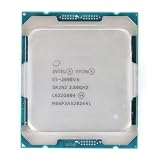
- Total Cores 14
- Total Threads 28
- Processor Base Frequency 2.60 GHz
- Max Turbo Frequency 3.50 GHz
- Sockets Supported LGA2011-3
Intel’s Xeon 6 E-core product brief lists platform accelerators and management or security capabilities including Data Streaming Accelerator (DSA), QuickAssist Technology (QAT), Dynamic Load Balancer (DLB), In-Memory Analytics Accelerator (IAA), Resource Director Technology, Platform Monitoring Technology and Trust Domain Extensions. A feature’s presence in the platform brief does not by itself establish that a particular application will benefit; verify model-level support, configuration and software requirements.
Why Intel built a high-density E-core Xeon
Sierra Forest is aimed at throughput and density rather than maximizing the speed of one thread. Intel positions Xeon 6 E-core systems for scale-out services such as cloud-native applications, web serving, content delivery, network-function virtualization, 5G core workloads and media processing. These jobs can often be split among many independent workers, making additional cores useful when the software can keep them busy.
Intel argues that E-core systems can improve performance per watt and per rack, and has claimed up to a 3-to-1 rack-level consolidation advantage in suitable infrastructure-refresh scenarios. That is a vendor claim, not a universal result: it depends on the comparison system, workload mix, utilization, server configuration and consolidation assumptions. A buyer should request the underlying test conditions and validate the result against its own service-level objectives and power limits.
Rank #4

- Manufacturer: Intel CPU Frequency: 2.20 GHz CPU Max Turbo Frequency: 3.60 GHz Number of Cores: 22 Threads: 44 Cache: 55 MB Intel Smart Cache Number of UPI Links: 0 Lithography: 14 nm Thermal Design Power: 145 W Memory Types: DDR4 1600/1866/2133/2400 Max Memory Size: 1.5 TB Max # Memory Channels: 4 Sockets Supported: FCLGA2011-3 E5-2699v4
E-core versus P-core: choose for the workload
E-core Xeons are not simply a better version of P-core Xeons because they have more cores. They target different performance characteristics. A dense E-core server may deliver more aggregate work per rack or watt for parallel workloads, while a P-core processor may be preferable when a small number of threads determine latency or when software depends on P-core-specific capabilities. Intel’s Xeon 6 materials identify AMX acceleration with P-core products; do not assume Sierra Forest provides the same AMX feature set.
| Consideration | E-core Xeon 6 (Sierra Forest) | P-core Xeon 6 (Granite Rapids) |
|---|---|---|
| Typical fit | Highly parallel, scale-out throughput and density | Higher per-thread performance; demanding general-purpose, analytics, HPC or latency-sensitive work |
| Core density | Designed for high core counts per socket | Fewer cores than the highest-density E-core designs; optimized for a different performance balance |
| AI feature consideration | Do not assume P-core AMX support | Intel lists AMX acceleration for Xeon 6 P-core products |
| Main validation question | Can the application use many cores efficiently without hitting memory, licensing or scheduling limits? | Does stronger per-thread performance or an accelerator materially improve the target workload? |
AMD EPYC and Arm-based cloud processors such as AWS Graviton or Ampere are also relevant comparisons for some deployments. Raw core counts across architectures are not a performance ranking. Compare measured throughput, response time, memory bandwidth and capacity, PCIe or CXL needs, software compatibility, licensing and platform cost on the intended workload. Intel’s own benchmark claims are likewise configuration-dependent; vendor results should be read with their test setup and footnotes, not treated as a general guarantee.
Workloads that may benefit—and those that need caution
Better candidates for E-core density
- Stateless web tiers, content delivery and services that scale by adding independent workers.
- Containerized microservices and network functions with predictable parallelism.
- Media pipelines and batch jobs that can keep many cores productively occupied.
- Cloud or telecom infrastructure where rack power, cooling or floor space is a binding constraint.
Workloads to benchmark carefully
- Lightly threaded databases or transactional systems whose response time depends on a few fast threads.
- Applications limited by memory bandwidth: adding cores does not guarantee proportional throughput if workers compete for the same memory channels.
- Software licensed per core, where license fees may outweigh CPU or rack savings.
- AI or other workloads that require a specific accelerator, including AMX; confirm the processor feature set rather than inferring it from the Xeon 6 name.
- Applications with strict latency targets, irregular parallelism, or dependencies that are difficult to distribute across cores.
Compatibility and deployment checks
A processor choice is also a platform and software decision. Before deployment, verify the exact server supports the processor, memory type and capacity, firmware, accelerators and operating environment required. Intel’s E-core brief lists Linux, Windows Server, KVM, Hyper-V, VMware, OpenVINO and oneAPI support, but the supported versions and vendor qualification status can change. Check the current Intel, operating-system, hypervisor and server-vendor support matrices for the exact model and release.
PC Slower Than It Used to Be?
A free scan shows the junk files, broken settings and background clutter dragging Windows down - then fixes them in one click.Free scan · Windows 10 & 11Crashes, No Sound, or Screen Glitches?
Random freezes, missing sound and display glitches usually trace back to one bad driver. Find and replace yours safely.Free scan · under a minuteBest Value

- Part Number Identification: CD8069504194501 for easy reference and compatibility verification
- CPU Series Specification: 2nd Generation Intel Xeon Scalable processor from the Gold 6000 series
- Processor Frequency: 3.10GHz base clock speed with 18 cores for high-performance computing tasks
- Package Type: OEM tray processor without retail packaging
- Cooling Device Notice: Processor only, cooling device not included and must be purchased separately
- Server platform: confirm FCLGA4710 motherboard and firmware support, socket count, thermal envelope and OEM qualification.
- Memory and I/O: check DIMM type, population rules, supported speed and capacity, PCIe lane allocation, and any attached accelerators or storage.
- Virtualization: test guest operating systems, NUMA presentation, scheduling and workload placement with the intended hypervisor and firmware.
- Mixed fleets: benchmark E-core and P-core systems as separate performance classes; a common Xeon 6 family label does not make their per-thread behavior interchangeable.
- Cloud or hosted deployment: confirm the exact processor, region, instance or dedicated-server configuration and price with the provider. Processor launch does not prove availability from a particular service.
A practical buying comparison
For a procurement decision, compare the cost and useful work of complete systems—not just the CPU’s core count or list price. Include server chassis, memory, networking, storage, support, power and cooling, migration costs, and software licensing. A system with fewer cores can be cheaper overall if it meets the workload target or avoids per-core fees; a denser system can make sense if it consolidates enough servers without compromising latency or reliability.
- Characterize the application: measure concurrency, CPU utilization, tail latency, memory use and throughput at the actual service target.
- Check scaling limits: determine whether the workload gains useful throughput as cores increase, or stalls on memory bandwidth, locks, I/O or serial work.
- Price software and infrastructure together: model per-core licensing alongside server count, rack power, cooling, support and migration.
- Compare the right alternatives: test E-core Xeon against P-core Xeon, AMD EPYC, Arm-based options or existing servers using equivalent service targets and production-like data.
- Confirm availability and support: obtain a quote and written configuration from the OEM, cloud provider or reseller, then verify firmware and software qualification.
The useful comparison is sustained work at the required latency and availability, per unit of total cost and power—not the largest number printed in a product headline.
Quick Recap
Product prices and availability are accurate as of the date/time indicated and are subject to change. Any price and availability information displayed on Amazon at the time of purchase will apply.




