Do these 3 things before closing this tab:
1Fix the driver behind crashes, sound loss and screen glitches2Clear out junk files and repair common Windows errors3Scan for outdated or missing drivers - takes under a minutePredictive analytics cannot know the future. It uses historical and current data to estimate what may happen next, often as a probability, range, forecast, or risk score. The estimate is useful only when its assumptions fit the situation and someone can act on it. For personal finances, that might mean forecasting expenses or estimating cash needs—not treating an app’s projection as a guarantee.
What is predictive analytics?
Predictive analytics is the use of data and statistical or machine-learning methods to estimate a future or otherwise unknown outcome. It is a process, not a promise made by a particular software product: define an outcome, gather relevant data, fit a model, test its predictions, and use the results to inform a decision. IBM and AWS describe predictive analytics in these terms: IBM’s overview and AWS’s overview.


In a personal-finance context, a household might use past spending and known bills to estimate next month’s cash needs. A lender might estimate the likelihood of repayment across applicants. Neither estimate proves what one household or borrower will do.
What does “predict the future” mean?
A prediction is conditional: given the data available, the model, and its assumptions, an outcome is estimated to be more or less likely. The output may take several forms:
Free tools Windows power users keep installed
One-click scans. No signup required.
#1 Best Overall
- Point estimate: one estimated value, such as expected monthly expenses.
- Range: a set of plausible values, which can communicate uncertainty better than a single number.
- Probability: an estimated likelihood of an event, such as a missed payment within a specified period.
- Classification: a category, such as high or low risk.
- Ranking or score: cases ordered by relative likelihood or risk.
- Scenario estimate: an estimate under changed assumptions, such as how a budget might look after a rent increase.
A score or probability is not necessarily an explanation. A model may identify patterns associated with an outcome without establishing why it happens.
How it differs from related ideas
| Term | Main question | Typical output |
|---|---|---|
| Descriptive analytics | What happened? | Report, total, or dashboard |
| Diagnostic analytics | Why might it have happened? | Investigation of patterns or possible explanations; not proof of cause |
| Predictive analytics | What is likely to happen? | Probability, score, classification, or forecast |
| Prescriptive analytics | What should we do? | Recommendation based on predictions, objectives, or constraints |
| Forecasting | What future value is expected, often over time? | Time-series estimate, such as future expenses or demand |
| Machine learning | How can a system learn patterns from data? | A model or learned function; one possible method used in predictive analytics |
| Generative AI | What content can be created? | Text, images, code, audio, or other generated content |
Forecasting is one part of predictive analytics, but predictive analytics also includes tasks such as risk scoring and classification. Traditional methods can be appropriate: IBM describes moving averages, exponential smoothing, and ARIMA among forecasting approaches, alongside machine-learning methods (IBM’s predictive forecasting overview). A generative AI system may write a forecast in fluent language, but that fluency is not evidence that its estimate has been validated against real outcomes.
How a prediction is built and used
- Define the decision first. Specify what is being predicted, for whom or what, and how far ahead. “Predict spending” is vague; “estimate next month’s essential household expenses using transactions available at month-end” is more testable.
- Identify the action and stakes. Decide what someone could do with the estimate and what a wrong prediction would cost. A household cash buffer forecast and a credit decision have very different consequences.
- Gather relevant data. This may include past outcomes, dates, transactions, customer or product attributes, or outside factors. More data is not automatically better: it must be accurate, representative, relevant, and available when the prediction is made.
- Prepare the data. Check duplicates, missing values, inconsistent labels, timestamps, and unusual records. Keep information from after the prediction point out of the model.
- Choose a method that fits the target. Regression estimates a number; classification estimates a category or event; time-series methods estimate values over time; survival models estimate time until an event. Anomaly detection flags unusual cases, while clustering groups similar cases and may support further analysis.
- Test on data the model did not learn from. Set aside validation and test data. For time-based forecasts, train on earlier periods and test on later ones rather than randomly mixing dates.
- Compare with a simple baseline. Check whether the model improves on a recent average, last period’s value, a seasonal pattern, or an existing rule. Complexity is not useful if it does not improve the decision.
- Put the output into a workflow and monitor it. Track errors, data changes, subgroup performance, and whether the prediction actually improves decisions. AWS’s machine-learning guidance emphasizes monitoring because data and conditions evolve.
A common trap is data leakage: allowing information into training that would not have been known at prediction time. For example, a model intended to estimate whether a bill will be paid late could appear to perform well if it uses a collections field filled in only after the payment problem is recognized. That result may collapse in real use.
Where predictive analytics is used
- Personal finance: estimate cash-flow needs, categorize likely recurring expenses, or explore budget scenarios. These estimates are planning aids; unexpected costs and changing income can make past patterns a poor guide.
- Retail: estimate product demand, stockout risk, customer churn, or response to a promotion.
- Finance: estimate credit, fraud, cash-flow, or payment risk. High-impact uses call for careful review of fairness, explanations, privacy, and error consequences.
- Manufacturing: estimate failure or maintenance needs from equipment data; alerts are useful only if operators have a reliable response process.
- Healthcare: estimate risks such as readmission or deterioration. Such outputs should support, not replace, clinical judgment.
- Marketing and customer service: rank conversion or churn likelihood and prioritize outreach. Historical targeting can reproduce disparities or lead to excessive contact.
How accurate can predictions be?
There is no meaningful universal accuracy number. Performance depends on the outcome, prediction horizon, population, time period, metric, baseline, and cost of mistakes. A stable, recurring expense may be easier to estimate over a short horizon than an individual’s behavior months ahead or a rare financial shock.
Quick wins for a faster PC:
Clear out junk files and repair common Windows errorsFree Scan →Fix the driver behind crashes, sound loss and screen glitchesFind Drivers →Use metrics suited to the question
For numerical predictions, mean absolute error (MAE) reports typical absolute error in the outcome’s units; root mean square error (RMSE) penalizes large errors more heavily. Percentage error measures such as MAPE can mislead when actual values are zero or near zero. R-squared alone does not establish that a forecast is useful. AWS describes RMSE in its regression documentation.
For event classifications, accuracy may conceal failure on rare outcomes. If only a small fraction of transactions are fraudulent, a model that labels every transaction legitimate can appear highly accurate while detecting no fraud. Precision, recall, F1, and precision-recall measures may be more informative, depending on the costs of false alarms and missed events.
Rank #3
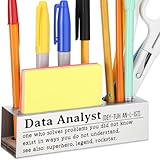
- Perfect Gift for Data Analysts – A fun and unique desk sign for business intelligence experts, data scientists, and analytics professionals.
- Bold & Readable Design – High-contrast lettering ensures visibility on any desk, making it an instant conversation starter.
- Compact & Lightweight – Small enough to fit any workspace without taking up too much room but big enough to make an impact.
- Durable & Long-Lasting Material – Made with premium materials to withstand daily office use while maintaining its sleek look.
- Great for Any Occasion – Ideal for birthdays, work anniversaries, promotions, or just a fun appreciation gift for number crunchers
Check calibration and uncertainty
If a model assigns a well-calibrated 70% probability to many comparable cases, the event should occur in about 70% of those cases over time. It does not mean the event is certain for any single person. A model can rank cases well yet give poorly calibrated probabilities, so test those properties separately. For forecasts, examine ranges or prediction intervals as well as the central estimate, and check errors by horizon, season, and relevant group.
Ask whether the prediction changes a decision
A model metric does not account for the cost of setting it up, acting on a false alarm, missing an event, or changing behavior in response to the score. The practical test is whether the prediction improves decisions compared with a reasonable alternative.
What predictions cannot establish
- Certainty: an estimate does not guarantee an outcome.
- Causation: a variable associated with an outcome is not necessarily its cause. For instance, support calls may be associated with customer churn because they signal an existing problem; discouraging calls would not necessarily prevent churn.
- Unmeasured factors: a model cannot reliably account for information it does not have.
- Unprecedented conditions: historical patterns offer limited guidance after a structural change, such as a major policy, market, or technology shift.
- A good decision: even a well-performing model can be used unfairly, illegally, or without an economically sensible action.
When the aim is to learn whether an intervention causes a change, predictive modeling may need to be supplemented with causal analysis or an experiment.
Rank #4
Common failure modes and safeguards
- Overfitting: the model learns historical noise and fails on new cases. Use held-out testing and a baseline.
- Data or concept drift: the inputs, outcome rate, or relationship between them changes. Monitor performance and reassess whether retraining or retirement is needed.
- Selection and survivorship bias: training data may omit people or cases that will appear in actual use. Check who is represented and who is missing.
- Imbalanced outcomes: rare events make headline accuracy misleading. Evaluate the error types and their costs.
- Feedback loops: the prediction changes treatment, which changes the data later used to judge the model. Record interventions and assess their effects.
- Automation bias: users may defer to a score despite contradictory evidence. Make room for human review and challenge, especially for consequential decisions.
- Privacy and fairness risks: examine data permissions, data security, and performance across relevant groups. NIST’s materials address bias management and trustworthy and responsible AI; Microsoft’s responsible-AI guidance discusses fairness, reliability and safety, privacy and security, inclusiveness, transparency, and accountability.
Do you need special software?
Not necessarily. Choose tools based on the decision, data, technical skill, risk, and ongoing maintenance—not on the promise of “AI.”
- Spreadsheet: a sensible starting point for a small, low-risk dataset, simple averages, and transparent scenarios.
- SQL or database tools: useful when structured data already lives in a database and analysts can work there.
- Python or R: flexible options for learning, research, prototypes, and custom workflows. Software may be free, but development, hosting, security, monitoring, and maintenance still take time and money.
- Managed cloud or enterprise platform: consider one when the workflow needs scale, integration, deployment, governance, and ongoing operational support. Usage, compute, storage, and data-transfer costs can apply.
For example, BigQuery ML lets SQL-oriented teams train and evaluate models in BigQuery; its capabilities are described in Google’s documentation. Google lists a free monthly on-demand query allowance and usage-based pricing on its pricing page; actual costs depend on usage and configuration. AWS SageMaker AI is a broader managed option for custom machine-learning workflows, with consumption-based charges described in the AWS decision guide. For any vendor, verify current availability, regional pricing, and service terms before committing. A managed platform is usually unnecessary for a one-off household budget estimate.
When to build a model—and when not to
Predictive analytics is a stronger fit when a decision happens repeatedly, usable historical examples exist, the outcome can be measured, the prediction arrives in time to act, and the benefit can justify the cost and risk.
The Tool Desk
Outbyte Driver Updater FREEScan for outdated or missing drivers - takes under a minuteDriver Scan →Outbyte PC Repair FREERepair Windows errors before they cause bigger problemsFix Now →Use a simpler method or stop if the target is vague, labels are unreliable, no action follows the prediction, the future environment is changing too quickly, or the potential harm from errors cannot be acceptably managed. In high-impact settings, get appropriate specialist, legal, and governance review before deployment.
Before building, write down the target and time horizon; identify the data available at prediction time; name the action; define a simple baseline; estimate the cost of false positives and false negatives; check privacy and fairness risks; and assign responsibility for monitoring and responding to failure.
Quick Recap
Product prices and availability are accurate as of the date/time indicated and are subject to change. Any price and availability information displayed on Amazon at the time of purchase will apply.




