The Tool Desk
Outbyte PC Repair FREERepair Windows errors before they cause bigger problemsFix Now →Outbyte Driver Updater FREEFix the driver behind crashes, sound loss and screen glitchesFind Drivers →Bitcoin mining became an early commercial proving ground for immersion cooling because mining ASICs run continuously, concentrate heat in a small footprint, and earn money only when their computing output justifies the electricity and operating costs. Submerging miners in dielectric fluid can improve heat removal and equipment density, but it does not make a mine automatically cheaper or more profitable.
The 2015-era BitFury project that popularized the idea was described as a planned 40 MW facility, with approximately 250 kW per rack. Those figures are historical design estimates, not current specifications or universal limits. The technology has since moved beyond experiments: manufacturers list purpose-built immersion miners, while the economics and fluid choices have become more complicated.

Why Bitcoin mining was a natural fit for immersion cooling
Mining ASICs are specialized machines built for one workload: calculating hashes for the Bitcoin network. Unlike office servers that may have variable utilization, miners are typically intended to run around the clock. Their economics hinge on electricity cost, uptime, hash rate, hardware efficiency, and the changing value of mining rewards.
That makes cooling unusually consequential. Fan power and room cooling add to the cost of every unit of computing, while heat, dust, and fan failures can disrupt operation. Dense deployment can also reduce the land and building footprint needed for a given electrical load. Immersion cooling addresses several of these constraints at once: it transfers heat directly from submerged equipment to a liquid loop, rather than relying on large volumes of air moving through rows of machines.
#1 Best Overall

- 🍻 Made of high quality 304 stainless steel material. Sturdy and durable, can be used for a long time.
- 🍻 Complete disinfection can be achieved after 15 minutes wort boiling.
- 🍻 This cool the cooked wort quickly. Let the wort reach your preferred temperature for Yeast inoculation .
- 🍻 This wort chiller is used for cooling beer or malt.
- 🍻 Our products have lifetime free warranty and replacement parts policy, if you encounter any problems during use, please feel free to contact us. Our customer service department will help you solve any problems.
In its historical account of BitFury’s planned facility, Data Center Knowledge reported a target of about 250 kW per rack, compared with the article’s contemporary 2–5 kW-per-rack comparison for conventional enterprise or colocation equipment. This illustrates the density ambition of the project, not a benchmark that every immersion system can achieve. Actual capacity depends on the miners, tank, heat exchanger, pumps, electrical distribution, and local conditions.
Mining was also a commercially demanding test. A cooling system had to work continuously at scale and support a business where power consumption is a core expense, rather than merely an occasional facility overhead. Modular tanks or containers can help operators deploy and replace generations of ASICs, although the tanks themselves still require engineering, service access, and heat rejection.
What happens inside an immersion cooling system
Immersion is not simply a tank of liquid. The complete system includes the miner, dielectric fluid, tank, circulation or condensation equipment, heat exchanger, controls, and a way to reject heat outdoors or deliver it to a useful heat load.
Single-phase immersion
In a single-phase system, the ASICs sit in a non-conductive fluid that remains liquid during normal operation. The fluid absorbs heat and is circulated through a heat exchanger; another loop or an outdoor cooling system then releases that heat. Depending on the design and climate, heat rejection may use dry coolers, radiators, cooling towers, or other equipment.
Do these 3 things before closing this tab:
1Clear out junk files and repair common Windows errors2Fix the driver behind crashes, sound loss and screen glitches3Repair Windows errors before they cause bigger problemsHydrocarbon or synthetic-oil fluids are among the commercial alternatives marketed for mining. They avoid a boiling-and-condensing cycle, but operators still have to account for fluid volume and cost, pumping power, filtration, material compatibility, and maintenance.
Two-phase immersion
In a two-phase system, a low-boiling-point dielectric fluid absorbs heat by boiling. Vapor rises to a condenser coil, releases heat, condenses, and returns to the tank. The historical BitFury design described by Data Center Knowledge used 3M Novec 7100, with a reported boiling point of about 142°F (61°C), and water-cooled condenser coils. That is a description of the historical system, not a recommendation for a new build.
Two-phase systems can transfer heat effectively, but their economics and operating procedures depend heavily on the exact fluid, containment, materials compatibility, and regulatory and supply conditions. A low-temperature boiling fluid does not eliminate the need to reject heat from the facility.
How immersion can affect mining costs—and what it cannot solve
Potential benefits include lower fan power, reduced dependence on room air conditioning, more stable chip temperatures, less exposure to airborne dust, lower noise, and greater equipment density. Some installations may also allow higher operating temperatures or overclocking. These benefits are system- and site-dependent, and claims about longer hardware life require actual lifecycle and failure-rate evidence.
Free tools Windows power users keep installed
One-click scans. No signup required.
Rank #2

- 【MATERIAL DURABILITY】: 0.5mm thick 304 stainless steel pipe is sturdy, waterproof, and has a long service life. This premium material makes the stainless steel chiller, stainless steel wort chiller, and 304 stainless steel wort chiller cooling coil for outdoor brewing safe and suitable for long-term work in humid and low-temperature environments.
- 【EFFICIENT COOLING】: The double-layer design and long length increase the contact area between the cooling medium and the beer, accelerating heat exchange for rapid cooling. This high-performance wort chiller or beer cooling coil quickly brings your brew down to the ideal low temperature.
- 【PRACTICAL TOOL】: This essential wort cooler and immersion chiller quickly cools beer or boiled wort to reach the perfect temperature for yeast inoculation. The wort chiller cooling coil design is purpose-built for effective brewing.
- 【COMPACT DESIGN】: Measuring 5.63*5.91in, this immersion cooling tube features a space-saving design for easy installation in limited spaces like fermenters or kegs. Simply connect the fittings to your beer holding tank to activate this stainless steel tubing coil ice system immediately.
- 【FLEXIBLE LAYOUT】: Generous length allows the coil pipe to be easily coiled or arranged to fit containers of any capacity or shape. Customize the layout of this versatile stainless steel coil for precise temperature control in your unique brewing setup.
It is important to keep several measures separate:
- Cooling energy: Power consumed by fans, pumps, chillers, and other cooling equipment. A reduction in this category is not the same as the same percentage reduction in total facility energy.
- Miner energy efficiency: Hashes produced per unit of electricity. Overclocking may increase hash rate but can also raise power consumption, so the relevant comparison is the resulting efficiency and cost.
- Capital cost: Tanks, fluid, pumps, heat exchangers, piping, electrical work, controls, installation, and heat-rejection equipment must be included—not just the cooling vessel.
- Mining profitability: Revenue and costs also depend on bitcoin price, network difficulty, block subsidy, transaction fees, power contracts, ASIC cost, financing, curtailment, and uptime.
Vendors and operators have published ambitious figures, but they are not universal outcomes. GRC has claimed up to 50% lower build-out costs and up to 95% lower cooling-energy costs for mining deployments; those are vendor-reported upper-bound claims, not independently established results for every site. GRC’s mining white-paper announcement does not make those percentages a forecast for a buyer’s project.
Marathon has said its MARA 2PIC700 system can support 60–100% ASIC overclocking and cut cooling costs by up to 60%. These are company claims for its system; they should be evaluated against a clearly defined baseline, power use, hash-rate data, reliability, warranty terms, and local climate. See Marathon’s system announcement.
A useful project model compares the alternatives over the expected life of the miners. Include installed cost per kilowatt, cooling-loop parasitic power, maintenance labor, fluid sourcing and replacement, uptime, expected hardware life, and resale value. Model both ordinary operation and the effects of any proposed overclock. Without those inputs, a headline cooling percentage cannot establish payback or profitability.
Purpose-built immersion miners versus retrofitted ASICs
Purpose-built immersion miners are designed or configured for liquid operation. Depending on the model, they may have redesigned heat sinks, removed or altered fans, compatible materials, suitable power supplies, immersion-oriented firmware settings, and manufacturer support terms. BITMAIN’s catalog distinguishes air-cooled, hydro-cooled, and immersion-cooled products and lists models including the S21 XP Imm. and S21 Imm.; the catalog reflects products listed by the manufacturer, while current availability may change.
What’s actually slowing this PC down?
Pick the symptom - the matching free tool is one click away.
In 2024, BITMAIN announced an order for 26,000 ANTMINER S21 XP Imm. units for CleanSpark, stating a rating of 300 TH/s and 13.5 J/T for the announced configuration. These are manufacturer-announced product figures, not a guarantee of every unit’s field performance under every temperature or firmware setting. The purchase announcement is available from BITMAIN.
Retrofitting an air-cooled miner is a different proposition. Removing fans or changing thermal interfaces may affect heat transfer, materials, serviceability, and warranty. An electrically non-conductive fluid is not automatically chemically compatible with every component. Thermal compounds, elastomers, plastics, adhesives, coatings, capacitors, and cable materials can degrade or contaminate fluid over time. Intel’s Shell immersion case study describes component changes made for immersion compatibility, including considerations involving power supplies, heat sinks, and thermal-interface materials.
Before buying a retrofit system, obtain written answers for the exact ASIC model and board revision. Confirm the fluid and operating-temperature compatibility matrix, warranty status, firmware support, power-supply changes, and the process for repair and fluid handling. A miner should not be assumed immersion-safe merely because it powers on while submerged.
Why fluid choice changed after the historical BitFury design
The original Novec-based design belongs to a different supply and regulatory context. 3M said it completed its exit from PFAS manufacturing at the end of 2025. That does not mean every existing product or inventory source disappeared at that moment, but it does mean buyers should not assume legacy Novec or Fluorinert fluids will remain a straightforward default for new systems. 3M’s PFAS stewardship information and 2025 filing provide the company’s current context. Availability, support, transition arrangements, and legal requirements remain distinct questions that should be checked for the specific fluid and jurisdiction.
Recommended Free Tools
This is not evidence that two-phase immersion is obsolete. It is a reason to verify whether a proposed fluid is currently manufactured or only available from inventory, whether the supplier supports the intended application, and how environmental rules apply where the facility will operate.
Single-phase fluids are increasingly prominent in mining offerings. Engineered Fluids markets BitCool for ASIC immersion, while Midas and GRC offer tank or broader system products. A fluid supplier’s data sheet is not a substitute for compatibility testing with the buyer’s exact hardware and operating conditions.
For either phase, procurement should include a safety data sheet, environmental documentation, current supply terms, disposal and spill procedures, and evidence that performance data applies to the exact fluid and equipment being purchased. Fire behavior also matters: “non-conductive” does not mean “nonflammable.” Insurers and local authorities may require documentation before commissioning.
Heat still has to leave the site
Immersion transfers heat; it does not make heat disappear. The outdoor system or heat customer ultimately determines whether the thermal loop can handle the load. Dry coolers, chillers, cooling towers, and adiabatic systems have different power, water, and climate implications. A design that works in a cool climate may need more capacity or assistance during hot weather.
Operators should size the full loop for peak miner load, local summer design temperatures, fouling, redundancy, and future hardware changes. An undersized heat exchanger, pump, pipe run, or dry cooler can bottleneck a tank that appears adequate on paper. Model hourly weather and realistic derating rather than relying on an annual average temperature.
Recovered heat can potentially serve greenhouses, buildings, aquaculture, district heating, or industrial processes. That opportunity depends on a nearby customer needing heat at the times it is available. A remote mine with no year-round heat load may have no practical reuse case; heat recovery should not be treated as automatic revenue.
What the commercial examples show
The market now includes purpose-built miners, coolant, tanks, engineered systems, and operator-developed infrastructure. Their claims and offerings answer different questions, so they should not be treated as interchangeable proof of performance.
| Example | What it establishes | Important qualification |
|---|---|---|
| BitFury historical project | Immersion cooling’s early commercial mining ambition, including a planned 40 MW facility and high rack-density design. | Historical project description; the cited density figures are not a current universal specification. Data Center Knowledge. |
| GRC mining systems | A vendor promoting immersion infrastructure for cryptocurrency mining. | Its savings figures are vendor claims and need site-specific validation. GRC. |
| Marathon MARA 2PIC700 | An operator-developed two-phase system with published overclocking and cooling-cost claims. | Company claims; evaluate actual power, uptime, reliability, and baseline. Marathon. |
| BITMAIN immersion models | Manufacturer-listed immersion hardware and a 2024 announced S21 XP Imm. order for CleanSpark. | Catalog availability can change; announced ratings describe a product configuration, not all field conditions. BITMAIN catalog and order announcement. |
| Riot Platforms | Public company disclosures show immersion-related infrastructure and acknowledge that expected benefits may not be realized. | Operator-specific deployment, not a guarantee for other sites. See Riot’s miner announcement and operations update. |
Operational risks that can erase the apparent advantage
- Material incompatibility: Require a compatibility matrix for the exact miner, fluid, components, and operating temperature.
- Warranty and support: Get written manufacturer approval or use purpose-built equipment with applicable support terms.
- Heat-rejection bottlenecks: Engineer the complete thermal loop, including redundancy and hot-weather capacity.
- Fluid contamination: Specify sampling, filtration, cleanliness, and disposal procedures for particulates, moisture, and degraded materials.
- Service labor: Plan extraction, draining, lifting, cleaning, and contamination control before deployment; submerged hardware is not serviced like a fan-cooled miner.
- Fire and insurance: Review the fluid’s safety data, fire protection, insurer acceptance, and local code requirements.
- Two-phase supply risk: Confirm manufacturing status, inventory, vendor support, and jurisdictional rules for the exact fluid.
- Overclocking economics: Compare hashes per joule and per electricity dollar, incremental cooling power, expected failures, downtime, and replacement cost—not hash rate alone.
A technical review of immersion cooling notes maintenance and reliability concerns and finds retrofitting an air-cooled data center can be costly and generally unattractive. That is useful analytical guidance, not a rule that every retrofit fails. See the review paper.
Rank #4
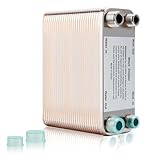
- 【CHILLS WORT IN MINUTES!】MRbrew 60-plate wort chiller cools wort faster than the immersion chiller by increasing surface area covered by cold water and running wort between plate and plate meanwhile. Gone for you are the days of an immension chiller that takes hours!
- 【HIGHLY SAVE YOUR WALLET】This super-efficient chiller uses less water than any other chiller on the market, the wort is flowing through the chambers inside the plate chiller and aerates for your pitching yeast, you will save water and and cost of buying an aeration stone and CO2 canisters, it is especially great for brewers in southern climates!
- 【NO LEAKS & RUST-FREE】This wort chiller's plates and fittings are made of 304 stainless steel and have been brazed together with pure copper in an oxygen-free furnace, there is no potential for leaks and rust, can withstand -321F to 392F. Do remember to clean the inlets and outlets to remove metal debris before use!
- 【GREAT UPGRADE】The chiller connection ports are 1/2" & 3/4" male NPT quick disconnect fittings. It has a tremendously low restriction, which makes it ideal for working with a pump to do gravity transferring. Working with a pump will increase flow rates through the chiller, allow for more mounting options and add the ultimate flexibility during the brew day!
- 【EASY TO USE AND CLEAN】The Wort Chiller is designed for effortless cleaning—simply rinse with a cleaning solution and water for thorough maintenance. Ideal for both laboratory and home beer brewing, it efficiently facilitates heat exchange between two liquids, saving you time and delivering exceptional cooling performance.
How immersion compares with other cooling approaches
| Approach | Often a fit when | Trade-offs |
|---|---|---|
| Air cooling | Capital simplicity, standard hardware, easy servicing, and available space matter most. | Noise, dust, fan failures, lower density, and dependence on room cooling can be disadvantages. |
| Hydro cooling | An operator wants liquid-assisted cooling without submerging every component. | Hardware modification and coolant-loop leak, corrosion, and maintenance risks remain. |
| Direct-to-chip cooling | General-purpose servers or GPUs need liquid cooling while retaining conventional server architecture. | Cold plates may not cool every component as uniformly as immersion; manifolds and service design add complexity. |
| Single-phase immersion | A large ASIC fleet benefits from tank-based heat transfer without a boiling cycle. | Fluid volume, pumps, filtration, compatibility, extraction, and heat exchangers require planning. |
| Two-phase immersion | Specialized thermal performance justifies a more complex fluid and containment approach. | Fluid supply, environmental rules, vapor management, and service procedures need particular scrutiny. |
Could a mining site later support AI or HPC?
Liquid-cooled mining infrastructure has attracted interest because high-density compute also needs power and heat removal. Providers such as LN Compute position liquid-cooled digital infrastructure for mining and potential GPU-oriented workloads, while GRC and ENDOR have announced work framed around AI factories and data centers. This is market positioning, not proof that an ASIC mine can be converted into a GPU facility without major changes.
AI and HPC deployments have different server hardware, networking, service procedures, utilization patterns, liquid distribution needs, and customer requirements. A mine may have valuable electrical capacity and a cooling loop, but its tanks may not fit GPU servers. Conversion depends on power contracts, fiber connectivity, substations, permitting, building layout, controls, customer demand, and the cost of modifying the cooling plant. The potential reuse value is therefore a site-specific option, not an automatic exit strategy.
When immersion makes sense for an operator
Large new-build mining campus
Immersion merits evaluation when power density, noise, land, or cooling constraints justify the added engineering. Compare complete installed costs and expected operating performance with air and hydro options before choosing a system.
Small or hobby operation
Air cooling often remains simpler when the fleet is small, standard hardware availability and easy repair matter, and space or noise constraints do not justify tanks, fluid, and a dedicated heat-rejection loop.
Outdated Drivers Are Slowing You Down
One free scan finds every outdated or missing driver and matches the right update for your exact hardware.Free scan · exact hardware matchPC Slower Than It Used to Be?
A free scan shows the junk files, broken settings and background clutter dragging Windows down - then fixes them in one click.Free scan · Windows 10 & 11Existing air-cooled facility
A retrofit needs a full accounting for structural work, tanks, piping, electrical changes, miner modifications, heat rejection, service space, and fluid controls. The cooling benefit alone may not cover that conversion cost.
Operator considering AI/HPC later
Evaluate the site’s power, fiber, permitting, physical layout, and cooling adaptability separately from the mining equipment. Preserve conversion value only where the infrastructure and prospective customers support it.
A practical procurement checklist
Before signing a contract, ask vendors and equipment manufacturers for:
- The exact fluid name, manufacturing status, safety data sheet, environmental documentation, supply terms, and disposal plan.
- Compatibility results for the exact ASIC model and board revision, including thermal interfaces, seals, plastics, coatings, and power supplies.
- Written warranty and immersion-support terms, plus firmware and service procedures.
- Tank capacity at the intended miner load, maximum ambient-temperature rating, heat-exchanger design, and pump redundancy.
- Filtration, monitoring, leak detection, emergency shutdown, extraction tooling, and spare-parts availability.
- Fire-code and insurer documentation, spill procedures, and service-territory commitments.
- A full installed quotation covering electrical work, piping, heat rejection, controls, commissioning, shipping, fluid, and maintenance assumptions.
Public official pages in the reviewed product set do not establish dependable current list pricing for complete deployments. A miner, tank, fluid, and turnkey system are different purchases; compare written quotations on an installed-cost and operating-cost basis rather than treating them as interchangeable.
Quick Recap
Product prices and availability are accurate as of the date/time indicated and are subject to change. Any price and availability information displayed on Amazon at the time of purchase will apply.




