Yes, sovereign cloud and AI are moving from policy talk into real procurement and product deployments in 2026—but that is not the same as mass adoption. AWS launched its European Sovereign Cloud on January 15, and the European Commission awarded a sovereign-cloud framework worth up to €180 million over six years. The momentum is clearest among governments and regulated industries. For other organisations, the right choice depends on what they need to control: data location, provider access, legal exposure, AI processing or the technology supply chain.
What “sovereign cloud” actually means
Sovereignty is not a universal certification or a synonym for hosting data in Europe. It is a set of controls that can apply to different layers of a cloud service. The European Commission’s framework assesses 48 criteria across eight categories, including legal and jurisdictional factors, data and AI, operations, supply chain, technology, security and compliance, and sustainability. The Commission’s framework is a useful reminder that a data-centre address is only part of the question.
- Data sovereignty: Where data is stored and processed, and whether backups, logs, metadata, support records and disaster recovery remain within the required boundary.
- Operational sovereignty: Who can administer systems, where privileged staff are based, how access is approved and logged, and whether the service can keep operating through a provider or connectivity disruption.
- Legal sovereignty: Which entity provides the service, which laws may apply to it, and whether a foreign parent, subcontractor or support team could be compelled or technically able to access systems.
- Technology sovereignty: Who controls the software stack, management plane and cryptographic keys, and whether workloads can run without an external control plane.
- Supply-chain sovereignty: How much the service depends on foreign-controlled chips, firmware, networking, software, maintenance and updates.
- AI sovereignty: Where prompts, training data, model weights, inference, embeddings and telemetry are handled; who controls model access and updates; and whether AI can run locally or offline.
These layers answer different needs. Regional residency may be enough for a workload governed by location rules. A classified system that must work without external connectivity has a much higher bar. A provider can offer strong local operational controls while still relying on foreign-owned technology or a foreign parent; that may meet one requirement without meeting another.
Why 2026 is a turning point
Procurement is creating tangible demand
The Commission’s framework, awarded in April 2026, is worth up to €180 million over six years and applies to EU institutions, bodies, offices and agencies. It is evidence of a procurement category taking shape, not a subsidy or a forecast of total market size. The selected provider groups include partnerships led by Post Telecom, STACKIT and Proximus, with OVHcloud, Clever Cloud, S3NS, Clarence and Mistral among the named participants. The Commission’s procurement announcement validates these groups for the framework; it does not establish that their service breadth, capacity or pricing is interchangeable.
#1 Best Overall
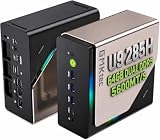
- EVOLUTION CORE ULTRA 9 285H MINI PC - GMKtec EVO-T1 is the next evolution in AI mini PC Ultra 9 series. The Core Ultra 9 285H offers 16 cores (six P-cores + eight E-cores + two LPE-cores) and 16 threads with a turbo clock of 5.4 GHz. It is currently one of the best value for performance AI mini PC computers.
- AI NPU - The 285H features an Intel AI Boost NPU, capable of up to 13 TOPS (Tera Operations per Second) for INT8 calculations, which is designed to accelerate AI tasks.
- INTEL ARC 140T GAMING PC - The Arc 140T GPU includes 8 Xe cores and supports features like DirectX 12, OpenGL 4.5, and OpenCL 3, making it capable of handling modern games and creative applications. It also supports Quick Sync Video for efficient video encoding and decoding, as well as AV1 encoding and decoding.
- 64GB DDR5 RAM + 1TB SSD - The EVO-T1 is equipped with Dual 32GB (Total 64GB) SO-DIMM DDR5 5600MHz memory sticks. 2TB PCIE 4.0 SSD Drive with 3x M.2 2280 Expansion slots. Each slot capable of reading up to 4TB. (12TB MAX)
- QUAD SCREEN 8K DISPLAY SUPPORT - EVO-T1 AI Mini PC support 4-screen 4K/8K output via HDMI 2.1 (8K@60Hz), DisplayPort 1.4 (4K@60Hz), and USB Type-C Transfer speed (supporting PD3.0/DP1.4/DATA). Ideal for gaming, video editing, and multitasking, it provides expansive and crisp multi-display support.
AI makes the boundary harder to define
A company can keep databases in a local region yet send sensitive information to an external AI API. That leaves important questions unanswered: where inference occurs, whether prompts are retained, where models and safety filters come from, and whether an agent’s tools or telemetry leave the intended boundary. Google’s 2026 Distributed Cloud announcements illustrate the push toward connected and air-gapped AI deployment, including Gemini in certain configurations. Google’s announcement describes the provider’s offerings; customers still need to confirm the exact model and features available for their deployment.
Policy is moving, but not all rules are settled
In June 2026, the Commission proposed a Cloud and AI Development Act as part of a broader technology-sovereignty package. The proposal signals policy direction, not final legislative obligations. The Commission also announced a preliminary view that Amazon’s and Microsoft’s market-leading cloud services should be designated as gatekeepers under the Digital Markets Act; that was a preliminary position, not a final designation. The technology package and the DMA announcement show that sovereignty is connected to industrial policy and market concentration as well as privacy.
Rank #2

- LOW ENERGY HIGH PERFORMANCE MINI PC - The Intel Core Ultra 5 125U is part of the Ultra 5 lineup, using the Meteor Lake architecture with BGA 2049. Intel Hyper-Threading technology is available and effectly doubles the core-count of the P-Cores, to a total of 14 threads. Core Ultra 5 125U has 12 MB of L3 cache and operates at 1300 MHz by default, but can boost up to 4.3 GHz, depending on the workload. With a TDP of 15 W, the Core Ultra 5 125U consumes very little energy but outputs high performance efficiency
- 32GB DDR5 RAM + 512GB SSD - The K15 mini computer is equipped with Dual 16GB (Total 32GB) SO-DIMM DDR5 4800MHz memory sticks. 512GB PCIE 4.0 SSD Drive with 3x M.2 2280 Expansion slots. Each slot capable of reading up to 8TB. (24TB MAX)
- QUAD SCREEN 4K DISPLAY SUPPORT - K15 Mini PC support 4-screen 4K/8K output via HDMI 2.1 (8K@60Hz), DisplayPort 1.4 (4K@60Hz), and USB Type-C Transfer speed (supporting PD3.0/DP1.4/DATA). Ideal for gaming, video editing, and multitasking, it provides expansive and crisp multi-display support
- OCULINK PORT - The Oculink port on the rear interface enables higher bandwidth capabilities, better frame rates and lower lag. The standard also operates at PCIe x4 speeds, compared to Thunderbolt's x3. Gamers and content creators can benefit from Oculink's higher bandwidth, resulting in better performance and lower lag for eGPU setups
- DUAL NIC FAST 2.5GBE + WIFI 6E + BT 5.2 - Dual Ethernet 2.5GbE LAN port design provides more applications, such as firewall, multichannel aggregation, soft routing, file storage server. Built-in WIFI 6E / Bluetooth 5.2 is more stable and efficient to connect multiple wireless devices such as projector, printer, monitor, speakers and etc
How the main 2026 offerings differ
“Sovereign cloud” covers several architectures, from enhanced public-cloud controls to dedicated and disconnected infrastructure. These examples are provider descriptions, not a ranking or a guarantee that every feature is available in every country, region or workload.
| Option | What it offers | What buyers should verify |
|---|---|---|
| AWS European Sovereign Cloud | AWS said it became generally available on January 15, 2026, as an independent cloud physically and logically separate from other AWS Regions. AWS says the cloud is located entirely within the EU and plans to expand its footprint beyond Germany. AWS announcement | Check the exact service and AI catalogue, target-country availability, support arrangements and recovery design. Ordinary hosting in an EU AWS Region is not automatically equivalent to this separate cloud. AWS also points to Dedicated Local Zones, Outposts and AI Factories for other deployment needs. AWS overview |
| Microsoft Sovereign Cloud and Azure Local | A portfolio spanning public sovereign-cloud options, local AI processing, confidential computing, customer-managed keys, policy controls, hybrid environments and disconnected deployments. Microsoft’s portfolio overview | Identify the specific tier and product that meets the requirement: a sovereign public-cloud region, Azure Local or a disconnected environment are not the same architecture. Microsoft describes European personnel controls and tamper-evident access logs, but feature availability depends on product and deployment. Microsoft documentation |
| Google Sovereign Cloud | Options include Data Boundary controls, partner-operated arrangements, Google Distributed Cloud, and connected or air-gapped deployments; selected configurations include AI capabilities. Google overview | Confirm which services, models and controls are offered in the relevant country and deployment. Partner-supervised controls can provide local oversight without making the entire underlying technology stack locally owned. Air-gapped product details are at Google Distributed Cloud air-gapped. |
| Oracle EU Sovereign Cloud | Oracle describes an EU-specific cloud for infrastructure, applications and AI, with more than 200 IaaS, PaaS and AI services in its sovereign-cloud materials. Oracle datasheet | Verify country, region, service and application availability rather than assuming every Oracle AI service is available under every sovereign deployment. Oracle’s sovereign AI brief describes its positioning, not universal availability. |
| European and European-partnered groups | The Commission framework includes groups involving providers such as OVHcloud, Clever Cloud, STACKIT, Proximus, S3NS, Clarence and Mistral. Procurement details | Assess ownership, local operating authority, technology dependencies, service breadth, capacity and support individually. “European provider” does not by itself establish full legal, operational or supply-chain sovereignty. |
Provider pages also distinguish products within a portfolio. For example, Google lists Assured Workloads and Sovereign Controls by Partners; buyers should compare each control set with the actual requirement rather than relying on a portfolio label.
The Tool Desk
Outbyte Driver Updater FREEScan for outdated or missing drivers - takes under a minuteDriver Scan →Outbyte PC Repair FREEClear out junk files and repair common Windows errorsFree Scan →Rank #3

- Entry-level NAS Personal Storage:UGREEN NAS DH2300 is your first and best NAS made easy. It is designed for beginners who want a simple, private way to store videos, photos and personal files, which is intuitive for users moving from cloud storage or external drives and move away from scattered date across devices. This entry-level NAS 2-bay perfect for personal entertainment, photo storage, and easy data backup (doesn't support Docker or virtual machines).
- Set Your Devices Free, Expand Your Digital World: This unified storage hub supports massive capacity up to 64TB.*Storage drives not included. Stop Deleting, Start Storing. You can store 22 million 3MB images, or 2 million 30MB songs, or 43K 1.5GB movies or 67 million 1MB documents! UGREEN NAS is a better way to free up storage across all your devices such as phones, computers, tablets and also does automatic backups across devices regardless of the operating system—Window, iOS, Android or macOS.
- The Smarter Long-term Way to Store: Unlike cloud storage with recurring monthly fees, a UGREEN NAS enclosure requires only a one-time purchase for long-term use. For example, you only need to pay $459.98 for a NAS, while for cloud storage, you need to pay $719.88 per year, $2,159.64 for 3 years, $3,599.40 for 5 years. You will save $6,738.82 over 10 years with UGREEN NAS! *NAS cost based on DH2300 + 12TB HDD; cloud cost based on 12TB plan (e.g. $59.99/month).
- Blazing Speed, Minimal Power: Equipped with a high-performance processor, 1GbE port, and 4GB RAM on Board, this NAS handles multiple tasks with ease. File transfers reach up to 125MB/s—a 1GB file takes only 8 seconds. Don't let slow clouds hold you back; they often need over 100 seconds for the same task. The difference is clear.
- Let AI Better Organize Your Memories: UGREEN NAS uses AI to tag faces, locations, texts, and objects—so you can effortlessly find any photo by searching for who or what's in it in seconds. It also automatically finds and deletes similar or duplicate photo, backs up live photos and allows you to share them with your friends or family with just one tap. Everything stays effortlessly organized, powered by intelligent tagging and recognition.
Where demand is likely to appear first
- Defence, intelligence and public administration: These buyers may have national-security, classified-data, continuity or procurement requirements that go beyond ordinary residency.
- Critical infrastructure: Energy, utilities, telecommunications, transport and logistics operators need to weigh foreign access and service interruption against the operational cost of isolation.
- Finance, insurance and healthcare: These sectors handle highly sensitive information and face detailed regulatory and resilience obligations. The required architecture still depends on the specific jurisdiction and workload.
- Industrial companies and research institutions: Sensitive intellectual property, valuable datasets and specialised AI workloads can justify local processing or tighter controls.
- Ordinary commercial businesses: A retailer, agency or startup without restricted data or critical services may get more value from conventional regional hosting, encryption and broad service choice.
Microsoft specifically identifies governments and regulated sectors such as energy, healthcare and financial services as potential users of its Sovereign Public Cloud. Its overview is a provider description, not a determination that every organisation in those sectors needs the product.
Four ways to deploy sovereign AI
| Deployment | What it controls | Best fit and trade-off |
|---|---|---|
| Sovereign AI API | Managed inference with processing in a specified jurisdiction. | Useful when the main requirement is controlled processing and the organisation accepts dependence on the provider’s model and control plane. |
| AI in a public sovereign cloud | Runs models in a sovereignty-enhanced cloud region. | Offers cloud-native services, but model choice, regional redundancy and feature availability may be narrower than in mainstream regions. |
| Appliance or distributed cloud | Places infrastructure in a customer data centre or local facility for local inference and tighter operational control. | Can suit data that must stay on premises, provided the organisation can staff and maintain specialist infrastructure. |
| Air-gapped or disconnected AI | Removes dependence on public internet access and, in some designs, a remote cloud control plane. | Fits highly sensitive or classified workloads. Isolation raises operating complexity and can slow updates while narrowing available services. Google says its air-gapped platform can operate without connectivity to Google Cloud or the public internet; exact AI capabilities depend on configuration. Product documentation |
What sovereignty can cost—and what it can constrain
There is no universal sovereign-cloud tariff. The European Commission’s impact assessment cites estimates of premiums of roughly 10% to 30%, depending on provider and offering, and an AWS comparison showing an average premium of about 15% across six services in January 2026. These are indicative estimates, not standard prices or a prediction for an individual contract. Commission impact assessment
Rank #4

- [Powerful PC] Gaming PC equipped with Core i9-14900F, 24 Cores 32 Threads, 36M Cache, Max Turbo Frequency: 5.8GHz, Windows 11 pro (64 Bit). With GeForce RTX 50 Series GPUs. Adopting DLSS 4 technology, it dramatically improves frame rate performance, supports FP4 low-precision computing, and doubles the efficiency of AI inference. SD graph generation speed is 3 times faster than RTX 4070 Super, significantly increasing creative productivity. Graphics work productivity has increased significantly.
- [High Speed DDR5 RAM & PCIE4.0 SSD] The desktop computer is equipped with Dual-DDR5 RAM (dual channel DDR5 high-speed memory, which can support up to 128GB RAM), 1 x M.2 2280 PCIE4.0 high-speed SSD, and support add 2 x 2.5-inch SATA HDD/SSD(not include) is enough to accommodate system files and massive games, Excellent reading and writing speed greatly shortening your boot time.
- [8K@60Hz Quad-Display] Desktop PC with GeForce RTX 5070 12G GDDR7, supporting DLSS 4, ray tracing, and AI cores. Easily connect 4 monitors via 1×HDMI 2.1 + 3×DP 1.4a — all ports support 8K@60Hz. Delivers stunning visuals and ultra-smooth performance for home entertainment, live streaming, video editing, AI workloads, 3D rendering, and AAA gaming.
- [Functional Interfaces] Mini computer is equipped with 4 x USB 3.2, 4 x USB2.0, 1 x HDMI2.1 port, 3 x DP ports, 2xRJ-45 Gigabit Network Ethernet, 1 x Fiber Optic PORT, 1 x Audio in/out. Built-in Bluetooth 5.4 and IEEE 802.11be wifi 7, Higher transfer rates and lower latency. Mini PC supports multiple device connection and can be used with servers, monitoring equipment, office equipment, projectors, televisions, etc, Mini desktop computer support automatic power on and Wake On Lan.
- [Warranty & Liquid Cooling] Warrant: 2 year/24 months. The compact computer size: 11.6*9.3*3.9in, 9.25lb, Chassis built-in 2 large copper fans, built-in liquid cooling device, to further enhance the computer heat dissipation, and at the same time can reduce noise, give full play to the overall performance of the computer.
The total cost can also include dedicated hardware, local staffing, migration, certification, duplicate infrastructure, resilience planning and the expense of exiting a service. A more isolated region may offer fewer databases, analytics tools, AI models, GPUs or managed services. Pricing and availability need confirmation for the precise service and region: for example, Google says Assured Workloads is consumption-priced and directs buyers to sales, while Sovereign Controls by Partners directs buyers to partners. Those are product-specific signals, not a market-wide pricing rule. Assured Workloads; Sovereign Controls by Partners
- Disaster recovery: Cross-border replication can improve resilience but conflict with geographic controls. Decide whether recovery may use another location in the same country, another EU country, a local private facility or offline backups.
- Metadata exposure: Ask whether billing records, diagnostic data, support attachments, logs, model telemetry and prompts are covered by the same boundary as primary data.
- AI dependencies: Local inference does not necessarily mean local model ownership, local updates, local GPU supply or locally controlled safety filters.
- Compliance is not sovereignty: GDPR, NIS2, DORA, SecNumCloud and C5 address different legal, technical or assurance questions. Compliance with one framework does not prove full sovereignty for every workload.
- Lock-in: Proprietary model APIs, identity systems, management planes, data formats and agent frameworks can make a sovereign deployment difficult to move. Test export and portability before committing.
How to test a sovereignty claim before buying
Ask the provider for evidence tied to the exact service, region and workload. A contract label is not a substitute for understanding how control works in practice.
Quick wins for a faster PC:
Scan for outdated or missing drivers - takes under a minuteDriver Scan →Repair Windows errors before they cause bigger problemsFix Now →Fix the driver behind crashes, sound loss and screen glitchesFind Drivers →- Map the legal entities: Who contracts with you, who owns that entity, which jurisdictions may apply, and what process governs a legal demand for access?
- Map data flows: Request diagrams for production data, backups, metadata, logs, support tickets, telemetry, prompts, model outputs and third-party observability tools.
- Verify human access: Establish where administrators and support personnel are located, how privileged access is approved, and whether access is recorded and independently auditable.
- Inspect key control: Determine whether keys are customer-controlled or held by an independent local party, and whether the provider can access plaintext during operations.
- Test continuity: Ask whether the service can run, recover, rotate keys and receive updates if the foreign parent company, external control plane or public network is unavailable.
- Check the supply chain: Identify dependencies on foreign-controlled chips, firmware, hypervisors, networking equipment, software and maintenance providers; decide which are acceptable for the stated goal.
- Specify AI behaviour: Name the model, inference location, prompt-retention policy, update origin, training or fine-tuning arrangement, telemetry path and agent-tool boundaries.
- Review resilience and exit: Set permitted recovery locations, recovery procedures, data export formats, model portability expectations and an exit test before signing.
- Demand independent evidence: Review contracts, technical controls, subprocessor lists, audits and product-by-product availability—not marketing language alone.
Which model fits the requirement?
- Choose a sovereign public cloud when regional residency and stronger administrative controls matter, you want managed cloud and AI services, and you accept some provider dependence.
- Consider a local provider when local ownership, jurisdiction or support is central and the workload can operate with a narrower catalogue or different migration requirements.
- Choose distributed or on-premises AI when data must stay inside your facilities, inference must continue through network outages, or you need tighter control of models and deployment.
- Choose air-gapped infrastructure when external connectivity is prohibited or the workload is classified, and the organisation can bear the operational and update burden.
- Do not buy the strictest option by default: If ordinary encryption and regional hosting meet the obligation, extra controls may add cost and constrain service choice without solving a real risk.
The practical test is not whether a cloud is called sovereign, but whether its specific legal, operational, technical and AI controls match the workload’s risks. In 2026, procurement and product availability show real momentum; universal adoption and complete technological independence do not.
Quick Recap
Product prices and availability are accurate as of the date/time indicated and are subject to change. Any price and availability information displayed on Amazon at the time of purchase will apply.




