BlackSky said its BlackSky 7 Earth-observation satellite returned its first imagery within hours of launch in March 2021. That was an early sign the spacecraft could image and send data—not proof it was already available for unrestricted commercial missions. The distinction matters: first light is one milestone in a longer path from launch to customer service.
What happened to BlackSky 7?
Rocket Lab launched BlackSky 7 aboard an Electron rocket on March 22, 2021, from Launch Complex 1 in New Zealand. After Electron’s kick stage deployed the satellite, BlackSky checked out the spacecraft and began imaging. The company reported receiving its first pictures within hours. GeekWire’s March 25, 2021 report described the launch and the early imagery.
What did the first image show?
The reported image showed part of Perth, Australia, including the Waterbank development site. An active construction area makes a practical demonstration target: repeated observations can help users track building activity and changes to infrastructure. But one early image demonstrates an initial imaging capability; it does not establish how the satellite would perform across every target, condition, or customer mission.
What does “goes to work” mean for a satellite?
In this context, the phrase refers to a quick first image, not necessarily full commercial availability. A satellite’s path from launch to customer use includes distinct milestones:
#1 Best Overall

- HOBBY MODEL KIT – Unassembled model packed in an envelope with easy to follow instructions. Ideal for ages 14 and up.
- NO GLUE OR SOLDER NEEDED – Parts can be easily clipped from the metal sheets. Tweezers are the recommended tool for bending and twisting the connection tabs.
- VOYAGER – 1.5 Sheet Model with a moderate difficulty level. Assembled Size: 1.38 x 1.77 x 6.70 inches.
- FROM STEEL SHEETS TO 3D – Pop out the pieces and connect using tabs and holes. Includes illustrated instructions.
- HIGHLY DETAILED ETCHED MODEL – Display your 3D model once completed - collect and build them all.
- Launch and separation: The spacecraft reaches orbit and separates from its launch vehicle or kick stage.
- Initial contact: Ground operators establish communications with it.
- Checkout: Teams test spacecraft functions, including power, communications, attitude control, and imaging systems.
- First light: The satellite captures an initial usable image.
- Calibration and validation: Operators assess image quality, pointing, geolocation, and data processing.
- Commercial commissioning: The spacecraft is integrated into the tasking and delivery system for customer missions.
Those steps need not finish at the same time. In 2025, BlackSky said its third Gen-3 satellite returned its first very-high-resolution imagery less than 24 hours after launch. The company later announced that the satellite entered commercial operations 21 days after launch. The separate milestones show why “first image” and “ready for customer missions” should not be treated as interchangeable claims. BlackSky’s announcement of the first imagery and its commercial-operations announcement describe those stages.
How could the first imagery arrive so quickly?
The reported sequence was straightforward: Electron placed the satellite in orbit, the kick stage deployed it, and BlackSky established contact and performed initial checks. The spacecraft then captured imagery during an early imaging opportunity; the data was downlinked and processed. BlackSky said its Spectra system used machine-learning algorithms to analyze the pictures. The account does not establish that the first image was delivered to a customer.
Rank #2

- Model Kit
- May Require Paints and Glues to Assemble
- Accurate Scale Model
- Detailed Instructions Provided
- Decals/Transfers Included
Getting an image quickly depends on more than the camera. The satellite needs a suitable opportunity to view a target, and the data must reach and move through ground systems. BlackSky’s reported result therefore reflects an early end-to-end demonstration—from spacecraft to processed imagery—rather than just a sensor switching on.
Why does rapid first light matter?
- It provides an early health check. Capturing and returning imagery indicates that key parts of the spacecraft and ground workflow are functioning, while leaving further validation to do.
- It can shorten the wait for added capacity. A newly launched satellite contributes sooner once it has been commissioned for customer missions.
- It connects hardware to usable information. A satellite’s value depends on more than collecting pixels; ground processing, analytics, tasking, and delivery determine how quickly users can act on the data.
- It matters for time-sensitive monitoring. Faster commissioning can bring additional observation capacity into a service sooner, including for security or emergency-response work.
BlackSky has said faster commissioning puts tasking capacity in customers’ hands sooner and increases the useful operating period of each spacecraft. Those are company-stated benefits, not a guarantee that every newly launched satellite will follow the same timeline.
Free tools Windows power users keep installed
One-click scans. No signup required.
Rank #3

- HOBBY MODEL KIT – Unassembled model packed in an envelope with easy to follow instructions. Ideal for ages 14 and up
- NO GLUE OR SOLDER NEEDED – Parts can be easily clipped from the metal sheets. Tweezers are the recommended tool for bending and twisting the connection tabs
- APOLLO CSM – 3.5 Sheet Model with a challenging difficulty level. Assembled Size: 5.07 L x 2.28 W x 3.45 H inches.
- FROM STEEL SHEETS TO 3D – Pop out the pieces and connect using tabs and holes. Includes illustrated instructions
- HIGHLY DETAILED ETCHED MODEL – Display your 3D model once completed - collect and build them all
What BlackSky 7’s image did—and did not—demonstrate
BlackSky 7 was part of the company’s Earth-observation constellation. The company’s proposition combines imagery with frequent monitoring and automated analysis, rather than treating a satellite photograph as the finished product. Spectra can help surface potential objects or changes for review; automated detections should not be treated as infallible identification, especially where decisions carry high stakes.
The Perth image was an early demonstration, not proof of every eventual capability of BlackSky 7. Image usefulness can depend on target access, orbital geometry, communications, lighting, and atmospheric conditions. Sharpness alone also does not establish accurate geolocation or reliable change detection.
Rank #4

- HOBBY MODEL KIT – Unassembled model packed in an envelope with easy to follow instructions. Ideal for ages 14 and up.
- NO GLUE OR SOLDER NEEDED – Parts can be easily clipped from the metal sheets. Tweezers are the recommended tool for bending and twisting the connection tabs.
- JAMES WEBB SPACE TELESCOPE - 2.75 Sheet Model with a moderate difficulty level. Assembled Size: 4.13 L x 2.75 W x 2.75 H inches. 1:221 Scale. 62 Pieces
- FROM STEEL SHEETS TO 3D – Pop out the pieces and connect using tabs and holes. Includes illustrated instructions.
- HIGHLY DETAILED ETCHED MODEL – Display your 3D model once completed - collect and build them all.
How BlackSky’s launch-to-service milestones have changed
Later Gen-3 announcements show both continued rapid first imagery and the separate work required to commission a spacecraft. These are company-reported milestones, not a general service-level promise.
| Spacecraft and milestone | Reported timing | What it means |
|---|---|---|
| BlackSky 7, 2021 | First imagery within hours of launch | Early on-orbit imaging and data return; the report does not establish commercial commissioning. |
| Third Gen-3 satellite, 2025 | First imagery in less than 24 hours; commercial operations after 21 days | First light preceded customer-facing operations. |
| Fourth Gen-3 satellite, March 2026 | First-light operations within hours; commissioned in less than one week | A later, faster reported path from launch to commissioning. |
The 2026 milestones are listed in BlackSky’s investor-relations press-release archive. For Gen-3, BlackSky’s published data sheet lists a best ground sample distance of 35 cm, tasking-to-collection in less than 10 hours, and collection-to-delivery in less than 90 minutes, subject to customer and system architecture. These are Gen-3 specifications, not specifications for BlackSky 7 or guarantees for every location and request.
Best Value
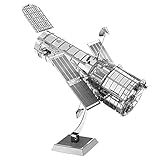
- HOBBY MODEL KIT – Unassembled model packed in an envelope with easy to follow instructions. Ideal for ages 14 and up.
- NO GLUE OR SOLDER NEEDED – Parts can be easily clipped from the metal sheets. Tweezers are the recommended tool for bending and twisting the connection tabs.
- HUBBLE TELESCOPE – 1 Sheet Model with a moderate difficulty level. Assembled Size: 3.00 x 2.00 x 2.50 inches.
- FROM STEEL SHEETS TO 3D – Pop out the pieces and connect using tabs and holes. Includes illustrated instructions.
- HIGHLY DETAILED ETCHED MODEL – Display your 3D model once completed - collect and build them all.
What this means for customers and investors
For a customer, rapid first light can signal that new capacity may reach service sooner, but the useful milestone is commercial commissioning—not simply the first photograph. BlackSky’s reported timelines also do not by themselves show when revenue begins or how much a particular satellite contributes. Those questions depend on customer access and the company’s operating and commercial arrangements.
For anyone assessing satellite-service claims, ask which milestone the timing describes: separation, first contact, first usable image, or commercial availability. Also check whether the figure is a company-reported result or a published service specification, and whether stated conditions apply. That keeps a striking launch-day milestone in proportion to what customers can actually order.
Quick Recap
Product prices and availability are accurate as of the date/time indicated and are subject to change. Any price and availability information displayed on Amazon at the time of purchase will apply.




