A vehicle “write-off” is a tax deduction, not a cash refund: it reduces taxable income, and the tax savings depend on your tax bracket. For federal tax purposes, vehicle costs are generally deductible only for qualifying business, medical, charitable, or limited military-moving use. Personal driving—and usually commuting—does not qualify.
The key decisions are which miles qualify, whether to use the standard-mileage or actual-expense method, and whether your records support the claim. These are federal rules; state tax treatment can differ.

Who can claim a vehicle tax deduction?
Self-employed people and sole proprietors generally claim qualifying vehicle expenses on Schedule C (Form 1040), line 9. Partnerships, S corporations, and corporations report costs on their applicable business returns.
Most employees cannot deduct unreimbursed vehicle expenses on their federal tax return. The miscellaneous itemized deduction for unreimbursed employee expenses remains suspended for most employees for tax years beginning after 2017. Narrow exceptions can apply to certain Armed Forces reservists, qualified performing artists, and fee-basis state or local government officials.
#1 Best Overall

- KEEP PERFECT RECORDS: Adams Vehicle Mileage and Expense Journals help you log business use of your car or truck with year start and year end odometer readings and flawless daily records
- GET THE BEST DEDUCTION: 588 entries capture the date, odometer readings, total miles and business purpose—everything you need to document business use for the IRS
- SUMMARIES MAKE TAX TIME EASY: Annual summary pages hold monthly mile totals to calculate percentage of business use; monthly maintenance totals help you deduct unreimbursed vehicle expenses
- INCLUDES 6 RECEIPT POCKETS: Don’t forget to save receipts; you get 2 double-sided pockets for oil changes and other service; 2 pockets for repairs, and 2 pockets for parking and tolls
- KEEP IT IN THE CAR: This portable 5-1/4 x 8-1/4 booklet was meant to travel with you; keep one in each glove compartment for a complete record of business use
For employees, the usual solution is reimbursement through an employer’s accountable plan. The employee must substantiate the expense and return any excess reimbursement.
What vehicle use is deductible?
You must separate your annual mileage into business, commuting, and personal categories. A qualifying business trip might include driving from one workplace to another, visiting a customer, traveling to a supplier, or going to a temporary work location for a genuine business purpose. Keep records that substantiate the trip and its business purpose.
Travel from home to your regular workplace is generally commuting, which is personal and not deductible. Making a business phone call, carrying work materials, or stopping for a personal errand does not usually convert a commute into business mileage.
For a mixed-use vehicle, the basic calculation is:
Business-use percentage = qualifying business miles ÷ total annual miles
What’s actually slowing this PC down?
Pick the symptom - the matching free tool is one click away.
Under the actual-expense method:
Business deduction = allowable vehicle cost × business-use percentage
For example, if you drive 12,000 total miles and 7,200 are qualifying business miles, your business-use percentage is 60%. You generally apply that percentage to allowable mixed-use expenses.
The two ways to deduct business vehicle costs
Business owners generally compare these two federal methods when eligible:
- Standard mileage: multiply qualifying business miles by the applicable IRS rate.
- Actual expenses: add allowable vehicle costs and deduct the business-use share.
Calculate both methods before filing. The method producing the larger deduction may vary by year, and method-specific restrictions apply. (Source: IRS Publication 463.)
The Tool Desk
Outbyte Driver Updater FREEScan for outdated or missing drivers - takes under a minuteDriver Scan →Outbyte PC Repair FREERepair Windows errors before they cause bigger problemsFix Now →Rank #2
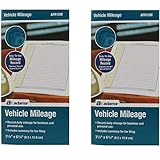
- Sold As 2 Journals
- Adams Vehicle Mileage 3 1/4 x 6 1/4
- Record daily mileage for business and personal use
- Includes summary for tax filing
2026 standard mileage rates
The IRS split the 2026 rates into two periods. The rates below are published by the IRS.
| Type of use | January 1–June 30, 2026 | July 1–December 31, 2026 |
|---|---|---|
| Business | 72.5 cents per mile | 76 cents per mile |
| Medical | 20.5 cents per mile | 23.5 cents per mile |
| Charitable | 14 cents per mile | 14 cents per mile |
| Qualifying military moving | 20.5 cents per mile | 23.5 cents per mile |
For 2025, the business rate was 70 cents per mile (Source: IRS Publication 463). Medical and military-moving mileage generally requires qualifying circumstances. The moving rate generally applies to qualifying active-duty military moves and certain qualifying intelligence-community moves. The charitable rate is set by statute rather than by the IRS’s annual business-mileage calculation (Source: IRS Notice 2026-10).
Business parking fees and tolls can generally be added to a standard-mileage deduction. You cannot also deduct gasoline, repairs, insurance, registration, lease payments, or depreciation for the same vehicle and year because ordinary vehicle costs are built into the mileage rate. (Source: 2025 Instructions for Schedule C.)
When standard mileage is unavailable
The standard-mileage method is generally unavailable if you:
Recommended Free Tools
- Use five or more vehicles simultaneously in the business, such as in a fleet operation.
- Claim MACRS depreciation for the vehicle.
- Claim Section 179 or bonus depreciation for the vehicle.
- Use a depreciation method other than straight line.
- Claim actual vehicle expenses after 1997 for a leased vehicle.
For an owned vehicle, you generally need to elect standard mileage in the first year the vehicle is available for business use if you want to preserve the ability to use that method in later years. If you choose standard mileage for a leased vehicle, you generally must use it for the entire lease term. (Source: IRS Publication 463.)
How the actual-expense method works
With actual expenses, you track the vehicle’s allowable costs and deduct the business portion. Potentially deductible costs include:
- Gasoline and oil
- Repairs and maintenance
- Tires
- Insurance
- Registration and license fees
- Lease payments
- Depreciation
- Business-related parking and tolls
- The business portion of vehicle-loan interest
Personal expenses are not deductible. If 60% of your miles are qualifying business miles, you generally cannot deduct 100% of your insurance, repairs, interest, or other mixed-use costs. (Sources: IRS Publication 463; Publication 334.)
Vehicle-loan interest for business use
Under the actual-expense method, interest on a vehicle loan must be allocated between business and personal use. The business portion may generally be deductible when the vehicle is used in a trade or business.
PC Slower Than It Used to Be?
A free scan shows the junk files, broken settings and background clutter dragging Windows down - then fixes them in one click.Free scan · Windows 10 & 11Crashes, No Sound, or Screen Glitches?
Random freezes, missing sound and display glitches usually trace back to one bad driver. Find and replace yours safely.Free scan · under a minuteRank #3

- Comprehensive Package for Long Term Use: this package comes with 6 auto mileage and expense notebooks; Each mileage log book for car contains 32 pages; This sufficient quantity enables you to keep track of your expenses for a longer period
- Ideally Sized for Convenience: with dimensions of 6.3 x 3.3 inches, the vehicle mileage log book is the ideal size to carry around; Its compact nature ensures you can easily tuck it into your glove compartment or bag, ready to jot down important information whenever the need arises
- Quality Material for Ease of Use: the vehicle book is made from quality paper, providing a smooth writing surface for all your record keeping needs; This ensures clear documentation of all your auto mileage and expenses for easy reference
- Organized Layout for Detailed Record Keeping: each car mileage log book boasts an organized layout with appropriate categories; You can track different types of expenses like mileage, oil changes, parking charges, and even cleaning and repair costs; The 2 page layout allows you to track expenses by day over a 12 months period, with monthly and annual summary pages on the back for easy accurate recording; This gives you a clear and broad view of your vehicle's running costs
- Ideal for Divers: the mileage tracking book constitutes the ideal tool for divers with features specifically designed for auto mileage and expense logging; They provide a systematic way of recording mileage, gas usage, oil changes, and other vehicle related expenses incurred
Do not deduct the same interest twice. For example, if you claim personal-use interest under the newer Schedule 1-A deduction, that same interest cannot also be claimed as a business expense on Schedule C. (Source: 2025 Instructions for Schedule C.)
Buying a vehicle: depreciation, Section 179, and bonus depreciation
Buying a vehicle does not normally make the entire purchase price immediately deductible. The cost is generally recovered through depreciation, subject to business-use requirements, vehicle classification, passenger-automobile limits, and other statutory restrictions.
Section 179 limits
For tax years beginning in 2026, the general Section 179 maximum is $2,560,000. The deduction begins to phase out when total Section 179 property placed in service exceeds $4,090,000.
The Section 179 cost limit for qualifying sport utility vehicles is $32,000 for 2026. For 2025, the corresponding figures were a $2,500,000 maximum, a $4,000,000 phaseout threshold, and a $31,300 SUV limit. (Sources: IRS Publication 946; Internal Revenue Bulletin 2025-45.)
Free tools Windows power users keep installed
One-click scans. No signup required.
Section 179 also has business-use and taxable-income restrictions. A vehicle generally needs more than 50% qualified business use to receive the same accelerated treatment available to a vehicle used 50% or less for business. If business use later falls to 50% or less during the recovery period, depreciation recapture or a change to straight-line depreciation may apply. (Source: Instructions for Form 4562.)
Bonus depreciation
Under the One, Big, Beautiful Bill, 100% additional first-year depreciation is generally available for eligible depreciable property acquired after January 19, 2025, if applicable qualification rules are met. Certain used vehicles may qualify; used property is not automatically excluded.
Bonus depreciation is separate from the standard-mileage method. Claiming bonus depreciation generally prevents you from using standard mileage for that vehicle. Passenger-automobile depreciation caps and the business-use percentage can still restrict the usable deduction. (Sources: IRS bonus-depreciation guidance; IRS Publication 946.)
Passenger-vehicle depreciation limits
For passenger automobiles placed in service during 2025, the IRS lists these maximum first-year depreciation amounts:
Rank #4

- Sold as 1 EA.
- Mandatory records for all who use their automobile for business purposes. Records mileage, parking fees and tolls.
- Features a detachable year-end summary for tax advisor.
- Undated-start any time.
- Good for one full year.
| Situation | Maximum first-year amount |
|---|---|
| Section 168(k) additional first-year depreciation applies | $20,200 |
| Section 168(k) additional first-year depreciation does not apply | $12,200 |
The listed later-year limits are $19,600 for the second year, $11,800 for the third year, and $7,060 for each succeeding year. These limits are reduced for personal use. (Source: IRS Publication 463.)
Leasing a vehicle for business
A business leasing a vehicle can generally choose standard mileage or actual expenses, subject to the restrictions for each method.
Under actual expenses, only the business portion of lease payments is deductible. Advance payments must be spread over the lease term, and payments that are economically purchase payments are not treated as ordinary lease payments. A lease lasting 30 days or more may also require an IRS lease-inclusion amount, which reduces the deductible lease expense.
Lease payments connected with commuting or other personal use are not deductible. Unlike an owned vehicle, choosing standard mileage for a leased vehicle generally commits you to that method for the full lease term. (Source: IRS Publication 463.)
The personal car-loan-interest deduction
A separate temporary deduction applies to certain personal vehicle loans for tax years 2025 through 2028. Individuals may deduct up to $10,000 per year of qualified passenger-vehicle loan interest whether or not they itemize.
The deduction generally requires all of the following:
- The loan was originated after December 31, 2024.
- The loan was used to purchase the vehicle.
- The vehicle is for personal use, not business or commercial use.
- The loan is secured by a first lien on the vehicle.
- The vehicle is new to the taxpayer; used vehicles generally do not qualify.
- The vehicle is a qualifying car, minivan, van, SUV, pickup truck, or motorcycle.
- The vehicle has a gross vehicle weight rating below 14,000 pounds.
- Final assembly occurred in the United States.
- You paid or accrued qualified interest during the tax year.
Lease payments do not qualify. The deduction phases out as modified adjusted gross income exceeds $100,000, or $200,000 for married couples filing jointly. (Sources: IRS Topic 505; IRS Schedule 1-A guidance.)
For a 2025 federal return filed in 2026:
- Complete Schedule 1-A (Form 1040), Part IV — No Tax on Car Loan Interest.
- Attach it to Form 1040, Form 1040-SR, or Form 1040-NR.
- Enter the deduction as directed by the Form 1040 instructions.
Schedule 1-A, Part IV asks for the vehicle identification number and separates interest already deducted on Schedule C, Schedule E, or Schedule F from interest claimed on Schedule 1-A. (Source: 2025 Schedule 1-A.)
Do these 3 things before closing this tab:
1Clear out junk files and repair common Windows errors2Fix the driver behind crashes, sound loss and screen glitches3Repair Windows errors before they cause bigger problemsWhere to report business vehicle deductions
| Taxpayer or cost | Typical federal reporting path |
|---|---|
| Sole proprietor’s standard mileage or actual operating costs | Schedule C, line 9 |
| Depreciation | Schedule C, line 13; Form 4562 when required |
| Lease payments | Schedule C, line 20a |
| Vehicle-use details | Schedule C, Part IV, or Form 4562, Part V |
| Personal qualified vehicle-loan interest | Schedule 1-A, Part IV |
Schedule C, Part IV is generally used for standard mileage, leasing, or a fully depreciated vehicle when Form 4562 is not otherwise required. Form 4562, Part V is used when claiming depreciation or when Form 4562 is otherwise required. (Source: 2025 Instructions for Schedule C.)
Records you need to keep
The IRS expects contemporaneous, adequate records—not a year-end estimate. A mileage app, spreadsheet, diary, or written log can work if it reliably documents the required information. Records should be made at or near the time of the trip; the IRS says taxpayers cannot deduct amounts that are merely estimated or approximated. (Source: IRS Publication 463.)
Your log should show:
- The date of each trip
- The destination or area
- The business purpose
- Beginning and ending odometer readings, or miles driven
- Business miles
- Total annual mileage
- Parking and toll amounts
- Receipts and other evidence for actual expenses
Records supporting a deduction generally should be retained for at least three years from the date the return is filed. Keep vehicle depreciation and basis records throughout the recovery period and longer when needed to support a later sale, trade-in, or other disposition. (Source: IRS Publication 463.)
Common vehicle write-off mistakes
- Writing off the entire car: Business use does not automatically make the full purchase price deductible. Business percentage, depreciation limits, and vehicle rules still apply.
- Assuming a heavy SUV is fully deductible: Weight and classification do not eliminate Section 179 limits, business-use rules, taxable-income limits, or recapture.
- Claiming mileage plus gasoline: You generally cannot claim both under standard mileage for the same vehicle and year. Parking and tolls are usual separate additions.
- Counting commuting as business mileage: Home-to-regular-workplace travel is generally personal.
- Using Schedule A as an employee: Most employees cannot claim unreimbursed mileage there under current federal rules.
- Claiming the personal loan deduction for a used vehicle or lease: The temporary deduction generally requires a qualifying new vehicle purchased with an eligible loan.
- Assuming an electric vehicle credit is available for a vehicle acquired in 2026: The new, previously owned, and commercial clean-vehicle credits generally are not available for vehicles acquired after September 30, 2025, although earlier acquisitions may qualify if all requirements were met. (Sources: IRS Clean Vehicle Tax Credits; IRS Form 8936 instructions.)
These are federal income-tax rules. State income-tax treatment can differ, so check your state’s rules before assuming a federal deduction will transfer to your state return.
For detailed situations involving depreciation, multiple vehicles, vehicle trade-ins, or a major Section 179 claim, review IRS Publications 463, 334, and 946 or consult a qualified tax professional.
FAQ
Can I deduct my car if I use it for work?
Usually only if you are self-employed or otherwise have qualifying business use. You can generally deduct qualifying business miles or the business portion of actual expenses. Most employees cannot deduct unreimbursed vehicle expenses on their federal return, although an employer accountable-plan reimbursement may be available.
Is it better to use standard mileage or actual expenses?
Neither method is always better. Compare qualifying business miles multiplied by the applicable IRS rate with the business share of gasoline, repairs, insurance, registration, interest, depreciation, lease payments, and other allowable costs. Method restrictions can prevent you from switching or using standard mileage.
Can I write off my entire business vehicle purchase?
Not automatically. The deduction is limited by business-use percentage, passenger-vehicle depreciation limits, Section 179 rules, bonus-depreciation rules, taxable income, and other requirements. A vehicle used partly for personal purposes does not receive a full business deduction.
Quick wins for a faster PC:
Scan for outdated or missing drivers - takes under a minuteDriver Scan →Repair Windows errors before they cause bigger problemsFix Now →Can I deduct interest on my personal car loan?
For 2025 through 2028, you may qualify for an above-the-line deduction of up to $10,000 per year for interest on certain loans used to buy a qualifying new passenger vehicle. The vehicle must meet requirements including U.S. final assembly, a first-lien loan, and personal rather than business use. Leases and used vehicles generally do not qualify.
The Bottom Line
The safest vehicle deduction starts with accurate mileage records and a clear separation between business, commuting, and personal driving. Self-employed taxpayers should compare standard mileage with actual expenses, while employees should generally pursue accountable-plan reimbursement rather than claiming a federal unreimbursed expense. Buying an SUV or using a vehicle heavily for business does not by itself make the entire cost deductible, and the 2025–2028 personal loan-interest deduction has strict vehicle and financing requirements.
Quick Recap
Product prices and availability are accurate as of the date/time indicated and are subject to change. Any price and availability information displayed on Amazon at the time of purchase will apply.




