The best investment tool depends on the decision you need to make: use a calculator to explore a savings scenario, company disclosures to research an investment, a screener to narrow candidates, and portfolio analysis to inspect your existing holdings. No single tool does all four jobs well. Start with free official resources, then consider specialist tools only if they answer a question you still have.
Choose a tool for the question you need to answer
Planning, due diligence, screening, and portfolio review are different tasks. A calculator can model assumptions; it cannot tell you whether an investment is suitable. A screener can produce a shortlist; it does not replace checking the underlying information. A portfolio tool can help reveal what you own, but its analysis is not a guarantee of future results.
| Task | Question it helps answer | Tool to consider | What to keep in mind |
|---|---|---|---|
| Planning | How might saving over time affect a goal? | Investor.gov financial tools and calculators, including a compound-interest calculator | The result is a scenario based on the inputs, not a promised return or outcome. |
| Research and due diligence | What information has a public company disclosed? | Investor.gov’s research guidance and the public disclosures it points investors toward | Use primary information as part of your decision process, rather than relying only on summaries or ratings. |
| Screening | Which stocks, ETFs, or mutual funds should I examine further? | Morningstar’s screener | Morningstar describes screening for these asset types; coverage, access, and current terms should be checked directly. |
| Portfolio review | What are my portfolio’s performance, allocation, fees, and overlapping holdings? | Morningstar’s portfolio-analysis tools | These are capabilities described by the provider, not independently verified results or proof of superiority. |
| Investor education and tools | Where can I find investor education and tools intended to support informed decisions? | FINRA’s investor portal | Educational resources do not amount to an endorsement of a specific investment or commercial platform. |
The U.S. Securities and Exchange Commission (SEC) says more than 8 million Americans visit Investor.gov each year for financial-planning tools and calculators, a professional-background search tool, and information about building wealth and avoiding fraud. The cited page does not specify the year represented by that annual figure. Investor.gov’s tools and calculators are a practical starting point if you want to explore a plan before paying for a specialist service.
Use calculators to explore plans, not predict returns
Run scenarios with your own assumptions
A compound-interest calculator can help you see how a savings target changes when you adjust inputs such as the amount you contribute, the length of time, or an assumed rate of return. Try more than one set of assumptions and pay attention to which input changes the result most. The output is a model of those assumptions, not a forecast that an investment will earn a particular return.
#1 Best Overall

- Brand New in box; The product ships with all relevant accessories
- Dedicated keys allow easy access to common financial and statistics functions
- Easy-to-use design provides business, finance and statistical calculations fast
- Specially designed to meet the mathematical needs
For a free online option, use the compound-interest calculator listed on Investor.gov. If you prefer entering figures on a handheld device, a financial calculator may also suit the task; it is a convenience choice, not a requirement or an SEC recommendation.
Use the result as a planning prompt
A calculator can help frame questions such as whether your contribution target or timeline fits your goal. It cannot establish whether a particular investment is appropriate, account for every personal circumstance, or guarantee that the assumptions will hold. Treat the output as a way to compare scenarios, then evaluate investment choices separately.
Rank #2

- Profitability calculations; cash flow function Calculates NPV and IRR for uneven cash flows
- Time-value-of-money and Amortization keys solve problems including: pension calculations, loans, mortgages, etc.
- Ideal calculator for students, managers and statisticians
- Built-in functionality : List-based one- and two-variable statistics with four regression options: linear, logarithmic, exponential and power
- The BA II Plus calculator is approved for use on the following professional exams: Chartered Financial Analyst exam. GARP Financial Risk Manager (FRM) exam. Certified Management Accountants exam
Research an investment using primary information
Before buying or while holding a security, check the information available about it rather than relying solely on a screener result, a rating, or a short description. Investor.gov explains that securities-industry rules are grounded in the principle that investors should have access to basic facts about an investment. It also says public-company information can help investors judge whether to buy, sell, or hold a security. Read Investor.gov’s guidance on researching before you invest.
- Use a screener, if useful, to narrow the field. Treat the results as candidates for further investigation, not recommendations.
- Open the underlying disclosures. For a public company, review its publicly available information and disclosures as part of your due diligence.
- Check the claim against the source. If a tool presents a rating, forecast, or summary, identify what information supports it and whether the underlying detail answers your question.
- Keep your decision separate from the tool’s output. Research tools organize information; they do not remove the need to assess your own circumstances and the risks involved.
The SEC’s Office of Investor Education and Assistance describes its role as helping investors invest wisely, build wealth, and avoid fraud. Its official office page links that investor-education purpose with access to resources and services.
Rank #3
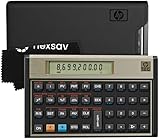
- HP 12C: INDUSTRY STANDARD SINCE 1981 – Trusted by professionals in real estate, banking, and finance for over 40 years. The HP 12C finance calculator remains the go-to tool for fast and accurate calculations in high-stakes business environments.
- 120+ FUNCTIONS FOR FINANCIAL ANALYSIS – Calculate loan amortization, bond pricing, mortgage payments, NPV, IRR, depreciation, and more with this large calculator. Built-in business and statistical functions allow you to perform complex calculations in just a few keystrokes.
- RPN ENTRY FOR FASTER WORKFLOWS – Reverse Polish Notation (RPN) allows for efficient data entry with fewer keystrokes and no formulas. This RPN calculator is perfect for a mortgage payment calculator, accounting calculator, business calculator, or real estate calculator for desktop.
- PROGRAMMABLE FOR REPEAT TASKS – The HP12C desk calculator stores custom keystroke sequences for repeated use. This large calculator supports up to 20 cash flows for IRR/NPV analysis, modeling investment scenarios, projecting returns, and automating routine calculations.
- INCLUDES CLEANING CLOTH, CASE & BATTERIES – Compact design fits easily on a desk or crowded table area. Includes a protective carrying case, cleaning cloth, and comes with pre-installed batteries so it's ready to use out of the box. A great choice for home finances, business professionals, and accountants.
Use screeners to create a shortlist
A screener is useful when you want to filter a large set of investments before researching individual candidates. Morningstar describes its screener as covering stocks, ETFs, and mutual funds. That product-page description establishes the categories it advertises, not how complete or current its coverage is for your needs, or whether its results are better than another provider’s.
Before depending on a screener, check whether it covers the market and asset types you care about, what information it uses and how often that information is updated, and whether the features you need require an account or paid access. Current Morningstar prices and feature entitlements are not established here, so confirm them on the provider’s site before subscribing.
Rank #4

- HP 10BII+ FOR STUDENTS & PROFESSIONALS – This HP calculator is built for business, finance, accounting, and statistics courses. Perfect for learners and professionals who need to solve common financial problems quickly without memorizing formulas or relying on spreadsheets.
- 100+ FUNCTIONS FOR REAL WORLD MATH – Quickly solve time value of money, interest rates, loan payments, NPV, IRR, cash flows, and more. The 10bII+ also includes probability distributions for statistics courses—a feature not often found in financial calculators.
- ALGORITHMIC INPUT WITH DEDICATED KEYS – This high-school/college calculator uses algebraic and chain logic with minimal keystrokes. Layout appears the same as standard calculators for easy learning. Dedicated keys give quick access to commonly used financial and statistical functions
- APPROVED FOR MAJOR EXAMS – The HP 10bII+ algebra calculator is permitted for use on SAT, PSAT/NMSQT, and AP tests. An ideal statistics calculator and business calculator for school finance and accounting students preparing for class, coursework, or standardized exams.
- INCLUDES TRAVEL CASE, CLEANING CLOTH & BATTERIES– Slim, durable, and easy to keep on hand or store in a backpack or locker. Includes a protective case, cleaning cloth, and batteries so it’s ready out of the box. Large screen with clear contrast (non-backlit) is easy to read during exams or lectures.
Review your portfolio for exposures and costs
Portfolio-analysis tools are meant to help you examine holdings together rather than one at a time. Morningstar describes portfolio features for performance, allocation, fees, and overlapping holdings. Those dimensions can help you ask whether a portfolio is concentrated, whether multiple holdings provide similar exposure, or what costs are represented in the analysis. The feature description is the provider’s own; it is not an independent assessment of accuracy or investment performance.
- Performance: Check what period and comparison the tool presents before interpreting a result.
- Allocation: Look at how the tool groups holdings and what that grouping reveals about exposure.
- Fees: Understand which costs are included in the display and which may not be.
- Overlap: Review whether separate funds or securities hold similar underlying investments.
These are questions to ask when assessing a portfolio tool, not claims that every provider offers the same depth of analysis. Compare the data source, update cadence, asset coverage, clarity of its results, and any access restrictions before relying on it.
The Tool Desk
Outbyte Driver Updater FREEFix the driver behind crashes, sound loss and screen glitchesFind Drivers →Outbyte PC Repair FREEClear out junk files and repair common Windows errorsFree Scan →Best Value

- PROFESSIONAL FINANCIAL CALCULATOR : Built-in TVM, IRR, NPV. Engineered for business analysts, real estate investors, accountants, and finance students.
- ADVANCED CASH FLOW & AMORTIZATION : Execute time value of money, break-even analysis, depreciation schedules, and bond pricing. Trusted for professional exam prep", MBA coursework, and banking certifications.
- CATIGA CF-300 : Flip-open hard case with a snap-close design for a secure fit. Compact and portable: designed for daily professional use in office, classroom, or on-site.
- ALL-IN-ONE FOR PROFESSIONALS : From NPV/IRR for real estate analysis to statistical calculations for business analysts. Handles probability, linear regression, and complex financial formulas.
- MORTGAGE, LOAN & INVESTMENT CALCULATOR : Covers bond pricing, loan amortization, investment analysis, and exam-level computations. Your go-to accounting calculator, business calculator, and real estate calculator in one device.
Verify professionals and guard against impersonation
A polished tool or convincing message does not prove that the person behind an investment offer is legitimate. The SEC’s 2026 Investor.gov bulletin warns that fraudsters may impersonate investment professionals or firms registered with state securities regulators, FINRA, or the SEC. It also highlights diversification as an investor consideration. Read the SEC’s Investor.gov tips for 2026, and use official investor resources to check a professional’s background rather than trusting contact details or credentials supplied by the person who approached you.
Do not treat a tool’s rating, forecast, or marketing claim as a guarantee. The available information does not establish a tool-by-tool cybersecurity comparison, so a security ranking among these services would not be justified.
When is a paid investment tool worth considering?
Consider paying only when a tool’s specific features address a recurring need that free resources do not meet. A specialist screener or portfolio-analysis service may be useful if you need the provider’s advertised screening or portfolio-review capabilities. Check the current price, what the subscription includes, any account or access restrictions, and how the provider describes its data before committing. These terms can change, and current prices and entitlements for the cited Morningstar tools are not established here.
There is no supported basis here for ranking investment-tool providers by price, market coverage, data freshness, or overall quality. Choose by task and verify the terms directly instead of treating a brand comparison as a universal “best” list.
Windows Errors? Fix Them Before They Spread
Repair common Windows errors and clear accumulated junk for a smoother, more stable PC - no reinstall needed.Free scan · no reinstallOutdated Drivers Are Slowing You Down
One free scan finds every outdated or missing driver and matches the right update for your exact hardware.Free scan · exact hardware matchQuick Recap
Product prices and availability are accurate as of the date/time indicated and are subject to change. Any price and availability information displayed on Amazon at the time of purchase will apply.




