If you’re choosing a corporate card, compare eligibility and repayment terms, employee controls, finance tools, geographic availability, and the rewards you can actually use—not just the headline earn rate. This guide covers Ramp, Brex, BILL Divvy, and American Express. The available information supports comparing these four programs, but not a defensible ranking of seven, so it does not invent three more products or call the four a ranked “best” list.
How to compare corporate card programs
A card program can affect who qualifies, how the business repays charges, what employees can buy, and how much work finance must do to reconcile spending. Use the same questions for every provider, and confirm current terms with the issuer before applying.
- Eligibility and liability: What business and financial requirements apply, who is responsible for repayment, and does approval involve a business credit check or revenue threshold?
- Fees and repayment: What fees apply, and must the balance be paid in full or can it revolve? The available provider information here does not establish comparable fees, repayment terms, or liability rules.
- Controls: Can administrators set limits for each employee, merchant, or category? Are approval workflows and real-time monitoring available?
- Finance workflow: Check how the program handles receipts, expense categorization, accounts payable, and accounting integrations. A card that reduces manual work may fit better than one with a more attractive but restrictive rewards offer.
- Geography: Confirm which countries and currencies are supported and whether cards will work where your employees travel or operate. Issuance availability and merchant acceptance are separate questions.
- Rewards: Compare eligible spending categories, payment-cadence conditions, caps, redemption options, restrictions, and any fees. Estimate the value your business can realize rather than assuming points equal cash.
Provider pages describe features and terms from the companies selling the products; they are not independent tests of comparative performance. Ramp’s own comparison of Ramp, Brex, and American Express is also vendor-authored, so treat it as product information rather than neutral ranking evidence: Ramp’s comparison.
What the four programs describe
The table summarizes the specific distinctions established in the providers’ published materials. “Not stated” means the cited material used here does not establish a comparable detail; it is not a claim that the provider lacks that feature.
#1 Best Overall

- SLIM & COMPACT DESIGN: Holds 15–25 business cards (depending on card thickness) or a small number of standard-sized cards. Lightweight and slim profile fits easily in your pocket, briefcase, or bag—ideal for everyday business carry.
- PREMIUM PU LEATHER & STAINLESS STEEL: Crafted with a high-quality PU leather exterior and a durable stainless steel interior, offering a professional appearance with enhanced protection and long-lasting use.
- SECURE MAGNETIC CLOSURE: Built-in magnetic flip closure keeps your cards securely stored while allowing quick and easy access during meetings, presentations, or networking events.
- RFID BLOCKING PROTECTION: Integrated RFID blocking technology helps reduce the risk of unwanted wireless scanning for RFID-enabled cards, providing added peace of mind during daily professional use.
- IDEAL GIFT FOR PROFESSIONALS: A practical and stylish choice for business owners, entrepreneurs, sales professionals, and corporate staff—perfect for work, networking, or professional gifting.
| Program | Controls and finance tools | Eligibility or reach | Rewards information |
|---|---|---|---|
| Ramp | Built-in spend controls, approval workflows, and real-time expense tracking. Ramp product page | Ramp says eligibility depends on the provider and that some providers require revenue thresholds or business credit checks. Specific Ramp approval criteria and supported countries are not stated on the cited page. Ramp product page | Specific earning rates, caps, and redemption terms are not stated on the cited page. Ramp product page |
| Brex | Custom limits by category and merchant, real-time expense monitoring, automated receipt collection, and categorization. Brex product page | Brex describes local-currency cards in 50+ countries; confirm availability for your entity and employees. Brex product page | Its rewards support page says points earning is uncapped and lists gift cards and travel among redemption options. Current point value and detailed redemption rules are not established here. Brex rewards page |
| BILL Divvy | Physical and virtual cards, employee-level controls, and integration with BILL Spend & Expense. BILL card page | BILL states that applicants need a registered business, a US business bank account, and an EIN. BILL card page | BILL says rewards vary with payment frequency; its examples include up to 7x points on restaurants and 5x on hotels with a weekly payment schedule. The page lists cash back, statement credit, and gift cards as redemption options. These are conditional, vendor-stated terms; confirm current rates and rules. BILL card page |
| American Express Corporate Program | American Express describes central billing, expense tools, and reward options, and lists Corporate Platinum, Gold, Green, virtual, purchasing, and meeting cards. American Express Corporate Program | The issuer describes emerging and mid-sized companies as having $4M–$300M in annual revenue and large/global businesses as having $300M+. These are issuer-described segments, not universal qualification rules. Specific approval criteria and geographic availability are not stated here. American Express Corporate Program | Reward options are described, but comparable earning rates, caps, and redemption values are not stated here. American Express Corporate Program |
Where each program may fit
Ramp: prioritize controls and expense visibility
Ramp describes a combination of spend controls, approval workflows, and real-time expense tracking. Those features are relevant if finance wants to set guardrails and see spending as it occurs. The cited product page does not establish a comparable rewards proposition or a single approval standard; ask about your business’s eligibility, repayment arrangement, fees, and any rewards before treating it as a fit. Ramp corporate card
Brex: consider distributed teams and automated expense capture
Brex describes merchant- and category-level limits, real-time monitoring, receipt collection, and categorization. Its stated local-currency card availability in 50+ countries makes it worth evaluating for internationally distributed teams, subject to confirmation for the countries and entities involved. Brex says points earning is uncapped and identifies travel and gift cards as redemption options, but an uncapped point balance does not establish the cash value of those points. Review current redemption rules and restrictions before comparing rewards. Brex corporate card · Brex rewards terms
Rank #2

- Material: Genuine leather and PVC card slots.
- Size: 4.72"*3.15"*0.7" (12*8*1.8 CM)
- Large Capacity: The card holder has 26 cards slots. It is enough room for your ID card, credit cards, gift cards and dicounted cards. Small size is perfect to fit in your pockets or handbags.
- RFID Blocking: RFID Blocking designed lining keeps your vital information Secure. Be safe and protected from Electronic Pick pocketing.
- Great Gift Idea: Great gift for mother, daughter, grandmother and so on.
BILL Divvy: assess the repayment schedule alongside rewards
BILL’s Divvy Card combines employee-level controls and physical or virtual cards with BILL Spend & Expense. BILL’s published eligibility requirements include a registered business, a US business bank account, and an EIN. Its examples of up to 7x restaurant points and 5x hotel points are tied to a weekly payment schedule, so they should not be read as unconditional rates. Compare the schedule you would actually use, the full rewards rules, and repayment obligations before estimating value. BILL Divvy Card
BILL also displays customer outcome figures on its product page. It says surveys of 1,200+ BILL Spend & Expense customers from Aug. 26–Sep. 26, 2025, found “$6.7K+ saved per month by customers” and “$54K+ earned in rewards per month”; it says a survey of 953 BILL users, verified Apr. 17, 2026, found 16+ hours saved per month. BILL cautions that results may vary. These are vendor-reported survey figures, not independent market averages or a forecast for an individual business. BILL card page
Quick wins for a faster PC:
Clear out junk files and repair common Windows errorsFree Scan →Scan for outdated or missing drivers - takes under a minuteDriver Scan →Repair Windows errors before they cause bigger problemsFix Now →Rank #3

- 2-sided business card holder, fits maximum card size: 3.6"x2" (91x53mm). Approximately Holds up to 20 business cards
- Holder is made of premium and durable PU leather
- Two pocket and magnetic shut holder design, ensure the cards stay within the case will be completely protective
- MULTI-FUNCTIONAL DESIGN: Perfectly sized for business cards, ID cards, and metro passes. Also fits credit cards (Recommended for EMV Chip / Tap-to-Pay cards due to magnetic closure).
- 1pc high quality PU leather business name card holder
American Express: compare the corporate card types and program structure
American Express lists several options—including Corporate Platinum, Gold, and Green cards, plus virtual, purchasing, and meeting cards—and describes central billing, expense tools, and reward options. That menu makes it important to compare the specific card and program proposed for your company rather than assuming every option has the same features or terms. The revenue bands on its page describe customer segments, not automatic eligibility thresholds. American Express Corporate Program
How to choose without overvaluing rewards
- Screen for eligibility and repayment first. Ask what financial or business checks apply, who bears liability, whether the account must be paid in full, and what fees can apply. A card that your company cannot qualify for—or whose repayment terms do not suit its cash flow—is not a practical choice, regardless of rewards.
- Map controls to actual purchasing risks. Identify which employees need cards and whether limits should be set by person, merchant, or category. Check whether managers can approve requests and how quickly finance can see transactions.
- Trace a purchase through reconciliation. Ask how receipts are collected, how expenses are categorized, and whether the required accounting or AP systems connect. Confirm which steps are automatic and which still require employee or finance action.
- Validate where the cards will be used. Confirm issuance for the company’s location, employee eligibility, currency support, and practical acceptance in the countries where staff spend.
- Calculate realizable rewards. Use your expected eligible spending, required payment cadence, category mix, caps, redemption choices, and restrictions. Then subtract fees and account for the value of any repayment or workflow conditions. Do not assign a cash value to points unless the provider’s current terms support it.
- Get current terms in writing. Product pages can change. Confirm the offer, eligibility, fees, repayment, rewards, and geographic availability directly with the issuer before making a decision.
What this comparison can—and cannot—establish
The four providers describe different combinations of controls, expense tooling, reach, and rewards, but the cited materials do not supply a consistent set of fees, liability terms, approval criteria, or reward values for a like-for-like ranking. The most defensible choice is therefore the program that meets your eligibility and repayment needs, controls the spending risks you actually have, and fits your finance workflow—after you verify its current terms.
Quick Recap
Best Value

- GENUINE LEATHER CARD HOLDER WALLET: Crafted from genuine leather with durable stitching and a classic slim profile, this men’s card holder wallet combines professional style with practical everyday organization.
- LARGE CAPACITY – HOLDS UP TO 25 CARDS: Designed for customers who need extra storage, this large capacity wallet holds approximately 25 credit cards or up to 50 business cards, making it ideal as a credit card wallet, business card holder, or everyday organizer.
- RFID BLOCKING PROTECTION: Features built-in RFID-blocking material designed to help protect compatible contactless credit and debit cards from unauthorized RFID scanning, providing added protection for everyday carry and travel.
- EXPANDABLE POCKET + DUAL COMPARTMENTS: Features 2 interior storage compartments—one expandable gusseted pocket that opens wider as needed and one flat compartment. Conveniently organize credit cards, business cards, folded cash, receipts, and other small essentials.
- COMPACT SIZE THAT EXPANDS: Measures approximately 4" x 2.75" x 0.5" when closed and expands up to approximately 1" thick, providing substantial storage capacity while maintaining a compact, pocket-friendly design.
Rank #4
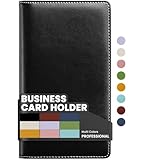
- Large capacity business card storage: This book-style business card organizer can hold up to 240 business cards, two cards back-to-back in each pouch. It is very compact & professional. Enough capacity for your different cards: business cards, credit card, social security, gift cards, insurance cards, name cards, personal IDs, mini photos, and more
- Sturdy & Long-lasting card book: Name card holder is made from high-quality pu leather cover and PVC pocket sheets. Long-lasting and sturdy
- Easy to find & read: Card holder book transparent slots are good for reading and finding information on the business card
- Compact size business card folder: The slim profile and lightweight design make carrying a breeze – Carry it in your hand, pocket or handbag when on the go. Dimension: 7.7"x 4.5" x 0.7"
Product prices and availability are accurate as of the date/time indicated and are subject to change. Any price and availability information displayed on Amazon at the time of purchase will apply.




