Free tools Windows power users keep installed
One-click scans. No signup required.
Improving global food security takes more than producing more food. People also need the purchasing power and access to obtain nutritious diets, while food systems must withstand shocks and get food from farms to consumers with less loss. Five complementary policy approaches address these challenges; the right mix depends on local needs and capacity.
1. Protect purchasing power and access to nutritious diets
Food can be available in markets yet remain out of reach for households that cannot afford it. In The State of Food Security and Nutrition in the World 2025, FAO, IFAD, UNICEF, WFP and WHO report that persistent food-price inflation has undermined purchasing power and access to healthy diets, particularly for low-income populations.
Pair household protection with sound policy
Measures to protect vulnerable households can help them maintain access to food when prices rise. They work within a broader economic setting: fiscal and monetary policy, as well as resilient trade, also matter. No single instrument fits every country or inflation episode; choices need to reflect local price dynamics, public resources and the people facing the greatest barriers.
2. Invest in resilient agrifood systems and useful data
Food security depends on whether public institutions and food systems can adapt as needs and conditions change. The 2025 FAO-led report calls for better data systems and sustained investment in resilient agrifood systems.
#1 Best Overall
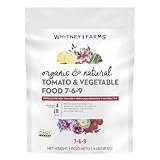
- READY TO USE ORGANIC PLANT FOOD: Easy-to-apply fertilizer features all-in-one particle for even coverage with little dust; just sprinkle granules on the soil around your plants (follow rates on label), mix into the soil, and water to activate
- FOR IN-GROUND AND CONTAINER GARDENS: This organic tomato fertilizer feeds your whole vegetable garden, whether you're planting in-ground, in raised beds, or in containers; it's also OMRI listed for organic use
- PROTEIN-BASED NPK FERTILIZER: 7-6-9 NPK vegetable plant food features protein-based nutrients that provide feeding with no manure odor
- ORGANIC FERTILIZER FOR VEGETABLES & FRUITS: Whitney Farms Organic & Natural Tomato & Vegetable Food is a source of key nutrients for bountiful harvests of your favorite vegetables and fruits
- SLOW-RELEASE NUTRIENTS PLANT FOOD FOR SUSTAINED GROWTH: Reapply Whitney Farms Organic & Natural Tomato & Vegetable Food slow-release fertilizer every 6 weeks throughout the growing season to replenish nutrients and help plants thrive
Make information and capacity part of long-term planning
Reliable, relevant data can help decision-makers identify changing needs and respond to shocks. Investment in system resilience builds capacity over time rather than addressing only an immediate shortage. The useful combination will depend on what information is missing, which groups are underserved and where the system is most exposed to disruption.
3. Strengthen smallholder research, extension and farming services
Smallholders and women farmers need services that respond to their circumstances, rather than a uniform prescription. The Committee on World Food Security’s Global Strategic Framework recommends support tailored to these farmers’ needs.
Rank #2

- READY TO USE: Easy-to-apply flower and vegetable fertilizer features all-in-one particle for even coverage with little dust; just sprinkle granules on the soil around your plants (follow rates on label), mix into the garden soil, and water to activate
- ORGANIC NUTRIENTS FOR HEALTHY PLANTS: Whitney Farms Organic & Natural All Purpose Plant Food is an organic plant fertilizer that provides key nutrients to plants to promote vigorous growth and abundant blooms and harvests
- PROTEIN-BASED NUTRIENTS: 9-2-6 NPK fertilizer provides feeding without a manure odor; plant food rich with potassium, in addition to nitrogen derived from feather meal, blood meal, soybean meal, and bone meal
- FOR ALL TYPES OF GARDENS: OMRI listed for organic use; perfect for outdoor gardens, in-ground, raised bed, and container plants, and all types of plants including vegetables, herbs, fruits, and flowers
- LONG-LASTING FEEDING: Reapply our slow-release fertilizer every 6 weeks throughout the growing season to replenish nutrients and help plants thrive
Connect farmer knowledge with research and practical support
Appropriate research, extension and farming services can help increase productivity, diversify production, improve the nutritional value of what is produced and build resilience, including to climate change. The framework also advises combining farmer knowledge with scientific research where appropriate. This is a case for responsive support, not a blanket endorsement of any particular crop, product or input.
4. Reduce food loss at the stage where it happens
Food can be lost before it reaches a shop, or wasted later at retail, in food service or in households. These are different stages, so an effective response should target the point at which food is being lost or wasted.
Rank #3

- FEEDS UP TO 3 MONTHS: Miracle-Gro Shake 'N Feed Tomato, Fruit & Vegetable Plant Food is a plant fertilizer that feeds plants for up to 3 months, and nourishes above and below the soil
- FORMULATED WITH CALCIUM: This plant food for vegetables contains calcium to help form stronger cell walls, producing better quality and longer-lasting fruits and vegetables
- WHERE TO USE: For use with vegetable, fruit, and tomato plants, whether in-ground or indoor or outdoor container plants
- HOW TO APPLY: Apply this garden product evenly onto the soil and work into the top 1-3 inches of soil for in-ground plants, or lightly work into the soil of established container plants; water to start feeding
- COVERAGE: One 4.5 lb. container of Miracle-Gro Shake 'N Feed Tomato, Fruit & Vegetable Plant Food feeds up to 128 sq. ft.; reapply every 3 months and water regularly for a beautiful garden all season long
Improve handling before retail
The Food and Agriculture Organization of the United Nations (FAO) reports on its food-loss guidance page that 13.2 percent of food is lost in the supply chain after harvest and before retail. The page, accessed in 2026, does not identify the estimate’s original publication year. FAO says reducing these losses can improve food availability and access and support smallholder incomes. Better production, harvesting, handling and distribution can each be relevant, depending on where losses occur.
Address waste at retail, food service and household levels
FAO separately cites UNEP’s 2024 statistics that 19 percent of food is wasted at retail, food-service and household levels. That figure concerns later stages, not the post-harvest, pre-retail loss measured by the 13.2 percent figure. Keeping the categories separate helps direct action toward the right part of the food chain.
Rank #4

- CLASSIC GARDEN RATIO – 5-10-10 pairs moderate nitrogen with doubled phosphorus and potassium; each 5 lb bag delivers 0.25 lbs actual N, 0.5 lbs actual P2O5, and 0.5 lbs actual K2O (1.25 lbs total nutrients).
- ROOTS & BLOOMS OVER LEAVES – Lower nitrogen keeps plants from going all-leaf while higher P & K drives deep roots, abundant flowering, and well-developed fruit, the time-tested formula for tomatoes and fruiting vegetables.
- PERFECT FOR ROOT CROPS & BULBS – The low-N ratio favors carrots, potatoes, beets, onions, and flowering bulbs, and is ideal for fall feeding that builds root reserves without forcing tender growth.
- ONE FORMULA, WHOLE GARDEN – A reliable multi-use solution for vegetable gardens, flower beds, and perennials; forgiving enough for beginners, consistent enough for experienced growers.
- EASY GRANULAR APPLICATION – Apply 2–3 lbs per 100 sq ft in garden rows or 20–25 lbs per 1,000 sq ft broadcast; one 5 lb bag covers 200–250 sq ft; low burn risk at recommended rates when watered in.
5. Build climate resilience into food and agriculture policy
Climate extremes threaten livelihoods, food security and access to healthy diets, according to FAO. Resilience therefore belongs in food and agriculture policy, not only in emergency response.
Plan for local exposure and needs
Resilient farming and inclusive agrifood-system planning can help communities prepare for climate-related shocks. The appropriate measures depend on local conditions, the people and livelihoods at risk, and the capacity of existing institutions. A policy that is useful in one place should not be assumed to suit another.
What’s actually slowing this PC down?
Pick the symptom - the matching free tool is one click away.
Best Value

- 🌺 MUST HAVE: When looking for the very best in natural gardening
- 🌺 NATURAL: Source of carbohydrates and vitamins that stimulates microbial growth in soil
- 🌺 DO IT RIGHT: Renewable resource that YOU can put back into Mother Nature
- 🌺 WHAT YOU GET: Clear package of 2 pounds of clean dry molasses with label
- 🌺 WE MAKE IT RIGHT: Not only can you rest assured that all of our products are covered by Amazon’s Return Policy, on the Farm, we will always stand by our products
How should decision-makers choose among these approaches?
The five approaches are complementary, not a universal ranking. To assess which mix fits a particular country or community, decision-makers can ask:
- Which food-security need is most urgent: availability, affordability and access, nutrition, or resilience?
- Which population and geography would the intervention serve, and who currently faces barriers?
- What local shocks pose the greatest risk?
- What implementation capacity and financing would be needed?
- Which outcomes should be measured, and over what timescale?
Those questions help connect policy choices to the conditions they are meant to change. The central test is whether people can reliably obtain nutritious food, and whether the systems that support that access can keep functioning when conditions change.
Quick Recap
Product prices and availability are accurate as of the date/time indicated and are subject to change. Any price and availability information displayed on Amazon at the time of purchase will apply.




