For U.S. federal income taxes, where you report cost of goods sold (COGS) depends on the return your business files. A sole proprietor generally calculates it on Schedule C; certain corporations and partnerships that claim a COGS deduction attach Form 1125-A. In either case, COGS generally starts with beginning inventory plus qualifying costs and subtracts ending inventory—but the form, line numbers, and inventory rules differ. The line references below are for the 2025 Schedule C guidance and the November 2024 revision of Form 1125-A; check the form and instructions for your filing year.
Choose the reporting route for your federal return
| Business filing route | Where COGS is calculated | Where the result goes |
|---|---|---|
| Sole proprietor filing Schedule C | Schedule C lines 35–42, as described in IRS Publication 334 (2025) | Schedule C line 4, using the line 42 result |
| Filers of Forms 1120, 1120-C, 1120-F, 1120-S, 1065, or 1065-B claiming a COGS deduction | Attach Form 1125-A; its line 8 calculates COGS | The appropriate line on the business return; see the current return instructions |
The IRS lists the returns that require Form 1125-A when the filer reports a COGS deduction on its About Form 1125-A page. Confirm that list and the applicable form revision for your filing year. These are federal reporting routes, not instructions for state or local returns.
Calculate COGS on Schedule C
For the 2025 Schedule C layout described in IRS Publication 334, complete lines 35 through 42. The calculation begins with inventory at the start of the year, adds the listed costs, then subtracts inventory remaining at year-end.
- Line 35 — Beginning inventory. Enter the value of inventory at the start of the tax year.
- Line 36 — Purchases. Enter purchases, less items withdrawn for personal use.
- Line 37 — Cost of labor. Include qualifying labor costs, not amounts you paid yourself.
- Line 38 — Materials and supplies. Enter the applicable materials and supplies costs.
- Line 39 — Other costs. Enter other costs included under the form’s instructions.
- Line 40 — Total. Add lines 35 through 39.
- Line 41 — Ending inventory. Enter the value of inventory at the end of the tax year.
- Line 42 — COGS. Subtract line 41 from line 40, then carry the result to Schedule C line 4.
Use the applicable tax-year Schedule C and instructions rather than assuming line numbers stay the same. IRS Publication 334 (2025) explains the Schedule C calculation and its inventory context.
PC Slower Than It Used to Be?
A free scan shows the junk files, broken settings and background clutter dragging Windows down - then fixes them in one click.Free scan · Windows 10 & 11Crashes, No Sound, or Screen Glitches?
Random freezes, missing sound and display glitches usually trace back to one bad driver. Find and replace yours safely.Free scan · under a minute#1 Best Overall

- Easy To Track Your Finances: HAUTOCO accounting ledger book keeps you on top of your expenses and income! Help you keep your money organized, spend well, and set and achieve financial goals
- Premium Material: The A5 accounting ledger book has a total of 120 pages and 2040 lines of entries. It is made of 100gsm thick paper to reduce ink leakage; it is equipped with a waterproof and sturdy PP cover to protect the inner pages
- Practical Design: Compact 8.3 x 6.2'' expense tracker notebook is easy to carry and features information pages, 2025 calendar, yearly financial goals page, and PVC pocket for storing important tickets and loose items
- Manage Your Finances Effectively: Undated accounting books with number, date, description, account, payment or deposit amount, and total balance. You will be able to easily analyze your financial activities and quickly prepare accurate financial statements
- Ideal For Small Business or Personal Use: An accounting log journal can track your business or personal financial status. With a clear record of transactions, you can find unnecessary expenses or fraudulent charges
Calculate COGS on Form 1125-A
For the November 2024 revision of Form 1125-A, enter beginning inventory on line 1 and report the applicable costs on lines 2 through 6. Line 7 is ending inventory. Line 8 subtracts line 7 from line 6; enter the result on the appropriate line of the return. Form 1125-A includes purchases, labor, additional section 263A costs, and other costs in its calculation, so do not copy Schedule C line entries mechanically.
Attach Form 1125-A when required for the return you file and claim a COGS deduction. Check the current Form 1125-A and the instructions for your business return before filing; form revisions and filing requirements can change.
Rank #2

- PERFECT FOR RECORD KEEPING: The 2 Pack account ledger books are versatile and can be used to track finances, budgets, expenses, and other business or personal records. They are perfect for individuals, or small business owners who need a reliable and efficient way to keep track of their finances. With 100 pages, customers can record transactions over an extended period, making it a handy tool for bill planner, weekly budget planner, monthly budget planner.
- COMPACT AND LIGHTWEIGHT: The Budget Planner is compact and lightweight with each book weighing 7 ounces and measuring 8.5 x 6.25 inch, making them easy to carry around. You can take the budget notebook in a bag or briefcase, making them ideal for on-the-go use. This feature ensures that you can access your records at any time, whether you are at work or on the move.
- PREMIUM QUALITY: Elegant style with the words ''Account Tracker'' embossed in fancy Gold Foils. Water-proof and scratch resistant hard cover. Coil ring binding is a practical design feature that enhances the functionality of the account ledger books. It allows pages to turn smoothly and easily, making it effortless to flip through the book while keeping pages in place. The ring binding also ensures that pages won't fall out, preventing the loss of vital information.
- DURABLE WATER-PROOF COVER WITH GOLD FOIL LETTERS: The words ''Account Tracker'' embossed in shiny Gold Foil letters gives it a professional and fancy look that can fit in any setting. Additionally, the durable cover is scratch resistant, It provides a durable layer of protection that can withstand daily wear and tear, making it suitable for long-term use.
Check whether inventory rules apply to your business
Inventory rules are relevant to manufacturers, wholesalers, retailers, and other businesses that make, buy, or sell goods to produce income. A personal-service business—such as a doctor, lawyer, carpenter, or painter—ordinarily is not covered by the inventory chapter in Publication 334 unless it also sells or charges for materials and supplies normally used in its work. Some qualifying small-business taxpayers may also use different inventory treatments. Whether an exception applies depends on the taxpayer and the applicable tax-year rules.
The 2025 Schedule C instructions define a small-business taxpayer, for the treatment discussed there, as one with average annual gross receipts of $31 million or less for the three prior tax years, indexed for inflation, and that is not a tax shelter. This is a tax-year-specific eligibility threshold, not a general COGS limit or a permanent amount. Review the 2025 Instructions for Schedule C and Publication 334 to determine whether the rules fit your situation.
Quick wins for a faster PC:
Repair Windows errors before they cause bigger problemsFix Now →Fix the driver behind crashes, sound loss and screen glitchesFind Drivers →Rank #3

- EASY TO USE - Use this accounting ledger book to track your payments, deposits, balances, and develop good bookkeeping habits to meet your financial goals.
- ACCOUNT TRACKER - Use a colorful ledger book to record every expense you make no matter what day it starts. The accounting book is plenty of space to record each transaction you make, and state its number, date, description, account, payment or deposit amount, and total balance
- MANAGE YOUR FINANCES & SUCCEED - Use this account tracker notebook, You will be able to easily analyze your financial activities and quickly prepare accurate financial statements. Use your records to regularly assess your spending and income and find any unnecessary expenses you can cut to improve your financial performance.
- HIGH QUALITY - The expense tracker is size of 5.8" x 8.3", is used to high quality 100gsm pure white paper, brown elastic band and a back pocket for extra space.
- PERFECT FOR - Use monthly account log book for your personal or business finances, improve your productivity with this financial organizer.
Review valuation and accounting-method issues
Inventory valuation and the accounting method used to track inventory can affect reported COGS. Form 1125-A asks about inventory valuation methods, LIFO, section 263A, and changes in how inventory quantities, costs, or valuations are determined; it calls for an explanation of changes. The 2025 Schedule C instructions also discuss inventory methods for small-business taxpayers and say to file Form 3115 to change an inventory accounting method.
- Do not assume a small-business exception applies without checking its eligibility rules.
- Do not change inventory methods or valuations casually; the proper treatment depends on your facts and filing history.
- If you are considering a method change or are unsure how section 263A, LIFO, or inventory valuation applies, consult a tax professional familiar with inventory accounting.
The forms and publications cited here explain federal reporting, but they do not determine which costs are deductible or which accounting method is right for a particular taxpayer.
Quick Recap
Best Value

- EASY TO MANAGE - Use this accounting ledger book to track your payments, deposits, and balances, and develop good bookkeeping habits to meet your financial goals.
- UNDATED ACCOUNT TRACK - Use a ledger book to record every expense you make no matter what day it starts. The accounting book is plenty of space to record each transaction you make, and state its number, date, description, account, payment or deposit amount, and total balance.
- HIGH QUALITY - The A5 expense tracker notebook is used to high quality 100gsm pure white paper, brown elastic band and a back pocket for extra space. A total of 64 sheets(128 pages), it comes with 3480 entry lines (29 lines per page, 60sheets/120pages), 1 page Year Overview, 7 lined notes pages.
- MANAGE YOUR FINANCES & SUCCEED - Use this business expense tracker notebook, You will be able to easily analyze your financial activities and quickly prepare accurate financial statements. Use your records to regularly assess your spending and income and find any unnecessary expenses you can cut to improve your financial performance.
- THE PERFECT GIFT - Use account ledger book for your personal or business finances, give it to your friends, colleagues as a gift for Birthday| Easter|Children's Day|Halloween|Thanksgiving|Christmas|Back to school and New Year's Day.
Rank #4
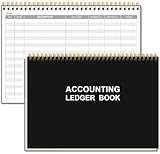
- EASY TO MANAGE - Use this accounting ledger book to track your payments, deposits, and balances, and develop good bookkeeping habits to meet your financial goals.
- UNDATED ACCOUNT TRACK - Use a ledger book to record every expense you make no matter what day it starts. The accounting book is plenty of space to record each transaction you make, and state its number, date, description, account, payment or deposit amount, and total balance.
- MANAGE YOUR FINANCES & SUCCEED - Use this business expense tracker notebook, You will be able to easily analyze your financial activities and quickly prepare accurate financial statements. Use your records to regularly assess your spending and income and find any unnecessary expenses you can cut to improve your financial performance.
- HIGH QUALITY - The A5 expense tracker notebook is used to high quality 100gsm pure white paper, pink elastic band and a back pocket for extra space. A total of 64 sheets(128 pages), it comes with 3480 entry lines (29 lines per page, 60sheets/120pages), 1 page Year Overview, 7 lined notes pages. The accounting book is plenty of space to record each transaction you make, and state its number, date, description, account, payment or deposit amount, and total balance.
- THE PERFECT GIFT - Use account ledger book for your personal or business finances, give it to your friends, colleagues as a gift for Birthday| Easter|Children's Day|Halloween|Thanksgiving|Christmas|Back to school and New Year's Day.
Before you file
- Identify the business entity and the federal return it files.
- Use the form and instructions for the tax year being reported.
- Reconcile beginning inventory, qualifying costs, and ending inventory using the applicable form’s line structure.
- Check whether Form 1125-A is required or whether your business qualifies for a different inventory treatment.
- Review any inventory valuation or accounting-method change and provide explanations required by the form.
Product prices and availability are accurate as of the date/time indicated and are subject to change. Any price and availability information displayed on Amazon at the time of purchase will apply.




