Free tools Windows power users keep installed
One-click scans. No signup required.
For a qualifying export of services, issue an invoice with the prescribed particulars and export endorsement, use the applicable zero-rating route, report the invoice, and keep the contract, delivery, payment and filing evidence together. A customer’s overseas location alone does not make a supply an export: first check the statutory export tests and any service-specific place-of-supply rule.
First, confirm the service qualifies as an export
Under section 2(6) of the IGST Act, a service is an export only when all the statutory conditions are met:
- The supplier is located in India.
- The recipient is located outside India.
- The place of supply is outside India.
- Payment is received in convertible foreign exchange or in Indian rupees where permitted by the Reserve Bank of India.
- The supplier and recipient are not merely establishments of the same person.
The place-of-supply rule can vary by service type, so identify the service and the actual arrangement before selecting export treatment. CBIC’s sectoral FAQs discuss payment and IT-service tests, but the current Act and applicable service-specific provisions govern. Get service-specific advice if the recipient’s location, an intermediary or agency role, related establishments, place of supply, or payment channel is unclear.
What to put on the export invoice
CBIC’s Rule 46 invoice particulars include the following information for a tax invoice:
Recommended Free Tools
#1 Best Overall

- Two-Part Carbonless Invoice Book: Each invoice book has 50 sets of invoices, each with a white/light yellow section, with the yellow section retained in the invoice book to maintain detailed records.
- Consecutively Numbered: Enlarged red 6-digit numbers in the upper right corner of each invoice receipt book help you quickly navigate through your orders.
- Wraparound Divider Flap: A thick folded cardboard divider is integrated into the back of each invoice book for use between each two-part sales order to prevent the written content from rubbing off on subsequent copies of the invoice, resulting in wasted invoices.
- 2 Packs/50 Sets (100 Sets Total): Each invoice book provides 50 sequentially numbered carbonless sets of 2 invoice books for long-term use.
- Customizable Space: Each invoice book for small business has space at the top to add a company seal or sticker.
- Supplier’s name, address and GSTIN.
- A consecutive invoice number unique for the financial year, and the issue date.
- Recipient details, including the applicable address particulars.
- Service Accounting Code (SAC) and a clear description of the service.
- Total and taxable value, applicable tax rate and tax amount.
- Place-of-supply particulars where required, reverse-charge status, and the supplier’s or authorized representative’s signature or digital signature.
For an export, use the endorsement that matches the route chosen:
- “SUPPLY MEANT FOR EXPORT ON PAYMENT OF IGST”; or
- “SUPPLY MEANT FOR EXPORT UNDER BOND OR LETTER OF UNDERTAKING WITHOUT PAYMENT OF IGST”.
Include the recipient, delivery-address and destination-country particulars applicable to the transaction. The CBIC Rule 46 page also lists an application-for-removal detail in its export proviso; that detail is framed around goods and may not be meaningful for a service invoice. Check the current rule and invoice schema for your case rather than copying a goods-only field without considering its applicability.
Rank #2

- QUALITY INVOICES: Adams Order books provide a professional invoice or customer receipt; a great way to create and maintain a professional image for small businesses and service providers
- 50 TWO-PART CARBONLESS FORMS: Customers get the perforated white top copy; retain the canary and pink copies for your records
- WRAP-AROUND COVER: Fold the back cover between sets to keep invoices neat and legible
- ROOM FOR CUSTOMIZATION: A blank space at top leaves room for your company stamp; a big savings over custom-printed forms
- CONSECUTIVELY NUMBERED: Large 6-digit numbers in the upper right hand corner help you thumb through orders quickly
Invoice timing
The general deadline for a taxable service invoice is within 30 days of the supply. The cited rule provides a general 45-day period for insurers, banking companies and financial institutions, including non-banking financial companies; there are also accommodations for certain notified suppliers dealing with distinct persons. Continuous-service contracts have additional rules tied to due dates or specified events. Apply the rule that fits the supplier and contract rather than assuming the general deadline covers every case.
Choose a zero-rating route
CBIC describes two broad routes for exports, which are zero-rated supplies: pay IGST and claim a refund of the tax paid, or export without payment of IGST under a bond or Letter of Undertaking (LUT) and seek a refund of eligible input tax credit (ITC). The GST Portal GSTR-1 guide also summarizes these routes. Eligibility, refund calculations, restrictions and filing procedures depend on current rules and the exporter’s circumstances.
Rank #3

- 【Package Included】You will get 2 Job Invoice Forms 50sets/book,100sets in total. Each receipt book is divided into 2 parts,white,yellow.
- 【Material】Our work order forms are made of paper, not easy to tear, large quantity can meet long time uses.
- 【2-Part Carbonless Receipts】Give the white original copy to the customer for their records; you keep the yellow carbonless copy as a record.
- 【Designed for the Service and Repair Industry】The order form has dedicated sections for filling in labor costs, material costs, and various miscellaneous expenses.
- 【Wraparound Back Cover】The back cover can be folded between each set of receipts ,which can keep the receipts neat and clear.
| Route | Broad treatment | Points to weigh |
|---|---|---|
| Pay IGST | Pay IGST on the export and claim a refund of the tax paid. | Consider the cash-flow effect, refund process, eligibility and current procedural conditions. |
| Bond or LUT without payment | Export without paying IGST under bond or LUT and seek a refund of eligible ITC. | Consider eligibility, the ability to meet payment-receipt conditions, the required endorsement and supporting evidence, and current refund restrictions. |
An LUT or bond is a procedural undertaking; it does not by itself establish that a supply meets the statutory export definition. The CBIC Rule 96A text requires a bond or LUT in FORM GST RFD-11 before export for the without-payment route. The cited rules PDF is dated 2020, so confirm later amendments and permitted RBI payment forms before relying on its details. That text says that if payment for exported services is not received within one year from the invoice date, or within an extension allowed by the Commissioner, the supplier must pay the tax due with applicable interest within the period specified in the rule.
Report invoices and reconcile the evidence
The GST Portal’s GSTR-1 user guide explains that an export invoice may be reported without a shipping-bill number and date when those details are not yet available. If they arrive after filing, the guide allows them to be declared in a later period through the GSTR-1 amendment section. This reporting facility does not replace the need to retain the invoice, contract, payment evidence, return record and relevant export or refund support together. Portal labels and filing guidance can change.
Rank #4
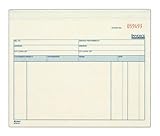
- 3-part carbonless (white, canary, pink paper sequence)
- Space at top for company stamp
- Consecutively numbered within each book
- 50 sets per package - 7.44 x 8.5 inches
- Made in the USA
Keep a practical record trail
The CGST Accounts and Records Rules require a true and correct account of exported services and relevant documents. Listed document categories include invoices, bills of supply, delivery challans, credit and debit notes, receipt, payment and refund vouchers, and e-way bills where relevant. The rules also address separate accounts by activity, advances and their adjustments, and records of tax payable or paid and ITC claimed. They permit electronic records authenticated by digital signature under the stated rule.
To connect the export test, invoice and filings, keep an organized set of records such as:
Best Value

- Extra Custom Space: Personalize with 40 characters for your business name and 60 per address line. Avoid text cut-offs on custom invoice books tailored for professional quotes, purchase orders, invoices, work orders repair orders and receipts
- Sequential Numbering: Includes 2 books with 50 duplicate sets each (100 total NCR sets). Sequentially numbered pages ensure organized record-keeping for retail shops, contractors, and daily business
- Perforated Carbonless Paper: Get clean, smudge-free duplicate copies without messy carbon sheets. Standard 5.5x8.5 books tear cleanly at the perforation to a 5.5x8 customer receipt
- Wrap-Around Divider Cover: Built-in heavy wrap-around shield slips between the white and yellow paper sets. Safely prevents ink or text transfer to the next carbonless forms below
- Built For Trade Professionals: Low minimum orders suitable for small entrepreneurs. Receipt book with carbon copies for HVAC, plumbing, mobile mechanics, landscaping, and electrical work
- Signed contract, statement of work, purchase order and amendments.
- Evidence of the service delivered and the period or event it relates to.
- Sequential invoice and any credit or debit note, linked to the agreement.
- Accounting entries, advances and payment-adjustment records.
- Bank, remittance and foreign-exchange or permitted-rupee receipt evidence.
- GSTR-1 export reporting and any later amendments.
- LUT or bond and refund records if you use that route.
- Correspondence or other material that explains the recipient, service, place-of-supply and payment treatment.
This is a practical recordkeeping checklist, not a separately prescribed document schedule. Its purpose is to make it possible to trace what was supplied, to whom, how it was invoiced, how consideration was received, and how the transaction was reported.
How long to retain GST records
Section 36 of the CGST Act states a retention period of 72 months from the due date for furnishing the annual return for the year to which the accounts and records relate. This is not a period counted from the invoice date. If an appeal, revision or other proceeding is pending, the text provides for retention until one year after final disposal or the ordinary retention period, whichever is later.
The cited CBIC Act page is legacy-hosted text with a 2017 publication context. Check the currently amended provision and any case-specific retention hold before calculating a destruction date.
Check whether e-invoicing applies
The Invoice Registration Portal describes e-invoice fields, including the QR code embedding the Invoice Reference Number (IRN), in its e-invoice guidance. Whether a particular exporter must use e-invoicing depends on the applicable current threshold notification, turnover history and exemptions. The portal guidance alone does not settle every taxpayer’s eligibility; check the notification that applies to your business. Digital records are permitted under the accounts rules, but accounting software does not determine export status or replace filing and retention duties.
Windows Errors? Fix Them Before They Spread
Repair common Windows errors and clear accumulated junk for a smoother, more stable PC - no reinstall needed.Free scan · no reinstallOutdated Drivers Are Slowing You Down
One free scan finds every outdated or missing driver and matches the right update for your exact hardware.Free scan · exact hardware matchQuick Recap
Product prices and availability are accurate as of the date/time indicated and are subject to change. Any price and availability information displayed on Amazon at the time of purchase will apply.




