A weaker rupee makes a fixed U.S.-dollar price cost more in rupees: multiply the USD price by the applicable INR-per-USD exchange rate. If your dollar purchase cost more rupees this time, the exchange rate may have moved, but the card issuer’s markup, tax on that fee and the rate used at settlement can also affect the final debit.
How the exchange rate changes your purchase cost
The exchange rate tells you how many rupees are needed to buy one U.S. dollar. When that INR-per-USD figure rises, a purchase with an unchanged USD price costs more rupees before fees.
For example, as arithmetic only, a USD 100 purchase converts to ₹9,000 at ₹90 per dollar and ₹9,500 at ₹95 per dollar. The ₹500 difference comes from the exchange-rate change alone; it is not a historical rate comparison or a full card-bill estimate.
Why the final card debit can differ from a headline rate
A quoted or reference exchange rate is not necessarily the rate applied to your transaction. With a card, the network may convert the purchase when it is settled, after the merchant initially authorizes it. The rupee amount shown at authorization can therefore be an estimate, and the final amount can differ if the applicable rate changes before settlement. Check your issuer’s current terms and the transaction details on your statement.
#1 Best Overall
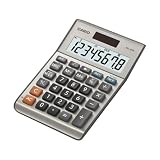
- LARGE EIGHT-DIGIT DISPLAY – Clear and easy-to-read 8-digit display, perfect for everyday calculations and ensuring accurate results in home or office settings.
- TAX & CURRENCY EXCHANGE FUNCTIONS – Effortlessly handle tax calculations and convert home currency to other currencies for easy financial management.
- GENERAL PURPOSE CALCULATOR – Ideal for a wide range of applications, from basic math to business and personal use, with memory keys for quick storage and recall.
- USER-FRIENDLY KEYBOARD – Easy-to-use layout, featuring square root, percent calculation, and simple functions that make it perfect for everyday tasks.
- COMPACT & PORTABLE DESIGN – Space-saving design that fits easily on any desk or in a briefcase, making it ideal for both home and office use.
Issuer markup and tax on the fee
Your card issuer may add a foreign-currency markup to the converted amount. ICICI Bank’s published example states that its rate is based on the network conversion rate at settlement plus a 3.5% markup, with GST on the markup. That is ICICI’s stated pricing example, not a standard rate for every bank or card. GST in this example applies to the fee, not to the USD purchase value itself. See ICICI Bank’s foreign-currency markup terms.
Other transaction charges
Depending on the card and transaction, card-specific fees or a merchant charge may also affect the total. Review the fee schedule for the card you will use rather than assuming the exchange-rate calculation is the entire cost.
Rank #2

- Ad Free
- Online Currency Exchange Calculator
- 33 Currencies available in the Exchange Calculator
What dated rupee figures tell you—and what they do not
Official observations illustrate why the date matters. A Government of India answer to a Lok Sabha question reported that the rupee closed at ₹93.88 per U.S. dollar on March 24, 2026, and had depreciated 9.0% during FY 2025–26 through that date. Separately, an RBI page sourced to FBIL listed ₹94.5975 per dollar at 1:00 p.m. on June 30, 2026. Neither figure is a live consumer quote or a rate to assume for a later card transaction. Read the Lok Sabha answer and view the RBI reference-rate page.
The Government’s parliamentary answer describes the exchange rate as market-determined, with no target or specific level or band. It says the RBI monitors the market and intervenes during excess volatility. Factors it lists include the Dollar Index, capital flows, interest-rate trends, crude prices and the current-account deficit. For the period discussed, the answer attributed rupee depreciation to a higher trade deficit and relatively weak support from capital flows; that account is not a forecast of future exchange-rate movements.
Rank #3

- Check your calculations thanks to the calculator's inbuilt serial impact roller printer that enables you to monitor your inputs and retains ongoing records. This two-color printer with a four-key memory prints red and black ink at up to 2.3 lines per second onto the included roll of paper.
- Printing calculator offers 12-digit LCD display for convenient viewing. 4-key memory keeps often-used figures accessible for faster calculations. Clock and calendar functions help maintain schedules.
- Easy-to-use solution for all of your basic math needs. Streamline financial calculations with currency conversion, tax calculation, and item counter functions. 1-year manufacturer limited warranty.
- Dimensions: 2.2"H x 6.4"W x 9.1"D. Package content: AC adapter, paper roll, user manual.
- Powered by any standard AC outlet, eliminating the need for expensive batteries. Decimal switch, rounding switch, percent, sign change, backspace, double zero, and grand total functions help you solve a variety of mathematical problems.
Credit or debit card versus prepaid forex card
Neither payment method has one universal rate or fee structure. Compare the terms that determine your effective rupee cost, not just an advertised rate or a “zero markup” claim.
| What to compare | International-use credit or debit card | Prepaid forex card |
|---|---|---|
| Conversion rate and timing | Check which network or issuer rate applies and when conversion occurs; settlement may follow authorization. | Check the rate offered when you load or debit the card, and whether that rate is indicative or guaranteed. |
| Foreign-currency charges | Check the issuer’s foreign-currency markup and any tax applied to that fee. | Check loading, reloading, card issuance, ATM withdrawal and cross-currency charges that apply to your use. |
| Rate certainty | The final amount may depend on the rate used at settlement and the card’s terms. | Bank of India says its card rates are indicative and subject to change with market volatility; it says the rate prevailing at debit or credit applies. |
| Fees payable in India | For cards covered by the RBI circular, fees or charges payable in India must be denominated and settled in rupees. | |
Bank of India’s wording is specific to its published card-rate information, not an independent market estimate or a rule for all providers. Check Bank of India’s foreign-exchange rates. The RBI’s 2023 circular states: “It is advised that fees/charges payable in India have to be denominated and settled in Rupees only.” Read the RBI circular dated May 9, 2023.
Rank #4

- Dual power ways: Solar power or 1 AA battery (Battery Included) , energy saving and convenient.
- Adopt Japanese LCD screen, 12 digits, display data clearly.
- Support +/-(negative),%,√ calculation; Rounding off & decimal place setting; CE/C (part/all clear), MC/MR/M+/M- (memory) key.
- Auto shut-down in 8min if no further operation.
- Big ABS plastic button, offer accurate positioning and comfortable texture, support >1 million times press.
How to compare the real cost before paying
- Record the USD price. Note the purchase amount before conversion, including any price changes or charges shown by the merchant.
- Check your card’s current terms. Look up the conversion method, foreign-currency markup, tax on that fee, and any relevant card or ATM charges.
- For a forex card, check the rate and timing. Confirm whether the quoted rate is indicative or guaranteed and review loading, reloading and cross-currency fees.
- Compare the final INR amount. For a large or recurring purchase, use recent statement examples where available, and compare the eventual rupee debit including fees—not only the initial authorization estimate.
- Assess any INR conversion offered by the merchant or terminal. Ask for the offered rate and compare the displayed amount with your issuer’s full terms before accepting. The available information does not establish a universal markup for this conversion option.
- Consider rewards last. Include any reward value only after you have calculated the complete cost; rewards do not automatically offset a higher conversion cost or fee.
How to read tax-threshold references
Threshold figures should not be mistaken for a fee on every USD card purchase. The Government of India’s 2025–26 Budget Speech proposed raising the Liberalised Remittance Scheme (LRS) tax collected at source (TCS) threshold from ₹7 lakh to ₹10 lakh. The Income-tax Rules, 2026 include a reporting-table threshold of ₹10 lakh or more for a person with a PAN and ₹5 lakh or more for a person without a PAN in the cited entry concerning foreign-currency card credit or foreign-currency expense through a debit or credit card. Read the 2025–26 Budget Speech and view the cited Income-tax Rules entry.
Those provisions do not, by themselves, establish that every ordinary USD card purchase incurs TCS, determine how separate LRS remittances aggregate, or settle an individual’s tax treatment. For a specific transaction, consult current Income Tax Department guidance or a qualified tax professional.
Outdated Drivers Are Slowing You Down
One free scan finds every outdated or missing driver and matches the right update for your exact hardware.Free scan · exact hardware matchPC Slower Than It Used to Be?
A free scan shows the junk files, broken settings and background clutter dragging Windows down - then fixes them in one click.Free scan · Windows 10 & 11Quick Recap
Product prices and availability are accurate as of the date/time indicated and are subject to change. Any price and availability information displayed on Amazon at the time of purchase will apply.




