Recommended Free Tools
The Strait of Hormuz affects oil prices because it is a narrow shipping route for a large share of the oil and liquefied natural gas (LNG) traded worldwide. A threat to transit can lift prices before cargoes are stopped; a disruption can then delay deliveries, tighten fuel supplies and raise shipping costs. Asian importers have the greatest direct exposure, but global markets can spread price effects well beyond Asia.
Why is the Strait of Hormuz so important to oil and fuel supply?
Hormuz is a chokepoint, not an oil-producing region. It lies between Iran and Oman, connecting the Persian Gulf with the Gulf of Oman and the Arabian Sea. At its narrowest point it is 21 nautical miles (39 km) wide; the shipping lanes are each about two miles (3.7 km) wide, with a two-mile buffer zone, according to the International Energy Agency’s February 2026 factsheet.
The cargoes include crude oil and condensate, refined petroleum products such as diesel and jet fuel, and LNG. These are not interchangeable: crude is processed by refineries, while refined products can be delivered for use directly, and LNG is natural gas cooled into liquid form for transport. A disruption can therefore affect different fuels through different supply chains.
| Measure | Period and reported amount | What it represents |
|---|---|---|
| Total oil flows | 20.9 million barrels per day, first half of 2025 (U.S. Energy Information Administration, or EIA) | About 20% of global petroleum-liquids consumption and one-quarter of global maritime oil trade, according to the EIA’s World Oil Transit Chokepoints page, accessed October 7, 2026. |
| Total oil flows | 20.7 million barrels per day, 2024 (EIA) | A separate annual measure reported by the EIA on the same page; it should not be merged with the first-half 2025 figure. |
| Crude oil and condensate; petroleum products | 14.7 million and 6.1 million barrels per day, respectively, first half of 2025 (EIA) | The two categories show that the route carries both refinery feedstock and finished fuels. |
| Total oil exports; crude and condensate; oil products | Nearly 20 million; nearly 15 million; and nearly 5 million barrels per day, respectively, 2025 (International Energy Agency, or IEA) | The IEA estimates total oil transit at around 25% of the world’s seaborne oil trade, and crude and condensate at nearly 34% of global crude oil trade, in its 2026 factsheet. |
| LNG | Just over 112 billion cubic metres, 2025 (IEA) | Almost 20% of global LNG trade, according to the IEA’s 2026 factsheet. |
The EIA’s first-half 2025 and the IEA’s full-year 2025 estimates use different periods and methods. They are distinct measurements, not a single figure to combine.
The Tool Desk
Outbyte PC Repair FREERepair Windows errors before they cause bigger problemsFix Now →Outbyte Driver Updater FREEFix the driver behind crashes, sound loss and screen glitchesFind Drivers →#1 Best Overall

- Explore with Juvale: Discover the world with Juvale's 8-inch globe for children, an educational globe designed to ignite curiosity in young minds. Ideal for classrooms, it enhances learning with detailed depictions of countries, continents, and oceans
- Educational Decor Piece: This decorative globe offers a sophisticated touch to any space, making it perfect for a classroom globe or a desk globe for office settings. Its elegant design complements various decor styles while serving as an informative resource
- Durable and Reliable: Constructed from high-quality plastic, this globe for classroom use is built to endure frequent handling and spinning. Its robust design ensures longevity, making it a dependable educational tool for children and adults alike
- Compact and Portable: With a convenient 8-inch diameter, this world globe with stand is easy to transport and store. Perfect for desktops or small spaces, it offers ample opportunity to explore world maps without overwhelming your environment
- Interactive Learning Tool: This rotating globe encourages hands-on exploration, allowing children to engage with geography actively. From earth globes to world maps, it provides a dynamic learning experience that fosters a love for discovery
How can a threat to Hormuz move oil prices before supply stops?
Oil prices respond to expectations as well as barrels already missing from the market. If traders and buyers see a greater risk of delayed cargoes or scarce supply, prices can rise even while ships are still passing through the strait. If transit is interrupted, actual delays or lost deliveries can add to that risk premium, while ships may face longer routes, higher insurance or freight costs.
One dated example shows the distinction between risk and closure. During regional tensions in June 2025, the EIA said traffic through Hormuz had not been blocked, yet Brent crude rose from $69 per barrel on June 12 to $74 on June 13. This episode illustrates that risk can be priced in ahead of a stoppage; it does not establish a typical price response or show that Hormuz alone caused the entire increase. The EIA discusses the episode in “Amid regional conflict, the Strait of Hormuz remains critical oil chokepoint”.
The 2026 conflict has involved more severe market disruption. The IEA’s 2026 Sheltering From Oil Shocks summary describes a near halt in traffic, crude prices above $100 per barrel and much higher prices for some refined products, particularly diesel, jet fuel and liquefied petroleum gas (LPG). On March 11, 2026, the IEA reported that member countries had made 400 million barrels of emergency oil reserves available to the market. These are conditions and an action reported in that 2026 account, not a permanent price level or recurring release.
Rank #2
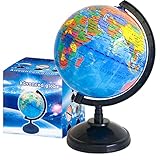
- Package Content:You will receive a geographic world globe with black stand,which measures 6 in/15 cm.The surface of the globe carries detailed geographic information.It includes countries,water bodies,capitals,continental borders,regional borders,and more.
- High-Quality Construction:The educational world globe is made of quality plastic,which will not harm the health of you and your family.It has high quality printing which is fine and clear.It supported with a durable plastic frame and base to ensure stability on a desk or table.
- 360° Rotatable Stand:The decorative rotating world map globe is 360 degree rotating with a premium plastic stand.You can play world travel games with your children,find out different countries by rotating the globe,which can stimulate their enthusiasm for learning.
- Beautiful Decoration:Brightly colored countries sit atop black frames and plinths,adding a dynamic and academic vibe to interiors.It can be used as an exquisite decoration to embellish the living room,bedroom,study room,desk,and office,adding a cultural atmosphere.
- Educational Gift:Our educational globes encourage curious children to explore the world of science.This globe is just the right size,making it a great practical gift for students.It's the perfect gift idea for almost any occasion,such as birthdays,Christmas,new office and studio openings.
Would a disruption make gasoline or household gas more expensive?
It can put upward pressure on fuel prices, but the sources do not establish a single retail price increase that applies to every country. Crude and refined-product prices can rise, while the price at a local pump also depends on refinery capacity, inventories, transport costs, taxes, currency movements and government policy. Diesel, jet fuel and LPG may face distinct pressures from gasoline because they have different product markets and supply chains.
Free tools Windows power users keep installed
One-click scans. No signup required.
“Gas” can also mean different things. If it means gasoline, the relevant channels include crude costs, refining and fuel distribution. If it means natural gas, Hormuz carries LNG, so a disruption can affect LNG supply and prices; it does not support a universal forecast for household gas bills. The IEA’s 2025 estimate of just over 112 billion cubic metres of LNG transit, almost 20% of global LNG trade, indicates the scale of that exposure, not a specific change to a customer’s bill.
Which countries are most exposed?
Asia receives most of the oil moving through Hormuz, so Asian importers face the largest direct risk of delayed or unavailable cargoes. The IEA estimates that 80% of oil flows are destined for Asia; China and India together received 44% of Hormuz crude exports in 2025. It identifies China and India as major buyers and Japan and Korea as particularly reliant on Hormuz flows in its 2026 factsheet.
Rank #3

- Go beyond countries and their capitals using this enhanced globe with a 2.8" video screen that explores cultures, animals, habitats and more through hours of BBC videos
- Educational: This world globe with stand and stylus lets you hear thousands of facts, interact with unique games, and trigger videos to visually experience Earth
- The 2.8" screen displays video and animations with playful characters that guide children through games and activities
- Interactive Map For Kids: Race around the world, discover new places, and solve mysteries by answering quiz questions in three entertaining & interactive games
- Intended for ages 5+ years; requires 4 AA batteries; batteries included for demo purposes only; new batteries recommended for regular use
For a separate historical measure, the EIA found that in 2024, 84% of crude oil and condensate and 83% of LNG moving through the strait went to Asian markets. China, India, Japan and South Korea together accounted for 69% of Hormuz crude oil and condensate flows that year, according to the EIA’s June 2025 analysis. These percentages use different years and denominators from the IEA’s 2025 figures.
Direct cargo exposure is not the same as price exposure. Even countries that buy little oil directly through Hormuz can be affected when global crude, refined-product and shipping markets reprice disruption. The IEA says a disruption can affect global markets immediately through pricing, despite most oil transiting the strait being destined for Asia.
Can Saudi Arabia and the UAE bypass the strait?
Yes, some crude can be moved around Hormuz through pipelines, but the alternatives cannot replace normal transit at full scale. The IEA estimates 3.5–5.5 million barrels per day of available export capacity across Saudi and UAE bypass routes, compared with nearly 20 million barrels per day of total oil exports through Hormuz in 2025.
Rank #4
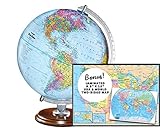
- START EXPLORING TODAY — A Must-Have for Any Teacher or Student, Ideal for any Learning Desk, Office, Kids Room, Bookshelf and Classroom
- ADDITIONAL EDUCATIONAL FEATURES — Accurately Tilted Axis, Time Dial, Population Centers, US states separated by different colors, raised relief showing mountain peeks.
- VERIFIED CARTOGRAPHY All Replogle manufactured maps comply with US State Department’s recommended guidelines.
- In order to transform flat map to a spherical shape, there are pre-planned trimming lines on the map that will be shown once globe ball has been formed. These are the trademarks of a traditional globe
- Raised relief embossing provides a 3D-like texture that both captivates and educates.
| Route | Destination and reported capacity | Important qualification |
|---|---|---|
| Saudi East-West pipeline | Runs from the Abqaiq area to Yanbu on the Red Sea. Saudi Arabia reported expanding the system to 7 million barrels per day in March 2025. | Sustainable flows at that rate have not been tested. Spare capacity depends on operating conditions and the ability to export from the west coast, according to the IEA’s 2026 factsheet. |
| UAE Abu Dhabi Crude Oil Pipeline | Carries crude to Fujairah on the Gulf of Oman. The IEA reports capacity near 1.8 million barrels per day, with up to 700,000 barrels per day of additional room under the conditions it assessed. | Available capacity depends on those conditions and export logistics; it is not a guaranteed volume that can be delivered instantly. |
| Iran’s Jask pipeline and terminal | Designed capacity is 1 million barrels per day. | The IEA says it effectively remains non-operational as a viable crude export option: a test cargo was exported in late 2024, with no further export reported since. Its design capacity should not be counted as available bypass supply. |
The IEA cautions that the logistics and supply chains needed to reroute and export substantial volumes have not been robustly tested. Pipeline capacity alone does not guarantee that producers can move, load and deliver replacement oil at the required rate.
What is known about Hormuz traffic during the 2026 conflict?
The IEA reports that the conflict, which began on February 28, 2026, sharply disrupted shipping and describes traffic as near halted. Its shipping monitor was last updated September 16, 2026. Exact transit levels remain uncertain: the monitor relies on Automatic Identification System (AIS) signals, but tankers may switch off transponders, and GPS jamming and AIS spoofing have been reported. The IEA says measured traffic is likely to understate actual traffic, making precise volumes difficult to determine. See the Middle East Maritime Chokepoints Shipping Monitor.
That monitoring caveat means neither “every tanker has stopped” nor a precise current flow count is established by AIS data alone. The defensible conclusion is that the IEA reports a near halt and severe market disruption, while exact traffic remains difficult to measure.
Quick Recap
Product prices and availability are accurate as of the date/time indicated and are subject to change. Any price and availability information displayed on Amazon at the time of purchase will apply.




