What’s actually slowing this PC down?
Pick the symptom - the matching free tool is one click away.
AI can help financial firms analyze more varied data and detect complex patterns, but it is not automatically more accurate or safer than a traditional risk model. The better choice depends on the task, the data, the consequences of a wrong decision, and whether the firm can explain, validate and monitor the model.
What is the difference between AI and traditional risk models?
Traditional statistical and quantitative models often start with a specified structure and assumptions. A generalized linear model (GLM), for example, estimates relationships using a chosen form. AI and machine-learning (ML) models can learn relationships and parameter settings from data, sometimes using more features or varied data formats. These are tendencies, not strict categories: “AI” covers many methods, and conventional models can be complex too.


For a financial firm, both approaches turn information into estimates that inform decisions. Depending on the use, a model might help estimate the chance of credit default, assess an insurance application or claim, measure market exposure, or identify operational risk. The outputs may feed into decisions or other controls; a model is not necessarily the sole decision-maker.
| Question | Traditional statistical or quantitative models | AI and ML models |
|---|---|---|
| How are relationships represented? | Often use a specified form and parameterisation; suitability depends on the assumptions and the task. | Can learn more flexible relationships from data, including complicated patterns. |
| What data can they use? | Often rely on structured, selected inputs and known variables. | Can use structured inputs as well as other data, such as text or images; more possible inputs do not guarantee more useful information. |
| How often can they change? | A fixed specification may be easier to govern, but can miss relationships that its assumptions do not capture. | Some methods can be updated more frequently or learn continuously, which can make change control and monitoring harder. |
| How easy are they to explain? | Some are comparatively interpretable, but GLMs and regulatory capital approaches can also be difficult to explain. | Some complex methods are difficult to interpret or audit; explainability varies by model and use. |
| What oversight do they need? | Validation and monitoring of assumptions, inputs and performance. | The same core disciplines, with particular attention to data representativeness, drift, complexity, updates and governance. |
The Bank of England, PRA and FCA discuss these capabilities and risks in their October 2022 discussion paper on AI and ML. A model’s label alone does not tell you whether it is suitable, understandable or well controlled.
#1 Best Overall

- Ideal for Gifting
- Ideal for a bookworm
- Compact for travelling
Where might financial firms use AI, and what could it improve?
Potential benefits include processing information more efficiently, analyzing a broader range of data and modeling relationships that a less flexible specification may not capture. Supervisory material describes possible uses in predicting credit default risk and processing insurance underwriting or claims. Those are potential capabilities, not evidence that AI will outperform another method in every firm or situation.
Credit risk
A model may estimate the likelihood that a borrower will default. ML could help identify patterns across a wider set of inputs, but the quality of the result depends on whether those inputs are relevant, accurate and representative. A result measured on training data alone would not establish how well it works on new cases.
Insurance
AI and ML may help process information used in underwriting or claims. More data or faster processing is not automatically better: incomplete or historically biased inputs can lead to poor estimates or unfair outcomes, and firms still need to assess how the model is used.
Rank #2
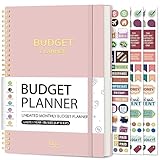
- Effective Budget Planning - Take control of your finances with the budget account book. This comprehensive planner allows you to plan and track your income, expenses, savings, and financial goals in one convenient place. With its intuitive layout and easy-to-use sections, you can stay organized and make informed decisions to achieve financial success.
- User-Friendly Layout - The budget planner features a user-friendly layout designed for easy navigation and organization. Each month, you'll find dedicated budget pages where you can set financial goals, track your income, and plan your expenses. Additional sections include debt trackers, savings goals, bill payment trackers, and more, making it simple to stay on top of your finances.
- Undated Monthly Calendar & Bonus Stickers - Featuring undated calendar each month, you'll have ample space to mark paydays, bills due, appointments, and important dates. Say goodbye to difficult writing spaces. Plus, we've included 3 cute sticker sheets that allow you to personalize your financial organizer and make budgeting more fun. Dates are not pre-printed and are completed by the user.
- Reliable and Convenient Design - Our monthly budget planner is designed for your convenience and built to last. The elastic band keeps everything securely in place, and the dual-sided pocket provides extra storage. Experience a budget planner that combines practicality and durability.
- Master Budgeting with Ease - Our financial planner includes a complete guidebook that provides valuable insights and instructions for optimal usage. From setting financial goals to tracking expenses, this guidebook offers step-by-step guidance and practical tips. Whether you're new to budgeting or an experienced user, this resource will help you make the most of your budget planner, empowering you to achieve financial success.
Market and operational risk
Financial institutions also use quantitative methods in market-risk and operational-risk work. The suitable data, decision context and validation tests differ across these areas, so a result from one use case cannot establish that the same method is appropriate in another.
There is no verified across-finance statistic in the cited material showing that AI models are categorically more accurate than traditional models. A meaningful comparison would test the competing approaches on data not used to fit them, ideally including a later time period, and assess whether their performance holds for the intended task.
What are the trade-offs for consumers and firms?
Prediction versus explainability
A flexible model may detect patterns that a more constrained method misses, but a complex output can be harder to explain, audit or challenge. Simpler-looking traditional models are not automatically transparent. The practical question is whether the firm can understand and scrutinize the particular model’s role in the decision, not whether it carries an “AI” label.
Rank #3
More data versus data quality
Using more sources or features can add useful information, but it also increases the need to check relevance, completeness, accuracy and representativeness. If data reflects historical bias or excludes important groups or circumstances, the resulting estimates can be poor or unfair.
Adaptability versus stability
Frequent updating can help a model respond to changing patterns, but it can also introduce data or concept drift: relationships that worked before may no longer hold. Continuous learning makes it especially important to know what changed, when it changed, and whether the revised model has been validated.
Do these 3 things before closing this tab:
1Clear out junk files and repair common Windows errors2Fix the driver behind crashes, sound loss and screen glitches3Repair Windows errors before they cause bigger problemsAutomation versus accountability
Automated outputs can weaken human oversight if nobody is clearly responsible for decisions, exceptions and model changes. Firms need governance that assigns responsibility and allows appropriate review rather than treating a model’s output as self-justifying.
Rank #4

- PERFECT FOR RECORD KEEPING: The 2 Pack account ledger books are versatile and can be used to track finances, budgets, expenses, and other business or personal records. They are perfect for individuals, or small business owners who need a reliable and efficient way to keep track of their finances. With 100 pages, customers can record transactions over an extended period, making it a handy tool for bill planner, weekly budget planner, monthly budget planner.
- COMPACT AND LIGHTWEIGHT: The Budget Planner is compact and lightweight with each book weighing 7 ounces and measuring 8.5 x 6.25 inch, making them easy to carry around. You can take the budget notebook in a bag or briefcase, making them ideal for on-the-go use. This feature ensures that you can access your records at any time, whether you are at work or on the move.
- PREMIUM QUALITY: Elegant style with the words ''Account Tracker'' embossed in fancy Gold Foils. Water-proof and scratch resistant hard cover. Coil ring binding is a practical design feature that enhances the functionality of the account ledger books. It allows pages to turn smoothly and easily, making it effortless to flip through the book while keeping pages in place. The ring binding also ensures that pages won't fall out, preventing the loss of vital information.
- DURABLE WATER-PROOF COVER WITH GOLD FOIL LETTERS: The words ''Account Tracker'' embossed in shiny Gold Foil letters gives it a professional and fancy look that can fit in any setting. Additionally, the durable cover is scratch resistant, It provides a durable layer of protection that can withstand daily wear and tear, making it suitable for long-term use.
Efficiency versus shared-system risk
Reliance on common third-party providers, data libraries or model components can create dependencies. If many firms use similar data or methods, their decisions may become more correlated, and a shared defect could affect multiple institutions. The Financial Stability Board lists third-party dependencies, market correlations, cyber risk, and model risk, data quality and governance among vulnerabilities to monitor. Its 2017 report warned that “The lack of interpretability or auditability of AI and machine learning methods could become a macro-level risk.” See the FSB’s 2017 report, its 2024 assessment and the Bank of England’s April 2025 Financial Stability in Focus.
Independent reader supportYour contribution helps us test, update, and keep practical guides available for everyone.How should a firm compare and validate the models?
A credible comparison evaluates models for the intended use rather than selecting a winner by category or a single headline metric. Core model-risk practices apply to both conventional quantitative methods and AI/ML; a more flexible or frequently updated approach can increase the work needed to establish that it remains reliable.
- Define the decision and its consequences. Establish what the model estimates, how the output will be used, and what could go wrong if it is inaccurate.
- Check the data. Review quality, completeness and representativeness, including whether the data is appropriate for the people, risks and conditions the model will encounter.
- Test beyond the fitting data. Use out-of-sample and, where appropriate, out-of-time tests; compare alternative methods and examine performance under changed conditions.
- Assess assumptions and explainability. Determine whether the model’s design makes sense for its purpose and whether its results can be scrutinized and, where relevant, challenged.
- Monitor after deployment. Track performance, drift, data changes, exceptions and model updates. Set version controls and review processes that fit how often the model can change.
- Assign ownership. Make clear who approves, validates, monitors and can intervene in the model’s use, including when a third-party service is involved.
A strong result on one metric is not proof that a model is safe or fair. Its performance, stability, data limitations, explainability and governance all matter.
Outdated Drivers Are Slowing You Down
One free scan finds every outdated or missing driver and matches the right update for your exact hardware.Free scan · exact hardware matchWindows Errors? Fix Them Before They Spread
Repair common Windows errors and clear accumulated junk for a smoother, more stable PC - no reinstall needed.Free scan · no reinstallBest Value
What do current US and UK supervisory guidance documents cover?
Regulatory material is jurisdiction- and institution-specific; it is not universal approval of a model type or a complete answer to every AI risk. The following position is current through 7 October 2026.
United States
On 17 April 2026, the Federal Reserve Board, OCC and FDIC issued revised Supervisory Guidance on Model Risk Management, superseding the older SR 11-7 guidance. It takes a risk-based approach tailored to model risk, organizational scale and complexity. It applies its principles to traditional statistical and quantitative models and to non-generative, non-agentic AI models; generative and agentic AI are outside the document’s scope. The agencies say the guidance is most relevant to banking organizations with more than $30 billion in assets, though it may also be relevant to smaller organizations with significant model risk. It is supervisory guidance, not a universal prescriptive rule.
United Kingdom
The current version of PRA Supervisory Statement SS1/23 was published and took effect on 23 April 2026. Its five principles cover identifying and classifying model risk; governance; development, implementation and use; independent validation; and model-risk mitigants. It is relevant to specified UK-incorporated banks, building societies and PRA-designated investment firms with internal model approval for regulatory capital calculations—not all UK financial firms. The principles are technology-neutral and include managing AI/ML risks where they arise in model use.
These documents show that established model-risk, data and governance controls apply to important parts of AI use, while questions remain about the reach of existing frameworks, particularly for generative and autonomous systems. They should not be read as a statement that every AI application is covered or that all related risks have been resolved.
What should a consumer take from the comparison?
For someone borrowing, buying insurance or using financial services, the label “AI-powered” does not establish that a decision is more accurate, less biased or better for the customer. Nor does “traditional” establish that a model is easy to understand. The more useful test is whether the institution uses appropriate data, checks performance for the decision at hand, monitors changes and has accountable oversight. Those are controls consumers cannot infer from a product label alone.
Quick Recap
Product prices and availability are accurate as of the date/time indicated and are subject to change. Any price and availability information displayed on Amazon at the time of purchase will apply.




