What’s actually slowing this PC down?
Pick the symptom - the matching free tool is one click away.
For an Australian business, keep records that explain its sales, purchases, expenses, GST adjustments and calculations, and the amounts reported or claimed on its activity statements. Retain tax invoices where required, import documents for GST paid on taxable imports, and evidence for business-use calculations. The Australian Taxation Office (ATO) sets a five-year retention baseline, but some records must be kept longer to cover an assessment review period.
Which GST records should a business keep?
The ATO says businesses need records showing the income and expenses used to calculate and support GST reported and credits claimed. Keep source documents alongside records that show how figures were worked out, so reported amounts can be traced back to transactions.

- Sales and supplies: Keep sales records and transaction evidence supporting GST collected and amounts reported.
- Purchases and expenses: Retain invoices, receipts and other evidence for business purchases and expenses included in GST reporting. Records should establish the amount and business purpose.
- Tax invoices: Keep valid tax invoices where required to support an input tax credit. ATO legal guidance says a tax invoice is generally needed when lodging the BAS, except for acquisitions with a GST-exclusive value of $75 or less. See the ATO’s GSTR 2000/10.
- Taxable imports: A tax invoice is not required to claim GST credits for taxable imports. Keep Department of Home Affairs documents showing the GST paid.
- Adjustments and GST calculations: Retain records of adjustments and decisions, elections, estimates, determinations or calculations made for GST purposes. If you apportion an amount or use a calculation method, keep the method and its basis.
- Mixed business and private use: Keep evidence of the business-use share when a purchase is used privately as well as for business.
- Payment records: Capture cash, online, EFTPOS, bank, credit-card and debit-card transactions, and make sure they can be reconciled with sales and expense records.
For a complete GST record set, the ATO’s records required for GST guidance explains the core obligation to record and explain relevant transactions.
How long must you keep GST records?
The ATO’s GST-specific guidance sets a baseline of five years. The period starts from when a record was prepared or obtained, or when the related transaction or act was completed, whichever is later. But five years is not always the final deadline: keep records long enough to cover the review period for an assessment that relies on them. A relevant amendment can also affect the review period. The ATO’s legal guidance on GST record retention describes these potentially longer periods.
#1 Best Overall

- Easy to Use Financial Records Organizer: This spiral-bound document folder features 12 pockets, to keep your receipts and records easily accessible in one place.
- Space-Saving Design: This petite tax organizer measures 9” x 7” when closed and can easily fit into any drawer, filing cabinet or safe. Inside, each pocket measures 6 ½” W x 4 ½” H allowing you to neatly store your folded tax documents such as medical expenses, prescriptions, donations and tax forms.
- Streamline Tax Time: In addition to a place to store your documents, each pocket includes a lined ledger, allowing even more opportunities for tracking.
- Bold, Professional Design: Featuring a bold blue and white striped design and a prominent title, our tax portfolio is designed for streamlined organization, whether you're managing household finances or a growing small business. Its striking aesthetic not only adds style but also ensures quick and easy location, enhancing your organizational efficiency.
- Perfect for Homes or Small Businesses: We’re confident our tax organizer will keep your documents in order, whether you’re a small business owner, freelancer/consultant or looking to organize your personal finances. This organization system will help to simplify year-end taxes for busy households or entrepreneurs.
Can GST records be kept digitally?
Yes. The ATO accepts paper and electronic records. Records must explain transactions, be in English or readily translatable, and remain readable and retrievable for the required retention period. Electronic bookkeeping software can tally amounts and produce GST reports, but using software does not remove the need to retain source documents or evidence behind calculations.
Choose a record system—paper or electronic—that lets you find source documents, reconcile payments, and show how adjustments or apportioned amounts were calculated. For digital records, keep usable backups and check that records transfer correctly if you change bookkeeping software. The ATO’s record-keeping tips also recommend separating business and personal records and capturing cash and card transactions.
Rank #2

- ✅ ALL-IN-ONE RECEIPT ORGANIZERS - Stop drowning in loose receipts! PocketCPA 3-in-1 Receipt Organizer Envelopes make tracking expenses & mileage completely effortless. 12 monthly envelopes = audit-proof records and tax prep all year long.
- ✅ RECEIPTS AT YOUR FINGERTIPS! - Our Smart Indexing System developed by PocketCPA matches every expense entry to its supporting receipt and provides instant access to receipts when needed.
- ✅ BUILT-IN EXPENSE LEDGER + AUTO MILEAGE LOG -Easily record business expenses and deductible business mileage right on your PocketCPA organizer. Ideal for documenting business expense deductions and travel reimbursements, whether needed for accounting, bookkeeping, finance, expense reimbursements or IRS or state tax audits.
- ✅ PERFECT FOR HOME, OFFICE & TRAVEL – Lightweight and portable, each 9.5" x 6.5" organizer can be easily stored or transported, helping you keep receipts and expense records organized wherever you work or travel.
- ✅ IRS AUDIT PROTECTION! - It's easy to locate any and all receipts if you need to produce them to IRS to support a tax deduction - because PocketCPA Organizers let you organize and locate your business receipts.
What is a practical way to organize the records?
- Capture each transaction: Record sales, purchases, expenses and payments, including cash and card activity.
- Attach its supporting evidence: Keep the receipt, invoice, import document or other source record with the transaction details.
- Record the GST treatment: Note relevant adjustments, calculation methods and the basis for any business/private apportionment.
- Reconcile before reporting: Check transaction records and payment trails against the amounts being reported or claimed.
- Retain and retrieve: Keep records for at least the applicable retention period, and confirm they remain readable and accessible.
A ledger or bookkeeping tool may help organize entries, but it is not a substitute for invoices, receipts, import documents or other source evidence. No particular software provider is endorsed by the ATO guidance cited here.
Quick Recap
Rank #4

- Improved Secure Zipper Closure: Unlike folders using elastic bands that can let contents slip out, our expanding file folder features a dependable zipper closure. It's thoughtfully designed to securely store and organize your important documents, including paperwork, bills, taxes, receipts, invoices, and more. Perfect for letter size.
- Large Capacity Monthly Organizer: 12 pockets design works great for monthly organizing and protecting all your essential documents in one place. You can securely store all your important papers without them getting cramped.
- Efficient Organization & Easy Lookup: To enhance your file organization, we provide blank labels along with this folder. You can personalize them to suit your requirements, such as labeling sections by month for effortless file retrieval.
- Additional Zipper Pencil Pouch: The front pocket has a depth of 3.5 inches, making it perfect for use as a pencil pouch to conveniently store pens, highlighters, and other frequently-used writing tools that you may need while working with your documents.
- Portable & Durable: Easily carried in a tote bag or backpack, it makes moving from place to place convenient and reduces the risk of losing items. Made of hard colored plastic with reinforced fabric sides. Waterproof & sturdy enough to keep papers safe. Acid-free, PVC-free, and archival quality for safe storage.
Rank #3
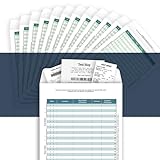
- [Multiple Purpose Business Organizer] Record business expenses on one ledger; Store receipts inside the envelope; Track auto mileage log on the back
- [Match Receipts to Expenses, Find Fast] Record an expense on a line (1-30); Mark the receipt with the line number; Find the receipt fast with the number
- [Receipts Organizer with Expense Ledger] Track your business expenses, prepare for an expense reimbursement or a tax deduction
- [Auto Mileage Log] Track business vehicle mileage; capture valuable business mileage deductions and save on your taxes
- [Perfect Size, Durable Paper Material] Heavy 100 lb paper, easy to write and no ink bleed. This business receipts organizer envelope measures 9.5×6.5 inches, large enough to comfortably fill out while being small enough to fit in a glove compartment, center console or work bag.
Product prices and availability are accurate as of the date/time indicated and are subject to change. Any price and availability information displayed on Amazon at the time of purchase will apply.




