Build resilience by mapping how food moves, identifying where a disruption would cause the greatest harm, and funding alternatives that can actually keep service running. For a distributor, public agency, food bank, or humanitarian operator, that means treating resilience as a capital-allocation and operating decision—not buying a particular software package, adding warehouses by default, or keeping the largest possible inventory.
The right design depends on the geography, foods handled, infrastructure, hazards, regulations, and service commitments involved. The examples below combine global guidance with specific U.S. and humanitarian cases; they are not a universal warehouse, inventory, or transport formula.
What resilience means for a food distribution network
A food distribution network is part of a connected agricultural supply chain: inputs and production feed into processing, packaging, storage, transport, retail or service points, and ultimately the people receiving food. A disruption at one point can affect the rest. The Food and Agriculture Organization (FAO) identifies disasters, conflict, and disease among the shocks that can threaten the chain; operators should also map relevant local infrastructure and operational risks.
Resilience is not simply avoiding every disruption. The United Nations’ 2017 analytical framework describes it as the ability to prevent, anticipate, absorb, adapt to, and transform positively when facing risks while maintaining an acceptable level of functioning and protecting longer-term well-being and development. For a food network, the practical question is: can essential flows continue, or recover in time, without creating unacceptable safety, service, or community impacts?
The Tool Desk
Outbyte PC Repair FREEClear out junk files and repair common Windows errorsFree Scan →Outbyte Driver Updater FREEScan for outdated or missing drivers - takes under a minuteDriver Scan →#1 Best Overall

- Help Organize Your Kitchen and Pantry: Imagine every time walking to your kitchen or pantry, found everything is neatly organized. No longer messy, you can get everything you want very quickly. With the stackable and space-saving design, these containers will make more efficient use of every inch of your kitchen pantry cabinets
- 4 Size Combinations Fit Your Needs: Our kitchen storage container set comes in 4 different sizes. Includes 6 Tall Container (2.5quart/2.8 liters), 6 Large Containers (1.8quart/2.0 liters), 6 Medium Containers (1.5quart/1.6 liters), 6 Small Containers (0.7quart/0.8 liters). Suitable for storing spaghetti, baking supplies, cereal, flour, sugar, oats, pasta, rice, coffee, tea, snacks, nuts and other dry goods
- Airtight Containers Keep Food Fresh: The side-locking lids with silicone gasket make these storage containers airtight, and the top flips open easily. The airtight storage system will always keep your food dry and fresh. All have the same lids make it easy to wash dry and reuse with ease
- BPA Free and Food Grade Material: Vtopmart pantry storage containers are made of durable plastic, BPA free, which have a longer life than many other brands plastic containers. Clear containers make it convenient to see what's inside, you can easily get what you want without opening every container
- 24 Reusable Labels: Except 24pcs dry food storage containers, you will also receive 24pcs labels. They are reusable, you can switch contents whenever you need. Just wipe clean with a damp cloth to change what you have written, Peel and Re-stick
FAO’s Guidelines to increase the resilience of agricultural supply chains (2023) state: “Efforts to strengthen resilience to risks need to be based on a thorough analysis of the exposure and vulnerability of supply chains to them, and on a cost–benefit assessment of damages versus interventions.” That is the core decision rule: understand the exposure before committing money to a fix.
How to assess risk before spending
1. Map the real flow, including dependencies
Draw the path from suppliers through production or processing, storage, transport, and delivery to stores, service points, or recipients. Record the facilities, routes, carriers, suppliers, and contracted services involved. Add dependencies that can stop or slow a flow, such as energy, labor, packaging, data systems, loading equipment, and access to roads or ports. A map that shows only warehouses and trucks can miss the constraint that actually causes the failure.
For each important node and connection, list plausible disruptions in its location and operating context: extreme weather or other disasters, conflict or insecurity, disease events, infrastructure interruptions, and operational failures. FAO describes the connected chain stages and broad shock types; the organization must determine which hazards and dependencies apply to its own network.
2. Rank exposure by service consequences
Identify where a single facility, carrier, route, supplier, or system could interrupt a critical flow. Estimate the likely consequences: missed deliveries, spoilage or other product loss, time to recover, effects on customers and communities, and the cost of operating around the failure. Consider how much volume and which products depend on the exposed point, and whether substitutes can serve the affected destination in the necessary time window.
PC Slower Than It Used to Be?
A free scan shows the junk files, broken settings and background clutter dragging Windows down - then fixes them in one click.Free scan · Windows 10 & 11Outdated Drivers Are Slowing You Down
One free scan finds every outdated or missing driver and matches the right update for your exact hardware.Free scan · exact hardware matchRank #2

- Food Container Set:Our 40 pcs food storage containers Includes 20 containers and 20 lids, and 16 reusable labels and marker pen. This set includes 6 rectangular containers (1*50.7oz, 1*33.8oz, 2*16.9oz, 2*8.1oz), 4 square containers (1*40.6oz, 1*23.7oz, 1*13.5oz, 1*5.7oz), 4 round containers (1*40.6oz, 1*23.7oz, 1*13.5oz, 1*6oz), and 6 round sauce boxes(3*2oz, 3*1oz).
- BPA-Free & Food Grade Materials: Our food storage containers with lids are made of high quality plastic materials that are durable and BPA-Free. This food containers with lids are made of transparent material(Not like glass,Slightly white), but you can also clearly see the food inside. Our meal prep containers reusable are great choices for storing leftovers, fruits, vegetables, cooked meals, dry food and sauce.
- Leak-Proof & Keep Fresh: Each lid of our plastic storage containers features silicone sealing strips and 4-sided latches designed to ensure an airtight and leak-proof. You will never have to worry about food or liquid spills again when you use this containers for food. Keep your fridge clean and say goodbye to fridge odors.
- Safe and Easy to Use: Our plastic food storage containers with lids can be heated in the microwave, washed in the dishwasher, and stored in the freezer. (Note: Please do not put the lid into the microwave and dishwasher, high temperature will lead to deformation of the sealing ring affecting the closure of the lid and container).
- Kitchen Storage & Space-Saving: The plastic containers with lids are designed to be stacked and nested. You can easily store these food containers to save space in your kitchen when not in use. Kitchen storage containers help to categorize storage and placement to keep your kitchen organized.
Separate a plausible risk from a consequential one. A location can face a hazard without being a network bottleneck; conversely, a relatively infrequent event can merit attention if it would stop a critical service for a long time. FAO calls for analyzing exposure and vulnerability and comparing the costs of interventions with the damage they could avoid. It also notes that policy and institutional considerations affect choices, so a purely financial calculation may not capture public-service obligations.
3. Compare interventions on both cost and feasibility
Before approving an investment, compare the option with the exposure it is meant to reduce, the interruption and recovery delay it might avoid, its implementation and ongoing costs, and its operational fit. Check whether the alternative has capacity at the right location and scale, can handle the food safely, and can be activated under the same emergency conditions that threaten the primary route. Consider effects on suppliers, local markets, and recipients as well as the operator’s own budget.
These are practical comparison factors, not a universal published scorecard. FAO supports exposure analysis and cost-benefit assessment; the additional tests reflect the operational issues illustrated by humanitarian and U.S. program examples.
Which investments can reduce a single point of failure?
| Option | Potential benefit | What to verify before relying on it |
|---|---|---|
| Alternative suppliers or sourcing regions | Can reduce dependence on one source or area. | Availability, lead time, quality and safety requirements, purchasing terms, and whether supply remains accessible during the hazard. |
| Alternate routes or transport modes | Can provide a way around an unavailable road, port, or carrier. | Actual route access, equipment and carrier capacity, timing, handling requirements, and emergency activation arrangements. |
| Additional storage locations or capacity | Can reduce dependence on a single site and support dispatch from another location. | Usable space, compatible handling, access to transport, inventory visibility, staffing, and a workable dispatch process. |
| Local delivery partners | Can extend last-mile reach, especially when the operator’s own fleet or access is constrained. | Coverage, capacity, coordination, product handling, communications, and whether partners can operate in the disruption. |
| Planning, risk-management, and shipment-visibility tools | Can support planning, risk identification, coordination, and tracking. | Data quality, integration with operating decisions, user readiness, and physical capacity to act on the information. |
Alternatives must be usable, not merely listed
A backup is meaningful only if it can serve the affected route, volume, product, and time window. A supplier in the same hazard zone, a route that depends on the same vulnerable bridge, or a warehouse without compatible handling capacity may not provide much protection. Test dependencies between alternatives rather than counting them as independent options.
Recommended Free Tools
Rank #3

- Neat & Organized: Each container is designed for easy stacking when in use, and easy storing when not.
- Storage Contained: Ridged lids are designed to ensure sturdier stacking in the fridge and pantry.
- Easy to Carry: The innovative extended lip provides extra support for handling the containers.
- Long-Lasting Durability: Twenty percent more durable*, each container is designed to last and be an essential part of your kitchen. [*Disclaimer TK]
- Made in the USA: EasyStore containers are built to store, built to save, and made in the USA.
WFP describes a mix of transport options in its humanitarian operations, including trucks, ships, aircraft, rail, riverboats, commercial carriers, and specialized vehicles, as well as local partners for last-mile delivery. This shows how an operator may assemble a portfolio of options; it does not mean every food network needs each mode. Match the alternative to the product, destination, timing, infrastructure, and scale at risk.
Storage redundancy needs capacity and a dispatch plan
More sites do not automatically mean more resilience. An alternate facility needs usable capacity, suitable handling, access to onward transport, and a process for moving or releasing inventory. The organization also needs to know who can authorize the change and how stock and orders will be accounted for at the alternate site.
A USDA Food and Nutrition Service account describes delayed deliveries to Food Distribution Program on Indian Reservations and Commodity Supplemental Food Program locations after a disruption at a contracted national warehouse. USDA reports that an emergency contract added deliveries from two warehouse locations. This illustrates a response to a specific concentration problem; it does not establish that two additional sites, or any particular number of warehouses, is right for another network.
Use planning and visibility to support decisions
WFP says its supply-chain planning uses analytics and digital tools to plan in real time, identify and manage risks, and track shipments for coordination and safe movement and storage. These are useful capabilities to consider when deciding what information planners need and how quickly it must reach decision-makers. Software does not create warehouse space, reopen a road, or provide a carrier; its value depends on timely, reliable information and the physical ability to act.
Quick wins for a faster PC:
Scan for outdated or missing drivers - takes under a minuteDriver Scan →Clear out junk files and repair common Windows errorsFree Scan →Rank #4
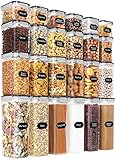
- Bundle Set: This kitchen & pantry organizers and storage set comes with 24 containers, they are inlaid together, so at first glance you may think there is only the same size, but when you take it apart, you will find FOUR different sizes. Includes 6 Large Tall Containers (2.5 quart /2.8 liters), 6 Large Containers (1.8 quart /2.0 liters), 6 Medium Containers ( 1.3 quart /1.4 liters), 6 Small Containers (0.7 quart /0.8 liters). Perfect for storing flour, sugar, spaghetti, rice, nuts, cereal, snacks, pasta, and more
- Sealing Safe: These flour and sugar containers are equipped with a silicone sealing strip and four locking lids to ensure that water and air cannot enter it, So as to better ensure the freshness and health of the ingredients in the clear storage containers for organizing and make the food very dry
- Well Organizer: These air tight sealable containers for food are designed to be superimposed, which is neat and saves space. Cereal containers storage set can be easily placed in cabinets and other places where you want to place them, They can be cleaned in the dishwasher (but not the lids), easy to use and convenient
- Premium Materials: You won't have to worry about the health of your family, as PRAKI airtight food storage containers for pantry set is made of premium plastic. These pasta storage containers for pantry make it easy to find the food item in the cabinet
- No Confusion: Except 24 PCS kitchen storage containers, you will also receive 40 pieces Labels and 1 Marker, which will help you never confuse flour with powdered sugar or baking powder with baking soda. The clear plastic let you see what is in the large pantry storage containers, you can get what you want easily
WFP’s current supply-chain page reports a network of 380 warehouses and logistics hubs and nearly 1,000 local partners for last-mile delivery; those counts are reported without a separate year on the page. It also says around 70 percent of humanitarian funding is spent on supply chains, again without a separate publication year. These are descriptions of WFP’s scale and operating context, not benchmarks for commercial networks or evidence that a particular footprint is optimal.
In 2025, WFP reported delivering 2.4 million metric tons of food, providing US$2.2 billion in cash and voucher transfers, and reaching 121 million people in over 100 countries; it said 62% of food was bought locally or regionally. WFP also reported that planning tools saved around US$12 million, enabling assistance to an extra 800,000 people. These are WFP’s reported 2025 figures, not a comparative return-on-investment estimate for another operator or software product.
Independent reader supportYour contribution helps us test, update, and keep practical guides available for everyone.Make coordination part of the continuity design
WFP’s emergency operations describe coordination with governments, suppliers, and local communities to establish supply sources and routes, manage cross-border movements, and organize convoys. For any organization, the transferable lesson is to decide in advance who has authority to activate alternatives, who shares status with whom, and how suppliers, facilities, carriers, agencies, and local partners will coordinate when normal operations fail.
A continuity plan should make those responsibilities actionable. Set out how the organization will identify a disruption, assess which flows are affected, decide whether to switch routes or facilities, communicate changes, and track recovery. Include the contacts, permissions, information, and procedures needed to act; a list of backup vendors without activation arrangements is not a complete plan.
What’s actually slowing this PC down?
Pick the symptom - the matching free tool is one click away.
Best Value

- 【Sturdy & Reusable】Made of premium thick plastic and strong construction, Dealusy meal prep containers with lids ensure no cracks for your take out meals. They can also be easily cleaned for reuse with hand wash or on the top rack of the dishwasher.
- 【Leakproof & Stackable】: These food prep containers come with tight sealed lids, you can easily stack them and won’t worry that the food would leaks or spills.
- 【Microware Safe & Freezer Safe】: Made of premium food grade plastic, these BPA-free disposable food containers can withstand a temperature from -4℉to 248℉, totally Microware Safe & Freezer Safe.
- 【Convenient Use】: With the pre-set volume of these disposable food containers, you can easily pack your healthy meals, vegetables and fruits without measuring your portions. Great for taking your meals out for school, work, gym or a camping trip.
- 【50 Value Package】: This value package includes 50 pack (100-Piece) 32 oz meal prep containers with easy open lids. They are the perfect choice for your daily meal preparation.
Include food safety and food defense
Continuity choices must preserve safe handling as well as availability. An alternate facility or route should be evaluated for the relevant food, packaging, temperature or handling needs, and applicable operating requirements. A workaround that moves product but compromises its safe handling is not a successful continuity measure.
Food defense addresses intentional contamination or adulteration, which differs from resilience measures aimed at ordinary disruption. It still belongs in organizational risk management. USDA’s Food Safety and Inspection Service (FSIS) provides food-defense resources for in-commerce firms, transporters, and warehouse and distribution centers, including guidance intended to help relevant businesses strengthen security and develop plans. Consult the current FSIS materials for applicable details rather than treating a general resilience article as a statement of current regulatory requirements.
FoodSafety.gov’s power-outage guidance is for households. It discusses keeping appliance thermometers and coolers available and handling food after an outage; those are consumer-level practices, not substitutes for commercial cold-chain specifications, transport controls, or network design.
Turn the analysis into an investment and continuity plan
- Document critical flows. Map products, origins, facilities, routes, customers or recipients, and essential dependencies.
- Identify vulnerable links. For each flow, note the likely disruptions and any single point that could stop or materially delay service.
- Set service priorities. Decide which products, destinations, and delivery windows are most important to protect, taking public obligations and community effects into account.
- Compare targeted options. Assess alternatives against the relevant exposure, expected interruption avoided, costs, usable capacity, handling, and emergency activation feasibility.
- Assign decisions and communications. Name who can approve a switch, who contacts suppliers and partners, and how operational status will be shared.
- Check safety and security. Review food handling and applicable food-defense planning at facilities and during transport.
- Revisit the plan as conditions change. Update the map and assumptions when suppliers, contracts, routes, facilities, hazards, or service goals change.
This method does not prescribe an ideal inventory level, warehouse count, mode mix, or software platform. The sources establish no universal value for those choices or comparative return for named commercial software. The defensible choice is the one that addresses a documented vulnerability and can actually be used under the conditions it is meant to cover.
Do these 3 things before closing this tab:
1Fix the driver behind crashes, sound loss and screen glitches2Repair Windows errors before they cause bigger problems3Scan for outdated or missing drivers - takes under a minuteQuick Recap
Product prices and availability are accurate as of the date/time indicated and are subject to change. Any price and availability information displayed on Amazon at the time of purchase will apply.




