Neither a heat pump nor a gas furnace is the right choice for every home. A heat pump can provide both heating and cooling, but its costs and cold-weather performance depend on the exact model, home, and utility rates. A gas furnace may suit a home with favorable gas economics or existing gas equipment; in a cold climate, a dual-fuel system is also worth pricing. Compare the equipment against your home’s heating load, local winter conditions, utility tariffs, and complete installation quotes—not a national average.
How a heat pump and a gas furnace differ
An air-source heat pump transfers heat from outdoor air into the home in heating mode; it reverses the process to provide cooling. A gas furnace burns natural gas to heat air. The heat pump’s ability to provide enough heat in winter depends on the model and system design, while a furnace’s fuel use depends partly on its actual AFUE rating and the home’s heating load.
| Option | How it heats | Cooling | What to check |
|---|---|---|---|
| Air-source heat pump | Moves heat from outside into the home; performance varies by model and outdoor temperature. | Can provide cooling by moving heat out of the home. | Model-specific capacity and efficiency at local winter design temperatures, backup heat, electrical work, and local electricity rates. |
| Gas furnace | Burns natural gas to heat air; compare the specific unit’s AFUE rather than assuming all furnaces have the same efficiency. | Does not provide cooling on its own; account for separate cooling equipment if needed. | Actual AFUE, local gas prices, annual heating load, existing gas service, and cooling-equipment costs if relevant. |
| Dual-fuel system | Combines a heat pump with a gas furnace; controls can use one or the other depending on conditions. | The heat pump can provide cooling. | Changeover temperature, control settings, local energy rates, and whether both systems are sized and commissioned together. |
DOE describes heat pumps as transferring rather than generating heat. That distinction does not by itself establish which system will cost less to run: local electricity and gas prices, climate, equipment performance, and usage all matter.
How to compare costs for your home
Compare complete installed quotes
Request written bids that list equipment and controls separately from electrical or panel work, duct changes, permits, removal of old equipment, commissioning, and warranty assumptions. A lower equipment price may not mean a lower project cost if one option requires substantial electrical or duct upgrades. If central air conditioning is needed or due for replacement, include that cost in the comparison; a heat pump can serve both heating and cooling.
The Tool Desk
Outbyte Driver Updater FREEFix the driver behind crashes, sound loss and screen glitchesFind Drivers →Outbyte PC Repair FREEClear out junk files and repair common Windows errorsFree Scan →#1 Best Overall
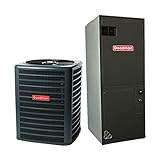
- Accessories such as Linesets, thermostats, LP conversion kits, Sold Separately
- ACCESSORIES - Sold separately unless specified in this listing
- Uses the HKSC/HKSX series of heat kits; NOT the HKR series
- Uses the HKSC/HKSX series of heat kits; NOT the HKR series
Estimate annual operating costs with local inputs
Ask contractors to use the same estimated heating and cooling loads, local utility rates, and equipment-performance assumptions. Include recurring fuel and electricity charges, and identify any fixed charges that would remain even if fuel use changed. Do not compare a heat pump’s efficiency label with a furnace’s AFUE and treat the result as a bill estimate: the systems use different energy sources and local tariffs determine what that energy costs.
DOE’s Federal Energy Management Program gives a northern-region example for 70,000 Btu/h residential furnaces that compares 95% AFUE and 80% AFUE models. Its cost calculations use a stated natural-gas price of $0.961 per therm, federal-facility assumptions, and a 21-year calculation. Those figures are a scenario, not a household forecast, and they are not a direct heat-pump-versus-furnace comparison.
Rank #2

- Home Comfort Solution: Elevate your living with Goodman's standout HVAC products. Merge the efficiency of the Goodman 2 Ton 15.2 SEER2 Heat Pump GLZS4BA2410and the Goodman Multi-Position Air handler AMST24BU1300. This duo forms the basis of a system, promising efficient heating and cooling and precision in temperature control, all crafted to deliver sustained performance over years. Note that you will want a heat kit if you live in a cold climate.
- Efficient and Reliable Cooling: Dive into a cooling experience with Goodman's 2 Ton 15.2 SEER2 Single Stage Heat Pump GLZS4BA2410. Designed for user-friendliness, it includes service valves, gauge ports, and inspection points. Pre-charged for 15’ of tubing, it's ready to ensure your home's comfort.,Couple its enduring build with a reassuring 10-year parts warranty, and you're set for efficient and reliable cooling throughout the year.
- Upgrade Your HVAC System: Goodman's Multi-Position Air handler AMST24BU1300 represents HVAC evolution. Constructed with corrosion-resistant aluminum, it boasts grooved tubing for better heat transfer. Rigorous helium pressure tests during its making vouch for its quality. This unit is tailored for versatile, long-standing cooling and heating needs.
- Versatile with Wide Compatibility: The AC unit stands out with its factory-installed filter drier, ensuring cleaner operation. Fully charged and ready for action, its design features secure performance optimization. The Horizontal coil design streamlines airflow, fortifying its reliability and efficiency credentials.
- This system uses R-32 refrigerant.
Use payback calculations cautiously
A household payback estimate needs the difference in installed cost and the expected difference in annual energy bills under your home’s conditions. Ask for the assumptions behind both numbers, including the heating load, equipment performance, energy rates, and any cooling savings or costs included. If a contractor cannot show those inputs, the payback figure is not a reliable basis for choosing equipment.
Can a heat pump work in a cold climate?
It can, but cold-weather suitability is model-specific. ENERGY STAR’s cold-climate certification testing uses an outdoor temperature of 5°F and includes performance criteria for efficiency and retained heating capacity at that temperature. Certification testing is not a guarantee that every heat pump will perform alike in every home or installation. Ask for the proposed model’s low-temperature capacity and efficiency data at temperatures relevant to your area.
Recommended Free Tools
Rank #3
- Home Comfort Solution: Elevate your living with Goodman's standout HVAC products. Merge the efficiency of the Goodman 4 Ton 15.2 SEER2 Heat Pump GLZS4BA4810 and the Goodman Multi-Position Air handler AMST48CU1300. This duo forms the basis of a system, promising efficient heating and cooling and precision in temperature control, all crafted to deliver sustained performance over years. Note that you will want a heat kit if you live in a cold climate.
- Efficient and Reliable Cooling: Dive into a cooling experience with Goodman's 4 Ton 15.2 SEER2 Single Stage Heat Pump GLZS4BA4810. Designed for user-friendliness, it includes service valves, gauge ports, and inspection points. Pre-charged for 15’ of tubing, it's ready to ensure your home's comfort.,Couple its enduring build with a reassuring 10-year parts warranty, and you're set for efficient and reliable cooling throughout the year.
- Upgrade Your HVAC System: Goodman's Multi-Position Air handler AMST48CU1300 represents HVAC evolution. Constructed with corrosion-resistant aluminum, it boasts grooved tubing for better heat transfer. Rigorous helium pressure tests during its making vouch for its quality. This unit is tailored for versatile, long-standing cooling and heating needs.
- Efficient Cooling: The AMST48CU1300 R-32 only air handler features internal factory-installed thermal expansion valves that optimize cooling, ensuring efficient operation. The unit is equipped with appropriately sized evaporator coil tubes, ensuring effective transfer and improved cooling performance. Featuring a direct-drive, 9-speed ECM blower motor, ensuring efficient airflow and enhanced comfort. The coil mounting track enables easy repositioning and flexible installation options.Flexible Installation: The Goodman AMST48CU1300 air handler can be installed in an upflow, horizontal right or horizontal left configuration.
- AHRI certified. See certificate number 215213861. This system uses R-32 refrigerant.
In regions where winter temperatures regularly fall below freezing, ENERGY STAR advises choosing equipment suited to the home and consulting a contractor. Discuss what provides backup heat, how the controls operate, and the outdoor temperature at which a dual-fuel system would switch from the heat pump to the furnace. A backup source may improve heating economics at still lower temperatures, but whether it does so depends on local rates and the equipment.
When each option may make sense
A heat pump may be a strong fit when
- You want one system to provide both heating and cooling.
- The proposed model can meet the home’s design heating load at local winter temperatures, with a backup plan where needed.
- Local electricity rates, equipment performance, and the installed quote compare favorably with the alternatives.
A gas furnace may be a strong fit when
- The home already has suitable gas service and the local gas economics favor it.
- The home’s cold-weather requirements or the available heat-pump options make a furnace the preferred heating source.
- You have accounted for separate cooling equipment if the home needs it.
Dual fuel may be worth pricing when
You want a heat pump for conditions where it is advantageous and a gas furnace for backup or colder conditions. It is not automatically the cheapest or best choice: the system’s controls, changeover settings, equipment sizing, and utility rates determine how it operates and what it costs.
Rank #4

- · Not Compatible: Two transformer systems, Conventional multi-stage systems, Dual fuel/hybrid heating, Electric baseboard heat (110-240 volts), Line voltage, Convectors, Radiant-ceiling heat, Mini split systems and 12V RV systems.
- · Easy to Install and Use: Large terminal blocks with universal sub-base, can be installed within 30 minutes, clear, easy-to-read backlight LCD display and easy controls make for a user-friendly experience.
- · Dual Power Supply: Can be powered by 24VAC power or 2 AAA batteries, No common wire (C-wire) required on most systems (only required on heat only and cool only systems).
- · Simple but Powerful Control: Easy-access front-load battery compartment, adjustable temperature differential (swing) for energy optimization and maximum system life, Support temperature
- · High Compatibility: Heat pump multi-stage systems or conventional single-stage systems, Forced air (gas, oil or electric), Electric furnace, Hot water steam or gravity radiant heat, Heat only systems, Heat pump w/o or with auxiliary or emergency heat, Millivolt conventional systems, Gas fireplaces (24V), Floor or wall furnaces, Cool only systems.(TIP: Before purchasing, check to see if this thermostat is compatible with your system.) auxiliary or emergency heat, Millivolt, Gas fireplaces (24V), Floor or wall furnaces, Cool only systems.(TIP: Before purchasing, check to see if this thermostat is compatible with your system.)
What to check before signing an installation contract
- Request the load calculation and sizing. Ask the contractor to verify the home’s heating and cooling loads with Manual J and show how the proposed equipment size follows from them. ENERGY STAR warns that improperly sized equipment can undermine comfort and performance.
- Verify cold-weather capacity. If considering a heat pump in a cold region, request model-specific capacity and efficiency data at local design temperatures. Ask whether the exact model meets ENERGY STAR Cold Climate criteria, including the certification measurements at 5°F.
- Get the backup and changeover plan in writing. For a heat pump or dual-fuel system, identify the backup heat source, thermostat and control logic, and any proposed changeover temperature. Ask what energy prices and operating conditions informed that setting.
- Inspect ducts and the home’s envelope. Ask about duct sizing, leakage, and insulation, as well as air sealing and insulation improvements. DOE recommends weatherizing homes replacing gas heat with a heat pump, particularly older homes. ENERGY STAR says sealing and insulating ducts can improve system efficiency by as much as 20%; treat that as a possible improvement, not a guaranteed result for your home.
- Compare bids on the same scope. Make sure each quote identifies equipment, controls, electrical or panel upgrades, ductwork, permits, removal, commissioning, and warranty assumptions so that omissions do not make one option appear artificially cheaper.
ENERGY STAR also estimates that a certified smart thermostat may save approximately $100 per year for some households, especially those with high heating or cooling bills or homes unoccupied much of the day. That undated estimate is conditional, not a guaranteed saving from choosing a heat pump or furnace. Confirm that a thermostat is compatible with the specific heating system and its controls before buying one.
Check incentives for the installation year and location
Do not count on a federal heat-pump tax credit for a 2026 installation without checking current IRS guidance. ENERGY STAR pages have stated different end dates for the listed federal credit, so the available information does not establish current eligibility. State and utility incentives also depend on location; verify any incentive directly with the relevant program before including it in your budget.
What’s actually slowing this PC down?
Pick the symptom - the matching free tool is one click away.
Quick Recap
Best Value

- · Not Compatible: Two transformer systems, Conventional multi-stage systems, Dual fuel/hybrid heating, Electric baseboard heat (110-240 volts), Line voltage, Convectors, Radiant-ceiling heat, Mini split systems and 12V RV systems.
- · Easy to Install and Use: Large terminal blocks with universal sub-base, can be installed within 30 minutes, clear, easy-to-read backlight LCD display and easy controls make for a user-friendly experience.
- · Factory Pre-set Energy-efficiency Program: 7-day, 5/1/1 easy-to-understand programming menus, flexible programming lets you sync your comfort with your schedule.
- · Simple but Powerful Control: Easy-access front-load battery compartment, adjustable temperature differential (swing) for energy optimization and maximum system life, Support temperature
- ·High Compatibility: Heat pump multi-stage systems or conventional single-stage systems, Forced air (gas, oil or electric), Electric furnace, Hot water steam or gravity radiant heat, Heat only systems, Heat pump w/o or with auxiliary or emergency heat, Millivolt conventional systems, Gas fireplaces (24V), Floor or wall furnaces, Cool only systems.(TIP: Before purchasing, check to see if this thermostat is compatible with your system.)
Product prices and availability are accurate as of the date/time indicated and are subject to change. Any price and availability information displayed on Amazon at the time of purchase will apply.




