Micron entered the solid-state drive market with its RealSSD family in 2007, naming enterprise servers and networking among its target applications. Over the next four years, the company announced distinct enterprise and notebook products, a SATA enterprise drive, and a tiered portfolio spanning boot, storage, and high-performance workloads. Micron’s announcements document its product strategy and performance claims; they do not establish market share or independently verified superiority.
Micron’s 2007 RealSSD announcement marked its SSD entry
Micron described RealSSD as its entry into the growing solid-state drive market. Its 2007 announcement covered products in multiple form factors and capacities, from 1GB to 64GB, for computing, enterprise server, and networking applications. The breadth of those intended uses matters: the launch was not limited to consumer notebooks, even though the family also included products for general computing.

The release establishes what Micron announced and where it said the products could be used. It does not show how many drives shipped, how customers adopted them, or what share of the market Micron captured.
In 2008, Micron separated enterprise and notebook use cases
Micron’s 2008 announcement introduced the P200 for enterprise computing and the C200 for notebook applications, illustrating an explicit split between business and client products. The P200 was described as a 2.5-inch single-level cell (SLC) SSD offered in capacities from 16GB to 128GB.
Recommended Free Tools
#1 Best Overall

- Accelerate your system with the Micron 5300 PRO SATA SSD and get the best combination of reliability, security, and solid performance
- Innovative 96-layer 3D NAND technology - increase storage density with 3.84TB of storage in a 2.5 inch form factor
- Comprehensive security - AES 256-bit encryption, power-loss protection, enterprise data path protection, adaptive thermal monitoring, and TCG Enterprise
- Enhanced Read Write speeds - sequential read and write performance levels of up to 540 MB/s and 520 MB/s
- Optimized to deliver high-performance for media streaming, OLTP, block and object stores, and business intelligence
Micron said the P200 had an approximately two-million-hour mean time between failures (MTBF), contrasting it with a 300,000-to-500,000-hour HDD figure cited in the same announcement. These are manufacturer-stated figures, not an independently validated comparison or a promise that an individual drive would operate for that length of time. MTBF is a population-level reliability metric, not an expected service life for a specific unit.
At the time, Micron vice president of Memory System Development Dean Klein said, “We are seeing SSD interest in a variety of applications where historically hard disk drives have reigned.” The quote captures the company’s view of the market opportunity; it is not evidence of adoption outcomes.
Rank #2

- Compatibility: 2.5-Inch form factor size for capacity-dense storage, SATA III 6G interface
- Performance: storage space of 7680GB, qlc NAND flash Type for endurance & Performance
- Applications: real-time analytics, big data, AI data lakes, machine and deep learning
- Features: AES 256-bit encryption, power Loss protection, end-to-end data path protection
- Reliability: 24x7 availability, long-term lifespan, full Micron Warranty can be claimed through point of purchase
The 2010 P300 brought Micron’s enterprise SSD to SATA 6Gb/s
In 2010, Micron announced the RealSSD P300, a 2.5-inch enterprise drive using a SATA 6Gb/s interface. The company listed 50GB, 100GB, and 200GB capacities and targeted servers, blade systems, storage arrays, and high-end workstations.
| Micron-published P300 specification or claim | Historical detail |
|---|---|
| Interface and form factor | SATA 6Gb/s; 2.5-inch drive |
| Capacities | 50GB, 100GB, and 200GB |
| Throughput | Up to 360MB/s read and 275MB/s write |
| Steady-state random performance | 44,000 read IOPS and 16,000 write IOPS |
| Endurance, 200GB model | 3.5 petabytes total bytes written (TBW), which Micron equated to approximately 1.9TB per day for five years |
All figures in the table are claims Micron published in its 2010 announcement. In particular, Micron said the P300 offered more than 15 times the write performance of competing SATA SSDs and described it as “the fastest SATA-based drive on the market.” Both are company comparisons, not independently confirmed rankings in the available announcements. Micron’s endurance equivalence is also tied to the 200GB model and its stated five-year framing.
Rank #3

- Parts should be installed by experienced technicians.
- Genuine Part and Model
By 2011, RealSSD covered several enterprise workload tiers
Micron’s 2011 portfolio positioning placed three products at different points in an enterprise storage system: P400e for entry-level tasks such as booting and read caching, P300 for data storage, and P320h for caching and high-performance PCIe workloads. This is a description of intended roles, not evidence that the products achieved particular sales or market share.
| Model | Micron’s stated role | Performance information in the announcements |
|---|---|---|
| P400e | Entry-level uses, including booting and read caching | Not stated in the cited 2011 portfolio announcement |
| P300 | Data storage | 2010 announcement: 44,000 read IOPS and 16,000 write IOPS described as steady-state performance |
| P320h | Caching and high-performance PCIe workloads | 2011 announcement: up to 750,000 read IOPS and 341,000 write IOPS, described as peak figures |
The P300’s steady-state IOPS and the P320h’s peak IOPS are different kinds of measurements. Without matching workloads and test conditions, they do not support a like-for-like speed ranking. The portfolio shows Micron presenting SSDs as workload-specific enterprise components rather than as one interchangeable drive category.
Quick Recap
Best Value
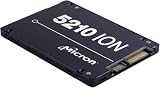
- Storage Capacity: 3.84 TB
- Encryption Standard: 256-bit
- Maximum read transfer rate: 540 MB/s
- Maximum write transfer rate: 350 MB/s
- Endurance (DWPD): 0.8
What the announcements establish—and what they do not
- Established: Micron announced RealSSD products in 2007, including products aimed at enterprise servers and networking.
- Established: By 2008, its announcements distinguished enterprise P200 and notebook C200 products; the P300 followed as a 2010 enterprise SATA drive.
- Established: In 2011, Micron described a tiered enterprise line that included P400e, P300, and P320h.
- Not established: These announcements do not quantify shipments, market share, customer adoption, present-day availability, or independent validation of Micron’s comparative performance claims.
Product prices and availability are accurate as of the date/time indicated and are subject to change. Any price and availability information displayed on Amazon at the time of purchase will apply.




