ATLANT 3D announced a $15 million Series A+ round on March 11, 2025, led by West Hill Capital. The Danish company plans to use the new capital to develop its atomic-layer processing technology, industrial products and commercial partnerships. Its “atom by atom” description is shorthand: the company describes selectively depositing material with atomic-layer thickness control, not placing individual atoms one at a time.
What ATLANT 3D raised—and what the money is for
The Series A+ was a new $15 million financing, not a statement of total funding. West Hill Capital led the round, as it had ATLANT 3D’s $15 million Series A announced in September 2022. Those two disclosed rounds total at least $30 million; the company has not disclosed a valuation or a complete investor list in the cited announcement.
ATLANT 3D said it would use the proceeds to advance its Direct Atomic Layer Processing (DALP) technology, develop industrial products, broaden its applications and partnerships, and expand sales, marketing and commercial activity. The company’s funding announcement and VentureBeat coverage report the round and its stated plans.
ATLANT 3D is a Danish advanced-manufacturing company developing microfabrication equipment, processes and research services for microelectronics and nanodevices. Its stated areas of interest include sensors and MEMS, optics and photonics, microfluidics, batteries, semiconductor research, quantum-device development, and aerospace and defense applications. These are target markets, not evidence that the company already supplies production systems to every sector.
#1 Best Overall

- Up to 16 Colors: Bring your designs to life with vibrant multi-color/multi-material printing capabilities, perfect for showcasing your creativity. Note: Connecting Bambu Lab AMS is required.
- 500mm/s and 20000 mm/s² Acceleration True High Speed: Don't wait around for your masterpieces. Lightning-fast printing speed lets you focus on creating, not waiting.
- Enclosed Design: Fully enclosed body improves print performance for advanced filaments. Automatic Bed Leveling: Say hello to high-quality, successful prints. Auto bed leveling makes 3D printing such an easy thing.
- Set Up in 15 Minutes: Spend more time printing and less time setting up. User-friendly design ensures a hassle-free assembly experience for all skill levels.
- Supported Filament: Ideal: PLA, PETG, TPU, PVA, PET ABS, ASA; Capable : PA, PC; Not Recommended: Carbon/Glass Fiber Reinforced Polymer.
What “atom by atom” means in practice
Atomic layer deposition (ALD) grows thin films through sequential, self-limiting surface reactions. It is valued for controlling film thickness and coating complex surfaces. ATLANT 3D’s proprietary DALP approach combines atomic-layer processing with selective, digitally controlled deposition: material is applied to chosen regions rather than necessarily coating a whole wafer for later patterning and removal.
That distinction matters. Atomic-scale control of film growth does not mean atomic-scale lateral patterning, and neither means that a machine individually manipulates isolated atoms like a molecular assembler. ATLANT 3D’s product materials cite a 0.3 nm step-height claim, but its lateral-patterning figures are much larger and refer to different measures. The company’s product and patent descriptions are available on its NANOFABRICATOR Lite page and patent list.
| Process concept | What it does | Important qualification |
|---|---|---|
| Conventional ALD | Deposits a thin film through repeated surface reactions, often conformally across the exposed substrate. | ALD controls film growth; patterning may require other steps. |
| DALP, as ATLANT 3D describes it | Applies material selectively to defined areas using proprietary microchemical reactors and digital control. | Potentially consolidates steps for particular structures; it does not automatically replace a full device-fabrication flow. |
| Lithography-based fabrication | Often deposits broader films, patterns resist or masks, and etches or otherwise removes unwanted material. | Established processes remain essential for many devices and may still be used alongside selective deposition. |
This is a simplified comparison, not a universal recipe. A finished device may still need substrate preparation, lithography, etching, annealing, metrology, testing, packaging and cleanroom controls.
Rank #2

- One-Click Automatic Printing: Experience hassle-free 3D printing with the Adventurer 5M Series. Enjoy automatic bed leveling for flawless first layers, ensuring consistent adhesion and saving time with no manual adjustments required.
- 12X Ultra Fast Printing: Featuring a CoreXY structure with 600mm/s travel speed and 20000mm/s² acceleration, the AD5M maximizes efficiency, reduces production cycles, and ensures high precision, making it ideal for rapid prototyping and mass production.
- Smart and Efficient Design: Quick 3-second nozzle changes, a high-flow 32mm³/s nozzle, and fast 35-second warm-up to 200°C deliver stable high-speed printing. Its dual-sided PEI platform and versatile options provide easy removal and adaptability for various creative projects.
- Superior Print Quality & Adaptability: Combines a 280°C direct drive extruder with dual-fan cooling and vibration compensation. Includes a standard 0.4mm nozzle and accepts optional sizes from 0.25mm to 0.8mm to fit various printing needs.
- Real-Time App Monitoring: Monitor print progress, adjust settings, and receive instant status alerts remotely with the Flash Studio. Smart mobile control ensures a seamless, effortless printing experience anytime, anywhere.
What the company’s equipment can—and cannot yet show
NANOFABRICATOR Lite: an R&D platform
ATLANT 3D presents the Lite as a research and development tool for materials work, process development and prototyping. The company’s published specifications list substrates up to 4 inches (100 mm), maximum substrate thickness of 10 mm, heater temperature up to 300°C and processing speed up to 200 mm/s. Standard DALP resolution is listed as 400 μm. Manual wafer loading and an ambient, uncontrolled process environment are specified for the standard configuration; controlled inert operation is an option. The company recommends Class 8 cleanroom operation for some configurations.
The Tool Desk
Outbyte Driver Updater FREEFix the driver behind crashes, sound loss and screen glitchesFind Drivers →Outbyte PC Repair FREERepair Windows errors before they cause bigger problemsFix Now →ATLANT 3D’s main product page separately advertises line widths down to 100 μm, processing speeds up to 200 mm/s, samples up to 100 mm and up to two materials simultaneously. The 100 μm line-width claim and 400 μm standard resolution are not interchangeable measurements; the published material does not explain whether they reflect different configurations or process modes. Neither should be confused with the claimed 0.3 nm step height, which describes a different dimension of performance.
The company lists applications and examples including gas sensors, MIM capacitors, thin-film and multilayer devices, Bragg mirrors, vertical interconnections and structures on complex surfaces such as deep cavities. These indicate intended capabilities and use cases; they do not establish that every listed device is commercially qualified or produced at scale.
Rank #3
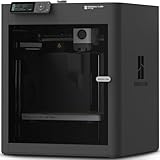
- Up to 16 Colors: Bring your designs to life with vibrant multi-color/multi-material printing capabilities, perfect for showcasing your creativity. Note: Connecting Bambu Lab AMS is required.
- 500mm/s and 20000 mm/s² Acceleration True High Speed: Don't wait around for your masterpieces. Lightning-fast printing speed lets you focus on creating, not waiting.
- Enclosed Design: Fully enclosed body improves print performance for advanced filaments. Automatic Bed Leveling: Say hello to high-quality, successful prints. Auto bed leveling makes 3D printing such an easy thing.
- Set Up in 15 Minutes: Spend more time printing and less time setting up. User-friendly design ensures a hassle-free assembly experience for all skill levels.
- Supported Filament: Ideal: PLA, PETG, TPU, PVA, PET ABS, ASA; Capable : PA, PC; Not Recommended: Carbon/Glass Fiber Reinforced Polymer.
NANOFABRICATOR Flow: a prototype, not a proven production line
At the time of the financing announcement, ATLANT 3D said it had demonstrated a prototype of the larger multimodular NANOFABRICATOR Flow. The available announcement supports calling Flow a prototype, not a commercially deployed, production-qualified platform.
Services for customers not ready to buy equipment
ATLANT 3D also offers feasibility studies, proof-of-technology work, pilot projects, joint development and microfabrication-as-a-service through its innovation services. This gives research groups and companies a way to explore a process without first installing a machine. Its investor-relations material describes a cost-based pricing approach, but the company does not publish a standard machine price; prospective customers must request a demonstration or quote.
Recommended Free Tools
Why selective deposition could matter—and the trade-offs
The investment case is not necessarily that one machine will replace a semiconductor fab. It is that selective deposition may shorten some materials and device experiments before a process is ready for established manufacturing equipment. Mask changes, cleanroom access and repeated patterning steps can make experimentation slow or costly; a digitally changed deposition pattern could be useful where flexibility matters more than wafer throughput.
Rank #4

- High-Speed Precision: The Bambu Lab P2S 3D printer prints up to 600 mm/s while maintaining exceptional accuracy. With the PMSM Servo Extruder and Active Flowrate Compensation, every layer of your printed object stays sharp and smooth, delivering flawless corners and consistent results.
- Ready to Print in 15 Minutes: Set up your P2S FDM 3D printer and start printing in just 15 minutes. With AI failure detection, quick-swap nozzles, and automatic calibration, this 3D printer makes professional-grade 3D printing effortless, even for beginners.
- Effortless Multi-Color Printing: The AMS 2 Pro enables seamless multi-color/multi-material 3D printing. It features built-in filament drying at up to 65 °C, keeping every spool ready for flawless prints. (Note: The P2S 3D printer does not support multi-color printing; Combo version required.)
- Smart Airflow for Any Filament: The Adaptive Airflow System automatically balances cooling and heat retention—keeping overhangs crisp with cool air, or maintaining a 50 °C chamber for engineering-grade materials. A carbon filter ensures clean, safe air while you print.
- Limitless Creativity, Seamless Workflow: Explore over one million 3D models on MakerWorld and bring them to life with a smooth, unified workflow using Bambu Studio, Bambu Handy, and your FDM 3D printer, from design to finished print.
- Potentially less waste: ATLANT 3D claims up to 90% less material waste for relevant processes. The cited materials do not specify a comparison baseline or test conditions, so this is not a general result for all users.
- Fewer steps in some workflows: Direct deposition may avoid some masking, patterning or etching operations for particular structures. It does not remove every downstream process a finished device needs.
- Faster iteration: The company says some prototyping workflows can move from months to days. The actual time saving depends on the materials, design, process and validation required.
- Complex surfaces and materials exploration: Conformal deposition and localized processing may help with high-aspect-ratio features or experiments that combine materials. Compatibility and repeatability still need to be established for each recipe.
For an R&D lab, the relevant comparison may be equipment ownership versus outsourced prototyping or access to a shared cleanroom—not DALP versus an entire high-volume fab. A buyer should ask what process steps the system replaces for the specific device, what steps remain, and how performance will be measured.
Independent reader supportYour contribution helps us test, update, and keep practical guides available for everyone.Evidence of commercialization: a customer, partnerships and open questions
The strongest disclosed customer evidence is a NANOFABRICATOR Lite sale to the University of Vermont and a research collaboration. ATLANT 3D says that work addresses next-generation batteries, analog neuromorphic-computing materials, high-power GaN electronics and active layers for perovskite solar cells. The University of Vermont announcement supports an early commercial sale and research use; it does not establish broad adoption or production-scale deployment.
In the March 2025 funding announcement, the company also reported more than 50 industrial and research partnerships, including organizations such as Sony and STMicroelectronics; a team of more than 35; 11 filed patents; and patents granted in the United States, Singapore, Japan and South Korea. These are company-reported figures. A partnership announcement is not, by itself, proof of a purchase order, manufacturing agreement or product launch.
Do these 3 things before closing this tab:
1Repair Windows errors before they cause bigger problems2Scan for outdated or missing drivers - takes under a minute3Clear out junk files and repair common Windows errorsBest Value

- 600mm/s Speed & CoreXY Structure — Powered by an all-metal CoreXY frame and 20,000mm/s² acceleration, Adventurer 5M Pro reaches speeds up to 600mm/s. Integrated vibration compensation algorithms eliminate ghosting and ringing for smooth, high-precision surface finishes.
- 3-Second Quick-Swap Nozzle & Auto Leveling — Features a tool-free, quick-release nozzle mechanism for effortless 3-second replacements across multiple sizes (0.25/0.4/0.6/0.8mm). One-click full auto-leveling ensures precise bed calibration and a perfect first layer every time.
- Dual Filtration System & Quiet Enclosure — Built with an integrated dual filtration system and a fully enclosed chamber to ensure a clean printing environment and thermal stability. Powered by low-noise motion control, it operates quietly under 50dB for seamless home, office, or classroom use.
- 280°C High-Temp Extruder & Broad Material Compatibility — With a 280°C max nozzle temperature and a 110°C heated bed, it reliably prints engineering materials like ABS, ASA, and PETG-CF, as well as standard PLA and PETG.
- Smart Camera & Mobile Control — Features a built-in camera for real-time monitoring and time-lapse video creation. Monitor progress, adjust settings, and receive instant status alerts via Flash Studio. Integrated with filament detection, power loss recovery, and a 4.3-inch touchscreen for effortless operation.
Materials figures also need their dates and definitions. The March 2025 announcement described about 20 validated materials. ATLANT 3D’s current public website says DALP can process more than 450 materials. The company does not define these figures using the same validation standard in the cited material, so the larger figure should not be read as 450 production-ready recipes.
Who might consider DALP—and who may not
- Potential fit: University or corporate R&D teams developing materials, thin films or early device prototypes; projects needing localized or multi-material deposition; and organizations that value process flexibility over high-volume throughput.
- Less obvious fit: Manufacturers with mature, optimized flows; users who require high-volume wafer processing; and projects needing submicron lateral features without additional patterning tools.
- Questions to resolve before buying: Which materials and recipes have been validated for the intended application? What repeatability and metrology data are available? What environmental controls, precursor handling and facility requirements apply? Which conventional steps remain? What throughput is achievable for the buyer’s geometry, and what is the total quoted cost?
These questions matter because published specifications describe the Lite’s limits, not a guarantee that every material, substrate and geometry will meet a customer’s target. ATLANT 3D’s service model can be a more appropriate first step when a team needs technical feasibility evidence before committing to in-house equipment.
What the $15 million signals
The financing gives ATLANT 3D capital to pursue a path from research tooling toward broader industrial use. A productized R&D system, a named university customer and project-based services are tangible early commercialization signals. Public information cited here does not establish revenue, order backlog, independent performance benchmarks or production-scale deployments. The central test is whether customers can reproduce useful results, integrate the process into real device flows and justify the economics beyond exploratory prototyping.
Quick Recap
Product prices and availability are accurate as of the date/time indicated and are subject to change. Any price and availability information displayed on Amazon at the time of purchase will apply.




