Recommended Free Tools
Technical skill mastery is not a course-completion badge or a fixed number of study hours. It is the ability to perform reliably, solve unfamiliar problems, explain decisions, and adapt as tools change. The most practical route is to choose a specific outcome, map the competencies it requires, practice beyond tutorials, build increasingly realistic projects, seek feedback, and keep evidence of what you can do.
For a career changer or working professional, that process also has a financial dimension: time spent learning has an opportunity cost, and paid courses or credentials are worth buying only when they address a real gap. Start with the work you want to be able to do, then choose the least costly learning path that helps you demonstrate it.
What technical skill mastery means
A technical skill is an applied capability involving tools, systems, methods, or specialized procedures. It can mean writing software, analyzing data, configuring cloud infrastructure, operating CAD equipment, documenting a system, or using a spreadsheet model to support a business decision.
Knowing terminology is not the same as being able to use a skill. A learner may recognize programming syntax but still struggle to design a maintainable application, debug a failure, or work in an unfamiliar codebase. A useful view of competence separates several abilities:
#1 Best Overall

- The 5 tier letter tray with handle pull out trays of well-thought out dimensions that will keep the stuff you need organized, at hand
- Contemporary and elegant mesh construction with powder coat finish will blend in with any décor. It’s versatile and you can add to any space in your home or office
- A smart & practical desk file tray decorative and multifunctional will be a reliable helper for your families, friends, co-workers, etc, helping them get rid of messy working tables
- Made of high quality mesh steel construction with good touch feeling, and you can move it easily. It will hold all your files, folders, and papers
- The desk trays provide a great way to tidy any A4 or paper sized paperwork, folder, document, magazine with space for stationary & desk accessories. For use on office, home or school classroom.
- Knowledge: understanding concepts, vocabulary, and why a method is used.
- Procedure: carrying out a task, initially with guidance if necessary.
- Fluency: completing familiar tasks efficiently and consistently.
- Problem-solving: diagnosing failures and choosing a remedy when the answer is not supplied.
- Judgment: weighing trade-offs and recognizing quality, safety, or reliability concerns.
- Transfer: applying the underlying skill in a new situation, rather than only repeating a tutorial.
“Mastery” is therefore better treated as a progression than a finish line. Technical tools and standards change, while the ability to learn, troubleshoot, and adapt remains useful.
| Stage | What you can do |
|---|---|
| Awareness | Describe the purpose of the skill and recognize its main concepts. |
| Guided execution | Complete standard tasks by following examples, documentation, or a structured lesson. |
| Independent application | Complete common tasks without step-by-step instructions. |
| Troubleshooting | Find causes of failure and choose a suitable correction. |
| Integration | Combine the skill with adjacent capabilities in a realistic workflow or project. |
| Adaptation | Apply it to unfamiliar tools, constraints, or problem types. |
| Teaching and judgment | Explain the skill, review others’ work, and design sound processes or trade-offs. |
Moving forward does not require perfection. A practical progression gate is being able to complete a representative task independently and explain the decisions behind it.
Choose an outcome before choosing a course
Goals such as “learn coding,” “master AI,” or “get into cybersecurity” are too broad to guide daily practice or evaluate progress. Define what you want to produce, diagnose, explain, or improve instead.
- Instead of “learn coding,” aim to build and deploy a small web application.
- Instead of “learn data,” aim to automate a monthly report from CSV files and explain the results.
- Instead of “learn cloud,” aim to configure and monitor a small cloud-hosted service.
- Instead of “get into cybersecurity,” identify a specific foundational role, practical task, or credential valued by the employers you are targeting.
A strong target has a visible output, a way to test performance, achievable prerequisites, and a path to more difficult work. Ask: What must I be able to produce, diagnose, explain, or improve when I am done?
What’s actually slowing this PC down?
Pick the symptom - the matching free tool is one click away.
This framing helps control costs. Before paying for a subscription, boot camp, or exam, identify the precise obstacle it will remove—such as lack of structure, feedback, a practice environment, or a credential required in your target field. If you only need an occasional answer or current command reference, a broad paid library may not be the economical choice.
Map the skill into competencies
Before selecting a curriculum, sketch the capabilities that make up the target. The map should be specific enough to reveal the next practice task, but it does not need to be a complete encyclopedia of the field.
Rank #2

- All-in-One Desk Organizer: WALI multi-tier desk organizer features 4 letter trays, a vertical file folder organizer, 2 metal pen holders and a sliding divided drawer, keeping your office supplies for desk tidy and maximizing desktop space, ideal for women and men as office desk accessories
- Premium Metal Quality: WALI desktop file organizer is crafted from thickened steel metal wire mesh, featuring dense small mesh to hold desk supplies steadily. Its sturdy structure enhances load-bearing capacity to avoid deformation; all parts are firmly fixed to prevent falling, ensuring overall stability and durability of the desktop organizer
- Save Space: Documents are organized by the vertical file folder organizer. Tiered letter tray is suitable for planner, paper, letters,books, magazines, mail, bills and phones. The sliding drawer and metal pen holders can store all office supply accessories, such as pens, pencils,markers, scissors, suitable for workers, teachers and students
- Easy Installation: No complicated tools or tedious steps. 1 Pack WALI desk organizers and accessories can be assembled in minutes with clear instructions. Ideal for office, dorm, college, home office, school, classroom use
- Elegant & Practical Decor: Classic black finish complements any office, school or dorm decor, serving as both a practical home office storage and organization tool and a sleek desktop decor to show your professional style, ideal for users who pursue a tidy, aesthetic workspace
| Map component | Questions to answer |
|---|---|
| Core concepts | What principles must I understand, not just memorize? |
| Tools | Which software, platforms, languages, or equipment are required for my goal? |
| Procedures | Which repeatable tasks must I be able to perform? |
| Prerequisites | What computing, mathematics, language, or domain knowledge is actually needed now? |
| Failure modes | What commonly goes wrong, and how would I recognize it? |
| Quality standards | How will good work be evaluated—for correctness, reliability, security, accessibility, or clarity? |
| Projects | What realistic outputs would combine these competencies? |
| Evidence | What could another person inspect or assess? |
| Next level | What capability should follow after the basics? |
For data analysis, a first map might include spreadsheet or programming fundamentals, data cleaning, missing values, querying, descriptive statistics, visualization, reproducibility, interpretation, and communication. It should also include privacy and data-quality limitations: a polished chart cannot repair biased or incomplete data.
Build a learning sequence that moves toward independent work
A structured course can provide useful order, but it should serve as one part of a performance loop: learn an idea, recall it without the lesson, use it in a task, combine it in a project, get feedback, and try it in a new context.
Do these 3 things before closing this tab:
1Clear out junk files and repair common Windows errors2Fix the driver behind crashes, sound loss and screen glitches3Repair Windows errors before they cause bigger problems- Orient: identify what the field does, which tools are relevant to your outcome, and what a beginner-sized deliverable looks like.
- Fill immediate prerequisites: learn the foundation needed for the next task. Avoid delaying all practical work until you have studied every possible prerequisite.
- Learn core concepts: seek the underlying models and principles, not only isolated commands.
- Follow one demonstration: see how concepts come together in a complete example.
- Reproduce it: rebuild the example from memory or with minimal reference.
- Vary it: change the input, requirement, data, design, or constraints.
- Make an independent project: choose a small problem without following a complete tutorial.
- Review and refine: test, debug, document, simplify, and improve the result.
- Transfer the skill: apply it to a different project or domain.
- Validate: seek review, complete a practical assessment, publish safe work, or use the capability in a real work setting.
Learning-focused courses on Coursera discuss approaches such as retrieval practice and spaced learning; these can be useful models for organizing study, not substitutes for performing the technical task itself: Better Learning and Learning How to Learn.
Design practice to expose and correct gaps
Watching a demonstration feels smooth because the instructor has already made the decisions. Strong practice requires you to make those decisions, encounter errors, and correct them. A useful session is short enough to repeat and structured enough to produce evidence.
- State the task in one sentence and decide what a successful result looks like.
- Attempt it without assistance for a fixed period.
- Record exactly where you became stuck or what failed.
- Consult documentation, an example, or a knowledgeable reviewer to address that specific gap.
- Correct the work, then repeat the task from a clean starting point.
- Write down the general lesson, not just the command that fixed today’s issue.
Recognition and recall are different. You may recognize a command when it appears in a video but fail to produce or adapt it independently. Close the tutorial, reproduce a process, explain a formula from memory, or solve a related problem before reviewing the worked answer. Revisit difficult material after intervals rather than cramming it once; mix related problem types so you have to decide which method applies.
Useful practice includes debugging intentionally broken examples, working with unfamiliar inputs, comparing alternative approaches, and checking results against a quality list. Rewatching, copying without modification, or repeating only easy exercises can feel productive while leaving independent performance untested.
Rank #3

- Unique 3+2 Shelves Design: 3 Tier sliding trays are perfect for storage all your documents,file folders and other desk accessories, 2 upright section is ideal for place your other paper/letters vertically.
- Made of sturdy metal steel mesh with smooth edge and professional black finish, more durable and stable, strong enough to hold all your files and sundries.
- The 3-tier paper tray and two vertical file shelves have a beautiful A4/letter size paper, documents,notepad, book, mailbox contact, files, folders and additional items such as stapler, tape, sticker, etc.
- More Sturdy Construction: Made of thick rounded mesh metal, not easy to bent, also with 2 metal bars to reinforce, more strong and durable compared with many other similar products in the market.
- Overall Size:12-1/4"W x 11-1/2"D x 9-1/2"H; each horizontal tray :12 x 11.4 x 2.7 inch(L x W x H);2 file holder:12 x 9.5 x 2 inch(L x H x W)
Build projects in a deliberate ladder
Projects reveal whether separate competencies can work together. A good project has a realistic objective, constraints, incomplete or imperfect inputs, decisions that are not fully prescribed, a way to test the result, documentation, and an output another person can inspect.
| Project stage | What to do | Example of added challenge |
|---|---|---|
| Guided | Follow a complete example to understand the workflow. | Build the demonstrated analysis or application while noting why each step is needed. |
| Reimplementation | Rebuild it without following each instruction. | Start from a blank file or workspace and reproduce the outcome. |
| Variation | Change a meaningful requirement or input. | Handle missing data, a new feature, a different design, or an altered deployment environment. |
| Independent project | Choose the problem and workflow yourself. | Define scope, test the output, and document assumptions. |
| Capstone | Deliver an end-to-end result with testing and presentation. | Make the project reproducible and explain limitations and trade-offs. |
| Maintenance | Improve or extend an existing result. | Refactor, update dependencies, monitor behavior, fix compatibility issues, or improve documentation. |
For coding, that might mean rebuilding a tutorial application and adding a feature with tests. For data analysis, it might mean cleaning an unfamiliar dataset, documenting decisions, and presenting defensible conclusions. For cloud or cybersecurity work, use safe, authorized lab environments and make configuration, monitoring, and recovery part of the deliverable. For design software or technical writing, show the source work, constraints, revision history, and how the output meets its intended use.
Coursera has reported an association in its own course data between hands-on exercises or programming assignments and higher reported skill development among completing learners. That platform-specific observation is not a guarantee that any project or course causes job readiness: Coursera’s account of its course data.
Choose learning resources for the job they need to do
No single format is best for every learner or subject. Use a course for sequence, official documentation for authoritative current behavior, projects for integration, and people or assessments when feedback is the missing ingredient.
The Tool Desk
Outbyte PC Repair FREEClear out junk files and repair common Windows errorsFree Scan →Outbyte Driver Updater FREEScan for outdated or missing drivers - takes under a minuteDriver Scan →| Format | Best use | Limit to account for |
|---|---|---|
| Official documentation | Current behavior, configuration, syntax, and product-specific reference. | May assume background knowledge and provide little beginner sequencing. |
| Structured course | Foundations and a coherent learning path. | Can encourage passive completion unless paired with independent tasks. |
| Project-based course | Practicing application with deliverables. | The project may be artificial or too closely guided. |
| Books and long-form guides | Developing coherent mental models and depth. | Fast-changing tools may outdate specific instructions. |
| Cohort or boot camp | Deadlines, accountability, peer work, and structured feedback. | Cost, pace, and instructional quality vary. |
| Mentorship | Personalized troubleshooting and professional judgment. | Quality mentors can be difficult to find and may be costly. |
| Communities | Practical edge cases and real-world failure modes. | Advice varies in accuracy and may not fit your version or context. |
| Certification preparation | Exam-specific knowledge when the credential matters. | Can overemphasize test performance at the expense of real work. |
| AI tutoring | Generating practice, alternate explanations, and review prompts. | May produce plausible errors or hide gaps in independent ability. |
Before paying for a course, check its update date, tool versions, prerequisites, instructor credibility, hands-on work, project originality, assessment method, feedback availability, and access terms. Official documentation and free technical resources can be especially useful when accuracy and cost control matter: Python documentation, Git documentation, GitHub Skills, Microsoft Learn, AWS Training and Certification, Google Cloud Training, and MDN Web Docs. These references may still need to be paired with a beginner-friendly sequence or feedback.
Commercial platforms are options, not guarantees. LinkedIn Learning promotes role guides, projects, exercise files, quizzes, coding environments, and preparation for external credentials; access is offered through a subscription model, and availability and terms should be checked for the learner’s location and eligibility. It may suit broad workplace upskilling, but not someone who needs intensive personal review. Coursera offers structured courses and certificate pathways that may suit learners seeking a longer sequence; a certificate still does not establish competence by itself. Udemy can be useful for a narrow tool or exam topic, but compare an individual course’s instructor, update history, exercises, and project depth instead of choosing by discount or review count alone. Prices and access terms vary; check the relevant provider page before committing.
Rank #4

- [5-Tier Paper Organizer with Handle]– This desktop paper organizer features 5 open-front letter trays and a built-in handle, making it easy to move between your desk, shelf, classroom table, or home office workspace.
- [Sort Papers, Folders, Mail & Documents]– Use this desk file organizer to keep letter-size paper, file folders, documents, mail, bills, forms, and notebooks neatly separated for quick access during daily work or study.
- [Office Storage for a Cleaner Desk]– Designed for desk organization and office storage, this paper storage organizer helps reduce workspace clutter and keeps important paperwork off your desktop but still within easy reach.
- [For Office, Home & Classroom Organization]– A practical letter tray organizer for offices, home offices, schools, dorm rooms, reception areas, and teacher desks. Available in more stylish color options, it also works as a cute desk organizer for women, adding a personalized touch to classroom storage, homework trays, and daily paper sorting.
- [Sturdy Metal Mesh Desk Organizer] – Made with durable metal mesh and a reinforced frame, this file folder organizer also works for desk accessories, catalogs, magazines, and paperwork while (USPTO Patent Pending, USPTO Patent Application Number: 23715477)
Use feedback and troubleshooting as part of practice
Feedback should help you identify the next improvement, not merely label a result as good or bad. Automated tests and linters can catch some defects; code review, instructor comments, peer review, user testing, practice exams, supervisors, and postmortems can reveal others.
Evaluate work across separate dimensions:
- Correctness: Does it produce the intended result?
- Reliability: Does it behave consistently under expected conditions?
- Quality: Is it understandable, maintainable, secure, efficient, or accessible as appropriate?
- Transfer: Can you use the approach in a different situation?
- Communication: Can you explain assumptions, limitations, and decisions?
A result that merely runs may still be unsafe, fragile, hard to maintain, or poorly explained. When a project will not work, reduce the problem and check the environment systematically:
Quick wins for a faster PC:
Fix the driver behind crashes, sound loss and screen glitchesFind Drivers →Clear out junk files and repair common Windows errorsFree Scan →Scan for outdated or missing drivers - takes under a minuteDriver Scan →- Confirm operating-system compatibility and required language or runtime version.
- Check dependency versions, environment variables, credentials, file paths, and permissions.
- Verify network or service availability and the input format.
- Review logs, the exact error output, and recent changes.
- Check whether the tutorial matches the installed version; consult current documentation, release notes, or migration guidance where relevant.
If documentation is confusing, find a minimal official example and reproduce the issue in the smallest possible case. When asking for help, include your goal, attempted command or steps, expected result, actual result, and environment. That makes it easier for someone to give actionable guidance.
Measure performance rather than study activity
Hours watched, notes taken, courses completed, and certificates collected describe activity, not necessarily competence. Better evidence comes from what you can do and the conditions under which you can do it.
| Rating | Capability | Evidence to attach |
|---|---|---|
| 0 | Not yet exposed to the competency. | No task attempted yet. |
| 1 | Can recognize or describe it. | A correct explanation or identification exercise. |
| 2 | Can perform it with guidance. | A completed task with notes or instructions available. |
| 3 | Can perform it independently. | A task completed without step-by-step help. |
| 4 | Can troubleshoot and adapt it. | A solution to an unfamiliar failure or changed requirement. |
| 5 | Can review, teach, or design a process around it. | A review, explanation, standard, or reusable process others can follow. |
For each competency, record the task, tools or assistance used, result, and a reviewer’s feedback if available. Other useful indicators include time needed for a familiar task, error patterns, documentation quality, test coverage, performance under realistic constraints, and the ability to explain trade-offs. A score without an example is only a confidence estimate. Assessment frameworks that use competency dashboards, simulations, and benchmarking illustrate ways to make skill evidence more concrete, but a framework or course is not itself proof of employment outcomes: Coursera’s skills-management course.
Independent reader supportYour contribution helps us test, update, and keep practical guides available for everyone.Decide whether a certificate is worth pursuing
Credentials have different purposes and evidentiary weight. A course-completion certificate records that a learner completed a course; a professional certificate usually represents a defined program; a vendor certification tests knowledge of a provider’s products; a license may be required for regulated work; and an academic qualification represents a broader course of study. None should be confused with a portfolio or demonstrated work experience.
Crashes, No Sound, or Screen Glitches?
Random freezes, missing sound and display glitches usually trace back to one bad driver. Find and replace yours safely.Free scan · under a minutePC Slower Than It Used to Be?
A free scan shows the junk files, broken settings and background clutter dragging Windows down - then fixes them in one click.Free scan · Windows 10 & 11Best Value
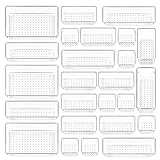
- ✔Make Everything Organized -- These clear versatile drawer dividers trays are perfect for any place in your home. Fit all kinds of drawers, such as vanity / bathroom / kitchen / office drawers/ craft room, ideal for organizing cosmetics, makeup tools, hair accessories, jewelry, pins, office supply, craft supplies, utensils, etc.
- ✔Combination of 4 Different Sizes -- One set includes 25pcs storage bins in 4 different sizes, which help you customize combinations to store items and organize drawer in shelf/ closet/ cabinet/ dresser . Includes: 9 x 6 x 2 inches (3pcs), 9 x 3x 2 inches(6pcs), 6 x 3 x 2 inches(8pcs), 3 x 3 x 2 inches(8cps).
- ✔Non-Slip and Durable -- Extra 100pcs silicone pads are included, just stick them on the bottom of the plastic trays for non-slip. Made of durable and clear plastic, so you can see what’s in it without digging around or making a mess, help you get a neat lifestyle.
- ✔Stackable Storage -- The drawer bins can be stacked into one other when you not use them, that will save much space and organize well. You will find it's so easy to keep things neat and tidy.
- ✔Easy to Clean -- Our desk drawer storage bins are easy to be wiped clean with a damp cloth and perfect for keeping everything in its place. Convenient for use in your daily life, make everything look beautiful and better organized.
A certificate can be worthwhile when a target employer, client, regulator, or professional community recognizes or requires it, or when its assessment provides a meaningful external test. It is weaker evidence when it depends mostly on memorization, lacks identity or practical assessment, or is unrelated to the intended role.
Before paying exam fees or investing in preparation, check job postings and ask people in the field whether that specific credential is valued. Then pair it with a work sample or practical demonstration where the role allows. LinkedIn Learning advertises preparation for external credentials, but preparation access is not the certification itself and does not establish independent performance: LinkedIn Learning.
Use AI to support attempts, not replace them
AI tools can increase the number of practice opportunities, but generated explanations and code still need verification. Try them for a different explanation of a concept, a set of practice problems, a deliberately flawed example to debug, test-case ideas, or a mock review of work you have already attempted.
- Attempt the problem yourself before asking for a complete solution.
- Check technical claims against official documentation or a reliable test.
- Ask the tool to explain assumptions and identify cases its answer may not handle.
- Do not enter confidential data, credentials, or proprietary code into a tool unless you are authorized to do so and understand its data terms.
- Do not present AI-generated work as evidence of your own ability unless you can explain, verify, and reproduce it.
Use an “AI off” checkpoint periodically: complete a representative task without assistance, then compare it with your AI-supported result. If performance collapses without the tool, that is a useful sign that more independent practice is needed.
Plan progress by milestones, not a universal hour count
There is no reliable number of hours that guarantees mastery across different technical skills or learners. The time required depends on complexity, prior knowledge, practice quality, access to feedback and realistic projects, weekly consistency, and whether the goal is familiarity, job readiness, or advanced performance.
- First milestone: complete a small guided task and explain its main concepts.
- Second milestone: complete a related task independently.
- Third milestone: build a small project with tests or another suitable validation method and documentation.
- Fourth milestone: solve an unfamiliar problem and explain your trade-offs.
- Fifth milestone: produce work that meets an external standard relevant to your goal.
A course’s advertised schedule describes its planned course workload, not the full time a learner will need to perform independently. For example, Coursera lists Learning How to Learn at roughly two weeks at ten hours per week; that schedule is for the course, not a guaranteed timeline for mastering a technical field.
Recover when learning stalls
| What you notice | Likely issue | Useful next move |
|---|---|---|
| You can follow a tutorial but cannot start alone. | Tutorial dependence. | Rebuild a recent project from a blank starting point, then make a variation. |
| You have several unfinished courses. | Resource hopping. | Choose one primary path and one reference source for a defined period. |
| You are still planning and comparing tools. | Overplanning. | Set a small first deliverable and begin with the simplest suitable tool. |
| You have learned a framework but cannot diagnose basic problems. | Premature specialization. | Return to the transferable concepts underneath the tool. |
| Quiz scores are strong but projects are difficult. | Recognition without application. | Replace some review with closed-book tasks and troubleshooting. |
| The project keeps growing and remains unfinished. | Scope is too large. | Define a minimum version and a specific “done” condition. |
| Practice feels easy but teaches little. | Insufficient challenge. | Add unfamiliar inputs, constraints, testing, or a new environment. |
| You restart whenever a tool changes. | Tool churn. | Separate durable concepts from version-specific syntax and relearn only what the goal requires. |
| You repeat the same errors. | Too little feedback. | Use tests, standards, a reviewer, or a structured technical community. |
| You have credentials but no work samples. | Credential substitution. | Pair the next credential with a project, case study, or practical assessment. |
| Intense study is followed by long gaps. | Unsustainable workload or burnout. | Reduce the schedule and make a small weekly deliverable the goal. |
If motivation drops, reconsider the scope and the connection to a real need before assuming the problem is a lack of discipline. A smaller deliverable, visible progress, or a practice partner may make continued work more sustainable.
Maintain the skill after the first project
Skills decay when they are not used, and technical behavior can change with new versions, security expectations, and standards. Maintenance need not mean tracking every release. Follow changes that affect the work you intend to do, revisit documentation when upgrading, and periodically rebuild or extend an older project.
Keep a concise record of the tools and versions used, decisions made, tests performed, known limitations, and steps needed to reproduce the result. That record helps you refresh the skill, lets another person inspect your work, and prevents a future update from turning a once-working project into a mystery.
Quick Recap
Product prices and availability are accurate as of the date/time indicated and are subject to change. Any price and availability information displayed on Amazon at the time of purchase will apply.




