Windows Errors? Fix Them Before They Spread
Repair common Windows errors and clear accumulated junk for a smoother, more stable PC - no reinstall needed.Free scan · no reinstallOutdated Drivers Are Slowing You Down
One free scan finds every outdated or missing driver and matches the right update for your exact hardware.Free scan · exact hardware matchIndia’s Digantara announced on December 16, 2025, that it had closed a $50 million Series B. The Bengaluru company says the capital will fund international expansion, optical-system and satellite-manufacturing capacity, and research into missile warning, tracking and related space-based defense programs.
The important qualification is that this is not an announcement of a deployed space-based missile shield. Digantara’s established business is space-domain awareness—finding and tracking objects in orbit—while missile-warning satellites and any future space-based interceptors remain announced development objectives.
What happened in the funding round?
Digantara described the transaction as a completed $50 million Series B and said the money had been raised through direct equity funding. Its December 16, 2025 announcement named three new investors and two existing backers.
| Investor | Status in the Series B |
|---|---|
| 360 ONE Asset | New investor |
| SBI Investments Co. of Japan | New investor |
| Ronnie Screwvala | New investor |
| Peak XV Partners | Existing investor participating again |
| Kalaari Capital | Existing investor participating again |
Earlier reporting discussed Reliance Industries as a potential lead investor. Reliance was not named in the completed-round announcement, so it should not be described as an investor in this Series B without that qualification.
#1 Best Overall

- 【Excellent Optics】Astronomical telescope features 80mm aperture 600mm(f/6.7) focal length-The big aperture can capture more light; high transmission multi-fully coated optical lens can improve light transmittance, reduce the reflection of light. It will bring you more bright and clear images.
- 【Portable & Stable】Our refractor telescope has a backbag, an adjustable aluminum tripod and an upgraded phone adapter. All accessories can be packed into the bag, which is convenient for you to carry and storage for traveling. The tripod is stable and the height can adjust from 17.7" to 52", which is suitable for adults and kids. With the phone adapter, you can take amazing photos through your phone.
- 【Easy to Operate】 This telescope is easy to assemble even for astronomy beginners and kids. You can set up easily with the detail installation manual and video. No tools are required. It’s a great astronomy gift telescope for adults, astronomy enthusiasts, beginners and kids 8-12.
- 【Optimum Magnification】Our telescope for kids and adults is equipped with two replaceable excellent-quality eyepiecesa (20mm and 9mm) for 30X and 66X magnification. A moon filter transmits only 13 percent of the incoming light and improving contrast. Also with 5x24 finderscope, you can locate objects easily. A great option for astronomy lovers to explore the moon, Saturn and Jupiter.
- 【Satisfaction Service】We provide 3 years satisfaction service. If you have any questions about the product and service, please feel free to contact us to get 24-hour technical support from our expert team. Whether observing moon or viewing planets, our telescope can meet your all needs. It’s a great telescope for adults & 8-12 kids & astronomy beginners.
Secondary reporting has put Digantara’s cumulative funding at approximately $64.5 million, combining this round with earlier financing. That figure is a reported estimate rather than a total prominently disclosed in the company’s release. Janes also reported that the full capital had been received and characterized the round as all-equity.
How Digantara plans to use the $50 million
The company identified four broad priorities:
- Expanding beyond its existing India and United States operations.
- Building manufacturing facilities for optical systems.
- Increasing satellite-production capacity.
- Growing research and development, including a plan to double R&D teams over the following year.
CEO Anirudh Sharma later told Janes that roughly $25 million to $30 million could go toward space-based assets and $5 million to $10 million toward international expansion. Those are management’s allocation indications, not a formal line-item budget published in the funding release.
What Digantara already does
Founded in 2020 and headquartered in Bengaluru, Digantara began as a space-situational-awareness company. Its stated purpose is to detect, characterize and track satellites, debris and other objects in orbit, then turn those observations into data and analytics for government, defense and commercial users.
Rank #2

- Superior Optics: 400mm(f/5.7) focal length and 70mm aperture, fully coated optics glass lens with high transmission coatings creates stunning images and protect your eyes. Perfect full positive telescope for astronomers to explore stars and moon.
- Magnification: Come with two replaceable eyepieces and one 3x Barlow lens.3x Barlow lens trebles the magnifying power of each eyepiece. 5x24 finder scope with mounting bracket and cross-hair lines inside make locating objects easily.
- Wireless Remote: This refractor telescope includes one smart phone adapter and one Wireless camera remote to explore the nature of the world easily through the screen and take amazing celestial images.
- Adjustable Tripod: This telescope allows for many different viewing positions with a adjustable aluminum alloy tripod and a carry bag, the telescope and tripod can fit inside the bag for easy traveling and storage.
- Satisfaction: Buy with confidence from a leading manufacturer.
The company describes a combined infrastructure of space sensors, ground sensors, data processing and orbital-intelligence software. It names Space-MAP and STARS as platforms, while AIRA is described as the layer connecting hardware, data and processing. These are company descriptions; public sources do not establish the full performance of each product or disclose every customer contract.
SCOT: the first commercial satellite in the roadmap
SCOT stands for Space Camera for Object Tracking. The satellite launched in January 2025 on SpaceX’s Transporter-12 mission. Earlier reporting attributed a capability of tracking objects as small as about 5 centimeters to Digantara. That number is not a universal detection guarantee: performance depends on target reflectivity, range, illumination, viewing angle, sensor sensitivity and processing.
Digantara and some coverage have called SCOT the world’s first commercial space-surveillance satellite. That is a company or media characterization, not an independently established global designation.
Rank #3
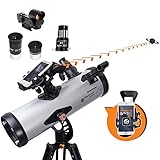
- SMARTPHONE-POWERED SKY TOUR: No experience needed! Just dock your phone, launch the StarSense Explorer app, and follow the on-screen arrows to locate stars, planets, nebulae, and more.
- PATENTED STARSENSE TECHNOLOGY: Unlike other astronomy apps, StarSense Explorer uses sky recognition technology to turn your phone into a celestial navigation system, analyzing star patterns overhead to pinpoint your telescope’s position.
- TONIGHT’S BEST TARGETS, INSTANTLY: The app generates a curated list of the top objects to see based on your time and location. See planets, bright nebulae, galaxies, and star clusters from the city—and even more from dark skies.
- SIMPLE SETUP, SMOOTH TRACKING: Features a manual altazimuth mount with altitude slow motion adjustment with a sliding rod. Follow the on-screen arrows to your target; when the bullseye turns green, you can view it clearly through the eyepiece.
- 114MM REFLECTOR WITH IMPRESSIVE VIEWS: The 4.5" Newtonian reflector with high-reflectivity coatings delivers sharp, vivid views of the Moon, planets like Jupiter and Saturn, and deep-sky favorites like the Orion Nebula and Andromeda Galaxy.
What the new missile-warning roadmap includes
| Program | Stated role | Status supported by public information |
|---|---|---|
| SCOT series | Electro-optical and LiDAR satellites for space-based surveillance | Existing satellite plus announced series; future deployments remain plans |
| ALBATROSS | Early missile warning and precision tracking | Announced development and deployment program |
| SKYGATE | Network of ground-based sensors for persistent observation | Announced network expansion |
Digantara said it was preparing to launch 15 space-surveillance satellites and two dedicated missile-warning satellites through 2026–27. The announcement is a forward-looking target, not a verified count of satellites already launched or operational. The public material available for this story also does not establish whether the company’s planned European expansion for mid-2026 was completed.
“Space-based missile defense” explained
Missile defense is a chain of distinct functions. A company can provide valuable parts of that chain without operating an interceptor.
- Detection: Sensors identify a launch or missile-related event, potentially using optical, infrared or other signatures.
- Characterization: Systems determine what was detected and separate a real threat from clutter or a false alarm.
- Tracking: Repeated observations estimate position, velocity and trajectory.
- Prediction and decision support: Software projects a path and possible impact area, then shares the information with command systems.
- Interception: A separate weapon system attempts to destroy or disable the missile.
Digantara’s announcement clearly supports missile warning and precision tracking as development targets. It also refers to “space-based interceptors,” but the available sources do not provide an interceptor design, test result, deployment date, named government customer or evidence of an operational weapon. The defensible description is therefore a company moving into missile-warning and tracking infrastructure, with an announced ambition involving interceptors—not a deployed missile-defense architecture.
Rank #4

- Superior Optics: Dianfan astronomy telescope features a focal length of 800 mm and a fully coated 90 mm objective lens. The large aperture gathers more light for brighter, clearer views, high-transmission coatings enhance contrast and color for sharp, vivid images for an enjoyable stargazing experience
- Powerful Magnification: With two eyepieces and a 3× Barlow lens, this telescope offers 32×–240× magnification. It allows you to observe craters and lunar seas on the surface of the Moon. With the 45° zenith mirror, images are upright and correctly oriented for terrestrial viewing, making distant targets details easier to observe. The telescope is ideal for beginners and astronomy enthusiasts
- Quick Setup & Beginner-Friendly: User-friendly design with clear instructions makes assembly simple—ready in about 15 minutes. Smooth focusing helps you quickly locate targets. Perfect for families to enjoy stargazing and explore the night sky together
- Portable & Versatile: Lightweight design with a sturdy stainless steel tripod ensures stable, steady viewing. Easy to carry in the included bag, making it perfect for travel and outdoor adventures. Suitable for stargazing, birdwatching, wildlife observation, and exploring cityscapes
- Professional Astronomical Telescope: The Dianfan 90x800 telescope combines quality , functionality and reliability. It delivers high-resolution views that bring the universe closer. Designed for adults high powered, it inspires interest in astronomy and science while encouraging exploration of the starry sky
Why combine satellites and ground sensors?
Advantages of space-based sensing
- Satellites can observe beyond the horizon and cover large areas.
- A constellation can improve revisit time and geographic reach.
- Space-based data can supplement national radar, airborne and maritime sensors.
Constraints of space-based sensing
- Persistent coverage requires enough satellites in suitable orbits, not just one spacecraft.
- Optical and infrared performance varies with lighting, viewing geometry, atmospheric effects and thermal background.
- Satellites are expensive to launch, replace and protect from jamming, cyberattack, physical attack and orbital congestion.
- Data is useful only when communications are secure and fast enough for warning and command decisions.
What ground sensors add
Ground sites can use larger apertures, be upgraded more easily and provide detailed confirmation. They also face terrain and horizon limits, weather, local infrastructure requirements and vulnerability to disruption. Digantara’s proposed model is therefore a fused space-and-ground system, not satellites replacing radars.
Independent reader supportYour contribution helps us test, update, and keep practical guides available for everyone.Why investors may see a larger opportunity
Governments and commercial operators face a more crowded orbital environment, growing debris concerns and demand for independent space intelligence. A company that controls sensors, satellites, processing and analytics can potentially reduce dependence on outside data, lower latency and tailor products for national-security users.
That “full-stack” strategy also raises capital needs and execution risk. Manufacturing facilities, launch procurement, constellation operations, secure data links and specialized hiring all consume cash before a network reaches useful persistence. Reuters-syndicated coverage cited a $60 billion global space-monitoring and intelligence market estimate, but market-size figures depend on definitions and methodology and should not be read as guaranteed demand.
Best Value

- BRIGHT, SHARP VIEWS ANYWHERE: Unlike many beginner telescopes, this quality refractor features fully coated glass lenses and a 70mm aperture for crisp, clear views of the Moon, planets, and daytime scenery—all in a lightweight, travel-ready design.
- PERFECT FIRST TELESCOPE FOR BEGINNERS: Designed for adults and kids to enjoy together, this beginner-friendly telescope sets up in minutes and delivers rewarding views with no prior experience required.
- EASY NO-TOOL SETUP: No complicated assembly or tools needed. The full-height tripod and telescope tube set up in seconds and pack neatly into the included backpack—so you’re always ready to observe on the go.
- DUAL EYEPIECES FOR VERSATILE VIEWS: Includes 20mm and 10mm eyepieces for wide and close-up views of celestial and terrestrial targets. Spot craters on the Moon at night or wildlife during the day.
- BONUS BACKPACK AND SOFTWARE: Includes a padded backpack with room for accessories, a finderscope, star diagonal, eyepieces, and a free download of Starry Night software to help you identify celestial objects and plan your next stargazing session.
India’s strategic and commercial context
Digantara fits India’s effort to develop domestic space and defense capabilities while selling specialized services internationally. The company has described operations in India, Singapore and the United States and planned European expansion. That does not make it equivalent in scale or maturity to government missile-warning systems or major defense primes.
Government and defense sales can be long-cycle, classified or dependent on export controls and national-security approvals. Public statements that a company serves governments or defense agencies are not the same as a disclosed contract, backlog or recurring revenue figure.
Questions that will determine whether the plan works
- Have any ALBATROSS missile-warning satellites launched, and what sensor bands and detection thresholds do they use?
- How persistent will coverage be across relevant regions and missile trajectories?
- How will Digantara’s data connect to national command-and-control and existing radar networks?
- What government contracts, if any, are publicly documented?
- What is the current revenue, backlog and cost of operating the planned constellation?
- What does “space-based interceptors” mean in practice: a Digantara-built weapon, an enabling sensor role or an early research objective?
- Has the announced European expansion been completed?
Bottom line
The Series B gives Digantara the resources to move from a primarily orbital-surveillance business toward a broader space-and-ground intelligence architecture. SCOT demonstrates an existing space-surveillance capability; ALBATROSS, SKYGATE, the 15-satellite target and the interceptor language describe the next stage. The decisive evidence will be launched hardware, sustained coverage, integration with government systems and customer adoption—not the funding announcement alone.
Quick Recap
Product prices and availability are accurate as of the date/time indicated and are subject to change. Any price and availability information displayed on Amazon at the time of purchase will apply.
Recommended Free Tools




