Do these 3 things before closing this tab:
1Scan for outdated or missing drivers - takes under a minute2Clear out junk files and repair common Windows errors3Fix the driver behind crashes, sound loss and screen glitchesMeta reportedly tried to acquire Safe Superintelligence (SSI), the startup co-founded by Ilya Sutskever, at a time when private-market reports placed the company’s valuation near $32 billion. Sutskever reportedly rejected Meta’s acquisition and recruitment efforts. Meta then pursued SSI co-founder and CEO Daniel Gross, who left SSI on June 29, 2025, and joined Meta’s superintelligence effort. Sutskever subsequently became SSI’s CEO.
The $32 billion figure was a reported company valuation, not a confirmed purchase price. No public Meta announcement, offer document or term sheet establishes the exact proposed deal.
What Meta reportedly tried to buy
The target was Safe Superintelligence Inc., not a publicly released AI model or a set of “$32 billion parameters.” SSI was founded in 2024 by OpenAI co-founder and former chief scientist Ilya Sutskever, Daniel Gross and Daniel Levy. Its stated purpose is to build safe superintelligence, with a research focus intended to avoid ordinary product cycles and short-term commercial pressure. SSI describes that mission on its official website.
CNBC and The Information reported that Meta sought to acquire SSI and also tried to recruit Sutskever. Those reports did not disclose the proposed purchase price, structure or a signed term sheet. The reported $32 billion number came from coverage of SSI’s private-company valuation, including the Wall Street Journal’s background reporting. A valuation reflects what investors or a financing market may assign to a company; it is not automatically the amount an acquirer offered.
Free tools Windows power users keep installed
One-click scans. No signup required.
#1 Best Overall

- Built for Local AI Development: AMD Ryzen AI Halo is designed for local AI development and inference, featuring 128GB unified memory and support for up to 200B parameter models to build and run intensive AI workloads locally.
- 128GB Unified Memory: Features 128GB LPDDR5x unified memory at 8000 MT/s with 256 GB/s memory bandwidth, providing a shared memory pool across the CPU, GPU, and NPU to support larger AI models.
- AMD Ryzen AI Max+ 395 Processor: Features 16 cores, 32 threads, and Zen 5 architecture, paired with AMD Radeon 8060S integrated graphics featuring 40 RDNA 3.5 compute units and an AMD XDNA 2 NPU with up to 50 TOPS.
- Linux AI Developer Platform: Purpose-built for Linux-based AI development with full AMD ROCm software support and preloaded tools, models, and workflows optimized for local AI development.
- Compact, Connected Design: Includes a 2TB M.2 SSD, 10GbE LAN, Wi-Fi 7, Bluetooth 5.4, USB-C connectivity, and HDMI 2.1b.
SSI had attracted substantial funding despite having no conventional consumer product publicly described in the cited coverage. Its perceived value rested on Sutskever’s scientific reputation, a scarce frontier-AI team, the company’s safety thesis and investor expectations that it could make a significant technical breakthrough. Reuters reported that SSI raised $1 billion in 2024: Reuters’ funding report.
Why Meta would want SSI
Meta has not publicly explained an internal rationale for the reported acquisition attempt. Several strategic motives are plausible, but they are analysis rather than confirmed statements:
- Access to Sutskever’s frontier-AI research expertise and a highly regarded team.
- A shortcut into advanced reasoning or superintelligence research instead of relying only on incremental improvements to existing models.
- Control of a group that could strengthen Meta’s credibility against OpenAI, Google and Anthropic.
- Preventing a competing technology company from securing SSI’s founders and research direction.
- Creating a dedicated research effort that could feed Meta’s broader AI ambitions.
SSI’s mission and Meta’s public objective are related but not identical. SSI presents itself as a focused effort to build safe superintelligence. Meta later described its goal as “personal superintelligence”—AI integrated into products and personal devices, including glasses—in a July 30, 2025 statement. That difference helps explain why acquiring a research lab would have been strategically attractive while also making founder independence important.
Why the acquisition did not happen
The available reporting does not establish why Sutskever rejected Meta’s efforts. It does not prove that compensation, safety disagreements, corporate culture or product strategy caused the refusal.
One possible explanation is structural: SSI was founded around a narrow, long-term research mission, while an acquisition by a large consumer-technology company could bring product deadlines, commercial priorities and new management controls. Preserving independence may have been more consistent with SSI’s stated purpose. That remains an informed interpretation, not a disclosed reason from Sutskever.
Rank #2

- EVOLUTION AMD RYZEN AI MAX+ 395 MINI PC - GMKtec EVO-X2 is the next evolution in AI mini PC Ryzen Strix Halo series. Thanks to AMD Simultaneous Multithreading (SMT) the core-count is effectively doubled, to 32 threads. Ryzen AI Max+ 395 has 64 MB of L3 cache and can boost up to 5.1 GHz, depending on the workload. The Ryzen AI Max+ 395 is currently rated as the "most powerful x86 APU" on the market for AI computing.
- AI NPU with XDNA 2 ARCHITECTURE - Powered by 16 “Zen 5” CPU cores, 50+ peak AI TOPS XDNA 2 NPU and a truly massive integrated GPU driven by 40 AMD RDNA 3.5 CUs, the Ryzen AI MAX+ 395 is a transformative upgrade and delivers a significant performance boost over the competition. The Ryzen AI Max+ 395 excels in consumer AI workloads like the llama.cpp-powered application: LM Studio. Shaping up to be the must-have app for client LLM workloads, LM Studio allows users to locally run the latest language model without any technical knowledge required and unleash their creativity and productivity.
- AMD RADEON 8090S iGPU GAMING PC - The AMD Radeon RX 8060S offers all 40 CUs with up to 2.9 GHz graphics clock and uses the new RDNA 3.5 architecture. The powerful iGPU is positioned between an RTX 4060 and 4070 laptop GPU and therefore enables gaming in FHD at maximum details in most demanding games. The 8060S can also utilize the full 64GB pool, which is perfect for running LLMs such as Deepseek 32B, which runs comfortably on this machine.
- EIGHT CHANNEL LPDDR5X - LPDDR5X is a new ground breaking memory small form factor installed on-board. With blazing speeds up to to 8000MT/s, it runs 1.5x faster than the DDR5 SODIMMs; 90% better performance over DDR5 SODIMMs in video conferencing and photo editing; 30% better performance in productivity apps; 4% better performance in digital content workloads.
- QUAD SCREEN 8K DISPLAY SUPPORT - EVO-X2 AI Mini PC support 4-screen 4K/8K output via HDMI 2.1 (8K@60Hz), DisplayPort 1.4 (4K@60Hz), and dual USB 4 40Gbps Transfer speed (supporting PD3.0/DP1.4/DATA). Ideal for gaming, video editing, and multitasking, it provides expansive and crisp multi-display support.
Meta’s pivot to Daniel Gross and Nat Friedman
After the reported acquisition effort failed, Meta pursued Gross and former GitHub CEO Nat Friedman. Gross was SSI’s co-founder and CEO at the time of the June 20, 2025 report. Friedman was Gross’s partner in NFDG, an investment partnership associated with stakes in companies including Perplexity and Character.AI.
Reports from CNBC, TechCrunch and Axios described advanced discussions about hiring both men. The reported arrangement also potentially involved Meta acquiring or buying out limited-partner interests in NFDG. That is different from buying SSI and should not be described as an outright acquisition of the venture firm; the precise legal and financial structure was not publicly established.
This combination matters because it blended three normally separate transactions:
- Company acquisition: buying SSI, including its ownership, people, intellectual property and direction.
- Talent acquisition: hiring Gross and Friedman for Meta’s AI effort.
- Investment or fund transaction: obtaining exposure to, or interests connected with, NFDG’s investment network.
Meta’s move therefore appears to have been about people and strategic access as much as corporate ownership.
Independent reader supportYour contribution helps us test, update, and keep practical guides available for everyone.What happened to SSI afterward
Gross’s departure changed the original headline’s meaning. Sutskever did not leave SSI for Meta. According to Sutskever’s statement reported by TechCrunch, Gross’s time at SSI had been winding down and he was officially gone on June 29, 2025.
Rank #3
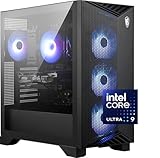
- Intel Core Ultra 9 285 Processor: Newly developed cores deliver ultra-smooth and responsive gameplay. AI accelerators prepare users for the next era of gaming on an AI PC.
- Simplistic Design: Enjoy the latest generation of Windows 11 Home for your everyday needs. *MSI recommends Windows 11 Pro for business use.
- NVIDIA GeForce RTX 5070 Ti GPU
- Cool While Gaming: In conjunction with an RGB CPU Air Cooler, the Aegis RS features four system cooling fans; three in the front and one in the rear to pull in cool air and push heat out of the PC.
- Turn on the Bright Lights: With the built-in RGB lighting, take your gaming experience to the next level by pressing the MSI LED button to cycle through lighting options. Customize lighting even further with MSI Center software.
After Gross left, Sutskever became SSI’s CEO, as reported by Reuters. SSI therefore lost its operating CEO but retained its central scientific co-founder in the top executive role. The company continued to describe its objective as building safe superintelligence.
Gross’s exit raises reasonable questions about operational continuity, recruiting, fundraising and governance. It does not, by itself, establish that SSI failed technically or commercially, nor that the company abandoned its mission.
PC Slower Than It Used to Be?
A free scan shows the junk files, broken settings and background clutter dragging Windows down - then fixes them in one click.Free scan · Windows 10 & 11Crashes, No Sound, or Screen Glitches?
Random freezes, missing sound and display glitches usually trace back to one bad driver. Find and replace yours safely.Free scan · under a minuteHow the episode fits Meta’s wider AI campaign
The SSI episode was one part of Mark Zuckerberg’s broader 2025 effort to make Meta a leading frontier-AI company. Meta publicly outlined a frontier-AI approach in February 2025 (Meta’s framework) and later centered its messaging on personal superintelligence.
Reporting also linked Meta’s campaign to the recruitment of Scale AI CEO Alexandr Wang and other researchers and executives. Axios described an environment in which companies offered unusually large packages for scarce AI talent: Axios’ August 2025 report. Public reporting about individual negotiations and compensation should be distinguished from officially announced appointments and disclosed employment terms.
Viewed together, these moves show why frontier-AI competition increasingly involves more than model releases. Companies are competing for founders, research groups, executive judgment, investor networks and the ability to shape a long-term technical agenda.
What remains unknown
- Meta’s exact acquisition proposal for SSI, including price, structure and timing.
- The reason Sutskever rejected the acquisition and recruitment approaches.
- Gross’s precise title, compensation and responsibilities at Meta.
- The legal and financial structure of any transaction involving NFDG’s funds or limited partners.
- Whether SSI has achieved a technical breakthrough; no such result is established by the cited reports.
The accurate way to describe the story
Meta reportedly tried to acquire SSI, a startup reportedly valued at about $32 billion, but the acquisition did not occur and Sutskever reportedly rejected Meta’s efforts. Meta then recruited SSI’s departing CEO, Daniel Gross, along with Nat Friedman, while Sutskever stayed and became SSI’s CEO. The result was not a $32 billion purchase of SSI. It was a failed reported acquisition attempt followed by a high-profile combination of executive hiring and possible venture-investment dealings.
Quick Recap
Product prices and availability are accurate as of the date/time indicated and are subject to change. Any price and availability information displayed on Amazon at the time of purchase will apply.




