Free tools Windows power users keep installed
One-click scans. No signup required.
The Koenigsegg Agera RS is a road-legal, road-and-track hypercar built in just 25 examples between 2015 and 2018. It combines a twin-turbo V8, active aerodynamics, carbon-fiber construction and unusual everyday concessions such as a detachable roof and usable luggage space. Its 2017 Nevada runs established one of the most important independently witnessed production-car speed records, although the evidence available here does not support calling it the current outright fastest production car in September 2026.
The figures below come primarily from Koenigsegg’s technical and historical material. They are manufacturer specifications and record claims, not the results of an independent road test.


What the Agera RS is
Koenigsegg introduced the Agera RS at the Geneva Motor Show in March 2015. The program drew technology from the One:1 and was intended to work on both public roads and race tracks while remaining fully road legal. All 25 cars had sold within 10 months of the debut, which Koenigsegg described in 2016 as the fastest-selling model in its history at that point.
Each car was hand-built, and individual specifications can differ. That matters when comparing power, options, provenance and eventual resale prices.
#1 Best Overall

- Brand new box, Limited edition.
- True-to-scale detail. Detailed interior, exterior.
- Real rubber tires
- Made of diecast metal with some plastic parts. Dimensions
- Officially licensed product.
Performance and the 2017 speed records
Factory acceleration and braking figures
| Measure | Koenigsegg-published figure |
|---|---|
| 0–100 km/h | 3.0 seconds |
| 0–200 km/h | 8.0 seconds |
| 0–200–0 km/h | 13.5 seconds |
| Braking, 100–0 km/h | 30.5 metres |
| Maximum lateral acceleration | 1.5 g |
These numbers are Koenigsegg specifications rather than independently instrumented test results. Tire, fuel, surface, weather and vehicle setup can affect real-world performance.
What happened in Nevada
On 4 November 2017, an Agera RS made two opposite-direction runs on a closed Nevada public road. Koenigsegg’s current model page records a 446.97 km/h (277.87 mph) average. The company’s history page separately reports a 447.19 km/h average production-vehicle top speed, along with these other records:
Rank #2

- Resin Replica: This car is meticulously crafted from resin
- No Moving Parts: No doors, hood, or other moving components
- 33.29 seconds for 0–400–0 km/h
- 445.63 km/h average flying-kilometre speed
- 444.76 km/h average flying-mile speed
- 457.94 km/h in a single direction
The 446.97 and 447.19 km/h averages are figures from separate official Koenigsegg pages. They should be treated as separately published values, not silently merged into one number.
Is it still the fastest production car?
The Agera RS remains associated with a verified two-way production-car record from 2017. However, the supplied evidence contains no authoritative September 2026 ranking that establishes whether a later production car has surpassed it. The defensible claim is that it holds the documented 2017 achievement, not that it is certainly the current fastest production car worldwide.
Do these 3 things before closing this tab:
1Scan for outdated or missing drivers - takes under a minute2Repair Windows errors before they cause bigger problems3Fix the driver behind crashes, sound loss and screen glitchesRank #3
Engine, transmission and chassis
| Component | Specification |
|---|---|
| Engine | Koenigsegg twin-turbocharged aluminum 5.0-litre V8 |
| Lubrication | Dry-sump |
| Transmission | Seven-speed paddle-shift gearbox |
| Published gasoline output | 865 kW (1,160 hp) on Koenigsegg’s technical specification |
| Model-page petrol output | 1,150 bhp; the same page also describes an optional 1,360 bhp megawatt upgrade |
| Torque | 1,000 Nm from 2,700 to 6,170 rpm; 1,280 Nm maximum |
| Construction | Carbon-fiber body and structure |
| Aerodynamics | Active aero, dynamically active rear wing, front flaps and front splitter/winglets |
| Wheels and brakes | Hollow carbon-fiber Aircore wheels and carbon-ceramic brakes |
| Ride control | Electronically adjustable ride height |
The apparent horsepower mismatch is not an error to average away: Koenigsegg’s technical page uses 865 kW (1,160 hp), while its model page summarizes 1,150 bhp and identifies a separate optional megawatt upgrade. Buyers should verify the exact specification of an individual car.
Dimensions and practicality
| Dimension or capacity | Published value |
|---|---|
| Length | 4,293 mm |
| Width | 2,050 mm |
| Height | 1,120 mm |
| Wheelbase | 2,662 mm |
| Dry weight | 1,295 kg |
| Curb weight | 1,395 kg |
| Fuel tank | 82 litres |
| Luggage capacity | 150 litres |
The Agera RS is more usable than its extreme speed suggests. Its detachable hardtop can be stored inside the car, and the luggage compartment is a genuine design feature rather than an afterthought. Those concessions do not turn it into a touring car, but they distinguish it from many track-biased exotics.
Rank #4
Exterior and cockpit: what to look for in photos
Koenigsegg’s official Agera RS model page is the appropriate source for exterior and cockpit imagery. When evaluating photographs, look for:
- the removable hardtop and its internal storage arrangement;
- exposed or painted carbon-fiber bodywork;
- the large active rear wing and associated aero mechanisms;
- side outlets, the front splitter and front winglets;
- Aircore carbon wheels behind the carbon-ceramic brakes; and
- the luggage area, an unusually practical detail for a car of this performance level.
Because many Agera RS cars were individually specified, a photograph of one example should not be assumed to represent every car’s trim, wheels, aero finish or cabin equipment.
Best Value
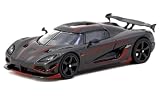
- 1:64 Scale
- Adult Collectible 14 years and up
- Includes display base and acrylic cover, often in a paper sleeve or blister pack
- Rolling rubber tires
- Licensed product
Price when new and what can be said about value today
Historical launch pricing
ANSA reported on 19 January 2016 that all 25 cars had sold and described an unofficial base price of about $2 million, approximately €1.83 million at that time. This is historical launch-era reporting, not an inflation-adjusted figure or a guaranteed invoice price for every specification.
Current market value
A responsible current resale price cannot be stated from the available evidence. Transaction values depend on mileage, ownership history, service records, country and taxes, options, specification and whether the car is a special Final Edition or another highly individualized build. An asking price, auction estimate and completed sale are not interchangeable measures.
How to read an Agera RS “review”
Koenigsegg’s published numbers establish the car’s engineering brief and record attempts, while an independent road test would be needed to assess ride quality, steering feel, noise, real fuel consumption, repeatability and usability in ordinary traffic. The company’s founder, Christian von Koenigsegg, described the program as delivering performance, road feel and responsiveness alongside high technical sophistication; that is a manufacturer statement, not an independent evaluation.
For a prospective owner or collector, the most meaningful checks are the exact build sheet, confirmation of road registration in the relevant jurisdiction, documented servicing, carbon-composite condition, brake and tire status, and complete provenance.
Bottom line
The Agera RS is a 25-car, road-legal technical showcase whose strongest documented credentials are its 2017 two-way speed achievement, extreme power-to-weight targets and unusually thoughtful roof and luggage solutions. Its original price is known only as historical reporting, and its present value or current world-speed ranking requires case-specific, up-to-date evidence.
Quick Recap
Product prices and availability are accurate as of the date/time indicated and are subject to change. Any price and availability information displayed on Amazon at the time of purchase will apply.




