Neoclouds are specialized cloud providers built primarily for artificial-intelligence workloads. They combine dense GPU clusters, high-speed networking, storage, scheduling software and managed AI services. The category is maturing from opportunistic hourly GPU rental into contracted infrastructure businesses—creating new options for AI companies and investors, but also exposing them to heavy capital needs, customer concentration, power constraints and rapid hardware depreciation.
What is a neocloud?
“Neocloud” is an industry term, not a universally standardized legal or technical category. In practical terms, it describes a cloud provider whose main product is accelerated computing for AI, usually delivered through GPU-dense clusters and an AI-oriented software and services stack. UK competition authorities more formally describe firms such as CoreWeave, Crusoe, Lambda and Nebius as specialized GPU or AI-infrastructure suppliers rather than relying on the neocloud label (UK Competition and Markets Authority report).


A neocloud may offer on-demand, spot, reserved or multi-year contracted capacity. Its product is more than an accelerator chip: customers also need the networking, storage, orchestration, cooling, power and support that let many GPUs operate as one usable system.
| Provider type | Main offering | Typical strength |
|---|---|---|
| Hyperscaler | Broad compute, databases, storage, networking and enterprise services | Global integration, compliance and procurement |
| Neocloud | GPU-heavy AI infrastructure and related platform services | Accelerator capacity and distributed-AI performance |
| GPU marketplace | Aggregated or peer-supplied GPU capacity | Price discovery and flexibility |
| AI platform | Model APIs, training abstractions and deployment tools | Developer productivity |
| Colocation operator | Data-center space, power, cooling and connectivity | Physical infrastructure |
| Sovereign cloud | Regionally controlled infrastructure | Data residency and strategic autonomy |
Why did neoclouds emerge?
AI demand grew faster than conventional cloud infrastructure could be adapted. Training and large-scale inference require dense accelerator systems, large memory pools, fast interconnects, high-throughput storage and software that coordinates distributed jobs. CoreWeave’s annual filing explains why these requirements differ from general-purpose cloud workloads (CoreWeave SEC filing).
What’s actually slowing this PC down?
Pick the symptom - the matching free tool is one click away.
#1 Best Overall

- 【Powerful Load-bearing】12U Network Rack Open Frame is constructed from durable cold rolled steel; Rack shelf supports enhance stability, wall-mounted capacity of 130lbs, the ground-mounted up to 260lbs
- 【Considerate Designs】Open-frame layout, including a top panel adding space, anti-slip shelf stops fixing devices and compatible racks for stack and expansion to meet requirements of home server rack
- 【Complete Accessories】A 12U open frame server rack, two ventilated shelves, four shelf stops, four velcro straps and a set of equipment mounting screws
- 【Versatile Application】Ideal for space-efficient multi-device setups in warehouses, retail, classrooms, offices and more; Excellent choices as AV Rack/IT Rack
- 【Effortless Setup】 Network Rack includes hardware, a comprehensive manual, mounting hole drilling template and an online assembly video to simplify setup
Hyperscalers offer unmatched breadth, but their infrastructure must serve databases, business applications and millions of smaller workloads as well as AI. A specialist can instead assemble contiguous clusters for a large training run, deploy a new GPU generation quickly and tune its systems around utilization of accelerators. The scarce resource is therefore not simply “a GPU”; it is a reliable, networked cluster with enough power and storage to keep those GPUs busy.
NVIDIA’s DGX Cloud Lepton illustrates the resulting ecosystem. Announced in May 2025, it connects developers with GPUs supplied by partners including CoreWeave, Crusoe, Lambda, Nebius and Nscale (NVIDIA announcement). That model can make specialized capacity easier to discover without turning every provider into the same business.
What “coming of age” means
The category is reaching commercial maturity through several concrete changes:
- Public-market access: CoreWeave completed its initial public offering in March 2025, issuing 37 million Class A shares at $40 each and reporting approximately $1.4 billion in net proceeds after underwriting discounts (SEC filing).
- Longer contracts: Leading providers increasingly sell multi-year capacity commitments to AI laboratories and technology companies instead of relying only on hourly rentals.
- Managed products: Providers now package training, inference, fine-tuning, storage, observability and Kubernetes rather than selling bare virtual machines.
- Enterprise processes: Security controls, support, service-level commitments and procurement terms are becoming as important as GPU specifications.
- Institutional financing: Data centers, power arrangements and accelerator fleets require debt, leases, project finance and other structured capital.
- Broader workloads: Inference, agent evaluation, robotics and other physical-AI applications are joining the original pretraining market.
Lepton’s documentation lists endpoints, development pods, batch jobs, managed infrastructure, storage, observability and bring-your-own-compute options (NVIDIA DGX Cloud Lepton documentation). That is a sign of a platform layer forming around GPU capacity, not proof that every listed provider has the same scale or reliability.
How neoclouds differ from AWS, Azure and Google Cloud
A neocloud is not automatically faster or cheaper. The right choice depends on the workload and the full cost of operating it.
Where a neocloud can help
- More concentrated, contiguous GPU capacity for distributed training
- Potentially quicker access to newly deployed accelerators
- Specialist support for cluster scheduling and AI frameworks
- Flexible dedicated, reserved or spot configurations
- Potentially better price-performance for sustained AI use
Where a hyperscaler remains stronger
- More regions and mature global networking
- Integrated identity, databases, analytics, security and enterprise software
- Larger compliance, support and procurement organizations
- Established governance and billing across an existing cloud estate
- Greater ability to absorb short-term capacity shortages
A company training a model on a dedicated cluster may favor a neocloud, while an application that combines AI with databases, identity, analytics and regulated data may be simpler on a hyperscaler. Hyperscalers can also answer neocloud competition with new GPU instances, discounts, custom silicon, managed AI services and partnerships.
The neocloud technology stack
Hardware
Fleets may include NVIDIA H100, H200, B200, GB200 or GB300 systems, alongside AMD or other accelerators. NVLink- and NVSwitch-style connections can link GPUs within a node or rack, while high-bandwidth fabrics connect many nodes for distributed training.
Physical infrastructure
AI racks draw far more power and generate more heat than ordinary servers. Providers need high-density facilities, advanced liquid or hybrid cooling, large electricity allocations, network interconnection and sites chosen for power availability, latency, taxes and regulation.
Systems software
The operating layer commonly includes Kubernetes or another cluster manager, GPU scheduling and quotas, batch queues, container registries, telemetry, distributed-training libraries, storage caching and data-transfer services.
AI platform services
Managed offerings can include notebooks, development pods, model endpoints, fine-tuning, serverless inference, evaluation environments, model registries and workspace or secrets management. These services reduce infrastructure work, but they also create compatibility and portability questions for customers.
Who matters in the market?
CoreWeave
CoreWeave is the best-known public pure-play AI cloud. It describes a platform spanning infrastructure, orchestration, storage, networking and managed services, with proprietary orchestration aimed at training and inference (CoreWeave). Its IPO gives investors a public window into a business that combines cloud revenue with data-center and financing risk.
Nebius
Nebius positions itself as a full-stack AI-infrastructure company spanning compute, software and services, and appears among NVIDIA’s Cloud Partners. Public partnership or marketing status should not be confused with independently verified operating scale.
Do these 3 things before closing this tab:
1Scan for outdated or missing drivers - takes under a minute2Repair Windows errors before they cause bigger problems3Fix the driver behind crashes, sound loss and screen glitchesRank #3
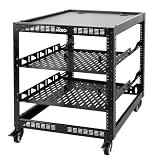
- 【Powerful load-bearing】12U Network Rack Open Frame is constructed from durable Cold Rolled Steel; Rack Shelf Back Support enhances stability; load-bearing capacity of 260lbs
- 【Sliding&Considerate】Open-frame layout, including four wheels easy to move, a top panel adding space, anti-slip shelf stops fixing devices and compatible racks for stack and expansion to meet requirements of home server rack
- 【Complete Accessories】A 12U open frame server rack, two ventilated shelves, four shelf stops, four casters, four velcro straps and a set of equipment mounting screws
- 【Versatile Application】Ideal for space-efficient multi-device setups in warehouses, retail, classrooms, offices and more; Excellent choices as AV Rack/IT Rack
- 【Effortless Setup】Server rack with wheels includes hardware, a comprehensive manual, mounting hole drilling template and an online assembly video to simplify setup
Crusoe
Crusoe offers GPU and CPU infrastructure, storage, managed Kubernetes, managed inference and serverless fine-tuning, with spot, on-demand and reserved models (Crusoe pricing).
Lambda and infrastructure-led entrants
Lambda focuses on GPU cloud services for developers and training workloads. Infrastructure and energy companies are also entering the market. IREN announced a $3.4 billion AI-cloud contract and a 5GW strategic partnership with NVIDIA in May 2026; those are company announcements and do not by themselves establish deployed or revenue-generating capacity (IREN announcement).
Runpod and Vast.ai
Runpod and Vast.ai are marketplace-oriented alternatives. They can be attractive for experimentation and burst capacity, but a marketplace host is not necessarily equivalent to an enterprise neocloud with uniform hardware, formal service levels and owned, tightly integrated clusters.
NVIDIA, the partner and competitor
NVIDIA supplies the dominant accelerator ecosystem, lists cloud partners and operates Lepton, while also offering managed AI-cloud capabilities. That creates distribution opportunities for neoclouds and dependence on a company that can influence both supply and customer access.
Quick wins for a faster PC:
Fix the driver behind crashes, sound loss and screen glitchesFind Drivers →Repair Windows errors before they cause bigger problemsFix Now →How the economics work
Neocloud economics resemble infrastructure development more than simple software subscriptions. Providers may purchase or lease GPUs and build facilities before customer revenue arrives. Their returns depend on utilization, pricing, power costs, financing and the useful life of each accelerator.
Pricing is workload-specific
CoreWeave’s pricing page displayed North American GB200 NVL72 on-demand capacity at $42 per hour and a single-GPU inference price of $10.50 per hour when observed; newer systems such as GB300 were listed as contact-sales products (CoreWeave pricing). These are page observations, not universal GPU prices.
Runpod’s page, updated July 27, 2026, displayed examples including H200 Pods at $4.39 per hour, B200 Pods at $5.89 and H100 Serverless workers at $4.55 (Runpod pricing). Vast.ai says its marketplace prices move with supply, demand, GPU type and interruptibility (Vast.ai pricing guide). Rates can exclude storage, egress, support, taxes, minimums and other charges.
Contract quality matters
Reserved capacity can lower effective rates for predictable workloads, but leaves a buyer exposed if a model plan changes, funding falls through, a newer GPU arrives or delivery is delayed. Investors should distinguish announced capacity, ordered hardware, installed hardware, networked clusters, generally available capacity and revenue-generating capacity.
The Tool Desk
Outbyte Driver Updater FREEScan for outdated or missing drivers - takes under a minuteDriver Scan →Outbyte PC Repair FREEClear out junk files and repair common Windows errorsFree Scan →Total cost matters more than the hourly GPU rate
- Storage, persistent volumes and checkpoint retention
- Data ingress and egress
- Idle capacity and utilization losses
- Engineering labor and migration work
- Restart costs after failures or interruptions
- Power, debt service, leases and depreciation for the provider
How to choose a provider
- Define the workload: Separate interactive development, fine-tuning, pretraining, batch inference and low-latency production inference.
- Verify capacity: Confirm the exact GPU, region, cluster size, topology and whether capacity is dedicated, shared, interruptible or reserved.
- Measure the system: Ask for network performance, storage throughput, scaling behavior and documented replacement or recovery procedures.
- Check software compatibility: Review CUDA and driver versions, PyTorch support, container access, Kubernetes or Slurm integration, APIs, Terraform and observability tools.
- Price the whole job: Include compute, storage, transfer, idle time, support, engineering and expected restart costs.
- Review governance: Confirm region, residency, encryption, tenant isolation, certifications, customer-managed keys and export-control restrictions.
- Read the contract: Examine minimum commitments, termination rights, escalation clauses, burst capacity, upgrade terms, service levels and maintenance windows.
Risks investors and buyers should not overlook
Financing and customer concentration
A provider can appear strong because of one large contract. Examine customer count, largest-customer share, contract duration, take-or-pay provisions, prepayments, counterparty credit and renewal risk. Debt service and construction delays can pressure cash flow even when demand is high.
Power and construction
The bottleneck is increasingly the ability to secure electricity, cooling, permits, network connectivity and construction capacity—not merely the ability to order GPUs.
Hardware obsolescence
New generations can reduce the appeal of older clusters, but older GPUs may remain economical for inference, fine-tuning or less demanding jobs. Depreciation and residual values therefore matter more than headline GPU counts.
Reliability and data economics
A cheap interruptible instance can cost more if it has slower networking, poor storage, frequent interruptions or expensive restarts. Marketplace capacity also varies by host and region, so enterprise buyers must verify isolation, support and availability guarantees.
Windows Errors? Fix Them Before They Spread
Repair common Windows errors and clear accumulated junk for a smoother, more stable PC - no reinstall needed.Free scan · no reinstallCrashes, No Sound, or Screen Glitches?
Random freezes, missing sound and display glitches usually trace back to one bad driver. Find and replace yours safely.Free scan · under a minuteVendor dependence and competition
Many providers depend heavily on NVIDIA for chips, software compatibility and ecosystem access. At the same time, hyperscalers can add capacity, deploy custom silicon, bundle AI services or acquire partners. Neocloud growth does not imply hyperscaler decline.
What comes next
The durable market is likely to shift toward inference-specific infrastructure, multi-provider orchestration, regional and sovereign AI clouds, custom silicon and tighter integration of storage, networking and model operations. Smaller providers may consolidate as capital costs rise and customers demand stronger service guarantees. Investors will increasingly need to separate signed commitments and power pipelines from installed, utilized and profitable capacity.
Frequently Asked Questions
Are neoclouds always cheaper than AWS, Azure or Google Cloud?
No. Savings depend on GPU generation, region, commitment, utilization, networking, storage, support and egress. A lower hourly rate can be outweighed by idle capacity or restart costs.
Is a neocloud the same as a GPU marketplace?
No. A neocloud generally operates specialized, integrated AI infrastructure, while a marketplace aggregates capacity from hosts that may differ in hardware, reliability and contractual guarantees.
Recommended Free Tools
What should investors verify in a neocloud company?
Check operational rather than announced capacity, utilization, customer concentration, contract quality, debt and lease obligations, power availability, depreciation, hardware refresh needs and cash flow after capital spending.
The Bottom Line
Neoclouds are becoming a genuine infrastructure layer for AI, not merely a discount source of GPUs. Their winners will be the providers that secure power, deploy clusters on schedule, keep them highly utilized, deliver dependable software and support, and turn customer commitments into profitable operating capacity.
Quick Recap
Product prices and availability are accurate as of the date/time indicated and are subject to change. Any price and availability information displayed on Amazon at the time of purchase will apply.




