Enterprise content management (ECM) software helps organizations capture, organize, find, use, govern, retain, and dispose of business content. It is more than cloud storage or a shared drive: a full ECM program connects documents and other information to permissions, workflows, records policies, and the business processes that depend on them.
There is no universal best ECM platform. The right choice depends on whether you need collaboration, formal records controls, document capture, case workflows, integration with systems such as SAP or Microsoft 365, or some combination. Many organizations can extend software they already own; others need a specialist or enterprise suite.
What ECM software does
ECM is an umbrella category for software and related services that manage enterprise content from creation or capture through classification, collaboration, search, workflow, retention, archiving, and disposition. It can handle office files, PDFs, email and attachments, contracts, invoices, scanned forms, engineering files, images and video, web content, case files, customer correspondence, and records created by business applications.
An ECM system manages both the content—files, pages, media, versions, and metadata—and its business context: who can see it, what case or transaction it belongs to, whether it needs approval, how long it must be kept, and what happens at the end of its lifecycle. Microsoft describes ECM as broader than file storage and document management, encompassing governance, compliance, retention, and workflow in its ECM overview.
Recommended Free Tools
#1 Best Overall

- PORTABLE SCANNER FOR USE ON-THE-GO — The fastest and lightest mobile single-sheet-fed compact document scanner in its class¹
- QUICK DOCUMENT SCANNING ― This Epson ultra-fast scanner scans a single page as quickly as 5.5 seconds²; Windows and Mac compatible
- VERSATILE PAPER HANDLING ― Portable scanner scans documents up to 8.5 x 72 in; Also easily digitizes receipts and ID cards to make accounting, bookkeeping, and organizing simpler
- INTUITIVE, HIGH-SPEED SOFTWARE — Epson ScanSmart Software³ is a smart tool allowing you to easily scan, review, and save; Stay organized easily with the help of this Epson scanner
- EASY SETUP — USB-powered connect to your computer for quick and simple scanning; No batteries or external power supply required to operate portable document scanner; Standard Connectivity: USB 2.0
- Capture: Bring in files from scans, email, forms, mobile devices, file shares, and business applications.
- Classify: Apply document types, metadata, security, and retention rules.
- Store and collaborate: Control versions, permissions, coauthoring, and sharing.
- Find and act: Search for content and route it through reviews, approvals, or case processes.
- Govern: Preserve authoritative records, apply legal holds, audit activity, and manage disposition.
The category increasingly overlaps with content services: instead of requiring every file to move into one repository, a platform may make content available within business applications and processes. Gartner’s April 28, 2026 Critical Capabilities for Document Management evaluates areas including governance, metadata and search, AI, APIs, collaboration, and workflow. “ECM” and “document management” are not perfectly standardized or separate product boundaries.
ECM versus adjacent software
| Category | Primary job | How ECM differs or extends it |
|---|---|---|
| Cloud file storage | Store, sync, and share files. | ECM may add formal records controls, retention, workflow, taxonomy, and lifecycle management. |
| Document management | Manage document versions, access, metadata, and search. | ECM may also cover records, media, web content, capture, case processes, and archiving. |
| Content management system (CMS) | Create and publish digital content, often for websites. | ECM focuses on enterprise-wide information and its governance, not only publishing. |
| Web content management | Manage website pages, templates, and publishing. | Often one component of a broader content environment. |
| Digital asset management | Organize rich media such as images, audio, and video. | May be a specialist product or one component of a wider platform. |
| Records management | Preserve authoritative evidence under retention and disposition rules. | A governance function that may be included in an ECM platform. |
| Knowledge management | Help people find and reuse organizational knowledge. | ECM can supply governed repositories, metadata, search, and context for that work. |
| Business process management | Model and automate processes. | ECM connects process steps to related documents, records, and case information. |
| Enterprise search | Find information across systems. | ECM may provide native search, but should also connect to external repositories when needed. |
| Collaboration platform | Support teamwork and coauthoring. | Collaboration alone does not guarantee records management, defensible disposition, or compliance controls. |
Product boundaries are blurred. SharePoint, Box, OpenText, Hyland, Laserfiche, M-Files, and other vendors offer overlapping capabilities, and an organization may assemble ECM from several products rather than buying one monolithic suite.
Capabilities to evaluate
Capture and repository management
Check how the system ingests scans, email, forms, mobile submissions, and content from file shares and enterprise applications. For scanned or structured documents, ask about OCR, document separation, field extraction, classification, confidence scores, and human review of uncertain results. Confirm whether the original file is preserved and whether intake activity is auditable.
For day-to-day document control, test version history, coauthoring or check-in/check-out, previews, document IDs, templates, duplicate detection, relationships between documents, bulk operations, mobile or offline access, and format conversion. Microsoft’s SharePoint ECM guidance describes capabilities such as metadata, content types, unique document IDs, permissions, libraries, and workflows.
Do these 3 things before closing this tab:
1Scan for outdated or missing drivers - takes under a minute2Repair Windows errors before they cause bigger problems3Fix the driver behind crashes, sound loss and screen glitchesRank #2

- FAST SPEEDS - Scans color and black and white documents a blazing speed up to 16ppm (1). Color scanning won’t slow you down as the color scan speed is the same as the black and white scan speed.
- ULTRA COMPACT – At less than 1 foot in length and only about 1. 5lbs in weight you can fit this device virtually anywhere (a bag, a purse, even a pocket).
- READY WHENEVER YOU ARE – The DS-640 mobile scanner is powered via an included micro USB 3. 0 cable allowing you to use it even where there is no outlet available. Plug it into you PC or laptop and you are ready to scan.
- WORKS YOUR WAY – Use the Brother free iPrint&Scan desktop app for scanning to multiple “Scan-to” destinations like PC, Network, cloud services, Email and OCR. (2) Supports Windows, Mac and Linux and TWAIN/WIA for PC/ICA for Mac/SANE drivers. (3)
- OPTIMIZE IMAGES AND TEXT – Automatic color detection/adjustment, image rotation (PC only), bleed through prevention/background removal, text enhancement, color drop to enhance scans. Software suite includes document management and OCR software. (4)
Metadata, taxonomy, and search
Metadata describes what content is—such as a contract, customer, matter, project, or retention category—rather than only where it is saved. A taxonomy or controlled vocabulary keeps labels consistent; content types define fields and behavior for classes of content. Look for required and optional fields, metadata inherited from a workspace or case, synonyms, auto-classification, entity extraction, and monitoring for missing or inaccurate values.
Folders can be familiar, but they often force content into a single hierarchy and create duplicated structures. Metadata supports different views of the same material, provided people maintain it and the organization assigns ownership. Microsoft’s SharePoint ECM guidance recommends using metadata rather than folders to define a content hierarchy.
Test search against realistic content, not a polished demo. Check full-text and OCR search, filters and facets, relevance, permissions trimming, saved searches, archived records, and connectors to repositories such as Microsoft 365, file shares, ERP, and CRM. A search feature that cannot respect access permissions is a security problem, not a shortcut.
Collaboration and workflow
For collaboration, assess coauthoring, comments, review and approval, guest access, secure links, expiry, download restrictions, watermarking, and external sharing. A product that excels at sharing files may still lack the depth needed for formal records, legal holds, or complex cases.
Rank #3
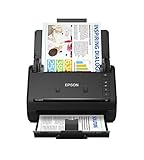
- FAST DOCUMENT SCANNING — Document scanner with feeder allows you to speed through stacks with a 50-sheet Auto Document Feeder (ADF); Efficient office scanner to help you scan more productively
- INTUITIVE, HIGH-SPEED SOFTWARE — Quickly scan with this desktop document scanner; Epson ScanSmart Software lets you easily preview scans, email files, upload to the cloud, and more; Plus, automatic file naming saves even more time
- SEAMLESS INTEGRATION — Easily incorporate your data into most document management software with the included TWAIN driver; Office document scanner integrates seamlessly with business workflows
- EASY SHARING — Duplex scanner allows you to scan straight to email or popular cloud storage2 services like Dropbox, Evernote, Google Drive, and OneDrive for simple storage and sharing
- SIMPLE FILE MANAGEMENT — Scanner allows the creation of searchable PDFs with Optical Character Recognition (OCR) and convert scans to editable Word or Excel files effortlessly; Designed for home and office document scanning
Workflow examples include contract review, invoice approval, employee files, customer onboarding, claims, quality control, change management, and correspondence routing. Ask whether the system handles sequential and parallel approvals, queues, deadlines, escalations, conditional rules, exceptions, forms, audit trails, process analytics, and controlled testing and deployment of workflow changes. OpenText positions workflow, business workspaces, document generation, and enterprise-application integration as parts of its Extended ECM offering; verify the capabilities and package relevant to your proposed deployment.
Records, retention, and security
Records management should be specific, not just a promise of “compliance.” Determine whether the platform supports records declaration, file plans, event-based retention, legal holds, disposition review, defensible deletion, locked records, audit trails, chain of custody, sensitivity labels, discovery and export, policy exceptions, and oversight of automated disposition. Microsoft describes records controls including retention, protection, auditing, legal holds, and final-state controls in its SharePoint ECM documentation. Software supports compliance; policy interpretation, configuration, user behavior, and audit evidence still matter.
- Backup is meant to restore systems or information after loss.
- Archiving preserves information, often for operational or compliance reasons.
- Records management applies controls to authoritative information throughout retention and disposition.
These functions can be related, but they are not interchangeable. For security, inspect role- and attribute-based controls, permissions at item, folder, workspace, and repository levels, identity-provider integration, single sign-on, multifactor authentication, conditional access, privileged administration, encryption, key management, data-loss prevention, audit logs, and delegated administration. Granular permissions can become an operational liability if no one owns access reviews and the permission model.
Integrations, extensibility, and AI
Assess APIs, webhooks, connectors, identity integration, email, ERP and CRM links, e-signature, analytics, migration tooling, SDKs, and low-code development. Integration also means monitoring failures, mapping identities, synchronizing metadata, and maintaining the connection over time. OpenText describes integrations with SAP, Salesforce, Microsoft 365, and other enterprise applications on its Extended ECM page.
What’s actually slowing this PC down?
Pick the symptom - the matching free tool is one click away.
Rank #4

- Scanner type: Document
- Connectivity technology: USB
- With Auto Scan Mode, the scanner automatically detects what you're scanning
- Digitize documents and images
AI may assist with OCR, classification, extraction, duplicate detection, summarization, translation, semantic search, and workflow recommendations. Treat it as a capability to test, not proof that a repository is ready for AI. Results depend on content quality, OCR, metadata, permissions, freshness, and duplicate control. OpenText markets conversational search, content discovery, summarization, translation, document generation, and generative-AI capabilities for its Content Management platform; availability and controls should be confirmed for the specific product and deployment.
- Is customer content used to train general models, and which model processes it?
- Are prompts, answers, and retrieved documents logged? Can users inspect source documents or citations?
- How are permissions enforced during retrieval, and can administrators disable features?
- Can staff review low-confidence classifications before they affect retention or legal status?
- How does the system handle stale or contradictory documents, multilingual scans, legal holds, and malicious instructions embedded in content?
Generative answers and autonomous agents carry greater risk than search or extraction because they can expose material, produce unsupported conclusions, or take actions. Keep human review and clear authorization boundaries for consequential decisions.
Architecture choices and vendor fit
Shortlist by the work the platform must do and the architecture your organization can operate—not by a universal ranking. Gartner’s 2026 document-management vendor field includes Box, DocuWare, Doxis, Dropbox, d.velop, Google, Hyland, IBM, Intalio, Laserfiche, M-Files, Microsoft, Newgen, OpenText, Objective, and Zoho, among others; the breadth of the field reinforces that product fit depends on capabilities and use case, not a single “best” label. See Gartner’s Critical Capabilities for Document Management.
| Architecture or product family | Often fits | Check carefully |
|---|---|---|
| Microsoft SharePoint / Microsoft 365 | Organizations already standardized on Microsoft that need coauthoring, document libraries, intranet, identity, and collaboration. | Advanced ECM can require additional services, configuration, governance, and specialist expertise. Licensing spans SharePoint, Microsoft 365, Purview, Power Platform, Copilot, and other services. |
| OpenText Content Management / Extended ECM | Large or regulated organizations with complex governance, records, archiving, document generation, and links to SAP or other enterprise applications. | Implementation and configuration can be complex; packaging and pricing are sales-led. Confirm exact package features and deployment model. |
| Hyland OnBase, Alfresco, and Nuxeo | Content-centric applications, case management, process automation, industry workflows, or embedded content services. | These are not interchangeable products. Compare the specific product, APIs, deployment, records, capture, workflow, DAM, and migration needs. |
| Laserfiche | Document and records management combined with forms, capture, workflow, and low-code process design. | Verify which capabilities are native, separately licensed, partner-delivered, or configuration-dependent; validate migration and integrations. |
| Box | Cloud-first collaboration, secure external sharing, distributed work, and content access across applications. | Confirm records declaration, legal holds, capture, complex workflow, and case-management depth before making it the primary ECM system. |
| M-Files | Organizations seeking to organize and retrieve content by business meaning and metadata rather than folder location. | Taxonomy ownership, metadata quality, integration breadth, migration, and user adoption are central to success. |
| DocuWare and similar mid-market platforms | Capture, invoice processing, approvals, and operational document workflows in small and mid-sized organizations. | Check global scale, records depth, developer tools, data residency, and complex integration requirements. |
| IBM FileNet, Newgen, and other enterprise platforms | Large-scale content services, case management, automation, industry solutions, or established governance needs. | Define the exact operating requirements and implementation capacity; no platform is a universal fit. |
Hyland’s public site describes its Content Innovation Cloud and identifies OnBase and Alfresco-related capabilities within a broader portfolio; compare the actual product rather than relying on a corporate-level label. See Hyland. Laserfiche describes document, records, AI-assisted organization, and automation capabilities on its products page and document and records management page.
Best Value

- OUR MOST ADVANCED SCANSNAP. Large touchscreen, fast 45ppm double-sided scanning, 100-sheet document feeder, Wi-Fi and USB connectivity, automatic optimizations, and support for cloud services. Upgraded replacement for the discontinued iX1600
- CUSTOMIZABLE. SHARABLE. Select personalized profiles from the touchscreen. Send to PC, Mac, mobile devices, and clouds. QUICK MENU lets you quickly scan-drag-drop to your favorite computer apps
- STABLE WIRELESS OR USB CONNECTION. Built-in Wi-Fi 6 for the fastest and most secure scanning. Connect to smart devices or cloud services without a computer. USB-C connection also available
- PHOTO AND DOCUMENT ORGANIZATION MADE EFFORTLESS. Easily manage, edit, and use scanned data from documents, receipts, photos, and business cards. Automatically optimize, name, and sort files
- AVOIDS PAPER JAMS AND DAMAGE. Features a brake roller system to feed paper smoothly, a multi-feed sensor that detects pages stuck together, and skew detection to prevent paper damage and data loss
How to choose ECM software
1. Define the content and process in scope
Inventory content types, volume and growth, annual creation, peak intake, scanned share, business owners, authoritative systems, external users, retention obligations, sensitive data, active workflows, and geographic requirements. Identify which material is an official record and which processes cannot function without it.
2. Score required capabilities
Use a weighted scorecard rather than awarding points for a vendor simply claiming a feature. Score each area for importance, then require a demonstration with your own scenarios.
| Capability area | What to test |
|---|---|
| Capture and OCR | Scans, email, forms, extraction confidence, review queues, and preservation of originals. |
| Metadata and classification | Content types, controlled terms, inheritance, correction, and quality monitoring. |
| Search and discovery | Full text, OCR, facets, permissions trimming, relevance, and cross-repository coverage. |
| Collaboration and sharing | Coauthoring, approvals, guests, secure links, and mobile experience. |
| Records and governance | Retention, legal holds, disposition review, audit, export, and policy exceptions. |
| Workflow and cases | Human queues, exception handling, escalation, integration failure handling, and process analytics. |
| Integration and operations | APIs, identity, ERP/CRM, monitoring, sandbox, release controls, and migration support. |
| AI controls | Permission boundaries, source visibility, model and logging terms, human review, and disablement. |
3. Decide whether to extend what you own
For a Microsoft-centered organization, compare configuring SharePoint and existing Microsoft services with adding a dedicated platform. The official U.S. pricing page showed SharePoint Plan 1 at $5 per user per month and Microsoft 365 Business Standard at $12.50 per user per month, both paid yearly; these are plan prices, not the cost of an ECM program, and licensing can vary by market and date. Check the current SharePoint plans and pricing before budgeting. Migration, governance, administration, storage, add-ons, automation, and compliance work can materially change total cost.
Other architectures include a dedicated enterprise suite for broad governance and connected processes, a specialist platform for capture or department workflows, or a federated content-services model that leaves records in existing applications while connecting metadata, search, and controls. A “single source of truth” might mean one repository, one logical search layer, one governance model, one authoritative system per content type, or synchronized systems. Those designs are not equivalent; name the one you actually need.
4. Test adoption and operational fit
Measure how easily users file and retrieve content, whether they can work in Outlook, Teams, Office, CRM, or ERP, whether metadata can be inferred, and whether the mobile and external-user experience is acceptable. Check that administrators can measure usage, users can correct bad classification, and department-specific needs do not produce unmanageable exceptions.
5. Calculate total cost of ownership
Include more than subscriptions: licenses, storage, usage-based AI or workflow charges, implementation, migration and remediation, taxonomy design, integrations, OCR, testing, training, change management, administration, records consulting, premium support, custom development, and eventual export or exit costs. Per-user, concurrent-user, storage, transaction, and module pricing can produce very different cost profiles. Public prices are often unavailable or incomplete: OpenText publishes package options but not a simple public per-user figure on its Extended ECM page; Laserfiche’s product information likewise does not establish a simple current public price. Obtain a quote for the precise users, modules, hosting, volume, support, and services required.
Implementation and migration
ECM is an operating model as well as software: it needs owners for information architecture, metadata, permissions, retention, workflow, and adoption. A phased implementation limits risk and reveals whether the selected platform works with real content.
Quick Recap
- Discover: Inventory repositories, shares, email, applications, owners, volumes, retention duties, sensitive data, workflows, external users, and integrations.
- Design the information architecture: Define content types, metadata, taxonomy, workspaces, search facets, authoritative systems, ownership, security, and retention categories.
- Prioritize a use case: Start with one or two valuable processes, such as contracts, accounts payable, employee records, engineering changes, onboarding, or claims—not every department at once.
- Run a realistic proof of concept: Include poor filenames, scans, duplicates, confidential files, complex permissions, guest users, exceptions, records, and legal holds. Measure retrieval success, classification accuracy, process time, user effort, relevance, access correctness, and migration fidelity.
- Remediate and migrate selectively: Decide for each content group whether to delete, archive, migrate unchanged, remediate first, convert, retain as a record, or leave in the source. Moving unmanaged files does not make them governed.
- Roll out and govern: Assign department champions and metadata stewards; provide training, usage monitoring, access reviews, retention reviews, search feedback, AI monitoring, and release management.
Common selection and rollout failures
- Buying a repository before designing information architecture: The result may be sprawling sites, duplicate content, inconsistent metadata, and poor search. Define content types, owners, retention, and authoritative sources before broad migration.
- Moving all legacy content as-is: Classify duplicates, obsolete files, personal content, unsupported formats, sensitive material, records, and unknown ownership before deciding what to move.
- Treating every file as a record: Over-classification creates unnecessary retention, legal, storage, and administration burdens. Define official records and distinguish them from transient work.
- Expecting search to repair bad information: Search cannot fix bad OCR, missing permissions, duplicate versions, ambiguous titles, or conflicting source systems.
- Ignoring permissions during migration: Inherited access, old groups, guest links, and shared accounts can expose information or prevent legitimate users from finding it.
- Underestimating integrations: Linking content to ERP, CRM, HR, email, or case systems can require identity mapping, synchronization, event handling, error queues, and ongoing maintenance.
- Letting AI decide records status without controls: Test and monitor generated metadata; require appropriate review before it determines retention or legal status.
- Selecting from feature checklists alone: Compare depth, usability, administration, migration tools, proven integration patterns, performance at your scale, partner quality, and total cost.
- Leaving exit terms until later: Require a way to export files, metadata, audit history, legal-hold and retention state, workflow definitions, and other necessary records, and clarify contractual migration assistance.
Which approach makes sense?
- Extend Microsoft 365 when collaboration and Office integration are central, the existing environment is established, and the organization can design and operate the additional governance and compliance controls it needs.
- Choose a dedicated enterprise ECM suite when records, complex workflows, archiving, and business-application integration must work across a large or regulated organization.
- Choose a specialist platform when a defined process—such as invoice capture, forms, case management, or external sharing—is the priority and the product’s governance depth fits the requirement.
- Keep a federated architecture when authoritative content must remain in several operational systems but users need connected search, context, and governance.
- Delay broad migration if ownership, retention rules, access model, or authoritative sources are still unknown. Resolve those decisions and pilot a high-value use case before expanding.
Product prices and availability are accurate as of the date/time indicated and are subject to change. Any price and availability information displayed on Amazon at the time of purchase will apply.
Quick wins for a faster PC:
Fix the driver behind crashes, sound loss and screen glitchesFind Drivers →Clear out junk files and repair common Windows errorsFree Scan →



