Free tools Windows power users keep installed
One-click scans. No signup required.
The most effective way for a CIO to break down silos is not to add another collaboration app. It is to redesign the operating model around shared business outcomes, clear decision rights, reliable information, and teams that can move work across functional boundaries with fewer handoffs.
Silos are usually a sociotechnical-system failure: incentives, ownership, processes, data, technology, and governance reinforce one another. Collaboration tools can help, but they amplify the system already in place. DORA’s 2025 research describes AI in similar terms: it can accelerate a healthy organization while magnifying fragmentation and weak controls in an unhealthy one. DORA’s research and Atlassian’s 2026 technology-leadership research both make the issue especially relevant as enterprises deploy AI across departments.
What a silo really is
A silo exists when a group, system, or process optimizes locally while obscuring information, decisions, dependencies, or consequences from the rest of the organization. Specialization is not automatically a silo. Specialized teams can work well when their goals, interfaces, ownership, and information exchanges are explicit.
- Organizational silos: Functions operate under separate leaders, budgets, targets, and career structures.
- Data silos: Information is inaccessible, duplicated, inconsistently defined, or trapped in separate systems.
- Process silos: Work crosses departments through manual queues, approvals, and handoffs.
- Technology silos: Platforms, identity systems, architectures, or data models cannot work together reliably.
- Knowledge silos: Critical context exists only in private chats, email, or individual expertise.
- Incentive silos: Local performance targets reward behavior that damages the end-to-end outcome.
- Geographic and hybrid-work silos: Distributed staff have unequal access to informal decisions and context.
- AI silos: Departments independently adopt models, agents, data sources, and policies without common oversight.
The CIO should therefore treat silo reduction as an operating-model and accountability problem before treating it as a software-purchasing problem.
#1 Best Overall

- The 5 tier letter tray with handle pull out trays of well-thought out dimensions that will keep the stuff you need organized, at hand
- Contemporary and elegant mesh construction with powder coat finish will blend in with any décor. It’s versatile and you can add to any space in your home or office
- A smart & practical desk file tray decorative and multifunctional will be a reliable helper for your families, friends, co-workers, etc, helping them get rid of messy working tables
- Made of high quality mesh steel construction with good touch feeling, and you can move it easily. It will hold all your files, folders, and papers
- The desk trays provide a great way to tidy any A4 or paper sized paperwork, folder, document, magazine with space for stationary & desk accessories. For use on office, home or school classroom.
The CIO’s role: architect of collaboration
The CIO is not the sole owner of cross-functional behavior. The CEO, business-unit leaders, finance, HR, legal, security, and risk functions all reinforce—or undermine—the operating model. The CIO’s distinctive responsibility is to connect business and technology priorities, design usable interfaces between teams, establish enterprise guardrails, and make information and ownership visible.
That means changing budgets, incentives, prioritization, and authority—not merely asking people to “collaborate better.” A CIO analysis published November 12, 2024 correctly connects silos with leadership, governance, resilience, innovation, and generative-AI execution. The practical test, however, is whether teams can make better decisions faster with less rework.
Diagnose before reorganizing
Do not launch a company-wide reorganization based only on employee sentiment or collaboration-platform usage. Begin with one high-value workflow and collect evidence.
Evidence to collect
- Where priority work waits for another team.
- How many handoffs an initiative requires from request to outcome.
- Which decisions are repeatedly escalated.
- Where people enter or reconcile the same data more than once.
- Which teams cannot see upstream priorities or downstream consequences.
- Where incidents reveal unclear ownership.
- Which metrics reward local optimization.
- Whether every product, service, data domain, and customer journey has a known owner.
- Where consequential decisions are recorded and whether they are searchable.
- Which tools duplicate one another or create notification overload.
A practical diagnostic
- Map one customer journey or value stream from request to measurable outcome.
- Interview IT, security, finance, legal, operations, product, sales, and frontline users.
- Review incident postmortems, project delays, change approvals, and duplicated investments.
- Create a dependency map of teams, systems, data owners, and approval points.
- Keep a two- to four-week friction log recording every wait, rework loop, unclear decision, and missing artifact.
- Select one workflow with visible impact, a measurable baseline, and an executive sponsor.
Replace functional activity with shared outcomes
Departmental activity metrics often conceal the real result. Replace them with a small number of jointly owned outcomes.
Windows Errors? Fix Them Before They Spread
Repair common Windows errors and clear accumulated junk for a smoother, more stable PC - no reinstall needed.Free scan · no reinstallCrashes, No Sound, or Screen Glitches?
Random freezes, missing sound and display glitches usually trace back to one bad driver. Find and replace yours safely.Free scan · under a minute| Siloed goal | Shared outcome |
|---|---|
| IT closes tickets quickly | Employees complete a critical business process without avoidable interruption |
| Security increases control coverage | Critical risk falls without making approved delivery unworkably slow |
| Product ships features | Customers complete a target journey more successfully |
| Finance reduces technology spend | Business value per technology dollar improves |
| Data publishes datasets | Decision-makers receive trusted data when decisions are made |
| Infrastructure maintains uptime | A customer-facing service meets its reliability and revenue objectives |
For each outcome, define what each function owns directly, what it influences jointly, which decisions it can make independently, and which dependencies it must expose. Shared OKRs are useful only when leaders also change funding, incentives, and priority-setting.
Choose team structures deliberately
Cross-functional teams are not a universal answer. The right structure depends on the work, required skills, risk, and scale.
Rank #2

- All-in-One Desk Organizer: WALI multi-tier desk organizer features 4 letter trays, a vertical file folder organizer, 2 metal pen holders and a sliding divided drawer, keeping your office supplies for desk tidy and maximizing desktop space, ideal for women and men as office desk accessories
- Premium Metal Quality: WALI desktop file organizer is crafted from thickened steel metal wire mesh, featuring dense small mesh to hold desk supplies steadily. Its sturdy structure enhances load-bearing capacity to avoid deformation; all parts are firmly fixed to prevent falling, ensuring overall stability and durability of the desktop organizer
- Save Space: Documents are organized by the vertical file folder organizer. Tiered letter tray is suitable for planner, paper, letters,books, magazines, mail, bills and phones. The sliding drawer and metal pen holders can store all office supply accessories, such as pens, pencils,markers, scissors, suitable for workers, teachers and students
- Easy Installation: No complicated tools or tedious steps. 1 Pack WALI desk organizers and accessories can be assembled in minutes with clear instructions. Ideal for office, dorm, college, home office, school, classroom use
- Elegant & Practical Decor: Classic black finish complements any office, school or dorm decor, serving as both a practical home office storage and organization tool and a sleek desktop decor to show your professional style, ideal for users who pursue a tidy, aesthetic workspace
Product or value-stream teams
A durable team owns an end-to-end product, service, customer journey, or business capability. It includes—or has dependable access to—the capabilities needed to discover, build, secure, operate, measure, and improve that service.
This reduces handoffs and clarifies accountability, but it can duplicate specialists, weaken standards, or make teams too large. End-to-end ownership does not mean every team owns everything.
Platform teams
Platform teams provide reusable capabilities such as identity, deployment infrastructure, data services, observability, or developer tooling. Their purpose is to reduce repeated work for product teams, not to become a central approval queue.
Microsoft’s Azure guidance, updated January 9, 2026, recommends clear boundaries between platform and workload teams, cross-functional representation, policy-based governance, and end-to-end ownership. The principles also apply beyond Azure when translated for multicloud, on-premises, and business-function environments.
Enabling teams
Enabling teams provide specialized coaching in areas such as security, cloud architecture, data governance, accessibility, or DevOps. Their engagement should normally be time-bound: they close a capability gap and help the receiving team become more independent rather than becoming a permanent dependency.
Communities of practice
Communities of practice preserve functional excellence while allowing knowledge to travel across delivery teams. They should produce reusable patterns, standards, and decisions—not just recurring discussion meetings.
Recommended Free Tools
Rank #3

- Unique 3+2 Shelves Design: 3 Tier sliding trays are perfect for storage all your documents,file folders and other desk accessories, 2 upright section is ideal for place your other paper/letters vertically.
- Made of sturdy metal steel mesh with smooth edge and professional black finish, more durable and stable, strong enough to hold all your files and sundries.
- The 3-tier paper tray and two vertical file shelves have a beautiful A4/letter size paper, documents,notepad, book, mailbox contact, files, folders and additional items such as stapler, tape, sticker, etc.
- More Sturdy Construction: Made of thick rounded mesh metal, not easy to bent, also with 2 metal bars to reinforce, more strong and durable compared with many other similar products in the market.
- Overall Size:12-1/4"W x 11-1/2"D x 9-1/2"H; each horizontal tray :12 x 11.4 x 2.7 inch(L x W x H);2 file holder:12 x 9.5 x 2 inch(L x H x W)
The Team Topologies vocabulary—stream-aligned, platform, enabling, and complicated-subsystem teams—can provide a useful design language. It is a model, not a rigid organizational template.
Make decision rights explicit
Inviting people to a meeting does not give them authority. For each consequential decision, define:
- Who is accountable for the outcome?
- Who makes the final decision?
- Who must be consulted or informed?
- Is the decision reversible?
- What risk requires executive, legal, security, or compliance review?
- What is the escalation path and decision deadline?
- Where will the decision be recorded?
- What happens if the deadline is missed?
A lightweight decision record should contain the decision, context, options considered, owner, date, constraints, risks, and a trigger for revisiting it. Avoid requiring consensus for every issue. Transparent consultation plus one accountable decision-maker is usually faster and clearer than giving every participant an invisible veto.
Govern through guardrails, not queues
The governing principle is simple: standardize controls that must be consistent; decentralize decisions that are close to the work.
The Tool Desk
Outbyte PC Repair FREEClear out junk files and repair common Windows errorsFree Scan →Outbyte Driver Updater FREEScan for outdated or missing drivers - takes under a minuteDriver Scan →Effective governance defines non-negotiable security, privacy, regulatory, architecture, and reliability requirements; automates checks where possible; supplies approved patterns and reusable components; publishes service expectations for central teams; and makes exceptions time-bound and visible.
Weak governance makes every team follow the same process regardless of risk, turns architecture or security into a permanent queue, confuses documentation with control, and measures approval counts instead of risk reduction. Track the time and cost governance imposes, as well as the incidents and exceptions it prevents.
Rank #4

- [5-Tier Paper Organizer with Handle]– This desktop paper organizer features 5 open-front letter trays and a built-in handle, making it easy to move between your desk, shelf, classroom table, or home office workspace.
- [Sort Papers, Folders, Mail & Documents]– Use this desk file organizer to keep letter-size paper, file folders, documents, mail, bills, forms, and notebooks neatly separated for quick access during daily work or study.
- [Office Storage for a Cleaner Desk]– Designed for desk organization and office storage, this paper storage organizer helps reduce workspace clutter and keeps important paperwork off your desktop but still within easy reach.
- [For Office, Home & Classroom Organization]– A practical letter tray organizer for offices, home offices, schools, dorm rooms, reception areas, and teacher desks. Available in more stylish color options, it also works as a cute desk organizer for women, adding a personalized touch to classroom storage, homework trays, and daily paper sorting.
- [Sturdy Metal Mesh Desk Organizer] – Made with durable metal mesh and a reinforced frame, this file folder organizer also works for desk accessories, catalogs, magazines, and paperwork while (USPTO Patent Pending, USPTO Patent Application Number: 23715477)
Policy-based controls and explicit platform contracts are generally more scalable than manual centralization. In regulated industries, preserve segregation of duties, legal privilege, retention, data residency, and auditability while still automating routine checks.
Build a trusted information flow
Most enterprises need several systems, not one universal application. Define an authoritative source for each information type and connect the systems reliably.
- System of record: The authoritative location for product, project, service, or portfolio work.
- Knowledge base: Decisions, standards, architecture, policies, runbooks, and FAQs.
- Communication layer: Time-sensitive discussion and coordination.
- Workflow automation: Intake, approvals, notifications, and escalation.
- Visual collaboration: Journey maps, service blueprints, architecture diagrams, and workshops.
- Data and analytics: Shared definitions, dashboards, ownership, and lineage.
- Identity and governance: Access, provisioning, audit, retention, and data-loss controls.
Set practical rules: chat is for coordination, while durable decisions belong in the knowledge or work system; every major initiative has one canonical status location; every service has an owner, support path, dependency list, and measurable objective; and integrations reduce duplicate entry rather than broadcasting every event everywhere.
Search, permissions, retention, source attribution, and discoverability matter as much as messaging speed. AI summaries and enterprise search are useful only when access controls, data quality, retention, and provenance are reliable. DORA’s 2025 findings support the broader warning that AI amplifies existing organizational strengths and weaknesses.
Run a 60- to 90-day pilot
Choose a workflow that crosses at least three functions, has visible business impact, a measurable baseline, identifiable handoffs, an executive sponsor, and enough importance to matter without making safe experimentation impossible.
- Measure the baseline: Record cycle time, wait time, rework, defects, escalations, and satisfaction.
- Define one outcome: Use a result that matters to the customer, employee, business, or risk owner.
- Name one accountable owner: Do not substitute a committee for accountability.
- Form the smallest capable team: Include the minimum necessary business, technology, security, data, and operational expertise.
- Map decisions and dependencies: Make ownership, consultation, escalation, and deadlines visible.
- Create one source of truth: Link communication to durable work and decision records.
- Remove or automate one major handoff: Prove a mechanism rather than launching a broad cultural program.
- Review weekly: Examine flow, blockers, risks, and outcome progress—not meeting attendance.
- Retrospect: Ask participants and stakeholders what changed and what remains blocked.
- Scale selectively: Expand only the practices that improved outcomes without unacceptable risk or overload.
Measure collaboration without rewarding noise
Use a balanced scorecard rather than counting messages, meetings, integrations, or active users.
Best Value
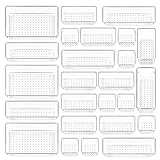
- ✔Make Everything Organized -- These clear versatile drawer dividers trays are perfect for any place in your home. Fit all kinds of drawers, such as vanity / bathroom / kitchen / office drawers/ craft room, ideal for organizing cosmetics, makeup tools, hair accessories, jewelry, pins, office supply, craft supplies, utensils, etc.
- ✔Combination of 4 Different Sizes -- One set includes 25pcs storage bins in 4 different sizes, which help you customize combinations to store items and organize drawer in shelf/ closet/ cabinet/ dresser . Includes: 9 x 6 x 2 inches (3pcs), 9 x 3x 2 inches(6pcs), 6 x 3 x 2 inches(8pcs), 3 x 3 x 2 inches(8cps).
- ✔Non-Slip and Durable -- Extra 100pcs silicone pads are included, just stick them on the bottom of the plastic trays for non-slip. Made of durable and clear plastic, so you can see what’s in it without digging around or making a mess, help you get a neat lifestyle.
- ✔Stackable Storage -- The drawer bins can be stacked into one other when you not use them, that will save much space and organize well. You will find it's so easy to keep things neat and tidy.
- ✔Easy to Clean -- Our desk drawer storage bins are easy to be wiped clean with a damp cloth and perfect for keeping everything in its place. Convenient for use in your daily life, make everything look beautiful and better organized.
Flow and delivery
- Lead time from approved idea to usable outcome.
- Time waiting on another team.
- Number of handoffs and percentage of work blocked by dependencies.
- Rework rate, change failure rate, and time to restore service.
- Decision latency and dependency-resolution time.
For software delivery, DORA’s commonly used measures are deployment frequency, lead time for changes, change failure rate, and time to restore service. DORA’s metrics are not a universal collaboration scorecard for finance, HR, legal, or every other function.
Business and collaboration outcomes
- Revenue, cost, risk, customer completion, adoption, or reliability impact.
- Employee productivity in a defined workflow.
- Percentage of major decisions documented.
- Percentage of work with a named owner and shared outcome.
- Stakeholder clarity about ownership, trust, and psychological safety.
- Search success for critical information.
Guardrails
- Security incidents and compliance exceptions.
- Unplanned work and employee overload.
- Tool sprawl, duplicate platforms, and duplicate data stores.
- Meeting hours and notification volume.
Choose tools by bottleneck, not popularity
| Bottleneck | Relevant category |
|---|---|
| Decisions and institutional knowledge are hard to find | Knowledge base or intranet |
| Ownership and dependencies are unclear | Work-management or issue-tracking system |
| Distributed coordination is slow | Messaging and meeting platform |
| Workshops and service mapping are weak | Visual-collaboration platform |
| Data definitions conflict | Data catalog, governance, and lineage tooling |
| Approvals are manual and inconsistent | Workflow automation |
| Access and auditability are weak | Identity, provisioning, and governance tooling |
Slack is most useful when distributed communication is the bottleneck and integrations can connect discussion to authoritative work. Its official pricing page currently displays Free, Pro, Business+, and Enterprise+ options; displayed prices and promotions are volatile, so verify them before purchasing at Slack’s pricing page.
Confluence is designed for durable knowledge, decisions, architecture, policies, and institutional memory. Its pricing page currently displays Free for up to 10 users, Standard at $5.42 per user per month, and Premium at $10.44 per user per month on the displayed view. Billing method, user count, geography, taxes, and enterprise arrangements can change the effective price. See Confluence pricing.
Jira can expose work, dependencies, releases, incidents, and change workflows, but it can also impose unnecessary process complexity when business work is forced into engineering-style workflows. See Jira’s current plans.
Quick wins for a faster PC:
Repair Windows errors before they cause bigger problemsFix Now →Scan for outdated or missing drivers - takes under a minuteDriver Scan →Miro is well suited to discovery workshops, customer-journey mapping, service blueprints, architecture visualization, and retrospectives. It should not be the sole system for durable ownership or operational status. Enterprise pricing is custom; compare governance, security, integrations, data residency, AI controls, and support at Miro’s pricing page.
Organizations already using Microsoft 365 should evaluate Teams, SharePoint, Entra ID, OneDrive, Outlook, and Power Platform as one governed estate rather than judging Teams as an isolated chat product. Review the relevant commercial edition and region at Microsoft Teams.
The procurement question is not “Which platform breaks down silos?” It is “Which bottleneck does this platform improve, and how will we prevent it from creating another source of truth?” Include licensing, migration, integrations, administration, training, governance, change management, retention, SSO/SCIM, audit, data residency, and support in total cost of ownership.
Failure modes and edge cases
- Adding a tool to a structural problem: Chat cannot resolve conflicting incentives or unclear ownership.
- Creating a committee without authority: Consultation without power adds delay, not accountability.
- Building a matrix with two bosses: Dual reporting requires explicit tie-breakers and escalation rules.
- Making a giant platform team: A central team becomes a bottleneck when it owns too many services or relies on manual approvals.
- Measuring activity: More messages and meetings may mean more noise.
- Treating one application as the source of truth: Define authoritative sources by information type instead.
- Ignoring non-IT functions: The most costly boundary may be between IT and operations, finance, legal, sales, manufacturing, or customer support.
- Scaling a heroic pilot: Test whether the method works beyond unusually motivated participants.
- Ignoring confidentiality: Transparency must respect legal privilege, segregation of duties, privacy, and data residency.
- Overlooking remote work: Replace hallway knowledge with searchable decisions, deliberate documentation, and inclusive meeting practices.
- Underestimating legacy constraints: Begin with bounded services and dependency visibility when immediate team autonomy is unrealistic.
- Misapplying cross-functional teams: Highly specialized engineering or incident-response work may need expert participation without making every specialist a full-time team member.
A practical CIO checklist
- Identify the highest-cost silo using workflow evidence.
- Name the shared business outcome.
- Map the value stream and its handoffs.
- Assign one accountable owner.
- Define decision rights, escalation rules, and decision records.
- Choose an authoritative source for each critical information type.
- Establish automated guardrails and time-bound exceptions.
- Form the smallest team with the required capabilities.
- Run a bounded 60- to 90-day pilot.
- Measure waiting, handoffs, rework, outcomes, risk, and employee load.
- Scale only practices that improve the result without creating new dependencies.
The Bottom Line
Breaking down silos is an operating-model transformation, not a collaboration-software rollout. Start with one costly workflow, align teams around a measurable outcome, give an accountable owner real authority, make information durable and searchable, govern through automated guardrails, and scale only what improves flow and business results.
Do these 3 things before closing this tab:
1Clear out junk files and repair common Windows errors2Scan for outdated or missing drivers - takes under a minute3Repair Windows errors before they cause bigger problemsQuick Recap
Product prices and availability are accurate as of the date/time indicated and are subject to change. Any price and availability information displayed on Amazon at the time of purchase will apply.




