Quick wins for a faster PC:
Clear out junk files and repair common Windows errorsFree Scan →Scan for outdated or missing drivers - takes under a minuteDriver Scan →Repair Windows errors before they cause bigger problemsFix Now →There is no single electricity figure for a data center. A facility’s consumption depends on its computing equipment, how heavily that equipment is used, its cooling, and its supporting power infrastructure. The most authoritative national estimate available is from the Lawrence Berkeley National Laboratory (LBNL), published through the U.S. Department of Energy (DOE) as the United States Data Center Energy Usage Report: 2025 Update. It estimates that U.S. data centers used 192 terawatt-hours (TWh) in 2024, or 4.7% of total U.S. electricity consumption, and it projects rapid growth through 2030. Those are modeled national figures, not metered totals for any one building. Operators reduce demand mainly by improving how much useful computing they get from each unit of energy, improving how power is delivered and heat is removed, and, where workloads allow, moving when computing happens.
How much electricity data centers use
The LBNL/DOE report is the reference point for national scale. Its figures are estimates and projections based on modeling and stated assumptions, and they describe the United States only.
| Measure | Value | Scope and qualification |
|---|---|---|
| U.S. data center use, 2024 | 192 TWh | Modeled national estimate in LBNL/DOE United States Data Center Energy Usage Report: 2025 Update |
| Share of U.S. electricity, 2024 | 4.7% | Share of total U.S. electricity consumption in the same report |
| Reference case, 2028 | 464 TWh | Projection, not an observed value |
| Reference case, 2030 | 649 TWh | Projection, not an observed value |
| Reference case share, 2030 | 11.8% | Share of forecast U.S. electricity use in the reference case |
| 2030 sensitivity range | 9.5% to 15.3% | Share of forecast U.S. electricity use across the report’s sensitivity cases, as summarized by DOE in Powering America’s AI Future: Data Center Resource Hub (2026) |
What the projections do and do not tell you
The 2030 sensitivity cases show how much the outcome depends on assumptions. The 2025 report gives sensitivity estimates ranging from 11% below to 21% above the reference case. It also says that compounded uncertainty could be roughly 20% below to 30% above. These are model uncertainty ranges. Unless the report defines them as statistical confidence intervals, do not describe them that way.
Two limits matter for any reader. First, a national total cannot tell you what a specific facility consumes. A campus, a colocation hall, and a hyperscale building can differ widely even when they serve similar customers. Second, the reference case is a scenario rather than a promise. The report stresses that industry trends, technology changes, and other external factors could move the outcome in either direction.
Do these 3 things before closing this tab:
1Fix the driver behind crashes, sound loss and screen glitches2Repair Windows errors before they cause bigger problems3Scan for outdated or missing drivers - takes under a minute#1 Best Overall

- An ultra quiet fan system designed for cooling cabinets that requires minimal noise.
- Features a multi speed controller to set the fans speed to optimal noise and airflow levels.
- Contains a CNC machined aluminum frame with a modern brushed black finish.
- Powered by wall outlet or USB port, included Turbo Adapter increases performance by 25 percent.
- Dimensions: 4.6 x 4.6 x 1.3 in. | Airflow: 26 CFM | Noise: 17 dBA | Bearings: Dual Ball
Why demand is rising
According to the report, recent and projected growth is driven mainly by two trends: more accelerated servers (machines built around GPUs and similar processors) are being shipped, and each of those servers has a higher rated power.
The report also warns that efficiency gains do not guarantee lower total use. There are two different measures to keep apart:
Rank #2

- 【better after-use experience】 Temperature reduction provides an expected longevity extension and higher performance of a critical network component,These fans are overall very helpful for devices that get a bit hot and start to throttle down.
- 【choice of most users】It works great ,for DIY cooling fan or as an additional cooling ,fan for your gaming needs. like as router, cabinet, Modem, DVR, Receiver, Streaming ,boxes, x-box, SSD, Security Camera NVR, andriod box, stereo, T-Mobile gateway. Good balance of quiet and airflow. keeping electronics cool .Three specifications of fans, suitable for more usage scenarios .
- 【Custom shock absorbing feet】 four feet using environmentally friendly rubber, after testing, the softness of the feet that can smoothly grab the desktop, not too hard and desktop resonance .
- 【Fan parameters】Connecter: USB; Cable Length: 55cm Or 21 inches; Bearing type: Sleeve ; Life: 35000 hours / Dimension: 360mm(L) x 120mm(W) x 25mm(H) / 4.7x4.7x1 in. per fan; Rated Voltage:5V 0.2A; Speed: 1500RPM; Air flow: 56.7CFM; Noise:23dBA .
- 【Warranty & Packing List】Warranty: One-year quality assurance. Please contact us, If the product has any quality problems, it will be refunded within 90 days or replaced within one year | Packing list: A finished product .
- Energy efficiency per computation measures how much work a chip or system completes per unit of energy. It can improve every year.
- Absolute electricity consumption measures how much power a facility or the nation draws in total. It can still rise if the amount of computing grows faster than efficiency improves.
A facility can become more efficient per computation and still draw more power overall. Most of the confusion in public discussion comes from treating these two measures as the same.
How operators can reduce demand
The report calls for continued work across six areas: chip design, IT hardware and system architecture, computing resource management and scheduling, facility power distribution, backup power systems, and cooling technologies. A useful way to read this list is in two halves. The first three areas reduce the energy needed for useful computation. The last three improve how the facility delivers power and removes heat. The report identifies these as areas to explore. It does not assign a fixed percentage saving to any of them.
Rank #3
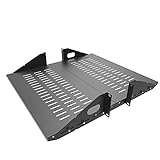
- Compatible with all 19” racks and cabinets to hold various IT, network and other equipment.
- Dimensions: W 19" x D 10" x H 2U per shelf ; 2 Shelves as set
- This Vented Center Weighted Mounting Rack Shelf fits the mounting posts in different deepth from 75 mm to 125mm.
- Max Weight Capacity: 110 Pounds; Center weighted.
- Slotted Venting to Improve Air flow and Help Prevent Overheating of Your Equipment
| Lever | Layer | What it affects | Savings figure |
|---|---|---|---|
| Chip design | IT side | Energy per computation | Not stated in the source |
| IT hardware and system architecture | IT side | Energy per computation | Not stated in the source |
| Computing resource management and scheduling | IT side | Energy per computation; can also change when loads run | Not stated in the source |
| Facility power distribution | Facility side | Losses between the grid connection and the equipment | Not stated in the source |
| Backup power systems | Facility side | Efficiency of backup power equipment | Not stated in the source |
| Cooling technologies | Facility side | Energy used to remove heat | Not stated in the source |
| Demand flexibility (shifting load timing) | Operations | When demand occurs, not necessarily total energy | Not stated in the source |
Sources: LBNL/DOE, United States Data Center Energy Usage Report: 2025 Update (2025), efficiency and flexibility sections.
IT-side measures
Chip design, hardware architecture, and workload management all sit closest to the computation itself. Reducing the energy each job requires lowers the load the facility must power and cool, so the benefit flows through the rest of the building. Scheduling decisions also determine how well servers are used, which affects how much idle hardware draws power.
Rank #4

- Space-Saving Design: Measures 19.0"H x 21.7"W x 17.7"D with a 14.2" max mounting depth, our 9U rack fits tight spaces while holding full 19" gear—ideal as a server cabinet or wall mount network cabinet for home offices and small server rooms
- Full Security: Both the lockable glass door and side panels protect your hardware from theft or tampering. This 9U wall mount rack gives you peace of mind in public or shared environments, ensuring your equipment rack stays safe and secure
- Active Cooling: The built-in cooling fan prevents overheating, keeping your wall mount server rack running reliably. Perfect for active networks, this 9U network rack extends the life of switches, routers, and PDUs by maintaining consistent airflow
- Heavy-Duty Build: Cold-rolled steel construction supports up to 110 lbs of 19" IT and A/V devices. Whether you need a wall mount server cabinet for shallow servers or a wall mount network rack for patch panels, this delivers years of reliable use
- Easy Installation: Pre-marked mounting holes and top/bottom cable ports make setup fast. Adjustable rails and numbered U positions allow precise rack mounting of your gear. This turns any wall into a tidy, professional server room in minutes
Facility-side measures
Power distribution, backup power, and cooling are where a facility’s own infrastructure converts grid electricity into usable computing power and removes the heat that results. Improvements here usually depend on measuring the existing system first. A cooling upgrade that does not match the actual heat load, for example, may not save much.
Demand flexibility
The report also recommends characterizing how data center demand varies over time and investigating flexibility, meaning shifting the timing of computing loads where operations allow. This is best understood as a way to serve more computing demand with a given set of energy resources. It is not a universal option. Latency-sensitive services and workloads that must run continuously generally cannot be moved without affecting service.
What’s actually slowing this PC down?
Pick the symptom - the matching free tool is one click away.
Best Value

- Color LCD control panel. Simplifies operation, clearing of codes and easier to read.
- Matte black cabinet brings stylish utility to the workplace.
- Added bumpers enable safer handling and movement around your facility.
- Larger casters makes rolling and navigation easier.
- Cools to mid-60s °F — for effective heat control around electronics, servers, and computers.
A practical starting sequence for operators
DOE’s Federal Energy Management Program (FEMP) publishes data center energy-efficiency resources and design best practices, revised in 2024 for a range of scenarios. The sequence below follows the report’s logic and FEMP’s emphasis on measurement and engineering assessment.
- Measure total facility electricity and separate IT load from cooling and power-delivery losses over a representative period.
- Review IT utilization and identify idle or underused servers, along with workloads that could run more efficiently.
- Assess power distribution, backup systems, and cooling against the measured load, using FEMP’s design best practices.
- Decide which loads, if any, can move in time without affecting service, and only then evaluate demand flexibility.
- Re-measure after each change so the result reflects the facility’s own data rather than a national estimate.
FEMP’s guidance does not establish a guaranteed savings percentage for any operator. The actual result depends on the facility’s equipment, climate, workload, and design.
Choosing between options
When comparing measures, use five questions:
- Layer: Does it act on the IT equipment or on the facility infrastructure?
- Effect: Does it reduce total energy, or only shift the timing of load?
- Cost: What capital and operating requirements does it carry? The cited sources do not give comparative prices for individual technologies.
- Constraints: Will it affect reliability, latency, or the type of workload the facility serves?
- Evidence: Is the expected benefit based on a measurement of the facility, or only on a national modeled estimate?
Answering the first question with a national figure and the second with a sensible sequence of measurements gives an operator a far clearer basis for decisions than any single headline number.
Quick Recap
Product prices and availability are accurate as of the date/time indicated and are subject to change. Any price and availability information displayed on Amazon at the time of purchase will apply.




