Quick wins for a faster PC:
Fix the driver behind crashes, sound loss and screen glitchesFind Drivers →Repair Windows errors before they cause bigger problemsFix Now →In March 2025, barley farmers were worried for a reason that is easy to miss from the bar stool. The malt they grow is bought largely to make beer, and two pressures were hitting that chain at once. Americans were drinking less beer, which weakened a domestic buyer for malting barley, while new tariff disputes threatened export markets and raised the cost of inputs farmers rely on. Reuters reported the concern on March 18, 2025. The farmers it quoted were describing exposure and fear, not a measured estimate of tariff losses across U.S. barley farms.
How barley ends up in a beer glass
Malt is made by germinating barley kernels, and it is a key ingredient in beer. That link is why a fall in beer demand can reach a barley field. Only barley that meets malting requirements feeds this chain, so beer demand matters most to the malting share of the crop, not to barley as a whole.
Montana grower Mitch Konen, who is also vice president of the National Barley Growers Association, told Reuters that roughly half of his barley was destined for Mexico, where it would be made into beer. Some of that finished beer came back to the U.S. as Modelo, Corona, and Pacifico. His case shows how one farm’s malt can cross two borders before it reaches a shelf.
Domestic beer demand: what the numbers show and what they do not
Reuters reported that U.S. beer consumption in 2024 reached its lowest level in more than 40 years, attributing the observation to Brewers Association chief economist Bart Watson. The story did not give an exact volume for that claim. Later Brewers Association data uses several different measures, which are easy to confuse:
Recommended Free Tools
#1 Best Overall
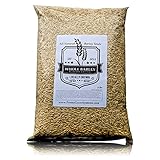
- All Natural Barley Seeds - USA Grown
- Bulk 5 pound bag of Barley Seed
- Whole Barley - hulls intact
- Perfect for growing barley grass for juicing
- Barley can also be used for Malt Brewing and Beer Making
| Measure | Period | Reported value | Source | What it measures |
|---|---|---|---|---|
| Per-capita beer consumption | 2010 and 2024 | 29.0 gallons falling to 23.1 gallons per legal-drinking-age adult | Brewers Association published series | Consumption per adult; the Association describes the fall as more than 20% |
| U.S. craft beer production | 2025 | 22,034,000 barrels, down 4% | Brewers Association 2026 production report | Craft production volume only |
| Overall U.S. beer category volume | 2025 | Down 5.7% by volume | Brewers Association 2026 production report | Total category volume, including non-craft beer |
| Monthly craft beer drinking among the general population | 2025 and 2026 | 30% in 2025, 28% in 2026 | Brewers Association 2026 consumer survey | Share of people who report drinking craft beer monthly; not a volume measure |
These figures point the same direction, but they do not measure the same thing. A drop in craft production is not the same as a drop in malt purchases, and a survey share is not a sales total. The survey also found that 54% of adults who drink alcohol but do not drink craft beer say they avoid it because they do not like the flavor. That is a reason for craft’s share to be flat, not a measure of barley demand.
Export exposure: Canada and Mexico
Domestic beer demand was only half the problem. Reuters described Canada and Mexico as the two export outlets at the center of the story, but they were in different positions in March 2025.
Rank #2

- 93% Germination Rate
- Grown in the U.S.A.
- Certified Organic
- Non-GMO
| Factor | Canada | Mexico |
|---|---|---|
| Role in U.S. barley trade (as Reuters described it) | Largest importer of U.S. malt barley | Third-largest importer of U.S. barley and the biggest importer of U.S. malt |
| Measure in place at the time of the report | Canadian counter-tariffs on U.S. barley and other agricultural goods took effect March 4, 2025 | No enacted measure described in that passage |
| Risk described in March 2025 | Loss of a large malt outlet under the counter-tariffs | Possible retaliation or switching to other suppliers, presented as a possibility |
| Status in later sources reviewed for this article | Not stated for Canada’s counter-tariffs; check current Canadian schedules | Not stated; no Mexican retaliation is confirmed here |
The two markets should not be treated as interchangeable. Canada’s exposure in the story was an enacted counter-tariff. Mexico’s was a conditional risk. Reporting on the conditional risk is not evidence that Mexico has acted.
Costs on both sides of the chain
Tariffs can raise costs as well as cut sales. Reuters reported concerns in March 2025 about several inputs:
Rank #3

- BARLEY SEED FOR PLANTING – Versatile barley seed for gardeners, homesteads and larger growing areas. Plant as a grain crop, seasonal cover crop, forage crop or garden ground cover.
- EXCELLENT COOL-SEASON COVER CROP – Barley establishes quickly under favorable conditions and provides dense vegetative growth that helps cover exposed garden soil during the cooler growing season.
- GREAT FOR FALL GARDENS – Plant after summer vegetables are harvested to keep garden areas growing rather than leaving soil bare. Barley can be incorporated into a fall cover-crop rotation before next year's garden.
- FORAGE & GRAZING APPLICATIONS – Barley can be grown as forage in appropriate livestock and grazing systems. Management and feeding suitability depend on the animals, growth stage and intended use.
- Farm inputs: fertilizer sourced largely from Canada, and crop chemicals imported from China.
- Brewer packaging: possible higher costs for steel kegs and aluminum cans. These were forecasts in the March 2025 article, not a realized cost estimate for the industry.
- Who absorbs it: Watson told Reuters that breweries would have to choose whether to pass the cost along or absorb it, and that the choice would have an impact.
Brewers Association’s June 2026 tariff analysis adds detail on which inputs are treated differently. It says qualifying Canadian-grown barley and malt that enter duty-free under the USMCA should remain exempt from the additional U.S. duties discussed there. It separates this from existing Section 232 tariffs on aluminum, steel, and derivative products, and says other imported brewing inputs may face proposed additional duties depending on origin and exemptions. This is the association’s reading, not a complete customs ruling for every shipment.
What farmers said in March 2025
Konen framed the concern in terms of farm finances. In Reuters’ account, he said, “Down here on the farm we’re already stretched pretty thin financially,” and “It makes us wonder whether or not we can even stay in business.”
Rank #4

- Non-GMO seeds grown and packaged in the United States
- Country Creek LLC.
- Barley has a ton of health benefits. (Please see item Description below).
- Packaged in resealable bag.
Steve Sheffels, a barley farmer and vice president of the Montana Grain Growers Association, put the burden on the farm side. He said, “The people who pay for tariffs are the farmers,” and, “We grow way more barley than we can possibly consume, so if those markets go away, then farmers are going to be competing for a much more limited number of buyers.” Sheffels’ view is a personal assessment, not a quantified study of who bears tariff costs.
Independent reader supportYour contribution helps us test, update, and keep practical guides available for everyone.What has changed since March 2025
The Reuters story reflects conditions on March 18, 2025. Tariff rules have moved since then, and the Brewers Association’s June 2026 analysis is the most recent tariff-specific source in this article. Its USMCA point applies to qualifying Canadian-grown barley and malt, and it does not settle how every product or origin is treated. Beer and craft indicators from 2025 and 2026 also show continued softness, but they should be read with their own denominators and periods rather than combined into one trend line.
The Tool Desk
Outbyte Driver Updater FREEFix the driver behind crashes, sound loss and screen glitchesFind Drivers →Outbyte PC Repair FREERepair Windows errors before they cause bigger problemsFix Now →Quick Recap
Best Value

- 100% Non‑GMO & All‑Natural – Unprocessed whole barley kernels, free from GMOs, additives, and preservatives for clean, natural nutrition.
- Versatile Animal Feed – Perfect for horses, cattle, sheep, goats, poultry, rabbits, and wild/breeding birds; use as a base grain or mix-in ration.
- Nutrient‑Dense Formula – Packed with fiber, plant‑based protein, B‑vitamins, and essential minerals to support healthy digestion, growth, and coat condition.
- Convenient Bulk Packaging – Generous 10 lb (160 oz) resealable bag preserves freshness and eases storage; ideal for farms, ranches, and backyard feeders.
- Sustainably Sourced – Grown and packed by Ernst Grain & Livestock, a trusted small‑business brand committed to responsible, family‑run agriculture.
How to read this if you track farm or beer-linked finances
- Separate volume from consumption. Production, category volume, per-capita intake, and survey participation answer different questions.
- Ask where the crop is sold. A grower with a large share of malt going to one export market carries more concentrated exposure than one selling to several buyers.
- Check tariff status by product and origin. The same barley or malt can be treated differently depending on its country of origin and whether it qualifies under USMCA.
- Look at input costs as well as sales. Fertilizer and crop chemical prices can squeeze margins even when crop prices hold up.
- Treat forecasts as forecasts. The metal packaging cost concerns were expectations reported in March 2025, not confirmed industry-wide costs.
Product prices and availability are accurate as of the date/time indicated and are subject to change. Any price and availability information displayed on Amazon at the time of purchase will apply.




