Free tools Windows power users keep installed
One-click scans. No signup required.
Discretionary income has two meanings. In everyday budgeting, it is the money left for flexible choices after essential costs and required payments are covered. In federal student-loan repayment, it is a fixed calculation: income minus a plan-specific multiple of the federal poverty guideline. The loan formula does not subtract your actual rent, groceries, or utility bills, so the two numbers will rarely match.
The two meanings of the term
In everyday budgeting
In a personal budget, discretionary income is whatever remains for optional spending, saving, and extras once necessary costs and required obligations are paid. No single household formula is standard. The result depends on two choices you make yourself: what counts as essential, and whether you start from gross pay or take-home pay.
A workable planning convention looks like this:
Take-home income − necessary costs and required payments = estimated flexible amount
This is a budgeting convention you choose to use. It is not a statutory definition, and it will change depending on how strictly you classify expenses.
Quick wins for a faster PC:
Clear out junk files and repair common Windows errorsFree Scan →Scan for outdated or missing drivers - takes under a minuteDriver Scan →Repair Windows errors before they cause bigger problemsFix Now →#1 Best Overall

- Effective Budget Plan Book – Take control of your finances with the SUNEE budget account book. This all-in-one budget planner allows you to plan and track your income, expenses, savings, and financial goals. Its intuitive layout and easy-to-use sections help you stay organized and make smart decisions to reach financial success. Our financial planner also included a comprehensive guidebook with valuable tips and instructions to help you get the most out of your budgeting planner.
- Full-Page Calendars – Each month’s full-page calendar provides plenty of space to track paydays, bills due dates, appointments, and important events. No more cramped boxes or tight writing areas, you can easily plan and organize your schedule at a glance.
- Colorful Pages Layout and Tabs – This vibrant budget planner features a user-friendly design for easy navigation and organization. Each month includes dedicated budget pages to set financial goals, track income, and plan expenses. Additional sections like debt trackers, savings goals, and bill payment trackers make managing your finances a breeze. The colorful backgrounds on each page offer clear, instant visibility.
- Bonus 4 Stickers and Convenient Design – This monthly budget planner is built for convenience and durability. Water-resistant cover protects against spills, while the elastic band keeps everything secure, and the dual-sided pocket offers extra storage. Plus, we’ve included 4 adorable sticker sheets to personalize your planner and make budgeting more enjoyable. Experience a budget planner that combines practicality with lasting quality.
- UNDATED DESIGN & 1 YEAR USE - Undated finance books start with 1 page-financial goals, 1 page-Mind Map, 1 page-Financial Strategy, 1 page-Tactics, 2 pages-Important Dates, 4 pages-Bill Tracker, 4 pages-Saving Tracker, 8 pages-Debt Tracker, followed by 12 Months(10 pages per month, 1 unique color for each month). 2 pages-Christmas Budgeting, 2 pages-Yearly Summary, 2 pages-Check Register and 12 pages-Notes(dotted). It is UNDATED, so you could start at any time, suitable for 1 year use.
For examples of what counts as a basic living need, the Consumer Financial Protection Bureau’s August 16, 2019 commentary on its ability-to-repay rule lists these categories:
- Food
- Utilities not already included in rent
- Transportation
- Out-of-pocket medical expenses
- Phone and internet
- Childcare
Those categories are useful for sorting your own expenses. The CFPB rule applies only within its own lending framework, so it does not set the boundaries of the budgeting term or the student-loan formula.
Rank #2
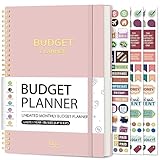
- Effective Budget Planning - Take control of your finances with the budget account book. This comprehensive planner allows you to plan and track your income, expenses, savings, and financial goals in one convenient place. With its intuitive layout and easy-to-use sections, you can stay organized and make informed decisions to achieve financial success.
- User-Friendly Layout - The budget planner features a user-friendly layout designed for easy navigation and organization. Each month, you'll find dedicated budget pages where you can set financial goals, track your income, and plan your expenses. Additional sections include debt trackers, savings goals, bill payment trackers, and more, making it simple to stay on top of your finances.
- Undated Monthly Calendar & Bonus Stickers - Featuring undated calendar each month, you'll have ample space to mark paydays, bills due, appointments, and important dates. Say goodbye to difficult writing spaces. Plus, we've included 3 cute sticker sheets that allow you to personalize your financial organizer and make budgeting more fun. Dates are not pre-printed and are completed by the user.
- Reliable and Convenient Design - Our monthly budget planner is designed for your convenience and built to last. The elastic band keeps everything securely in place, and the dual-sided pocket provides extra storage. Experience a budget planner that combines practicality and durability.
- Master Budgeting with Ease - Our financial planner includes a complete guidebook that provides valuable insights and instructions for optimal usage. From setting financial goals to tracking expenses, this guidebook offers step-by-step guidance and practical tips. Whether you're new to budgeting or an experienced user, this resource will help you make the most of your budget planner, empowering you to achieve financial success.
In federal student-loan repayment
For the federal income-driven repayment plans named in the U.S. Department of Education’s final regulation, discretionary income is defined as the greater of zero or your income minus a specified multiple of the applicable federal poverty guideline. The regulation is dated May 1, 2026 and is titled Reimagining and Improving Student Education—Federal Student Loan Program Final Regulations.
This definition answers only one question: how much income is treated as above a protected floor. It does not set the payment amount. The payment percentage is a separate step, and the regulation sets it out separately.
What’s actually slowing this PC down?
Pick the symptom - the matching free tool is one click away.
Rank #3

- Effective Budget Planning - Take control of your finances with the budget account book. This comprehensive planner allows you to plan and track your income, expenses, savings, and financial goals in one convenient place. With its intuitive layout and easy-to-use sections, you can stay organized and make informed decisions to achieve financial success.
- User-Friendly Layout - The budget planner features a user-friendly layout designed for easy navigation and organization. Each month, you'll find dedicated budget pages where you can set financial goals, track your income, and plan your expenses. Additional sections include debt trackers, savings goals, bill payment trackers, and more, making it simple to stay on top of your finances.
- Undated Monthly Calendar & Bonus Stickers - Featuring undated calendar each month, you'll have ample space to mark paydays, bills due, appointments, and important dates. Say goodbye to difficult writing spaces. Plus, we've included 3 cute sticker sheets that allow you to personalize your financial organizer and make budgeting more fun. Dates are not pre-printed and are completed by the user.
- Reliable and Convenient Design - Our monthly budget planner is designed for your convenience and built to last. The elastic band keeps everything securely in place, and the dual-sided pocket provides extra storage. Experience a budget planner that combines practicality and durability.
- Master Budgeting with Ease - Our financial planner includes a complete guidebook that provides valuable insights and instructions for optimal usage. From setting financial goals to tracking expenses, this guidebook offers step-by-step guidance and practical tips. Whether you're new to budgeting or an experienced user, this resource will help you make the most of your budget planner, empowering you to achieve financial success.
How the federal calculation works
- Identify your repayment plan. The protected multiple depends on the plan, so the same income can produce different discretionary income figures under different plans.
- Determine the income measure the plan uses. The exact income figure follows that plan’s rules. A 2020 Congressional Budget Office report described the then-typical policy as using adjusted gross income (AGI). Gross pay and take-home pay are not substitutes for that measure.
- Find the applicable federal poverty guideline. The guideline amount that applies depends on your household circumstances, including household size and applicable geography.
- Multiply the guideline by the plan’s multiple. Use the percentage in the table below.
- Subtract, and floor the result at zero. If the protected amount is larger than your income measure, discretionary income is zero.
- Apply the payment percentage separately. Only after discretionary income is set does the plan’s payment rate come into play.
Plan multiples at a glance
The table shows the regulation’s multiples and what each produces under an illustrative $20,000 poverty guideline. That $20,000 figure is a hypothetical used for arithmetic, not a current guideline amount.
| Repayment plan | Multiple of applicable guideline | Protected amount at a $20,000 guideline (illustrative) |
|---|---|---|
| REPAYE | 225% | $45,000 |
| IBR | 150% | $30,000 |
| PAYE | 150% | $30,000 |
| ICR | 100% | $20,000 |
Under this structure, a borrower with a $40,000 income measure on an IBR-style 150% multiple would have discretionary income of $10,000 ($40,000 − $30,000). That is the CBO’s own hypothetical example from its February 2020 report, which described the policy as then in effect and did not describe a current borrower population.
Rank #4

- ALL-IN-ONE B5 BUDGET PLANNER: With 15+ Functional Inserts –it covers every money-management pain point for beginners & pros. Stop juggling messy notebooks or incomplete trackers! The budget planner includes, monthly budget, bill expense detail, debt tracker, bill tracker, saving tracker...matches 90% of "how to manage money" search queries
- DURABLE BUDGET BOOK: Our budget organizer features a PVC waterproof cover and elastic band—no more ruined pages, made of 100GSM thick paper—no smudges or ghosting, coming with a heavy-duty double spiral binding—lays flat for easy writing. Built for daily use: toss it in your work bag, backpack, or purse without worry
- CONVENIENT B5 SIZE (7.3”X10.15”): No more choosing between "too small to write" or "too bulky to carry"! The B5 budget planner gives ample space to log expenses, note bill due dates, or map financial goals—without being cumbersome. Fits easily in laptop bags, backpacks, or purses—perfect for "on-the-go budget tracking
- UNMATCHED VALUE & COMPREHENSIVE GUIDEBOOK: Comes with 5 practical, high-quality freebies crafted, plus a comprehensive user guide that takes the guesswork out of financial planning. You’ll get: PVC waterproof colorful monthly tabs & wide range of label stickers, a ribbon bookmark, an elastic pen holder, a elastic band, an inner pocket, and a detailed step-by-step user guide handbook
- VISUAL CLARITY & LESS FATIGUE: Unlike plain black-and-white budget planners, our vivid color highlights reduce eye strain during long budgeting sessions, helping you track expenses, savings, and bills quickly and accurately. It’s the perfect fit for working professionals, international students, family financial managers, freelancers, new graduates, retirees
How marriage changes the picture
When both spouses have eligible federal student loan debt, the household’s discretionary income may be shared between them. Federal Student Aid’s illustrative example for the IBR plan shows the mechanics. A borrower with $67,540 of discretionary income in that scenario has a $562.83 monthly payment. If that borrower holds 60% of the couple’s eligible federal student loan debt, the proportional share is $337.70 ($562.83 × 60%).
These figures belong to that one example. Allocation rules are plan-dependent, so do not apply the 60% proportion to other plans or to other couples without checking the rules for your own plan.
Recommended Free Tools
Best Value
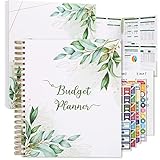
- Keep Track of Your Finances: Manage your personal and family’s finances with this monthly budget planner! Intuitive, comprehensive and fun, this budgeting planner allows you to keep track of your debts, expenses and bills, organize your spending and saving and optimize your budget for achieving your financial goals!
- Large Budgeting Planner: Our budget notebook features a large design of 8.5 x 11-inch that provides enough space for budgeting, financial planning and spending tracking but also for monthly reviews and building strategies for optimizing your budget!
- Well-Organized for Your Convenience: This budget book planner features an easy yet efficient template that includes a monthly budget with customizable categories, a debt tracker, a bill tracker, an expenses tracker as well as a section for financial goals and monthly review that will make things easier when it comes to budget planning!
- 12-Month Budget Management: Our budgeting book features a spiral-bound hardcover design made with high-quality 120gm thick paper and a 12-month undated design that allows you to start budget planning at any time of the year!
- Chic, Practical, Giftable: Featuring a superb boho cover and packed in a matching gift box, this budget book journal makes a lovely gift for a friend, family member or co-worker! The budget journal includes a special pocket for bills, receipts or other documents and comes with 5 stickers that will make your planning more fun and effective!
What the loan formula does not subtract
A reader who asks whether rent, groceries, or childcare reduce federal discretionary income usually expects the budget approach. Under the loan definition, actual household bills are not subtracted one by one. The protected amount is set by the poverty guideline and the plan multiple. Childcare appears on the CFPB’s list of basic expenses, but that list belongs to a different framework, and the loan formula does not work as a receipt-by-receipt deduction.
Terms that are easy to confuse
- Gross income, AGI, and take-home pay are different measures. A paystub net figure is useful for budgeting but is not the income measure for a federal repayment estimate.
- Discretionary income and disposable income are not interchangeable. The federal regulation defines discretionary income for student-loan repayment. CFPB lending rules use residual-income concepts, and the sources reviewed do not establish a single universal definition of disposable income.
- Budget discretionary income is a planning estimate. The student-loan figure is a regulatory calculation with defined inputs. Expect the two to differ.
Check the rules before you calculate
Repayment rules and poverty guideline amounts can change, and the May 1, 2026 regulation may affect how plans operate. Before relying on any number:
- Confirm which repayment plan applies to your loans.
- Confirm the income measure that plan uses for your situation.
- Confirm household size and the poverty guideline amount that applies to you.
- Check the current official rules with Federal Student Aid or your loan servicer.
If those inputs are settled, the federal calculation takes five steps and produces a result you can verify. Without them, any figure is only an estimate.
Quick Recap
Product prices and availability are accurate as of the date/time indicated and are subject to change. Any price and availability information displayed on Amazon at the time of purchase will apply.




