Medical billing and coding professionals turn healthcare records into standardized information used to document care and support payment. Coders interpret clinical documentation and assign diagnosis and procedure codes; billers use claim information to seek payment from insurers and public programs, follow claims, and resolve payment problems. Some employers combine the work, while others separate it into distinct roles.
What does a medical coder do?
A coder reviews clinical documentation and assigns standardized codes that represent diagnoses, procedures, services, and related information. The codes help maintain health records and support billing, reporting, and analysis. The U.S. Bureau of Labor Statistics (BLS) summarizes the function this way: “Medical coders assign the diagnosis and procedure codes for patient care, population health statistics, and billing purposes.” BLS, Medical Records Specialists


Common code systems include ICD-10-CM, CPT, and HCPCS Level II. Coders may contact nurses or other clinicians to clarify a diagnosis or obtain missing information; their work is based on the record, not on independently diagnosing or treating a patient. AAPC’s overview of medical coding and billing BLS
What does a medical biller do?
A biller prepares and submits claims to insurers or public programs and follows them through the payment process. Depending on the organization, billing work may also include gathering patient and coverage information, entering charges, checking whether prior authorization is needed, collecting copays, reviewing claims for coding accuracy, posting payments, adjusting accounts, and pursuing unpaid or denied claims. AAPC
Free tools Windows power users keep installed
One-click scans. No signup required.
#1 Best Overall

- 1,000+ TERMS AND EXAMPLES ON ONE SHEET - Over 420 prefixes, suffixes, and root words with 600+ real medical term examples and a medical abbreviations chart. Printed front and back on a single sheet.
- ORGANIZED BY BODY SYSTEM - Terms grouped by the 13 body systems you actually get tested on, with CPT code ranges for medical coders built in.
- MADE FOR NURSING STUDENTS, MEDICAL CODERS, PRE-MED, AND EMTs - A quick-reference tool, not a textbook replacement. Keep it on your desk, in your bag, or in your scrub pocket
When a claim is denied or underpaid, billers may investigate the reason, correct an error, submit an appeal, or follow up with the payer. Their aim is to get a claim processed and the account handled accurately—not to decide what care a patient should receive.
How are coding and billing different?
| Aspect | Coding | Billing |
|---|---|---|
| Main task | Interpret documentation and assign standardized codes. | Prepare, submit, and follow claims to seek payment. |
| Typical focus | Clinical records, code classification, completeness, and accuracy. | Coverage, charges, claim status, denials, payment posting, and account follow-up. |
| Main output | Coded record information. | Claims and resolved payment or account actions. |
This distinction describes the main functions, not a universal division of labor. Small practices may have one employee handling both coding and billing; larger organizations may divide work among coders, billers, auditors, and other health information staff. Titles and duties also vary by employer, care setting, and specialty. AAPC BLS
Rank #2
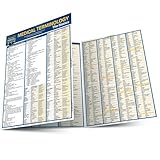
- Compact chart.
- Includes information on the foundation of medical words, the human body, terminology sets, five senses, synonyms and as well as a glossary.
What is the workday and work setting like?
The work is largely computer-based. Medical records specialists review and enter information, maintain and retrieve records, and check that records are timely, complete, and accurate. They may work in hospitals, physician offices, administrative services, or other organizations. Facilities that operate around the clock may schedule evening, night, or weekend shifts. BLS
Accuracy and confidentiality are core responsibilities. Specialists must follow administrative, ethical, and legal requirements that protect patient records and limit access to authorized people. AHIMA’s ethical coding standards also say professionals should refuse to take part in efforts to skew or misrepresent data or documentation. AHIMA ethical standards
Rank #3
What education and credentials may be useful?
BLS says medical records specialists typically need a postsecondary certificate, though some enter with a high school diploma and some positions may require an associate’s or bachelor’s degree. Employers may require or prefer certification. Training commonly covers medical terminology, health data standards, and coding systems. BLS
Credential options include programs from AAPC and AHIMA. They serve different purposes, and none is a universal requirement for every billing or coding job:
Rank #4

- Used Book in Good Condition
- Certified Professional Biller (CPB), AAPC: covers claim submission and follow-up, denials, appeals, payment posting, adjustments, and collections. AAPC CPB
- Certified Professional Coder (CPC), AAPC: a coding credential oriented toward physician-office settings. AAPC CPC
- Certified Coding Associate (CCA), AHIMA: addresses interpreting healthcare data for coding and evaluating claims. AHIMA CCA
- Certified Coding Specialist (CCS), AHIMA: is for professionals skilled in classifying medical data from health records. AHIMA CCS
Before paying for training or an exam, compare the credential’s intended setting and task coverage with local job postings. Confirm eligibility, exam requirements, continuing-education obligations, and current fees directly with the credential issuer; the credentials do not have a universal ranking.
Independent reader supportYour contribution helps us test, update, and keep practical guides available for everyone.What is the pay and job outlook in the United States?
BLS reported a median annual wage of $51,140 in May 2025 for the broader medical records specialist occupation. The lowest 10 percent earned less than $37,000, and the highest 10 percent earned more than $81,150. These are national occupational figures, not guaranteed pay or a salary estimate for every specialty, location, or job titled “medical biller and coder.” BLS
Outdated Drivers Are Slowing You Down
One free scan finds every outdated or missing driver and matches the right update for your exact hardware.Free scan · exact hardware matchWindows Errors? Fix Them Before They Spread
Repair common Windows errors and clear accumulated junk for a smoother, more stable PC - no reinstall needed.Free scan · no reinstallBLS projects employment in that occupation to grow 8 percent from 2025 to 2035, with about 14,000 openings per year on average over that period. The agency cites factors including an aging population and chronic conditions, and notes that AI-supported tools may affect demand by improving coding efficiency. These projections cover medical records specialists broadly, rather than billing-and-coding titles alone. BLS
How can you tell which role fits you?
Look at the actual duties in a job description rather than relying on the title. A coding-focused position is more centered on documentation review and code assignment; a billing-focused one is more centered on claim processing, payer communication, and account follow-up. For either path, compare the employer’s setting and specialty, the proportion of each kind of work, and any credential or experience requirements. Standards, reimbursement processes, credentials, and job titles differ outside the United States, so U.S. occupational figures and examples may not apply elsewhere.
Quick Recap
Product prices and availability are accurate as of the date/time indicated and are subject to change. Any price and availability information displayed on Amazon at the time of purchase will apply.




