The Tool Desk
Outbyte PC Repair FREERepair Windows errors before they cause bigger problemsFix Now →Outbyte Driver Updater FREEFix the driver behind crashes, sound loss and screen glitchesFind Drivers →Transparent solar panels—usually photovoltaic glass built into a window, skylight, or façade—do not have a reliable universal price. They are typically specified for a particular building project, so the cost depends on the glazing, installation, and electrical design. The main disadvantages are lower electricity generation than conventional solar panels, added construction complexity, and the need to balance power production with daylight and window performance.
What do transparent solar panels cost?
There is no broadly applicable public price for transparent photovoltaic (PV) glazing in the available product and industry sources. A supplier needs details such as window dimensions, glass construction, coating, electrical configuration, and how the glazing will connect to the building. ClearVue, for example, describes its Solar Vision Glass as bespoke and directs prospective buyers to its technical team for project specifications: ClearVue Solar Vision Glass.
Conventional rooftop solar benchmarks can provide context about solar-system costs, but they are not prices for solar windows. The U.S. Department of Energy’s 2025Q1 benchmark for a representative 250 kW commercial rooftop system, expressed in 2024 U.S. dollars, lists the following figures: DOE Solar Photovoltaic System Cost Benchmarks.
| Representative 250 kW commercial rooftop system | Minimum sustainable price (MSP) | Modeled market price (MMP) |
|---|---|---|
| PV-only | $1.95/Wdc | $1.98/Wdc |
| PV plus storage | $2.96/Wdc | $2.98/Wdc |
These are DOE benchmarks for conventional U.S. rooftop systems, not estimates for photovoltaic glazing. Applying them to window glass would give a misleading impression of what a solar-window project costs. Nor is a general premium for energy-efficient windows a substitute for a PV-glazing quote: the premium depends on the technology, expected building energy savings, and the owner’s financial requirements, as NREL explains in its Pathway to Zero Energy Windows report.
#1 Best Overall
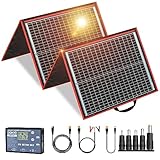
- 【COMPACT & TRAVEL-READY】 Folds down to 19.3x20.9x1.1in and just 7.3lb—light enough to pack, carry, and set up solo. Perfect for RVs, vans, camping, or backup power.
- 【LONG CABLE, COOLER & SAFER】 9.8ft (3m) cable lets you park the panel in full sun while your controller or power station stays shaded—better cooling, safer use, and more flexible setups.
- 【SEPARATE CONTROLLER, SAFER CHARGING】 Includes a standalone PWM controller for 12V batteries with full protections (reverse polarity, overcharge, overload, short-circuit). Easy to replace or upgrade later.
- 【CHECK DEVICE INPUT BEFORE ORDERING】 Some power stations cap solar input (60–100W). Even with 150W, output won’t exceed that cap—normal by design, not a defect. Message us if unsure—we’ll help confirm before you buy.
- 【USB PORTS FOR ESSENTIALS】 Connect to a 12V battery for steady phone/lights charging. Can also give quick emergency top-ups directly in sunlight (current may vary).
What to request in a quote
Ask the supplier and project team to itemize the solar glazing against the ordinary window specification it would replace. The comparison should include the glazing itself, façade or roof integration, electrical balance-of-system equipment, design and permitting, local labor, and expected maintenance. Request modeled annual electricity production for the actual location, orientation, and shading—not just a rated output per square metre.
Are transparent solar panels worth it?
They may be worth evaluating when a building has substantial suitable glazing and the project can use that surface to generate power without compromising essential window performance. Whether they make financial sense depends on the full building case: the window being replaced, installation scope, local electricity rates, energy savings or costs associated with the glazing, expected output, and product life. A generic payback period cannot account for those differences.
Compare the PV glazing with the same project’s realistic alternatives: high-performance conventional windows paired with rooftop or canopy solar, where those options are available. Rooftop PV is a different technology, not a transparent substitute, but it can help show what else the same budget might achieve. A 2026 modeling study of commercial transparent photovoltaic windows treats the products it studied as supplementary generation in its modeled case; its findings should not be assumed to predict performance for another product, building, or climate: Energy impact of transparent photovoltaic windows.
Rank #2

- 【200W N-Type 16BB High Efficiency】Built with advanced N-type monocrystalline cells and 16BB busbar technology, the Callsun 200 watt solar panel delivers up to 25.6% conversion efficiency. N-type cells provide excellent power generation and reliability, while the 16BB design helps reduce hot spots and microcrack risks for dependable long-term performance.
- 【400W Series Connection for Portable Power Stations】Pair two Callsun 200W panels in series to reach 400W total power, 47.48V Vmp and 54.62V Voc while maintaining 8.43A operating current. This configuration is well suited for many portable power stations with 60V-class solar input limits, helping maximize solar charging within supported voltage and current ranges.
- 【Boost Energy with Bifacial Technology】The Callsun 200W bifacial solar panel features a transparent backsheet that captures sunlight from both the front and rear sides. By utilizing direct, reflected and diffuse light, the bifacial design can generate additional energy from the rear side under suitable installation conditions, helping maximize overall solar output.
- 【TwinCell Anti-Shading Design】The Callsun 200W solar panel features a dual-module parallel design that divides the panel into two independently operating sections. When one section is partially shaded by trees, buildings or other obstacles, the other section can continue generating power. This design helps reduce the impact of partial shading and maintain more consistent energy production.
- 【Compact Design for RVs, Vans & Off-Grid Use】Each panel measures 51.3 × 30.3 × 1.4 inches and weighs 23.8 lbs, delivering strong power output in a compact footprint. This 200W solar panel is ideal for Class B vans, RVs, marine applications, rooftops and other space-conscious off-grid solar systems. Pre-drilled mounting holes make installation with compatible mounting hardware straightforward.
What are the disadvantages?
Less generation than conventional panels
Generating electricity through glazing generally means accepting design constraints that conventional rooftop modules do not share. NREL identifies lower generation than conventional rooftop or utility PV as one barrier to the economics of photovoltaic glazing. This does not mean every project is uneconomic, but it makes a project-specific yield estimate essential. See NREL’s discussion of photovoltaic windows in commercial buildings.
What’s actually slowing this PC down?
Pick the symptom - the matching free tool is one click away.
Window performance and transparency involve trade-offs
A solar window must function as a window as well as a generator. Visible light transmittance (VLT) affects how much daylight passes through; the glass’s U-value relates to heat transfer, while its solar heat gain coefficient (SHGC) describes how much solar heat enters the building. Tint, cell pattern, coatings, and glazing construction can affect both the view and building energy use. A product’s electricity rating alone does not show whether it will suit a particular room or façade.
ClearVue’s product page lists manufacturer specifications of up to 80% VLT, subject to coating, and up to 70 Wp/m². It also lists a 30-year performance warranty and a 12-year product warranty; its U-value and SHGC ranges vary with glass selection. These are the manufacturer’s published specifications, not independent comparisons or a guarantee of output in a specific building: ClearVue Solar Vision Glass.
Rank #3

- 【TRAVEL LIGHT, POWER ANYWHERE】 Weighing only 9.7lb and folding to 20×27×1.1in, this 200W panel is slim, portable, and easy to carry or mount—perfect for RVs, vans, boats, trailers, or emergency backup power.
- 【LONG REACH FOR FLEXIBLE SETUP】 A 9.84ft (3m) cable lets you place the panel in direct sunlight while keeping the controller or power station shaded, making installation safer and more convenient.
- 【SEPARATE CONTROLLER FOR SAFE CHARGING】 Comes with a standalone PWM controller that protects your 12V system against reverse polarity, overcharge, overload, and short-circuit—safe to use and easy to replace or upgrade later.
- 【CHECK YOUR POWER STATION’S INPUT LIMIT】 Some power stations cap input (e.g. 100-150W max). Even in full sun, the panel cannot exceed that cap—this is normal design, not a defect. Please confirm your specs or contact us before buying.
- 【USB PORTS FOR ESSENTIAL DEVICES】 When connected to a 12V battery, the dual USB ports provide steady power for phones, lamps, and small gadgets. They can also work in direct sunlight without a battery for emergency top-ups, though current may vary.
Construction and replacement can be more complex
PV glazing has to be coordinated with the building envelope and electrical systems. NREL identifies integration with construction as a source of added soft costs and potential delays to return on investment. Durability matters particularly because replacing building glazing can be disruptive and expensive. These are deployment challenges, not proof that every installation will fail.
There is no dependable payback figure without a project model
Façade area, orientation, shading, climate, electricity tariff, baseline window, installation costs, thermal properties, and lifetime all affect the economics. A manufacturer’s rated output is not the same as independently verified annual production for a particular building. Ask for an energy model and a whole-project cost comparison before relying on an estimated payback.
How to compare solar glazing with other options
Use the same building assumptions for every option, including the conventional-window-plus-solar alternative. Before making a decision, compare:
- Daylight and view: VLT, tint, cell pattern, and the view quality expected in the installed configuration.
- Electrical performance: rated output per square metre and modeled annual yield for the actual orientation and shading.
- Building performance: U-value and SHGC, along with the effects on heating, cooling, and daylight loads.
- Project scope: whether this is new construction, a façade renewal, or a retrofit, and which electrical and construction costs are included.
- Long-term evidence: product and performance warranties, relevant certifications, and demonstrated project history.
- Opportunity cost: what the same budget would deliver as conventional solar paired with ordinary high-performance glazing.
Finally, confirm that the proposed product actually generates electricity. Solar-control window film can reduce solar heat or glare, but it is not the same thing as photovoltaic glazing.
Quick Recap
Product prices and availability are accurate as of the date/time indicated and are subject to change. Any price and availability information displayed on Amazon at the time of purchase will apply.




