The Tool Desk
Outbyte PC Repair FREERepair Windows errors before they cause bigger problemsFix Now →Outbyte Driver Updater FREEFix the driver behind crashes, sound loss and screen glitchesFind Drivers →The global maritime supply chain is vulnerable because a large share of trade depends on a connected network of sea routes, canals, ports and tightly scheduled ships. A conflict, drought or operational constraint at a key point can force vessels onto longer routes, tying up capacity and raising costs. The effects can spread to importers and households, but they are neither automatic nor evenly distributed—and a disruption at one chokepoint does not mean all trade stops.
Why can a disruption at sea affect the wider economy?
More than 80% of world trade by volume is carried by sea, according to UNCTAD’s 2024 Review of Maritime Transport. That makes maritime transport essential to international commerce, but it does not mean every country or shipment depends equally on a particular route.
The network is geographically concentrated: canals and straits provide shortcuts between major markets, while ports and transshipment hubs connect shipping services. UNCTAD’s 2024 overview reported these annual shares:
| Route | Share of maritime trade | What the figure measures |
|---|---|---|
| Suez Canal | About 10% by volume; 22% of containerized trade | Annual trade crossing the canal, as reported by UNCTAD in 2024 |
| Panama Canal | Approximately 3% by volume | Global maritime trade facilitated by the canal, as reported by UNCTAD in 2024 |
These are route-specific shares of maritime trade, not percentages of global GDP. Other chokepoints, including the Strait of Hormuz and routes affected by Black Sea conflict, matter especially for particular energy and commodity flows. The exposure depends on what is being shipped, where it is going and whether a practical alternative exists.
Windows Errors? Fix Them Before They Spread
Repair common Windows errors and clear accumulated junk for a smoother, more stable PC - no reinstall needed.Free scan · no reinstallCrashes, No Sound, or Screen Glitches?
Random freezes, missing sound and display glitches usually trace back to one bad driver. Find and replace yours safely.Free scan · under a minute#1 Best Overall

- A 80-5152 construction kit of the Colombo express
- At the time of commissioning in 2005 she was the largest container ship in the world
- Two-part hull with bow thruster, rotating Ships propeller and moving rudder
- 23 container blocks with fine details
What happens when a shipping route is constrained?
Ships take longer routes
When security risks or physical constraints make a route less usable, carriers may reroute, change schedules or adjust services. During the Red Sea disruption described in UNCTAD’s 2024 review, carriers diverted vessels around the Cape of Good Hope. Panama Canal transit restrictions in 2023–2024 were attributed by UNCTAD to reduced water levels associated with drought. These illustrate distinct causes—security and climate stress—that can both constrain effective route capacity.
Longer voyages absorb shipping capacity
A vessel spending more time at sea is unavailable for its next scheduled journey. The same cargo flow can therefore require more ships and containers in circulation, while schedule changes can contribute to congestion at ports and transshipment hubs. UNCTAD estimated that by mid-2024 rerouting had increased global vessel demand by 3% and container-ship demand by 12% compared with its modeled no-rerouting counterfactual. Those are disruption-period comparisons, not a permanent increase or a measure of current demand.
Rank #2
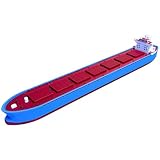
- AUTHENTIC CARGO DESIGN: A detailed 10-inch scale model of a modern bulk carrier, featuring a streamlined blue and red hull, white bridge superstructure, and simulated deck cargo hatches for a realistic industrial look.
- DESK-READY DIMENSIONS: Measuring 10 inches in length, this model is perfectly sized for professional environments, fitting comfortably on office desks, bookshelves, or mantlepieces without overcrowding the space.
- NO ASSEMBLY REQUIRED: Arrives fully assembled with a high-quality multi-color finish (Blue, Red, and White). Skip the tedious painting and gluing—this model is ready for immediate display right out of the box.
- STURDY & STABLE: Engineered with a flat-bottomed hull for maximum stability on flat surfaces. No flimsy display stands required; the ship sits securely on any level surface in your home or office.
- THE PERFECT LOGISTICS GIFT: An ideal professional gift for supply chain managers, freight forwarders, merchant mariners, and maritime enthusiasts who appreciate the "titans of trade" that power the global economy.
Costs and delays can travel beyond the disrupted route
Longer voyages can increase fuel use, crew time, chartering expenses and insurance costs. Freight rates may rise or become more volatile, and delays can disrupt production schedules or the availability of imported goods. More fuel use also means higher emissions. How much of any added cost reaches a business or consumer depends on contracts, inventories, alternative suppliers and market conditions; a shipping shock does not translate mechanically into an equal retail-price increase.
UNCTAD’s 2024 review modeled a conditional scenario in which global consumer prices could be 0.6% higher by the end of 2025 if the freight-rate increase observed from October 2023 through June 2024 persisted. This was a forecast scenario, not evidence that consumer prices actually rose by that amount because of shipping.
Quick wins for a faster PC:
Repair Windows errors before they cause bigger problemsFix Now →Scan for outdated or missing drivers - takes under a minuteDriver Scan →Clear out junk files and repair common Windows errorsFree Scan →Rank #3

- Cargo ship model meet your passion for military nautical collectibles with beautiful design.
- An accurate scale paper model for collectors and enthusiasts.
- Material: paper
- Model: Polish Gdansk Cargo Ship
- Model size (when you finish it): 30CM long
Who is most exposed to higher shipping costs?
The impact is uneven. Large, diversified economies and businesses may have more options to change suppliers, absorb temporary costs or hold inventory. UNCTAD identifies Small Island Developing States (SIDS) and Least Developed Countries (LDCs) as especially vulnerable to higher maritime costs and reduced connectivity. For an economy reliant on imported essentials, with few alternative routes or suppliers, the same freight shock can be harder to absorb.
That matters to household finances through the prices and availability of imported goods and through wider business costs. Food security is a particular concern in economies that depend heavily on maritime imports. But the actual household effect varies by country, product, timing and how businesses pass on—or absorb—cost increases. The available estimates do not establish a single consumer-price impact that applies everywhere.
Rank #4

- Accurate Scale Model
- Highly Detailed Model Kit
- Full Instructions Included
Are ships returning to the Suez Canal?
Recent statements point to some renewed use, but route activity and security risk are different measures. They should not be collapsed into a claim that the Red Sea route has fully normalized.
- March 3, 2026: The Suez Canal Authority said 56 vessels transited that day and described traffic as flowing normally. It also said some shipping-line suspensions remained contingent on regional security conditions.
- September 23, 2026: The Authority said navigation was proceeding smoothly and reported that Maersk transits rose from 8 in September 2025 to 67 in September 2026. It also described prospective returns by other lines, including an expected experimental transit; those plans should not be mistaken for completed voyages.
- Security reporting: IMO’s Red Sea material records incidents and 2026 statements, while a 2026 U.S. Maritime Administration advisory describes renewed threats. These sources establish continuing security concerns, not comprehensive traffic totals or freight costs.
For historical context, UNCTAD’s 2025 review reported that tonnage through Suez in May 2025 remained 70% below 2023 levels. That dated comparison does not contradict the Authority’s later report of increased transits: the sources refer to different periods and measures. No complete, independently verified daily 2026 traffic series is established here, so isolated operator or canal-authority updates cannot prove system-wide recovery.
Free tools Windows power users keep installed
One-click scans. No signup required.
Best Value

- AUTHENTIC MARITIME DESIGN: Celebrate the backbone of global trade with a highly detailed, 10-inch scale model of a modern container ship. Features a striking multi-color finish with a streamlined red and black hull, a crisp white bridge superstructure, and precisely arranged red and blue deck containers.
- READY FOR DISPLAY (NO ASSEMBLY): Skip the hassle of tedious gluing, painting, or model kit construction. This premium cargo vessel arrives fully assembled and ready to immediately elevate your space right out of the box.
- PERFECT DESK-READY DIMENSIONS: Measuring exactly 10 inches in length, this compact scale model is perfectly sized for professional environments. It fits seamlessly onto office desks, bookshelves, display cases, or conference room tables without overcrowding the area.
- STURDY, FLAT-BOTTOMED DESIGN: Engineered with a flat, stable hull that sits securely on any level surface. No flimsy display stands or mounts are required, making it a robust and worry-free decorative accent for active environments.
- THE ULTIMATE LOGISTICS & MARITIME GIFT: An ideal professional gift for supply chain managers, freight forwarders, maritime enthusiasts, merchant mariners, or anyone who appreciates the titans of international commerce.
The broader trade picture also needs its date qualifiers. UNCTAD’s 2025 review said maritime trade grew 2.2% in 2024 and projected growth of 0.5% in 2025. The latter was a forecast in that report, not a final 2025 result or a current 2026 outlook.
Independent reader supportYour contribution helps us test, update, and keep practical guides available for everyone.What makes the supply chain more resilient?
There is no single fix for every route or shock. Resilience choices involve a trade-off between the cost of preparing for disruption and the cost of being unable to adapt when it happens.
- Map route exposure: Identify whether essential goods depend on one chokepoint or can move through viable alternatives.
- Match the response to the shock: Security conflict, drought, infrastructure failure, port congestion and trade-policy changes call for different operational adjustments.
- Use operational alternatives where feasible: Rerouting, schedule changes and alternate sourcing can help maintain flows, but may add time or cost.
- Balance buffers against carrying costs: Inventory can provide time during delays, but storing goods ties up capital and cannot eliminate every supply interruption.
- Consider who bears the cost: A measure that is manageable for a diversified company may be unaffordable for an import-dependent economy or household.
These are decision factors, not a tested ranking of interventions. UNCTAD Secretary-General Rebeca Grynspan described the strategic stakes in the publication page for the 2024 review: “Building sustainable and resilient maritime transport and future-proofing global supply chains is not just an option – it’s a strategic necessity.”
Quick Recap
Product prices and availability are accurate as of the date/time indicated and are subject to change. Any price and availability information displayed on Amazon at the time of purchase will apply.




