There is no defensible universal winner among BlockDAG, Dogecoin, Ethereum Classic (ETC), and Monero: they use different algorithms, hardware, and reward systems, and an individual miner’s result depends on costs and network conditions. This is a retrospective look at the four options named for 2025—not a current profitability ranking. As of October 2026, the cited material does not establish comparable earnings or BlockDAG’s current operating and withdrawal status.
How to read a “best crypto to mine” list
Mining suitability is not the same as profitability. A useful comparison starts with the equipment an algorithm supports, then accounts for electricity, hardware cost, pool terms, network conditions, and whether rewards can be received and converted. The project documentation for ETC specifically identifies electricity cost, hardware efficiency, and scale as major profitability factors (Ethereum Classic miner FAQs).

The title’s 2025 date matters: a past-year label does not make this a live ranking for October 2026. The available project sources do not provide a like-for-like 2025 earnings comparison for these four coins, and a ranking without a stated measurement period, hardware, electricity price, pool fees, and other assumptions would be misleading.
| Coin | Mining approach in the cited project material | What a prospective miner should check |
|---|---|---|
| Ethereum Classic (ETC) | ETCHash; official guidance lists GPUs and ASICs, and discusses pool mining. | Exact card or ASIC compatibility, current DAG requirements, local power cost, and pool terms. |
| Dogecoin | Scrypt; the official guide describes specialized ASIC hardware and merged mining under supported arrangements. | ASIC purchase and operating costs, noise and cooling, and whether the pool supports the intended merged-mining setup. |
| Monero (XMR) | RandomX, designed to be CPU-friendly and ASIC-resistant. | CPU and memory capability, electricity use, uptime, and pool terms. |
| BlockDAG | Project-specific mining equipment and integration described in dated development releases. | Verify the live network, device availability and terms, mining process, reward rules, and withdrawals before spending money. |
Ethereum Classic: a GPU or ASIC route, not Ethereum mining
ETC uses ETCHash, a close relative of Ethash. The project’s miner FAQ lists both GPUs and ASICs and says small solo miners are unlikely to find blocks regularly at the network’s hashrate, making pool mining a practical consideration for many participants (Miner FAQs).
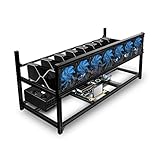
#1 Best Overall

- 6/8 SLOTS - Support to 6/8 GPU . (GPU is not included).
- MATERIAL - The open air mining frame case is made up of the highest quality stainless steel material, strong, durable and available. Fully protecting your GPU and eectronic device.
- PERFECT DESIGN - Professional design for mining rig frame, accelerating the air convection, super cooling design for heat dissipation. Enough space reserved between the graphics cards.
- EASY TO INSTALL - This mining case is easy to install and is with strong structure. Keep all cables clean and organized, along with everything in your mining machine.For installation steps, please refer to the user manual
- NOTICE - This mining rig frame is the Frame Only, not includes Fans or other CPU, GPU, PSU, Motherboards, Cables. If you are not 100% satistifed with this Miner, please feel free to contact us, we will offer you a satisfactory soluiton within 24 hours.
Hardware compatibility is specific, not permanent. ETC’s hardware guide described how the Thanos change extended the usability of 4 GB GPUs at the time, but forecast that limit would be reached around mid-2025. That forecast is now past; do not treat the old 4 GB figure as a present-day recommendation. Check the current DAG requirements for the exact card and mining software before buying or repurposing a GPU (ETC Mining Hardware Guide).
The ETC FAQ describes a 20% block-reward reduction every five million blocks. It also identifies transaction fees, uncle-related revenue, and MEV as possible additional revenue sources that depend on network use (Miner FAQs). These protocol and network factors do not establish what a particular miner will earn after costs.
ETC is distinct from Ethereum (ETH). Ethereum ended proof-of-work mining at the Merge on September 15, 2022, and now uses proof-of-stake validators; that does not mean ETC mining ended (Ethereum.org: Mining algorithms).
Rank #2
- ✅Premium Aluminum Construction: Constructed from high-quality aluminum for enhanced durability and heat dissipation, ensuring longevity and optimal performance.
- ✅ Accommodates 8 GPUs: Designed to house up to 8 graphics cards, providing ample space for expanding your mining setup and maximizing efficiency.
- ✅ Superior Airflow and Cooling: Engineered with optimized airflow design to prevent overheating and maintain optimal operating temperatures for prolonged mining sessions.
- ✅ Easy Assembly: Simple and straightforward assembly process allows for quick setup, getting you up and running in no time.
- ✅ Sleek and Space-Saving Design: Compact and minimalist design saves space while adding a professional touch to your mining rig setup.
Dogecoin: specialized Scrypt ASICs and pool terms
Dogecoin mining uses Scrypt. The official guide says miners pursuing profit use specialized Scrypt ASIC hardware and describes merged mining with Litecoin and other classic Scrypt currencies (Dogecoin: Mining Dogecoin).
Do these 3 things before closing this tab:
1Scan for outdated or missing drivers - takes under a minute2Repair Windows errors before they cause bigger problems3Fix the driver behind crashes, sound loss and screen glitchesMerged mining is not a guarantee that one device or pool will pay out several currencies. It depends on protocol support and the pool’s arrangement. Before committing, confirm which currencies the pool actually credits, how it calculates shares and payouts, and its fees and payout threshold.
For an ASIC, compare the purchase price and power draw with the unit’s efficiency, and account for noise and cooling. A machine that can mine Scrypt is not automatically a good fit for every miner: local electricity rates, operating conditions, and pool terms affect the outcome. The cited guide does not establish a current earnings estimate.
Monero: CPU-oriented RandomX mining
Monero uses RandomX, which the project describes as ASIC-resistant and optimized for CPUs. Its design uses random code execution and memory-heavy techniques; it is not a promise that every desktop CPU will be economical to run (Monero: RandomX).
The Monero project states that its continuing tail emission is 0.6 XMR per approximately two-minute block, with transaction fees also paid to the miner (About Monero; Monero FAQ). That is a network-level reward description, not an individual miner’s income: a miner’s share, uptime, electricity use, pool arrangement, and the value at which XMR can be exchanged all matter.
The project says RandomX was created with the intent of keeping mining decentralized and distributing block rewards more equitably (RandomX). For a personal-finance decision, the practical question is whether a computer you already own can run the workload at an acceptable power cost; buying a new computer solely to mine requires a separate capital-cost calculation.
Rank #4

- Hashrate: The MINI DOGE III HAS 700MH/S 400W , making it a high-performing miner for Dogecoin Litcoin
- Goldshell MINI DOGE Ⅲ is an upgraded version of MINI DOGE II with significantly improved hashrate
- Application Scenario: MINI DOGE III is an ideal choice for home mining with its whisper-quiet operation at just 35dB, resembling the sound of rustling leaves
- Specifications: Dimensions: 198×150×96(mm), Weight: 2.3KG, Algorithm: Scrypt, Cryptocurrency: LTC|DOGE Coin, Connection Port: Ethernet only, Operating Temperature: 0~35℃, Relative Humidity: ≤65%, Input Voltage: 100-240V, Power Cable: 10A, Fan Specifications: 4500rpm
- Competitive Advantages: Goldshell MINI DOGEⅢ offers high hashrate, low power consumption, and quiet operation, making it the best choice for home mining
BlockDAG: verify the operating path before treating it as a mining option
BlockDAG’s cited updates are dated development releases, not proof of its current consumer-mining status. A May 19, 2025 release described a Stratum connection and mining tests, while saying integration work for X1 and X10 devices was in progress (Dev Release-202). A November 17, 2025 release discussed reward-system work and an X1 app/X10 device synchronization issue that could prevent a mining session from starting (Dev Release-227).
Those statements do not establish the live network state in October 2026, current device availability, successful reward withdrawals, or profitability. Before paying for a device or relying on projected rewards, verify directly that the network and device path are functioning, what the device costs and requires, how rewards are calculated, and how they can be withdrawn. Do not compare an unverified reward path with established mining networks as if the risks were equivalent.
Independent reader supportYour contribution helps us test, update, and keep practical guides available for everyone.How to compare the real cost of mining
Estimate costs using your actual equipment and electricity tariff rather than a generic calculator result. A basic energy calculation is: daily energy use in kilowatt-hours = device power in watts ÷ 1,000 × hours operated per day. Multiply that by your per-kWh electricity rate. Include cooling or other material overhead where applicable; a device’s rated draw may not capture the whole setup.
Quick wins for a faster PC:
Fix the driver behind crashes, sound loss and screen glitchesFind Drivers →Repair Windows errors before they cause bigger problemsFix Now →Best Value
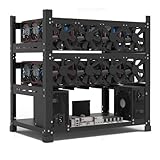
- SLOT - 6/8/12 GPU slots, support 2 ATX power supplies.
- MATERIAL - The open air mining frame case made up of the highest quality stainless steel material, strong, durable and available. Fully protecting your GPU and eectronic device.
- PERFECT DESIGN - Professional design for mining rig frame, accelerating the air convection, super cooling design for heat dissipation. Enough space reserved between the graphics cards.
- EASY TO INSTALL - Easy to install and strong structure. Keep all cables clean and organized, along with everything in your mining machine.
- NEED TO ASSEMBLE BY YOURSELF - For installation steps, please refer to the user manual. The Frame Only, Not includes Fans or other CPU, GPU, PSU, Motherboards, Cables. If you are not 100% satistifed with this Miner, please feel free to contact us, we will offer you a satisfactory soluiton within 24 hours.
- Hardware: Include the purchase price, any necessary computer or electrical upgrades, and a realistic resale value. For ETC, verify memory and DAG compatibility; for Dogecoin, account for the specialized ASIC form factor and operating environment.
- Network and rewards: Expected yield changes with network difficulty or hashrate, reward rules, and transaction-fee contribution. A stated block reward alone is not a forecast of what an individual miner receives.
- Pool arrangements: Compare fees, payout thresholds, payment method, reliability, and concentration. A pool’s advertised gross output is not the same as take-home proceeds.
- Operational certainty: Confirm software, network access, wallet handling, device terms, and a workable withdrawal route. This check is particularly important where current operation is not established by the cited project updates.
- Conversion and taxes: If you plan to convert coins to cash, consider exchange access, conversion costs, and applicable tax rules in your jurisdiction. The cited mining pages do not determine an individual reader’s tax treatment.
Only compare estimated net results after applying the same time period and consistent assumptions to each option. If the outcome depends on a coin price, network statistic, device offer, or pool term, use a current value and record when and where it was observed; none of the sources cited here supplies a current four-coin profit comparison.
Which option fits which kind of miner?
- Consider ETC if you have compatible GPU or ASIC hardware and can verify its current requirements and local operating cost.
- Consider Dogecoin if you are prepared for the cost, power draw, noise, and cooling needs of a Scrypt ASIC and have checked the pool’s exact merged-mining and payout terms.
- Consider Monero if you want to evaluate CPU-based mining on suitable hardware and can calculate its power cost without treating the network reward as personal income.
- Approach BlockDAG cautiously until current operation, device terms, reward rules, and withdrawals are independently verifiable.
These are equipment and due-diligence distinctions, not a ranking by expected return. A miner with different hardware, electricity rates, or risk tolerance may reach a different decision.
Quick Recap
Product prices and availability are accurate as of the date/time indicated and are subject to change. Any price and availability information displayed on Amazon at the time of purchase will apply.




