What’s actually slowing this PC down?
Pick the symptom - the matching free tool is one click away.
Personal finance tools can make it easier to see where money is going, organize a budget, and keep savings goals in view. They do not automatically improve your finances: the real benefit comes when a tool helps you make a decision or maintain a habit that matters to you.
What personal finance tools can—and cannot—do
A budgeting app, spreadsheet, worksheet, or planner can bring income, expenses, balances, and goals into a format that is easier to review. That may help you notice a pattern or make a plan, but the tool cannot remove financial constraints such as low income or rising prices, and using it alone does not guarantee better outcomes.
The Consumer Financial Protection Bureau (CFPB) defines financial well-being as the extent to which your financial situation and choices provide security and freedom of choice. Its framework goes beyond a balance or credit score: it asks whether you have control over day-to-day finances, can absorb a shock, are making progress toward goals, and have choices that let you enjoy life. A tool is useful when it helps with one or more of those aims. CFPB: Why financial well-being?
Where these tools can help
See spending and balances more clearly
Categorized transactions and account balances can make it easier to review actual spending against a plan. A recurring check-in may reveal a subscription, a spending category that has grown, or a bill that needs attention. Categories are not always accurate, so review and correct them rather than treating an app’s labels as a definitive account of your spending.
#1 Best Overall

- Profitability calculations; cash flow function Calculates NPV and IRR for uneven cash flows
- Time-value-of-money and Amortization keys solve problems including: pension calculations, loans, mortgages, etc.
- Ideal calculator for students, managers and statisticians
- Built-in functionality : List-based one- and two-variable statistics with four regression options: linear, logarithmic, exponential and power
- The BA II Plus calculator is approved for use on the following professional exams: Chartered Financial Analyst exam. GARP Financial Risk Manager (FRM) exam. Certified Management Accountants exam
Keep a budget in one place
A budget can organize income, planned expenses, and goals for a regular review. An app may automate parts of that process; a spreadsheet or worksheet can provide a simpler overview. Either format can help you decide what to prioritize, but it cannot make an unaffordable budget affordable.
Make savings actions easier to repeat
Reminders or automatic rules can help turn a savings intention into a recurring action. The CFPB’s 2022 analysis of proprietary Qapital data offers a useful, but limited, example: 81% of savings goals used spending-contingent rules, 41% used guaranteed rules, and 2% used nonfinancially contingent rules. These categories may overlap because a goal could use more than one rule.
Rank #2

- PROFESSIONAL FINANCIAL CALCULATOR : Built-in TVM, IRR, NPV. Engineered for business analysts, real estate investors, accountants, and finance students.
- ADVANCED CASH FLOW & AMORTIZATION : Execute time value of money, break-even analysis, depreciation schedules, and bond pricing. Trusted for professional exam prep", MBA coursework, and banking certifications.
- CATIGA CF-300 : Flip-open hard case with a snap-close design for a secure fit. Compact and portable: designed for daily professional use in office, classroom, or on-site.
- ALL-IN-ONE FOR PROFESSIONALS : From NPV/IRR for real estate analysis to statistical calculations for business analysts. Handles probability, linear regression, and complex financial formulas.
- MORTGAGE, LOAN & INVESTMENT CALCULATOR : Covers bond pricing, loan amortization, investment analysis, and exam-level computations. Your go-to accounting calculator, business calculator, and real estate calculator in one device.
In that data set, guaranteed rules—such as saving a set amount every payday—were associated with roughly 1.5 to 3.5 times larger increases in maximum amounts saved within a year and in the likelihood of reaching milestones than contingent rules. This is an association from one proprietary data set, not proof that a particular rule will cause better results for every person or app. CFPB: Consumer savings app strategies and savings outcomes
Build a useful financial check-in
A tool can provide a regular moment to ask whether you have day-to-day control, room to handle an unexpected expense, progress on a goal, and enough flexibility for choices that matter to you. Those questions give a more rounded view than monitoring only a single score or account balance.
Rank #3
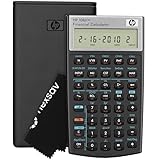
- HP 10BII+ FOR STUDENTS & PROFESSIONALS – This HP calculator is built for business, finance, accounting, and statistics courses. Perfect for learners and professionals who need to solve common financial problems quickly without memorizing formulas or relying on spreadsheets.
- 100+ FUNCTIONS FOR REAL WORLD MATH – Quickly solve time value of money, interest rates, loan payments, NPV, IRR, cash flows, and more. The 10bII+ also includes probability distributions for statistics courses—a feature not often found in financial calculators.
- ALGORITHMIC INPUT WITH DEDICATED KEYS – This high-school/college calculator uses algebraic and chain logic with minimal keystrokes. Layout appears the same as standard calculators for easy learning. Dedicated keys give quick access to commonly used financial and statistical functions
- APPROVED FOR MAJOR EXAMS – The HP 10bII+ algebra calculator is permitted for use on SAT, PSAT/NMSQT, and AP tests. An ideal statistics calculator and business calculator for school finance and accounting students preparing for class, coursework, or standardized exams.
- INCLUDES TRAVEL CASE, CLEANING CLOTH & BATTERIES– Slim, durable, and easy to keep on hand or store in a backpack or locker. Includes a protective case, cleaning cloth, and batteries so it’s ready out of the box. Large screen with clear contrast (non-backlit) is easy to read during exams or lectures.
For context, 73% of U.S. adults said they were doing okay or living comfortably financially in 2024, according to the Federal Reserve’s report published in 2025: 39% said they were doing okay and 34% said they were living comfortably. In the same report, 63% said they could cover a $400 emergency expense using cash or its equivalent. These are population-level findings, not a measure of what any particular app can accomplish. Federal Reserve: Economic well-being of U.S. households in 2024
What to weigh before using an app
Convenience has tradeoffs. An app may charge a fee, require account-linking steps, miscategorize transactions, or involve sharing sensitive financial information. A manual spreadsheet or paper planner may mean more work, but it can suit someone who prefers not to connect accounts.
Rank #4

- Solves time-value-of-money calculations such as annuities, mortgages, leases, savings, and more
- Performs cash-flow analysis for up to 32 uneven cash flows with up to 4-digit frequencies
- Calculates various financial functions: Net Future Value Net present Value Modified Internal Rate of Return Internal Rate of Return Modified Duration Payback Discounted Payback
- The Texas Instruments BAII Plus Professional features an Automatic Power Down (APD) function for extended battery life
- Prompted display guides you through financial calculations showing current variable and label. Ten-digit display
- Purpose: Decide whether you mainly need budgeting, expense tracking, a savings routine, or a broader view of your finances.
- Data entry: Compare manual entry with linked-account automation, and check that the app supports the institutions and account types you use.
- Cost: Check the current price and which features require payment; availability and pricing can change.
- Control: Find out whether you can correct transactions, export your information, and disconnect accounts.
- Privacy: Review what information is collected, how it is shared and retained, and the provider’s security disclosures.
- Fit: Choose a workflow you are realistically willing to maintain. A simpler system you use consistently may be more helpful than a feature-rich one you abandon.
How to think about privacy and account access
Linking an account may give a service access to sensitive details such as transactions and balances. The CFPB’s October 22, 2024 announcement about its personal financial data rights rule described consumer-authorized access and transfers involving information such as transactions, balances, payment initiation details, upcoming bills, and account verification. The announcement said the rule limits use of personal financial data to the purpose requested by the consumer. Because implementation, legal status, and deadlines can change, check current information before relying on the announcement as a statement of present requirements. CFPB announcement on personal financial data rights
Legal protections also depend on the service and its activities. The FTC explains that the Gramm-Leach-Bliley Act (GLBA) Privacy Rule covers businesses engaged in specified financial activities and protects nonpublic personal information. For covered sharing with nonaffiliated third parties outside stated exceptions, notice and opt-out requirements apply. Do not assume every budgeting app is covered or that the same rules govern every kind of sharing. FTC: How to comply with the GLBA Privacy Rule
Do these 3 things before closing this tab:
1Clear out junk files and repair common Windows errors2Scan for outdated or missing drivers - takes under a minute3Repair Windows errors before they cause bigger problemsBest Value

- Sold as 1 Each.
- Ideal for students and professionals. Over 100 built-in functions including probability distributions.
- Intuitive keyboard layout with minimal keystrokes required for many common functions.
- Easy-to-read display with adjustable contrast and on-screen labels.
- Permitted for use on SAT, PSAT/NMSQT and College Board AP tests.
Choose a format you will actually use
Digital tools are not the only option. MyMoney.gov provides federal budget worksheets, calculators, and checklists that can support a manual process. A paper planner or workbook is another optional aid; it will not automate tracking, but it may work well if writing things down helps you stay engaged. MyMoney.gov tools
Before committing to any format, identify one decision or habit you want it to support—for example, reviewing spending each week or setting aside money on payday. Then choose the least complicated workflow that gives you the information and reminders you need, while fitting your comfort with cost, manual effort, and data sharing.
Quick Recap
Product prices and availability are accurate as of the date/time indicated and are subject to change. Any price and availability information displayed on Amazon at the time of purchase will apply.




