Quick wins for a faster PC:
Clear out junk files and repair common Windows errorsFree Scan →Fix the driver behind crashes, sound loss and screen glitchesFind Drivers →Repair Windows errors before they cause bigger problemsFix Now →The safest shopping cart collects the least data, sends payment details directly to a reputable processor when practical, limits who and what can access customer records, and continuously checks the checkout page for changes. A cart connects identity, payment, fulfillment, marketing and support systems, so a breach can expose much more than a card number.
What an online shopping cart actually handles
A cart may create records in the browser, application server, payment processor, shipping system, help desk, analytics tools, exports and backups. “Customer data” is therefore a lifecycle, not one database field.
| Category | Typical examples | Why it matters |
|---|---|---|
| Identity and contact | Name, email, telephone number, username, customer-service messages | Can support phishing, account takeover and impersonation. |
| Order and fulfillment | Products, quantities, prices, order dates, billing and shipping addresses, delivery instructions, returns, refunds, loyalty and discount information | Reveals purchasing behavior and where goods are delivered. |
| Account and security | Password hashes, session identifiers, login records, device details, administrative audit logs | Can enable unauthorized access if poorly protected. |
| Payment-related | Primary account number (PAN), expiration date, cardholder name, security code, processor token, last four digits, brand, authorization and transaction IDs, digital-wallet or buy-now-pay-later references | Raw card data has the highest payment risk; tokens and limited references still require protection. |
| Technical and behavioral | IP address, browser and device information, fraud signals, cart-abandonment events, referral and marketing identifiers | Not being card data does not make combined technical and behavioral data harmless. |
WooCommerce documents commonly retained order history, names, email addresses, phone numbers, billing and shipping addresses, and payment-method notes in a store database (WooCommerce security FAQ). A processor token is generally a context-specific substitute for card details, but its safety depends on how it is issued, scoped, stored and used.
Follow the data from browsing to deletion
- A customer visits the storefront; the browser receives cart, session and third-party code.
- Products, quantities and prices are created in the browser and recorded by the server.
- Checkout collects contact, billing and shipping information.
- Payment components and scripts load on or around the checkout page.
- Card information goes to a gateway or processor, or is handled by the merchant if the integration is poorly designed.
- The store receives an authorization result, token or transaction reference.
- Order data is copied to fulfillment, shipping, tax, email, customer relationship management, analytics and support systems.
- Databases, logs, staff dashboards, CSV exports and backups create additional copies.
- Retention and deletion rules determine how long each copy remains.
Every integration adds another account, vendor and possible failure point. PCI Security Standards Council guidance treats shopping-cart software, hosted websites, developers, data centers and services affecting checkout as relevant to card-data security (PCI DSS eCommerce Guidelines).
Free tools Windows power users keep installed
One-click scans. No signup required.
#1 Best Overall

- DESK-MOUNTED CABLE ANCHOR LOCK: Enable secure cable management of a mouse, keyboard, & other workstation peripherals; Ideal for shared office/public computers; Use cable trap w/laptop security cable or padlock to deter theft/unauthorized access
- SECURITY FEATURES: All-metal collector buckle ensures reliability and durability; Multiple slot for securing various cable thicknesses and quantities
- SIMPLE INSTALLATION: Insert the cables into the cable traps and use a laptop security cable or padlock to prevent the collector buckle from being opened; Included double-sided tape keeps the security anchor in place
- EXPANDABLE AND MODULAR: Combine this cable anchor desk lock with the following accessories (sold separately) for further customization and compatibility: 3M4-DESK-LOCKING-KIT, UNIVK-LAPTOP-LOCK, CONNLOCKPK10, and KSLTAD
The main threats and the controls that address them
Account takeover
Credential stuffing, phishing, reused passwords, stolen session cookies and compromised administrator accounts can expose orders or change payment and refund settings.
- Require multi-factor authentication (MFA) for every administrator and staff account; use hardware security keys for high-value accounts where feasible.
- Use unique passwords, rate limits, login alerts, short-lived sensitive sessions and device or location anomaly detection.
- Remove inactive staff and vendor accounts immediately and review access periodically.
The FTC Safeguards Rule requires MFA for people accessing customer information at covered financial institutions, subject to a documented equivalent-control exception. It is not a universal federal requirement for every retailer, but it is a strong baseline (FTC Safeguards Rule guidance).
Card theft and browser skimming
Server malware, vulnerable payment plugins, exposed databases, unsafe APIs and malicious JavaScript can steal payment data. A legitimate analytics, tag-management or chat script can become the attack path if its vendor or account is compromised.
Rank #2
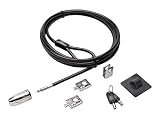
- The strong lock head is designed for desktop PCs and other devices
- 5mm Keying System featuring patented anti-pick Hidden Pin Technology
- 2 adapters and cable trap secure peripheral accessories
- Anchor plate allows devices without a Kensington Security Slot to be locked securely
- 8-foot carbon steel cable is cut-resistant and anchors to desk, table or any fixed structure
PCI DSS v4.0.1 requirements for payment-page scripts and tamper/change detection became effective April 1, 2025. Inventory every script, restrict it to the pages it needs, approve changes, and monitor unexpected modifications. PCI Security Standards Council guidance explains payment-page security and e-skimming (Payment-page security supplement).
Card testing
Criminals submit many small or failed transactions to discover which stolen cards still work. Use processor fraud tools, velocity limits, CAPTCHA or equivalent friction where appropriate, address verification, card-security-code checks, device and IP reputation, and rules for repeated declines. WooCommerce identifies card testing as a checkout risk (WooCommerce security FAQ).
Injection and vulnerable extensions
Outdated plugins, themes, libraries, checkout fields, coupon searches and API endpoints can permit cross-site scripting, SQL injection or privilege escalation. Apply strict input validation, parameterized queries, output encoding, secure headers, dependency inventories, code review and regular vulnerability testing.
Rank #3

- 5-Foot (1.5m) Carbon Steel Cable - Resists cutting attempts and provides ample length for easily anchoring your laptop to desks, tables, and other attachment points. Incorporates anti-shearing plastic sleeve to protect surfaces
- Slim Lock Head - Designed to support thin laptops using standard lock slots, lock secures while allowing your device to lie flat and stable
- Resettable 4-Wheel Number Code - Set or reset your personal number code from 10,000 possible combinations
- Pivoting Head and Rotating Anchor - The lock tip rotates 360º and the cable rotates up to 90º—allowing access to the ports near the lock slot on most devices and providing a convenient locking and unlocking experience
- One-Handed Attachment - Convenient slider allows for quick and easy attachment to the laptop with one hand
Third-party compromise and leakage
Assess payment, shipping, tax, marketing, support, review, loyalty, analytics, fraud and tag-management providers. The FTC recommends understanding what service providers do with customer information and taking reasonable steps to ensure they safeguard it (FTC Safeguards Rule guidance).
- Encrypt and restrict database backups, exports and support tickets.
- Keep card security codes out of logs, email, tickets and databases.
- Separate production and development credentials; never populate test systems with real customer data.
- Scan for exposed cloud storage, forgotten staging sites, unexpected files and overbroad staff permissions.
PCI DSS without the common overclaim
PCI DSS applies to organizations that store, process or transmit cardholder data. Hosted checkout, hosted fields and tokenization can keep raw card details in the processor’s PCI-controlled environment and reduce a merchant’s validation burden. They do not automatically remove the merchant’s website from scope: the checkout page can still load scripts, transmit payment-related data or affect the payment process (WooCommerce PCI guidance).
Recommended Free Tools
PCI DSS v4.0.1 has 12 principal requirements covering network security, stored-data protection, vulnerability management, access control, monitoring and testing, and security policy. PCI compliance addresses payment-card security; it does not replace privacy governance, secure development, retention rules or breach-notification analysis under applicable laws.
Rank #4

- Computer lock for HP, Lenovo, Acer, Asus and other brands; not compatible with Dell or Alienware (see part # K68008WW)
- Resettable 4-wheel Number code with 10, 000 possible combinations. Push-button design for one-handed engagement to easily attach lock
- 6’ long carbon steel cable is cut-resistant and anchors to desks, tables, or any fixed structure
- Attaches to laptops, desktops, TVs, monitors, hard drives, docking stations, projectors or any other device featuring a Kensington standard size security slot
- Independently verified and tested for industry-leading standards in torque/pull, foreign implements, lock lifecycle, corrosion, key strength and other environmental condition
Eligibility for the simplest e-commerce self-assessment questionnaire must be confirmed with the processor or a qualified assessor. PCI SSC has specifically clarified that a merchant’s payment page must not be susceptible to script attacks affecting account data for certain SAQ A eligibility paths (PCI SSC SAQ A clarification).
A layered security model
Collect and retain less
For each field, document its purpose, where it travels, where it is stored and when it will be deleted. Do not retain raw PANs or card security codes unless a compelling, formally managed requirement exists. Delete old exports, inactive accounts and unnecessary support records.
Encrypt the whole path
Use TLS on every page, secure cookies, modern TLS configurations, encryption at rest for sensitive databases, backups and exports, and key management separate from encrypted data. Never place sensitive data in URLs. TLS protects transit; it cannot stop a malicious script, compromised account, vulnerable plugin or infected server.
Best Value

- 【For Devices Without Security Lock holes】There is a lock slot plate lined industrial grade double sided adhesive, bound the plate to the hard surface of the devices, then insert the locking head into the plate and loop the cable around a fixed object.
- 【For Laptops With Built-in Security Lock holes】Just simply insert the lock head into the slot, and loop the cable around a fixed object.
- 【UPGRADED 100% ANTI THEFT】The lock head is made of super strong stainless steel and double lever lock, thicker and firmer. One key lever push button with 360°rotating, design for one hand operation. 5mm diameter cut-resistant wire braided cable is 30% thicker than normal. Extra length of 6.23ft allows easy movement of device.
- 【Code Combination】The computer locks utilizes a 4 digit security code. This customizable combination allows you to have over 10,000 different and unique combination. no lost keys!
- 【PACKAGE INCLUDED】1*Laptop Combination Lock, 1*Double Sided Adhesive Lock Slot Plate, 1*Manual, 3*Spacer. Please contact us if there is any problem with our product. We promise you a 100% satisfaction resolution. No risk, order now!
Limit access
- Use least privilege and role-based permissions.
- Maintain separate administrator accounts and production credentials.
- Store secrets in a secrets manager, not source code or spreadsheets.
- Review staff and vendor access and remove it at departure.
Maintain software safely
Keep the commerce platform, CMS, plugins, themes, libraries and operating system supported and patched. Automatic updates reduce exposure to known vulnerabilities but can break checkout compatibility; test changes in staging, keep rollback plans and restore-test backups.
Monitor the browser and the back end
Centralize restricted logs and alert on privilege changes, payment-setting changes, unusual refund spikes, failed-login bursts, repeated declines, unexpected files and checkout-script changes. Keep marketing and analytics code off payment pages unless its purpose is documented and its access is controlled.
Independent reader supportYour contribution helps us test, update, and keep practical guides available for everyone.Hosted, self-hosted or processor-hosted?
| Model | Strengths | Trade-offs and remaining duties |
|---|---|---|
| Hosted ecommerce platform | Provider handles much hosting and platform maintenance; integrated checkout; faster launch; lower chance of raw card exposure. | Less infrastructure control; apps, accounts, scripts and integrations remain risks; migration and data portability may be harder. |
| Self-hosted cart (such as WooCommerce) | Maximum control over code, hosting, database and extensions; flexible business integrations. | Merchant owns hosting, patching, backups, scans, access control, custom-code security and incident response. WooCommerce core is free, but its pricing page estimates hosting at $25–$350 per month and extensions at about $29–$299 per year each (WooCommerce pricing). |
| Hosted payment page (such as Stripe Checkout) | Processor collects payment details directly; can reduce PCI validation to a prefilled SAQ A; includes processor fraud and tokenization features. | Less checkout control and processor fees; merchant still secures its website, accounts, order data and integrations. Stripe lists standard U.S. domestic online card pricing at 2.9% + 30¢ per successful transaction, with geography and payment-method variations (Stripe Checkout, Stripe pricing). |
| In-house payment handling | Maximum control over flow and data. | Maximum PCI scope, key-management, segmentation, testing and breach exposure; generally unsuitable for small and midsize merchants without mature security operations. |
Shopify says stores on its platform are PCI compliant by default and that Shopify is a Level 1 PCI DSS-compliant service provider (Shopify PCI information). That statement does not secure merchant accounts, apps, staff permissions, exports or custom integrations. A hosted model reduces infrastructure work; it is not a guarantee.
Implementation checklist
Before launch
- Create a data inventory and map collection, transmission, storage and deletion.
- Remove fields without a defined fulfillment, fraud, legal or business purpose.
- Select hosted checkout, hosted fields or tokenization when direct card handling is unnecessary.
- Confirm processor responsibilities, compliance documentation and the applicable PCI self-assessment questionnaire.
- Configure TLS, secure cookies, MFA, backups, retention and breach-response procedures.
- Remove unused plugins, themes, apps and scripts.
During operation
- Patch the platform, CMS, extensions, libraries and operating system.
- Review checkout scripts and vendor changes.
- Restrict customer exports and test backup restoration.
- Monitor logins, privilege changes, refund spikes, declines and card-testing patterns.
- Review staff and vendor access; delete data that no longer has a documented purpose.
Before adding a script or vendor
- What data can it read, and does it run on the payment page?
- Can it capture form fields, keystrokes or page contents?
- Can it be limited to non-payment pages?
- How are vendor changes approved and detected?
- What contractual duties and breach procedures apply?
What to do when you suspect a breach
- Preserve logs and other evidence; avoid destroying affected systems.
- Isolate the compromised integration or account and rotate credentials, keys and tokens.
- Contact the payment processor and relevant hosting or platform providers.
- Determine which records and time periods were accessed.
- Restore only from a known-clean backup after the cause is addressed.
- Engage counsel and incident-response specialists to assess contractual, state, federal and international duties.
- Communicate verified facts without speculation and document corrective actions.
For covered financial institutions, the FTC Safeguards Rule requires reporting certain breaches involving unauthorized acquisition of unencrypted information affecting at least 500 consumers as soon as possible and no later than 30 days after discovery. That is sector-specific, not a universal ecommerce deadline (Safeguards Rule). Other notification deadlines vary by jurisdiction, data type and contract.
Crashes, No Sound, or Screen Glitches?
Random freezes, missing sound and display glitches usually trace back to one bad driver. Find and replace yours safely.Free scan · under a minuteWindows Errors? Fix Them Before They Spread
Repair common Windows errors and clear accumulated junk for a smoother, more stable PC - no reinstall needed.Free scan · no reinstallSigns of a responsible checkout for consumers
- Check the domain carefully and look for HTTPS, while remembering that the padlock alone proves little.
- Use a unique password and MFA; do not send payment details through email or chat.
- Prefer recognized payment methods and enable transaction notifications.
- Review statements and report suspicious charges promptly.
Consumers cannot audit a merchant’s servers, but these habits reduce the damage from account theft and fraudulent transactions.
How to compare security vendors
Compare payment-data exposure, PCI validation scope, browser-layer controls, MFA and audit logs, patch responsibility, data portability, compliance transparency, outage recovery and total cost. Include platform fees, payment processing, apps, hosting, security tools, support and professional compliance work. A lower subscription can cost more if the business lacks the expertise to maintain it. Cloudflare’s CDN, DNS, TLS, WAF and bot controls can complement a self-hosted store, but they cannot repair insecure application code or administrator access (Cloudflare TLS guidance, Cloudflare plans).
Quick Recap
Product prices and availability are accurate as of the date/time indicated and are subject to change. Any price and availability information displayed on Amazon at the time of purchase will apply.




