Free tools Windows power users keep installed
One-click scans. No signup required.
Advanced shipping technology improves the customer experience when it makes delivery more predictable, visible, flexible and easier to fix when something goes wrong. Tracking, predictive delivery estimates, warehouse automation, delivery choices and streamlined returns can reduce uncertainty at every stage—from order confirmation to refund.
Automation alone is not the benefit. The useful result is that customers get accurate information, a meaningful choice or a timely solution, instead of having to chase a retailer or carrier for answers.
What counts as advanced shipping technology?
The term covers the systems that plan, move, monitor and communicate about an order. These include transportation- and warehouse-management systems, carrier APIs and webhooks, tracking platforms, route-optimization software, barcode and RFID sensing, robotics, computer vision, predictive analytics, customer notifications and returns-management tools. AI may support prediction or decision-making within several of these systems.
Capabilities are at different stages of maturity. Carrier tracking APIs, shipping notifications, barcode automation, rate comparison and route optimization are widely deployed. RFID sensing, AI-based exception prediction, digital twins and computer-vision delivery verification are scaling in some operations. Delivery drones, autonomous robots and fully autonomous dispatch remain limited or emerging; they should not be treated as routine options for every shipment.
#1 Best Overall
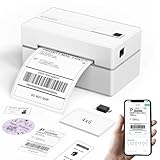
- Bluetooth Wireless Connection: KNAON Bluetooth shipping label printer enables wireless printing. For Mobile users, download the 'FlashLabel Pro' app from APP Store or Google Play for printing. Also, supports Windows and macOS, and can directly connect to the printer by downloading the 'FlashLabel Pro' App. Windows 7 or later computers can also print via Bluetooth by installing the latest advanced driver. Note: All devices CANNOT be connected directly to Bluetooth, and must be used through the 'FlashLabel Pro' app.
- USB Cable Connectivity: This printer ensures seamless USB connectivity with macOS, Windows (7 and above), ChromeOS, and Linux. KNAON printer features a built-in USB drive preloaded with drivers and tutorial videos for a fast and hassle-free setup. For ChromeOS, need to install 'FlashLabel' extension to your Google Chrome.
- Versatile DIY Labeling Options: KNAON Thermal Shipping Label Printer offers a vast selection of pre-designed templates, including 3,000+ templates, 5,000+ icons, and 100+ fonts available in the app. Designed for both professional and personal use, it supports various thermal paper sizes, ensuring effortless customization for all your labeling needs. Ideal for printing DIY shipping labels, barcode labels, thank-you labels, mailing labels, name tags, price tags, and various small thermal labels.
- Seamless Multi-Platform Compatibility: This Bluetooth shipping label printer works effortlessly with all major platforms, including Amazon, eBay, Shopify, USPS, UPS, Etsy, PayPal, Poshmark, DHL, and more, ensuring smooth and efficient label printing. (Note: Save the logistics label as a PDF file on the shipping platforms, then import it into the 'FlashLabel Pro' app for printing).
- Portable & Stylish Design: KNAON multi-function thermal label printer offers user-friendly operation in a compact design. Its perfect size (7.17 x 3.9 x 3.43 inches) makes it simple to store anywhere. With a fast printing speed of up to 180 mm/s and support for paper widths from 1.5 to 4.2 inches. The package also includes 10 test printing papers to get you started right away.
The customer benefit follows a chain: technology changes an operational process, that change addresses a customer problem, and the result can be measured. For example, a carrier event delivered through a webhook can trigger an accurate delay message; the relevant outcomes include whether customers were notified in time and whether shipment-status contacts fell.
1. Tracking reduces uncertainty about an order
Tracking ranges from occasional barcode scans to near-real-time sensing and predictive estimates. A tracking page that only repeats the latest carrier scan is useful, but it does not necessarily show a parcel’s continuous location. Visibility depends on the carrier’s network, scan frequency, handoffs, geography, service and data integration.
More useful tracking puts events in context: it shows a current status, explains a delay or exception in plain language, updates the delivery estimate when circumstances change, and offers an available next step. That helps customers plan for a home delivery and can surface address issues or stalled shipments before they need to contact support.
FedEx’s Tracking API supports notifications for possession, delivery exceptions, estimated-delivery changes and completed delivery. Its developer platform also supports shipment-visibility webhooks, which can push events to a merchant’s system rather than requiring repeated status checks. These are integration capabilities, not a guarantee that every shipment will produce continuous location data. FedEx Tracking API documentation and the FedEx developer portal describe the options.
For Shopify merchants, tracking can appear on the order-status page, in shipping emails and in the Shop app after a tracking number is added to a fulfilled order. Shopify says it recognizes tracking numbers from hundreds of carriers. This is a practical baseline for stores with straightforward fulfillment; it is not the same as predictive, cross-carrier exception management. Shopify’s order-tracking documentation explains the setup.
2. Predictive analytics helps make delivery promises more reliable
Prediction, optimization and intervention are related but distinct uses of analytics. A system may estimate an arrival time or delay risk without changing anything. The customer-experience improvement comes when a useful prediction leads to a timely action.
Prediction
Models can combine package events with historical performance, traffic, weather, capacity and network conditions to estimate arrival windows or flag risks such as a missed delivery attempt. Analytics can also inform capacity and demand planning, warehouse assignment, carrier choice and inventory positioning. The estimate is only as dependable as its input data and the conditions it can observe.
Optimization
Systems can use predictions to help choose a carrier, allocate a delivery slot, adjust a route or prioritize a shipment. DHL describes AI uses spanning route optimization, tracking, predictive analytics, warehouse processes and customs assistance. For customs, an image-based tool can suggest a structured goods description, but the shipper must review it for accuracy. DHL’s overview of AI in logistics and last-mile delivery also identifies data quality, integration, skills and investment as adoption challenges.
Intervention
If a system detects likely disruption, an operator might revise an ETA, alert support, offer an eligible pickup or redirection option, change a route, or escalate a high-value order. A precise-looking prediction that cannot be trusted may damage confidence more than an honest delivery window. Customer messages should reflect uncertainty when conditions change rather than preserve false precision.
Rank #2

- Bluetooth Wireless Connection: KNAON Y41BT Bluetooth shipping label printer enables wireless printing. For iOS and Android users, need to download the 'FlashLabel Pro' App from Apple Store or Google Play. Windows 7 or later computers can also print via Bluetooth by installing the latest advanced driver. Mac users with M1/M2/M3/M4 processors can connect to the printer by downloading the 'FlashLabel Pro' App from Apple Store. Note: All devices CANNOT be connected directly to Bluetooth, and must be used through the 'FlashLabel Pro' app.
- USB Cable Connectivity: This printer ensures seamless USB connectivity with macOS, Windows (7 and above), ChromeOS, and Linux. KNAON printer features a built-in USB drive preloaded with drivers and tutorial videos for a fast and hassle-free setup. For ChromeOS, need to install 'FlashLabel' extension to your Google Chrome.
- Versatile DIY Labeling Options: KNAON Thermal Shipping Label Printer offers a vast selection of pre-designed templates, including 3,000+ templates, 5,000+ icons, and 100+ fonts available in the app. Designed for both professional and personal use, it supports various thermal paper sizes, ensuring effortless customization for all your labeling needs. Ideal for printing DIY shipping labels, barcode labels, thank-you labels, mailing labels, name tags, price tags, and various small thermal labels.
- Seamless Multi-Platform Compatibility: This Bluetooth shipping label printer works effortlessly with all major platforms, including Amazon, eBay, Shopify, USPS, UPS, Etsy, PayPal, Poshmark, DHL, and more, ensuring smooth and efficient label printing. (Note: Save the logistics label as a PDF file on the shipping platforms, then import it into the 'FlashLabel Pro' app for printing).
- Portable & Stylish Design: KNAON multi-function thermal label printer offers user-friendly operation in a compact design. Its perfect size (7.2 x 3.15 x 2.65 inches) makes it simple to store anywhere. With a fast printing speed of up to 180 mm/s and supports paper widths from 1.38 to 4.41 inches. The package also includes 20 test printing papers to get you started right away.
FedEx announced Tracking+ and Returns+ in February 2026 as embedded, white-label post-purchase tools for enterprise shippers, designed to provide visibility, communications and AI-supported returns capabilities in merchants’ digital channels. FedEx also reports that users of certain returns AI capabilities have achieved up to 85% forecasting accuracy and 40% improved return prediction; those are company-reported figures, not independent industry benchmarks. Availability and commercial terms require confirmation with FedEx. FedEx’s announcement describes the offering and its claims.
3. Route optimization can improve last-mile reliability
Modern route optimization is not simply finding the shortest path. Depending on the operation, it can account for traffic, road closures, delivery windows, vehicle capacity, driver hours, stop density, package priority, weather, pickup commitments, special handling and the chance of a failed attempt.
Adjusting routes to real conditions can support more dependable delivery windows and fewer missed attempts. DHL describes route adjustment using traffic, delivery density and last-minute changes; UPS describes route optimization and network planning that account for weather, transportation delays and volume forecasts. Those capabilities may help an operator respond sooner, but results vary by geography and operating conditions. See DHL’s logistics overview and UPS’s explanation of automation and AI.
Do these 3 things before closing this tab:
1Clear out junk files and repair common Windows errors2Fix the driver behind crashes, sound loss and screen glitches3Repair Windows errors before they cause bigger problemsEfficiency and customer preference can conflict. The lowest-cost route may be a poor choice for an order requiring a precise appointment, signature, special handling or a lower-emission option. Carrier selection should weigh service reliability, visibility, damage, support burden and recovery options alongside price.
4. Warehouse automation helps orders leave correctly
Robotic picking, automated sortation, barcode recognition and computer vision can speed order processing and help verify that the right items and quantities are packed. Better handling and more consistent packaging can also reduce errors and damage. Those operational changes matter to customers because they affect whether the order arrives on time, complete and as purchased.
Automation can support more reliable inventory promises as well: accurate inventory visibility makes it less likely that a store will promise an item it cannot fulfill. Amazon describes using AI, automation, inventory transparency, carrier selection and fulfillment optimization across its network. DHL discusses warehouse automation, barcode recognition and wearable technology, while noting some examples are being explored rather than fully deployed. These are descriptions of company capabilities, not proof that every retailer using automation will achieve the same results. See Amazon’s fulfillment-network overview and DHL’s logistics overview.
5. RFID and IoT sensing fill some visibility gaps
A barcode event generally depends on a person or machine scanning a parcel. RFID readers can detect tagged parcels as they pass through covered locations, reducing dependence on manual scans. IoT sensors can, where installed and connected, report conditions such as temperature, shock or tilt as well as location. The customer benefit comes when teams use those signals to identify and respond to a misroute, delay or handling problem.
Windows Errors? Fix Them Before They Spread
Repair common Windows errors and clear accumulated junk for a smoother, more stable PC - no reinstall needed.Free scan · no reinstallCrashes, No Sound, or Screen Glitches?
Random freezes, missing sound and display glitches usually trace back to one bad driver. Find and replace yours safely.Free scan · under a minuteUPS said in April 2026 that RFID package sensing had been rolled out across its U.S. small-package network, including vehicles, facilities and packages shipped through more than 5,500 UPS Store locations. UPS describes the system as providing package-level visibility with less dependence on manual scanning. It also says its broader AI program includes a digital twin of its network that updates every 10 minutes. These are UPS-reported capabilities and do not mean that every parcel has continuous GPS tracking or an exact live location. See UPS’s RFID announcement and its account of AI initiatives.
- RFID coverage depends on tags, readers, network coverage and event reconciliation; gaps can remain between detection points.
- Sensor coverage varies by service, package and geography, and near-real-time visibility is not a guarantee of exact location.
- Raw events can confuse customers unless the interface explains what changed and what, if anything, they should do.
6. Useful notifications make the post-purchase journey coherent
Merchants can coordinate messages across the order lifecycle: confirmation, shipment, carrier handoff, in-transit progress, exception, out-for-delivery, delivery, return progress and refund or replacement. The goal is not to send a message at every event. It is to tell the customer what changed, what to expect and what action is available.
Rank #3

- Go Wireless by Bluetooth: Download the "NELKO"app to print via Bluetooth on your Nelko Bluetooth thermal label printer for iOS and Android. Printing shipping labels has never been easier. Windows 7 or later computers can also print via Bluetooth. For Mac users with M1 or M2 CPUs, install the app and connect to the printer via Bluetooth. Note: All devices cannot be directly connected to Bluetooth and need to be used through the app
- Print via USB: For Windows (7 and later), Mac OS,Chrome OS, you can connect the desktop label printer via USB cable. Note that Mac OS only works with USB connection, you can not print via Bluetooth
- Good Helper for Cost Saving: Advanced thermal direct technology is adopted to achieve the printing speed of 150 mm/s, up to 72 sheets 4x6 labels/min. High speed brings high efficiency and helps your business grow faster! 203 DPI makes printing clearer. No ink, no toner, only thermal labels needed. Both fanfold labels and roll labels could be used. Label size: labels width ranges from 1.54" to 4.1"(40-104 mm), such as 4x6, 3x2, 3x1, 2x1 thermal labels and so on
- Strong Platform Compatibility: This bluetooth shipping label printer can work with virtually all platforms, including Amazon, Ebay, Shopify, USPS, UPS, Esty, PayPal, Poshmark,etc.(Note: Please remember to save the logistics label as a PDF on the logistics platform, then upload it to the editor APP "NELKO" for printing
- Suitable for Commercial and Home Use: Printer driver, instruction videos and problem shooting videos are provided in U-Disk for better setting. Nelko PL70E label printer is much smaller than traditional printers and only requires a small piece of space to achieve printing. Very suitable for printing shipping labels, mailing labels, price labels, barcode labels, name tags and all kinds of small category labels
- Use plain language and a credible revised expectation when a delay occurs.
- Offer a next step when one exists, such as correcting an address or choosing an eligible pickup option.
- Reconcile carrier, warehouse, merchant and returns events so they do not contradict one another.
- Keep support easy to reach for problems an automated status cannot resolve.
- Use the merchant’s brand and voice consistently, even when carrier data powers the update.
FedEx’s digital-solutions information describes visibility, proof of delivery, APIs and webhooks as tools for post-purchase communication. The same data can feed a merchant’s own customer channels, but integration quality determines whether messages are timely and consistent. FedEx digital solutions outlines its services.
7. Delivery choices give customers control
Where the carrier and shipment permit it, digital delivery tools can let customers select a date or window, reschedule, redirect an order, use a pickup point or locker, request a safe place, set signature preferences or correct an address. These choices can prevent a failed attempt if offered before the delivery happens.
Options are not universal. Carrier, service level, package size, destination, security requirements and local infrastructure determine what is available. A merchant should show only choices that the underlying shipment can actually honor, and should explain when a change is no longer possible.
8. Proof of delivery can build trust, with privacy safeguards
Proof of delivery may consist of a signature, scan, geotimestamp, GPS coordinate, photograph, recipient check or chain-of-custody record. It can help customers locate a parcel and give support teams evidence to investigate disputes. A photograph documents where a package was left; it does not necessarily establish that the intended customer personally received it.
In March 2026, Amazon Web Services reported that UK parcel carrier Evri was deploying Veri Snap AI to analyze courier delivery photographs for package location, condition and compliance. AWS and Evri said the system had been tested on more than 20 million photos before broader deployment, and that Evri processes approximately 90 million delivery photos per month. These are company-reported figures and a UK-specific example, not a universal delivery standard. AWS’s announcement describes the deployment.
Delivery images, signatures and location data can expose personal information, home layouts or neighbors. Providers and merchants should limit collection to what is needed, control who can access it, set retention and deletion rules, and provide a way to contest an incorrect or misleading record. Computer vision can misclassify a location or condition, so consequential disputes need human review.
The Tool Desk
Outbyte Driver Updater FREEFix the driver behind crashes, sound loss and screen glitchesFind Drivers →Outbyte PC Repair FREERepair Windows errors before they cause bigger problemsFix Now →9. Returns technology carries the experience beyond delivery
A return is another shipment and often the customer’s next interaction with the seller. Self-service initiation, eligibility checks, prepaid or QR-code labels, drop-off or pickup choices, exchanges, store credit, return tracking and refund updates can remove avoidable effort. Behind the scenes, routing and disposition decisions can help determine whether an item is restocked, refurbished or handled another way.
FedEx’s enterprise announcement describes AI-supported returns tools intended to identify patterns, automate support and adapt policies at scale. AfterShip’s official documentation lists features including branded return pages, eligibility rules, labels, refunds, exchanges, routing, analytics, store credit, tracking and notifications. Feature availability depends on the selected plan and configuration. See FedEx’s announcement and AfterShip’s returns documentation.
Returns design involves trade-offs. Frictionless returns can increase costs or abuse; strict controls can frustrate legitimate customers. Faster refunds may require financial risk or confidence in inventory data. Sustainability should be assessed across transport, packaging, consolidation, refurbishment and disposal—not inferred from the absence of a return trip alone.
Rank #4

- [HIGH TECH LABEL PRINTER] Equipped with a Japanese high tech thermal print head, 203 DPI high printing quality. No ink, No toner, Clean with no mess, economical. Works with both fanfold labels and roll labels. Label size: labels width ranges from 1.57" to 4.1"
- [PRINT WIRELESSLY]The label printer support printing wirelessly. For windows 8 or later and Mac, you can print via Bluetooth. For Android& iOS, you can’t print via Bluetooth on phone, need to download the App "Jadens printer" and print on it.
- [PRINT VIA USB] USB connection works with both Windows (7 and newer) and Mac OS (10.9 and newer) devices. Please long and press the feed button to identify and calibrate label size each time you change labels.
- [WIDE USAGE] JADENS thermal label printer is widely used to print labels from various marketplaces and shipping platforms, such as Endicia, Dazzle, ShipStation, Shipping Easy, Shippo, ShipWorks, Ordoro, eBay, Amazon, Easy, and Shopify. Use JADENS thermal label maker machine to print shipping labels, warehouse labels, market labels, helping increase your productivity. Ideal for your online small business for shipping packages.
- [EASY TO SET UP & RELIABLE AFTER-SALE SERVICE] Set up in one minute. Printer driver, instruction videos and problem shooting videos are provided in U-Disk for better understanding. Offer one year warranty; customer support can be reached out to email, phone, remote control.
How to choose shipping technology for your operation
Start with the customer problem, the scale of the operation and the systems that must share data. A small store may need complete tracking and clear delay messages before it needs predictive AI; a multi-carrier operation may first need a consistent event model and reliable exception handling.
What’s actually slowing this PC down?
Pick the symptom - the matching free tool is one click away.
Small retailer
- Ensure each fulfilled order has a valid tracking number and that the carrier is correctly identified.
- Enable order-status and shipping notifications through the commerce platform.
- Use a shipping platform that supports the functions you need, such as labels, rate comparison, address validation or returns.
- Add branded tracking and more advanced workflows only when they address a measured customer problem.
- Track shipment-status contacts and delivery complaints per 100 orders as a baseline.
Growing omnichannel merchant
- Connect the commerce platform, order-management system, warehouse-management system, carriers and returns tools.
- Normalize carrier events and establish rules for which status is authoritative when systems disagree.
- Use webhooks or other event-driven integrations for timely notifications where supported.
- Set carrier rules based on delivery reliability and coverage as well as price.
- Alert teams to stalled shipments, missed handoffs, address errors and missed windows; offer redirection or pickup only where the shipment permits it.
- Compare promised and actual delivery by carrier, region, product and service.
Enterprise or 3PL
- Build a shared shipment-event model across carriers, modes and facilities, with clear data ownership.
- Validate event completeness and historical data before introducing predictive ETA or exception models.
- Connect control-tower alerts to operational teams and customer support, with human escalation paths.
- Pilot RFID, IoT sensing or computer vision in high-value or high-error flows before scaling.
- Audit AI workflows for false positives, privacy exposure, bias and operational drift; retain manual override and decision logs.
- Measure customer outcomes alongside warehouse and transportation efficiency.
Compare systems on operational fit, not feature count
- Coverage: supported carriers, countries, service levels, marketplaces, stores and warehouses.
- Data quality: event completeness, scan latency, ETA accuracy, exception clarity and history access.
- Integration: APIs, webhooks, native commerce links, rate limits and compatibility with existing systems.
- Customer controls: available delivery changes, language support and accessibility.
- Returns: exchanges, store credit, eligibility, labels, fraud controls and refund integration.
- Automation and oversight: rules-based versus predictive or generative AI, audit logs, manual override and escalation.
- Privacy and security: controls for addresses, location, signatures, photographs, access and retention.
- Scale and commercial model: peak throughput, API reliability, multi-brand support and fees per subscription, shipment, return, label, API call or support tier.
- Proof of value: ability to pilot against a baseline and attribute changes to the technology rather than unrelated operational shifts.
Common implementation failures to prevent
Overpromising an ETA
A narrow, confident-looking window can harm trust if the prediction changes repeatedly. Match precision to evidence, update the estimate when conditions change and make uncertainty understandable.
Treating a tracking gap as a lost parcel
Missed scans, carrier handoffs, customs, consolidation, rural delivery, weather, incorrect tracking numbers and API outages can all leave a shipment without a new event. The customer interface should distinguish “no new update” from evidence that an order is lost, and give support teams a way to investigate.
Letting systems send conflicting messages
Carrier, warehouse, merchant and returns platforms may describe the same order differently. A canonical event model, clear precedence rules and message testing can prevent a customer from receiving both a delay notice and a delivery confirmation for the same status.
Automating complex support without an exit
Routine status questions may suit automation; damaged goods, partial deliveries, wrong items, customs charges, high-value claims and “delivered but not received” disputes often require judgment. Make human escalation easy to find and avoid forcing customers to repeat information already supplied.
Assuming better data automatically means better decisions
RFID and sensors need correct package identity, reader coverage, reliable connectivity, event reconciliation and staff able to act on alerts. AI-generated customs descriptions or customer responses can sound plausible while being wrong; review is important where errors have financial or delivery consequences.
Ignoring integration and environmental costs
Legacy systems, inconsistent carrier interfaces and poor master data can make implementation harder than a product demonstration suggests. Faster shipping and free returns can also increase transport and packaging demand. Consolidation or route optimization may improve efficiency, but no single technology makes a shipping operation automatically sustainable.
How to measure whether customer experience improved
Measure customer outcomes directly, then use operational indicators to explain what changed. Lower shipping cost or more automation is not, by itself, proof of a better customer experience.
Customer measures
- “Where is my order?” contacts per 100 orders
- Delivery-related complaint rate and customer effort
- Post-delivery satisfaction or delivery NPS
- Cancellations attributed to delivery uncertainty
- Repeat purchase rate, interpreted alongside other changes in the business
- Return-initiation completion rate and refund cycle time
Operational measures with customer impact
- On-time delivery against the original promise and ETA accuracy
- First-attempt delivery rate and address-error rate
- Damage and mis-sort rates
- Time between an exception occurring and its detection
- Share of shipments with usable tracking events and proactive delay notifications
- Return-to-refund time and carrier performance by lane and service
Set a baseline, pilot a change on a defined shipment group, and compare the same outcomes over a suitable period. Segment results by carrier, region, service and product so an improvement in one lane does not hide a decline elsewhere.
Recommended Free Tools
The practical test
The best shipping technology makes logistics feel dependable: customers can see what is happening, understand what to expect, choose among genuinely available options and get a credible resolution when a delivery or return goes wrong. Choose systems for those outcomes, not for the presence of an AI label or the number of automated steps.
Quick Recap
Product prices and availability are accurate as of the date/time indicated and are subject to change. Any price and availability information displayed on Amazon at the time of purchase will apply.




