You can still spend ordinary U.S. pennies: they remain legal tender even though the U.S. Mint ended circulating penny production on November 12, 2025. If you have a jar of them, use them in transactions or ask your bank or credit union how it handles coin deposits and exchanges. Check a coin for an unusual date or mint mark before spending it if you are interested in collecting, but age alone does not establish value.
What “retired” means for the penny
On November 12, 2025, United States Treasurer Brandon Beach struck the final penny intended for circulation at the Philadelphia facility. The Mint described that event as the end of the penny’s 232-year run as a circulating coin. The title’s “230 years” is a rounded figure; the Mint’s stated figure is 232 years. Limited numismatic or collector pennies continue to be made, so the change ended circulating production, not all penny production. The Mint’s announcement also estimated that about 300 billion pennies were in circulation at the time.


The Mint says the suspension followed a Treasury determination that new circulating cents were no longer needed to meet U.S. needs. Its FAQ reports that the cost to produce a penny rose from 1.42 cents to 3.69 cents over the preceding decade, and estimates approximately $56 million in annual production savings from the suspension. Those are figures reported by the Mint, not a count of coins currently in circulation. The FAQ was last updated January 7, 2026.
Can you still spend pennies?
Yes. The Mint says pennies remain legal tender and may still be used in transactions. Its final-production announcement says businesses can continue to price goods and services in one-cent increments. The cited federal guidance does not establish a nationwide cash-rounding rule or guarantee that every individual retailer will accept pennies, so check a merchant’s policy if you are unsure.
Recommended Free Tools
Where to take a jar of pennies
For a small number of coins, spending them gradually is the simplest option. For a large quantity, contact your bank or credit union before making a trip: ask whether it accepts penny deposits or exchanges, whether there are quantity limits or fees, and whether coins must be rolled. Service can vary by institution and location.
In a 2020 public coin-circulation statement, the Mint encouraged people to spend coins, deposit them, exchange them for currency at financial institutions, or use a coin redemption kiosk. That general historical advice is not confirmation that a particular bank, credit union, or kiosk currently accepts pennies. Check the receiving service directly before sorting or transporting a large quantity.
Rank #2

- ✔ COLLECTIBLE - The United States Mint began producing the Lincoln Cent in 1909 to honor the centennial of Abraham Lincoln's birth. It was the first US coin to feature a real person on the obverse. Designed by Victor D. Brenner, it was the first one cent coin to display the mottos IN GOD WE TRUST and E PLURIBUS UNUM.
- 💰 QUALITY & DETAIL - A glossy finish hard cover houses both the 92 page anthology and the pennies in capsules. The Lincoln Penny Anthology was published in the year 2000. Each year historic events from 1909 to 2000 are covered on a page in the tri-fold book. The inner covers of the book hold the pennies in capsules.
- ✔ UNIQUE GIFT - Looking for a gift for a birthday, anniversary or graduation, the set includes the rare 1922 one cent, the 1943 Steel Penny. Coins are Collectible, Educational and Historical.
- 💰 PROTECTION – The coins are housed in acrylic capsules to keep safe from dust, dirt and oils. The book has a sturdy hard cover with a glossy finish that will look great on any coffee table. A Certificate of Authenticity is included that states the pennies are genuine United States minted coins.
- TRUSTED QUALITY ASSURANCE - Rest easy knowing your purchase is protected by our commitment to quality and reliability, ensuring a worry-free experience every time.
Should you check pennies before spending them?
If you have an interest in coin collecting, it may be worth setting aside a cent with an unusual date or mint mark for identification. The Mint highlights 1943 steel pennies, Philadelphia pennies bearing a 2017 “P” mint mark, and 2019 West Point pennies marked “W” as examples. These are leads for further identification, not a guarantee of a particular coin’s value. The Mint’s Lincoln cent information can help with basic identification.
- Look at the date and mint mark, using a magnifier if needed; a magnifier helps inspection but does not determine market value.
- Do not clean a coin you may want identified. Preserve it as found while you seek a reputable identification or appraisal.
- Do not assume a penny is valuable simply because it is old, a different color, or looks unusual at a glance.
The Mint’s FAQ reports that in fiscal year 2024 it produced and shipped approximately 3.2 billion pennies, which made up 57% of the 5.61 billion circulating coins produced that fiscal year. Those historical production figures help explain why cents are common, but they do not establish how many are in circulation now or the value of an individual coin.
Rank #3

- Pound of Wheat Pennies
What if a penny is bent, partial, or badly worn?
The Mint’s Mutilated Coin Redemption Program is permanently closed, and the Mint no longer accepts bent or partial coins for redemption. Do not mail a damaged cent to the Mint expecting payment. The Mint distinguishes these from “uncurrent” coins: whole U.S. coins that are worn but still recognizable as genuine and denomination and machine countable. Its FAQ says Federal Reserve Banks redeem those coins and forward them to the Mint. Consult the Mint’s coin-circulation guidance for that distinction.
Quick Recap
Best Value
Rank #4
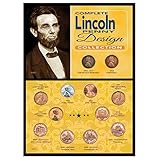
- Century of Lincoln Cent History – This 12-coin set traces the complete design evolution of the Lincoln penny from the early Wheat era through the modern Union Shield.
- Key Historical Varieties Included – Features the magnetic 1943 Steel Cent minted during WWII and a 1918 Wheat Penny marking the return of Victor David Brenner's "VDB" initials to Lincoln's shoulder.
- Authentic US Mint Coins – Every coin is a genuine United States Mint issue removed from circulation. A Certificate of Authenticity is included.
- Complete Design Timeline – Includes: 1910-1917 Wheat (VDB removed), 1918 VDB, 1943 Steel, 1958 Last Wheat, 1959 First Memorial, 1982 Last Copper, 1982 Zinc, all four 2009 Bicentennials (Kentucky, Indiana, Illinois, Washington), and 2010 Shield.
- Gift Ready Presentation – Coins arrive in a protective display portfolio with historical details, ideal for collectors, students, or American history enthusiasts.
Product prices and availability are accurate as of the date/time indicated and are subject to change. Any price and availability information displayed on Amazon at the time of purchase will apply.




