Do these 3 things before closing this tab:
1Fix the driver behind crashes, sound loss and screen glitches2Repair Windows errors before they cause bigger problems3Scan for outdated or missing drivers - takes under a minuteThomas R. Brown, who co-founded analog electronics company Burr-Brown Research Corporation with Page Burr, died of lung cancer at his Tucson home on June 6, 2002. He was 75. Brown helped build the company from a $50,000 garage startup into a prominent maker of high-performance analog and mixed-signal circuits, then returned to lead it through financial trouble before its 2000 sale to Texas Instruments.
Who was Thomas R. Brown?
Brown was an engineer and business leader who helped establish Burr-Brown in Tucson, Arizona. He and his friend Page Burr started the company in 1956, after Brown became interested in transistor electronics. The company’s early work centered on applying transistors to analog circuits, an alternative to vacuum-tube electronics.

Brown said in 2000 that the title he valued most was “engineer.” He described persistence as part of his approach: “Those electrons belonged to me and were going to do what I wanted them to do sooner or later,” he said, adding, “And after 2,000 tries, I made them do what I wanted them to do.” Arizona Daily Star
How Burr-Brown began and what it made
A Tucson garage startup
Brown and Burr launched Burr-Brown Research Corporation in Brown’s Tucson garage in 1956 with $50,000 in capital, according to the Arizona Daily Star. The company grew into a supplier of high-performance analog and mixed-signal integrated circuits.
#1 Best Overall
Operational amplifiers and mixed-signal circuits
Burr-Brown became associated with commercial solid-state operational amplifiers and later data-conversion and mixed-signal products. EDN identifies the company’s Model 130, introduced in 1958, as the world’s first transistorized operational amplifier. The University of Arizona says Brown led Burr-Brown to worldwide prominence in developing, manufacturing and marketing data-conversion and mixed-signal integrated circuits. EDN University of Arizona
Brown’s return to lead the company
Brown stepped away from day-to-day operations in 1976 for semiretirement. In April 1993, after Burr-Brown had suffered major losses, he returned at age 66 as president and CEO and helped turn the company around, according to the Arizona Daily Star.
His daughter Sarah M. Brown Smallhouse recalled that he “toughed it out through some pretty tough times at Burr-Brown” and did what was needed to improve the company. She also described how he taught his children to reason through problems: “He never said yes or no. He always took us through the thought process so we could come to a conclusion ourselves.”
Former Burr-Brown president and CEO Syrus P. Madavi called Brown “a professional and personal mentor,” and said he was “not only a very fine professional in our electronics industry, he was just absolutely a superb human being.” Arizona Daily Star
Rank #3

- Genuine Burr-Brown INA122P instrumentation amplifier
- Precision analog signal amplification with low power consumption
- 8-pin DIP package for breadboards or socketed PCBs
- High common-mode rejection ratio (CMRR) for noise immunity
- Low input offset voltage for accurate signal measurement
Texas Instruments acquired Burr-Brown in 2000
Texas Instruments acquired Burr-Brown in a stock deal in 2000. The Washington Post reported the deal’s value at about $7.6 billion; EDN later gave the purchase price as $7.68 billion. These are reported valuations of the acquisition, not figures for Brown’s personal proceeds. The Washington Post EDN
Independent reader supportYour contribution helps us test, update, and keep practical guides available for everyone.Brown’s death
Brown was diagnosed with lung cancer four months before his death. He died peacefully, surrounded by family, at his Tucson home on June 6, 2002, at age 75, according to the Arizona Daily Star and EE Times.
Quick Recap
Best Value

- Superior Sound Quality and High Open-Loop Gain: 120 dB (600 Ω)
- Ultra Low Distortion: 0.00008% and Wide Supply Range: ±2.5 V to ±18 V
- Low Noise: 8 nV/√Hz
- True FET-Input: IB = 5pA
- High Speed: Slew Rate: 20 V/µs Bandwidth: 8 MHz
Rank #4
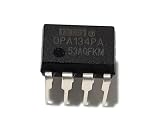
- Superior Sound Quality
- Ultra Low Distortion: 0.00008%
- Low Noise: 8 nV/√Hz
- True FET-Input: IB = 5pA
- High Open-Loop Gain: 120 dB (600 Ω)
Product prices and availability are accurate as of the date/time indicated and are subject to change. Any price and availability information displayed on Amazon at the time of purchase will apply.




