Toronto-based Perceptive Space announced on August 6, 2024, that it had emerged from stealth after raising an oversubscribed US$2.8 million pre-seed round. Panache Ventures led the financing, joined by Metaplanet, Mythos Ventures, 7percent Ventures and AIN Ventures. The startup is developing AI software that turns space-weather data into forecasts and operational risk assessments for particular spacecraft, orbits and missions.
That is a potentially valuable commercial layer, but it is not yet evidence of a proven replacement for government forecasting. Perceptive’s most striking performance statement—predictions “up to 10 times more accurate”—is a company-reported, bench-scale claim whose methods and independent validation have not been publicly established.
The funding and the company
Perceptive Space’s August 2024 announcement described the financing as an oversubscribed pre-seed round. The company says the capital will support product development, hiring, commercialization and the move from bench-scale work toward a full service for satellite operators and launch providers. The startup’s stated 2024 roadmap targeted a first product in 2025; that target should not be treated as proof that a generally available product launched.
| Item | Reported detail |
|---|---|
| Amount | US$2.8 million (also reported as approximately C$3.9 million, the Canadian-dollar equivalent) |
| Round | Oversubscribed pre-seed |
| Lead investor | Panache Ventures |
| Other named investors | Metaplanet, Mythos Ventures, 7percent Ventures and AIN Ventures |
| Announcement | August 6, 2024 |
| Headquarters | Toronto, Canada |
Founder and CEO Padmashri Suresh has worked across space-weather modeling, small-satellite missions, space policy and AI product development. The early team has reported experience connected with space weather, machine learning and aerospace engineering, including backgrounds at NASA, Los Alamos National Laboratory, MIT and the University of Waterloo. Those affiliations describe team experience, not endorsement of Perceptive’s product.
Windows Errors? Fix Them Before They Spread
Repair common Windows errors and clear accumulated junk for a smoother, more stable PC - no reinstall needed.Free scan · no reinstallOutdated Drivers Are Slowing You Down
One free scan finds every outdated or missing driver and matches the right update for your exact hardware.Free scan · exact hardware match#1 Best Overall

- PLEASE VERIFY YOUR PRODUCT IS COMPATIBLE WITH THIS SENSOR PRIOR TO ORDERING. Review images and model # lists below.
- This looks almost identical to another sensor we sell. Compare compatibility of both units.
- [Replacement Compatibility] Review the back of your sensor being replaced. It should read "MODEL NO.: 00592TX", "MODEL NO.: 00592TXR", "MODEL NO.: 06002M", "MODEL NO.: 06002RM", or ""MODEL NO.: 11126-592TXR"
- [Compatibility Note] Unsure of which replacement sensor your need? Reach out to AcuRite consumer support for confirmation.
- Requires 2 AA alkaline or lithium batteries (not included)
Perceptive Space’s financing announcement and VentureBeat’s coverage provide the funding details.
Why space weather matters to operators
Space weather is the changing solar and near-Earth environment, driven primarily by solar activity. Relevant events include solar flares, coronal mass ejections, solar-wind disturbances, radiation storms and geomagnetic storms.
The same event can affect two spacecraft differently. Consequences depend on orbit, latitude, altitude, spacecraft design, shielding, mission phase, event direction and intensity. Possible effects include:
- Satellite charging, electronic anomalies and temporary or permanent hardware problems.
- Increased atmospheric drag in low Earth orbit, which can change orbit and raise fuel requirements.
- Disruptions to radio communications, navigation and positioning.
- Higher radiation exposure for spacecraft electronics and astronauts.
- Constraints on launches, crewed operations and extravehicular activity.
- Geomagnetically induced disturbances in terrestrial power infrastructure.
NOAA’s Space Weather Prediction Center publishes forecasts, alerts, watches, warnings and impact scales covering radio blackouts, solar-radiation storms and geomagnetic storms. A solar flare is not automatically a satellite-killing event: the operational result depends on what reaches the asset, when it arrives and how that asset is configured.
See NOAA’s forecasts and products and impact scales for the public baseline.
Rank #2
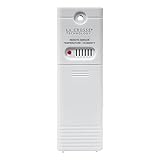
- PLEASE VERIFY compatibility ~ ONLY WORKS with model clock/weather stations (not limited to): 308-1414B, 308-1414W, 308-1414MB-INT, 308-1711BL, 308-1425B-INT, C85845, L78571, S75617, S77925, S84107, and S85814 (more models listed below)
- Temperature range: -40°F to 140°F (-40 °C to 60 °C); Outdoor humidity: 10% to 99% RH
- Transmission range: 330 ft. (100 meters) in open air (no obstructions)
- Powered by 2-AA batteries (not included)
- upgraded TX141TH-B (backwards compatibility with any weather station using TX141TH-B, v2, v3)
What Perceptive Space is building
Perceptive describes its planned platform as “decision intelligence” for space missions. Rather than stopping at a general solar or geomagnetic forecast, it aims to estimate conditions and consequences for a specific spacecraft, orbit or mission.
Stated product capabilities
- Hyperlocal or orbit-specific space-weather forecasts.
- Asset-specific risk and impact assessments.
- Operational recommendations that could inform spacecraft modes, launch timing or orbit-management plans.
- APIs and dashboards designed for mission-control and other operational systems.
- Support across a mission’s lifecycle, from design and operations through deorbit.
The company initially emphasizes low Earth orbit. Its longer-term ambition includes missions beyond LEO and possible applications for defense, aviation and other infrastructure operators.
As of August 18, 2026, Perceptive’s website presents the APIs and LEO dashboards as forthcoming, invites prospective users to request early access, and does not publish a generally available product, public pricing or a detailed production-release record.
The Tool Desk
Outbyte Driver Updater FREEFix the driver behind crashes, sound loss and screen glitchesFind Drivers →Outbyte PC Repair FREERepair Windows errors before they cause bigger problemsFix Now →How AI fits into the proposed forecasting system
The available descriptions support a high-level picture rather than a technical specification. Perceptive says it plans to combine multiple data sources, decades of solar and space-weather information, satellite-operational data and machine-learning models. The models are intended to complement physics-based and statistical forecasting, then connect environmental predictions to asset-level risk.
The public materials do not identify the model architecture, training-set size, exact sensors or feeds, forecast variables, lead times, spatial resolution, error metrics, deployment hardware or reproducibility procedures. It is therefore not possible to responsibly label the system as generative AI, a transformer, a recurrent network or any other specific architecture.
Rank #3

- Includes 1 indoor/outdoor thermo-hygrometer
- Supports up to 8 channels for integration with your Ambient Weather Station
- Wireless 915 MHz sensor range up to 300 feet (100 feet in most conditions) with 71 second refresh rate
- Sensor measures 4.75 x 1.5 x 0.6 in
- Sensor powered by 2 x AA batteries (not included)
What the “10 times more accurate” claim establishes—and what it does not
Perceptive told VentureBeat that its models produced predictions up to 10 times more accurate than existing forecasts at bench scale. “Up to” describes a best reported result, not a guaranteed improvement across every prediction or mission.
The publicly available account does not specify:
- What was predicted—such as flare probability, geomagnetic intensity, radiation, atmospheric density, drag or satellite anomalies.
- Whether accuracy means reduced numerical error, event-detection accuracy, classification performance or probability calibration.
- The forecast horizon, geographic or orbital domain, baseline model, sample period or out-of-sample procedure.
- Performance during rare extreme events, independent replication or live operational trials.
Accordingly, the 10-times figure should remain attributed to the company. It is not an independently established industry benchmark.
What’s actually slowing this PC down?
Pick the symptom - the matching free tool is one click away.
Perceptive Space versus NOAA
Perceptive’s potential value is specialization and integration, not simply replacing NOAA. NOAA supplies broad public information; a commercial platform could interpret those and other data for a particular operator’s decisions.
| Capability | NOAA Space Weather Prediction Center | Perceptive’s stated ambition |
|---|---|---|
| Public forecasts, alerts and watches | Yes | Uses or augments external data |
| General space-weather scales and models | Yes | Mission- and asset-specific interpretation |
| Broad public access | Yes; many products are public | Enterprise-oriented access and early access |
| Mission-specific recommendations | Limited in public products | Core stated objective |
| Subscription options | NOAA offers subscription services; the reviewed pages do not show a conventional SaaS price table | No public pricing found |
| Product maturity | Established government service | Early-stage commercial platform |
NOAA also maintains a directory of commercial space-weather providers and explicitly says that listing a provider is not an endorsement. Its commercial-data program evaluates and acquires private-sector space data.
Independent reader supportYour contribution helps us test, update, and keep practical guides available for everyone.Who might buy it
The likely buyer is an organization with mission-operations, flight-dynamics, spacecraft-systems, launch-operations, risk or defense responsibilities—not an individual consumer. Potential customers include:
Rank #4

- [Color LCD Screen Weather Station] Newentor temperature & humidity monitor with a large color LCD display shows essential home weather information at a glance: indoor/outdoor temperature & humidity, daily high/low records, customizable alerts, time/date, alarm clock & snooze, weather forecast, moon phase, and barometric pressure.
- [Two Power Modes & Adjustable Backlight] To enjoy a 24/7 continuous always-on vibrant display, simply connect this home weather station to a wall outlet using the included DC power adapter. When operating on battery power only (batteries not included), the digital thermometer automatically enters an eco-energy-saving mode, where the screen lights up for a quick 15-second glance before dimming. It is the perfect bedside or living room clock designed to fit your power preference.
- [3-channel Home Weather Stations Wireless Indoor Outdoor] Wireless temperature forecast station supports up to 3 remote sensors to monitor inside outside temperature & humidity of multiple locations. Package contains one remote sensor.
- [Wireless Forecast Station] The weather forecast station calculates the weather forecast for the next 12-24 hours, 7 to 10 days calibration ensures an accurate personal forecast for your location.
- [Wireless Weather Station with Atomic Time&Date] Atomic alarm clock weather station can be used not only as a wireless indoor outdoor thermometer but also as an atomic clock with dual alarms.
- Satellite operators managing communications, Earth-observation or science fleets.
- Launch providers making scheduling and safety decisions.
- Defense and national-security organizations.
- Spacecraft designers that need environmental risk estimates during mission planning.
- Eventually, aviation or infrastructure operators exposed to space-environment effects.
A customer could pay for lower downtime, faster alerts, machine-readable probabilities, integration with mission-control software and recommendations tied to the cost of intervention. The commercial case depends on demonstrating incremental value over NOAA’s public products and any existing internal tooling.
Free tools Windows power users keep installed
One-click scans. No signup required.
What a serious evaluation should test
Before relying on an AI forecast for an operational decision, a buyer would need evidence across several dimensions:
- Target: Define whether the system predicts solar events, geomagnetic conditions, density, radiation, scintillation, anomalies or a direct mission outcome.
- Horizon: Separate nowcasting from forecasts measured in hours, days or weeks.
- Resolution: Test Earth-wide, regional, orbital-shell and individual-trajectory performance where relevant.
- Latency: Measure the time from new observations to a usable alert or recommendation.
- Calibration: Check whether stated probabilities match observed frequencies.
- Rare events: Evaluate extreme storms separately because historical examples are limited.
- Errors: Price false positives against missed events; unnecessary intervention and hardware damage have different costs.
- Integration: Verify API reliability, alerting, audit logs, explainability and mission-control compatibility.
- Data resilience: Document every data source and the fallback plan when a sensor or provider is unavailable.
- Validation: Require historical backtests, independent benchmarks, live trials and quantified customer outcomes.
Commercial alternatives and limits
NOAA public products
Researchers, educators, analysts and smaller operators can start with NOAA’s forecasts, products, models and subscription services. Building asset-level interpretation and integration may require internal engineering.
Spire Global
Spire sells satellite-derived data, analytics, APIs and intelligence products. NOAA’s space-weather data-pilot documentation identifies Spire among commercial providers involved in space-weather observations. Its scope is broader data and intelligence infrastructure, not necessarily a direct substitute for Perceptive’s proposed mission-specific forecasting.
Tomorrow.io
Tomorrow.io and its space offering focus primarily on AI weather intelligence and satellite-derived atmospheric observations for terrestrial forecasting. NOAA’s June 2026 award of a $7.299 million commercial microwave-sounder data-buy contract to Tomorrow.io concerns atmospheric weather data, not proof of a spacecraft space-weather forecasting product.
Quick Recap
What remains unproven
- Independent validation of the 10-times accuracy statement.
- Performance during severe, unusual or poorly represented solar events.
- Named customer deployments and quantified operational outcomes.
- Public API documentation, production service levels and pricing.
- General availability beyond the early-access posture shown on the company website.
- Whether the system consistently outperforms NOAA or established commercial providers for a buyer’s specific mission.
Product prices and availability are accurate as of the date/time indicated and are subject to change. Any price and availability information displayed on Amazon at the time of purchase will apply.




