What’s actually slowing this PC down?
Pick the symptom - the matching free tool is one click away.
Science Corporation announced a $230 million Series C financing on March 5, 2026, to advance PRIMA, an implant intended to restore limited central vision for people with severe retinal degeneration. Despite the “brain implant” shorthand, PRIMA is placed beneath the retina, not in the brain. The round gives Science more capital for clinical work, manufacturing and regulatory submissions, but the device is not yet established as commercially available.
What Science raised and what the money is for
Science said the oversubscribed Series C included Khosla Ventures, Lightspeed Venture Partners, Y Combinator, IQT and Quiet Capital, among existing investors. The company says the financing brings its total capital raised since its 2021 founding to approximately $490 million. TechCrunch reported a post-money valuation of about $1.5 billion, attributing that figure to a source close to the company rather than to Science’s financing announcement.
Science says the new capital will support PRIMA commercialization, expanded clinical trials, manufacturing and infrastructure, as well as its broader neural-technology portfolio. The full $230 million is therefore not a launch budget for one device.
PRIMA is Science’s near-term commercial focus. The company also describes work on biohybrid neural interfaces, its Vessel organ-preservation and perfusion platform, a MEMS microfabrication foundry and a broader brain-computer-interface ecosystem. Science’s financing announcement outlines those uses.
The Tool Desk
Outbyte PC Repair FREERepair Windows errors before they cause bigger problemsFix Now →Outbyte Driver Updater FREEFix the driver behind crashes, sound loss and screen glitchesFind Drivers →#1 Best Overall

- 2X-25X Magnification: Supports 2x/8x/16x/25x magnification to zoom in and out on text. Please note that the magnifier must be placed on books or newspapers for reading; otherwise, the image may appear blurry due to the fixed focus
- 8 Color Modes: Choose from full color, black and white, black on white, white on black, blue on white, white on blue, yellow on blue, and blue on yellow. Multiple color modes are available to suit your vision needs
- Snapshot & Screen Lock: Supports photo capture and playback. You can take snapshots of important or loved ones' images and play them back. The freeze picture function is also available, making it easier to read and view. Supports TF cards up to 32GB (TF card not included)
- AV Output: Connect the magnifier to a television using a TV cable, allowing you to view images at a larger magnification than the screen of the magnifier
- Ergonomic Handheld Design & Foldable Bracket: The streamlined body makes it comfortable to hold for extended periods. The back of the magnifier features a foldable bracket for flat placement on a desktop. Slide the magnifier to read from start to finish in a newspaper. Ideal for reading, writing, and viewing maps, and books
PRIMA is a retinal implant, not a cortical brain implant
PRIMA is a photovoltaic chip implanted under the retina in an area where light-sensing photoreceptors have been lost. A camera-equipped pair of glasses captures the scene and projects patterned near-infrared light onto the chip. The implant converts that optical energy into electrical stimulation of remaining retinal circuitry; signals then travel through the optic nerve to the brain.
- The surgeon places the small chip beneath the retina.
- The glasses capture visual information and encode it into projected near-infrared patterns.
- The chip uses that light for both power and stimulation.
- Retinal cells and the optic nerve carry the resulting signals to the brain.
The system is not a standalone implant. Patients need the companion glasses and processing system, and it can work only when enough retinal ganglion-cell circuitry and optic-nerve function remain. Science describes the system at its PRIMA technology page and patient information page.
Rank #2

- 2X-25X Magnification: 3.5-inch digital magnifier supports 2x, 8x, 16x, and 25x magnification; designed for short-term reading assistance, helping to zoom in on text with ease; portable and ideal for quick visual aid
- 8 Adjustable Color Modes: Includes full color, black on white, white on black, blue on white, white on blue, yellow on blue, and blue on yellow; easily find the Eyoyo digital magnifier setting that enhances text visibility to match your vision needs
- Snapshot & Screen Lock Function: Capture important images and playback later; freeze the screen for easier reading and viewing; supports TF cards up to 32GB (card not included), electronic magnifier allowing you to save images for future reference
- AV Output for Larger Display: Connect the portable video magnifier to a television using the AV output for larger screen magnification; perfect for users who prefer a bigger display for clearer viewing
- Ergonomic Design & Foldable Bracket: Compact and lightweight with a foldable bracket for flat positioning on a desktop; comfortable to hold for extended use; slide the video magnifier smoothly across books, maps, or newspapers for effortless reading
Who the first indication is for
The initial target is severe central vision loss caused by geographic atrophy associated with age-related macular degeneration. That is a narrower population than “people who are blind.” Trials in Stargardt disease and retinitis pigmentosa are being expanded, but those are clinical-development programs, not approved uses. The expanded study is listed at ClinicalTrials.gov.
What the PRIMAvera study actually found
The pivotal evidence was published online by The New England Journal of Medicine on October 20, 2025. PRIMAvera was an open-label, multicenter, prospective, single-group, baseline-controlled study funded by Science Corporation and the Moorfields National Institute for Health and Care Research Biomedical Research Centre.
Rank #3
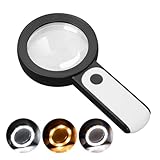
- HIGH POWER MAGNIFICATION: This magnifying glass provide Optical high magnification, allowing users with low vision to read text, no matter the size.
- ULTRA BRIGHT 18 LED WITH 3 MODES: The built-in energy-saving 18 LED lights provides extra luminance to ensure an overall better reading experience even at night or dark places. The stepless dimmable 3 lighting modes (cold, warm and mixed) can be switched based on different light condition, which can reduces visual fatigue, which is very useful for people with macular degeneration or far-sightedness/feyopia.
- EASY TO USE: Comes completely assembled, just requires 3x AAA batteries (not included). Easy to operate with a simple ON / OFF button switch, making it perfect for the elderly or those requiring an intuitive magnification system.
- LARGE LENS(Diameter 3.15"): Magnifies without optical distortion. Optimal to enhance reading and viewing very fine details in books, newspapers, magazines, photographs, maps, electronics, miniatures, jewelry, pill bottles, medications, hobbies, models, and crafts of all kinds.
- PERFECT GIFT FOR THE ELDERLY: Great magnifier for seniors, Most elderly have difficulty reading the small print on coupons, prescription,medical bottle.clear magnifier with light also a great choice for those who have low or impaired vision of most types.
| Measure | Reported result |
|---|---|
| Participants implanted | 38 |
| Participants assessed at 12 months | 32 |
| Clinically meaningful improvement threshold | At least 0.2 logMAR |
| Responders among 12-month completers | 26 of 32 (81%) |
| Estimated response including missing-data analysis | 80% |
| Serious adverse events | 26 events in 19 participants |
Participants could read letters, numbers and words under study conditions, but the trial did not show restoration of ordinary natural eyesight. Mean peripheral natural visual acuity remained equivalent to baseline. Most serious adverse events occurred within two months of surgery. Six implanted participants were not assessed at 12 months, so the 80% figure is an estimate that accounts statistically for missing follow-up, not a claim that 80% of every implanted patient will experience the same benefit.
The study’s size and design also matter. Thirty-eight implants provide important early human evidence, but an open-label study without a randomized sham-control group cannot answer every question about durability, safety or real-world function. The peer-reviewed findings and funding disclosures are available in NEJM; the study is registered as NCT04676854.
Rank #4

- 【High Power Magnification】This 5.0 inch portable magnifier reading aids provide 2X-32X zoom magnification, the unit has been an absolute lifesaver for who has macular degeneration. With this unit you can shop the grocery store, read restaurant menus, plus magazines and books.
- 【Simplified Buttons, Easy to Use】The low vision aids with the simplified buttons is more suitable for the operation of elderly or amblyopic children. There are no redundant buttons, which can meet the daily reading needs. Capabiities of memorizing the habits of users before the shutdown. Don't need to adjust every time.
- 【Eyes Don't Get Tired Easily】HD color LCD screen featuring 800*480 high resolution and the professional image processing DSP, restore colors and details truly. The vision aid does not deform when magnifying fonts, suit for long time reading, also can connect it to a television and computer by include cable to provide greater and clearer visual effects.
- 【Ergonomic Design Handle and Bracket】Integrated design of handle and bracket, the back of the digital magnifier with a foldable bracket on the handle, it can be laid on the page at an angle so you don't need to hunch over the top to read the text. The handle also can be installed according to the habit of left and right hands.
- 【Wide Range of Applications】The reading aids with multiple color modes for choose, meet the needs for different people, especially for the visually impaired, low vision, color blindness and amblyopia, letting eyes get a great visual experience. It's a great for who need it.
What patients may—and may not—expect
- Functional central vision: The demonstrated endpoint concerns visual acuity tasks such as reading symbols and words, not normal sight.
- Required wearable: The glasses are essential for capturing scenes, delivering power and generating the stimulation pattern.
- Anatomical requirements: A functioning optic nerve and usable downstream retinal circuitry are necessary.
- Surgery and rehabilitation: Implantation is invasive, and patients may need training to interpret the artificial visual signal.
- Unknown long-term performance: Twelve-month data do not establish lifetime durability, replacement procedures or outcomes if the glasses or software are discontinued.
Where regulatory approval stands
Science submitted a CE Mark application in Europe on June 23, 2025; an application is not the same as a granted CE Mark. Its March 2026 financing announcement described a European launch as expected or upcoming, not completed. In the United States, Science has described an FDA application and continuing regulatory discussions, but the cited materials do not establish FDA approval.
The company said PRIMA received FDA Breakthrough Device status in 2023. That designation can facilitate interaction with regulators; it does not authorize marketing or guarantee clearance. The company’s European filing is described at Science’s regulatory announcement.
Best Value

- 𝗘𝘆𝗲 𝗖𝗼𝗺𝗳𝗼𝗿𝘁 𝘄𝗶𝘁𝗵 𝗔𝗻𝘁𝗶-𝗚𝗹𝗮𝗿𝗲 𝗟𝗲𝗻𝘀: Designed for seniors and those with low vision, our page magnifier offers enhanced reading through 24 SMD LED lights coupled with an anti-glare lens, ensuring optimal lighting without straining your eyes.
- 𝗧𝗵𝗲 𝗠𝗼𝘀𝘁 𝗔𝗱𝘃𝗮𝗻𝗰𝗲𝗱 𝟯 𝗦𝘁𝗲𝗽𝗹𝗲𝘀𝘀 𝗟𝗶𝗴𝗵𝘁𝗶𝗻𝗴 𝗠𝗼𝗱𝗲𝘀: Featuring the latest ONE-button/touch and lighting technology on a magnifying glass for reading, turn on/off, switch effortlessly among cool white, warm white, and combo lighting modes to match your reading conditions. This latest technology in magnifying glass illumination ensures optimal comfort and clarity for all your reading needs.
- 𝗦𝗮𝘆 𝗚𝗼𝗼𝗱𝗯𝘆𝗲 𝘁𝗼 𝗔𝗿𝗺 𝗙𝗮𝘁𝗶𝗴𝘂𝗲 𝘄𝗶𝘁𝗵 𝗢𝘂𝗿 𝗙𝗼𝗹𝗱𝗮𝗯𝗹𝗲 & 𝗗𝗲𝘁𝗮𝗰𝗵𝗮𝗯𝗹𝗲 𝗦𝘁𝗮𝗻𝗱: Whether handling lightweight or heavier magnifiers, holding for extended periods can be tiring. Our magnifier's stand is skillfully crafted for hands-free operation. Easily collapsible and detachable, it promises convenience for every reading or crafting session.
- 𝗥𝗼𝗯𝘂𝘀𝘁 𝗮𝗻𝗱 𝗣𝗼𝘄𝗲𝗿-𝗦𝗮𝘃𝘃𝘆 𝗦𝗠𝗗 𝗟𝗘𝗗𝘀: Harnessing cutting-edge SMD LED technology, our magnifier promises a luminous viewing space while being astoundingly energy-efficient. These LEDs not only shine brighter but also use up to 50% less energy, significantly prolonging battery longevity. Built to withstand the test of time, these LEDs are engineered to shine for over 100,000 hours.
- 𝗤𝘂𝗶𝗰𝗸 𝟮-𝗛𝗼𝘂𝗿 𝗖𝗵𝗮𝗿𝗴𝗲 𝗳𝗼𝗿 𝗘𝘅𝘁𝗲𝗻𝗱𝗲𝗱 𝗨𝘀𝗲: Recharge your magnifier in just 2 hours and enjoy up to 8 hours of continuous use on medium brightness. Built in rechargeable battery is 1000 mAh capacity Perfect for all-day reading, crafting, and hobbies without the worry of frequent recharging.
What “bringing it to market” still requires
- Regulatory authorization in each intended market.
- Repeatable surgical procedures and training for specialist retinal centers.
- Manufacturing scale, quality systems and reliable supply of the implant and glasses.
- Long-term safety surveillance and post-market support.
- Patient-selection protocols, rehabilitation services and follow-up care.
- Reimbursement decisions; regulatory clearance alone does not ensure insurance coverage.
Science has not publicly disclosed a consumer price in the cited announcements, and the financing does not establish how patients or health systems will pay for treatment.
Is Science ahead of Neuralink?
Science may have a plausible path to an earlier commercial product because PRIMA addresses a specific ophthalmic indication and already has published human results. Neuralink’s principal public programs involve implanted cortical interfaces aimed at communication or motor control for people with paralysis and other neurological conditions. Those systems face different surgeries, endpoints and regulatory questions.
That comparison should be made by category. PRIMA is a retinal vision prosthesis and can reasonably be described as a retinal BCI. It is not the same kind of cortical motor or communication implant associated with Neuralink. Science may be competing to commercialize a vision-restoration BCI, not necessarily to become the first invasive neural-interface company of every type.
Bottom line for investors and patients
The $230 million round materially strengthens Science’s ability to fund trials, manufacturing and regulatory work around PRIMA. The technology has encouraging but limited 12-month evidence: 26 of 32 assessed participants met the study’s improvement threshold, alongside 26 serious adverse events in 19 participants. The decisive milestones are still authorization, durable safety, repeatable surgery, reimbursement and proof that the artificial vision is useful beyond controlled testing.
Free tools Windows power users keep installed
One-click scans. No signup required.
Quick Recap
Product prices and availability are accurate as of the date/time indicated and are subject to change. Any price and availability information displayed on Amazon at the time of purchase will apply.




