Data centers are built where the complete infrastructure package works—not simply where land is cheapest or people are most concentrated. Urban facilities buy customer proximity, carrier connections and skilled labor. Rural and exurban campuses buy acreage, electrical headroom and expansion space. The best site combines enough power, fiber, cooling, land, workforce, permitting certainty and resilience at an acceptable long-term cost.
First, identify the kind of data center
“Data center” describes several different businesses, and each has a different geography.
Colocation
Colocation companies rent racks, power, cooling and network connections to many customers. They commonly favor metropolitan markets with dense carrier networks, internet exchanges, cloud on-ramps, enterprise customers and technical contractors. A Rice University summary of recent research says third-party facilities cluster in dense urban markets because customers value proximity, even when urban costs are higher (Rice University).
Hyperscale cloud campuses
Cloud operators need large, contiguous parcels, high-voltage connections, substations and room for multiple construction phases. A campus may be called rural while sitting in an exurban industrial corridor near a major metro, highway, fiber route and labor market.
#1 Best Overall

- Save valuable floor space: 6U wall mount server cabinet Dimensions: 13.78" H x21.65" W x17.72" D.Maximum mounting depth is 14.2"
- Keep critical network equipment secure: glass door and side panels are lockable to prevent unauthorized access. Front door can be installed on either side of the front of the cabinet to satisfy your door swing orientation preference
- Easy equipment configuration: Fully adjustable mounting rails and numbered U positions, with square holes for easy equipment mounting with top and bottom punch-out panels for easy cable access
- Durability: Made of high quality cold rolled steel holds up to 110lb (50kg) (Easy Assembly Required)
- PCI & HIPPA and EIA/ECA-310-E compliant
AI and high-performance computing
AI training concentrates thousands of high-density processors in facilities requiring unusually large, firm electrical supplies and advanced liquid or hybrid cooling. The U.S. Geological Survey identifies reliable energy, water availability and regulatory conditions as central siting considerations for AI facilities (USGS).
Edge and enterprise facilities
Edge sites go near users, cellular aggregation points, hospitals, factories, exchanges and logistics hubs. Enterprise or on-premises facilities may sit beside a corporate, manufacturing, healthcare, research or government campus for security, compliance or disaster-recovery reasons.
Why cities remain attractive
Customers and interconnection
Businesses paying for private cloud access, managed hosting and cross-connects often value a nearby facility. Urban markets concentrate customers and the networks that connect them. Proximity can reduce route length and simplify deployment, support and compliance.
Fiber density—though not automatically enough capacity
Cities often offer multiple carriers, metro fiber, long-haul routes, internet exchanges and established carrier hotels. But a fiber route on a map does not guarantee dark-fiber availability, diverse building entrances, affordable cross-connects or spare capacity. A rural parcel on two diverse long-haul routes may outperform an urban building with congested or expensive local connectivity. NTIA lists market access and broadband infrastructure among relevant data-center growth factors (NTIA).
Labor and existing infrastructure
Metropolitan areas supply electrical and mechanical engineers, network technicians, facilities operators, security staff, contractors and emergency services. They may also already have roads, industrial zoning, utility corridors, substations, water connections and buildings suitable for conversion. These savings can outweigh higher real-estate prices.
Rank #2

- Universal 19” Rack Mount Compatibility – Perfect for pro audio, video, IT, and network gear. Compatible with mixers, routers, patch panels, servers, power amps, and more.
- Heavy-Duty Load Capacity – Built to support up to 550 lbs. Ideal for studio gear, DJ setups, server equipment, and AV components that demand serious stability.
- Robust Steel Frame & Design – Made with 1.5mm thick steel and weighs 36 lbs for maximum durability, reduced vibration, and long-term reliability in any setting.
- Mobile & Secure – Preinstalled with 3” industrial-grade caster wheels (lockable), making it easy to move and position your rack exactly where you need it.
- All-In-One Setup Kit Included – Comes with 34 rack screws (5mm & 6mm), a 1U blank spacer, and an assembly tool—ready for fast installation out of the box.
Why rural and exurban areas attract new campuses
Contiguous land and expansion
A large campus needs more than server buildings. The site may include electrical yards, substations, cooling plants, generators, fuel storage, security setbacks, roads, stormwater facilities and future phases. Rural parcels are often easier to assemble, while urban land is fragmented and politically difficult to expand.
Electrical headroom
The rural advantage is frequently the possibility of securing a large connection with room to grow—not guaranteed cheap electricity. A site can be beside a transmission line yet lack transformer capacity, a completed substation, an interconnection approval or a firm delivery schedule.
In June 2026, the Federal Energy Regulatory Commission directed all six regional transmission organizations and independent system operators to justify or reform tariffs for data centers and other large users, seeking faster interconnection while protecting reliability and ratepayers (FERC action; FERC fact sheet).
Free tools Windows power users keep installed
One-click scans. No signup required.
Lower density and energy opportunities
Fewer nearby homes can simplify large buildings, generator operation, security buffers and construction traffic, although opposition can still focus on water, noise, farmland, emissions, tax exemptions and electric rates. Rural sites may also sit near hydroelectric, nuclear, natural-gas or renewable generation, former industrial property or federal land. The Department of Energy has identified federal locations with existing energy infrastructure or potential new generation for data-center development; identification does not mean every site will be built (DOE sites; DOE announcement).
Incentives
Governments may offer equipment sales-tax exemptions, property-tax abatements, electricity-tax exemptions, infrastructure grants, expedited permits or special development agreements. The Congressional Research Service distinguishes federal energy tax benefits from state and local incentives (CRS). The relevant financial question is not the headline incentive but its net public value after roads, utility upgrades, foregone taxes and possible ratepayer costs. Washington’s 2026 review of separate urban and rural preferences illustrates why results must be evaluated by location and enforceable commitments (Washington JLARC).
Rank #3

- ADJUSTABLE DEPTH: 4- Post 22U 19" server rack enclosure with 4 vertical rails and adjustable mounting depth 5.7" to 33.0" (14,4cm to 83,8cm); IT rack is compatible with various servers / switches / data / video / AV and other IT networking equipment
- EASY SHIPPING AND ASSEMBLY: Enclosed 22U data rack cabinet ships compact flat-packed to avoid damage and facilitate installation; Include wheels & levelling feet to offer more stability; Home server rack cabinet is only 46.6in (118,3cm) in height
- DESIGN AND VENTILATION: Half height server rack cabinet has lockable and removable door and side panels with vented top allowing airflow; 4 Post 19" rack with 1764lb (800kg) weight capacity (stationary); Computer cabinet rack is EIA/ECA-310-E Compliant
- HARDWARE INCLUDED: Rolling home network rack includes rack mounting and equipment mounting hardware, such as 20 M6 cage nuts / screws, PVC cup washers; Front/rear doors and side panels Keys, 2x allen keys; Rack assembly hardware; Casters and leveling feet
- THE IT PRO'S CHOICE: Designed and built for IT Professionals, this 22U IT Server Cabinet is backed for life, including free lifetime 24/5 multi-lingual technical assistance
Power is now the central constraint
For a large AI campus, power can determine the location before land or tax benefits do. Evaluate:
- Initial and full-buildout megawatts.
- Firm versus interruptible supply.
- Transmission- or distribution-level connection.
- Substation and transformer availability.
- Interconnection-queue position and completion date.
- Who pays for lines and upgrades.
- Tariffs, demand charges and curtailment risk.
- Whether later phases can receive power.
The Lawrence Berkeley National Laboratory’s 2025 update models U.S. data centers reaching approximately 11.8% of national electricity consumption by 2030. That is an estimate, not a measured outcome (LBNL). A finished building without energized capacity cannot operate.
Latency: what must be close
Latency-sensitive work
Financial transactions, gaming, video communications, industrial controls, autonomous systems, telecom and some healthcare applications benefit from short, predictable network paths.
Latency-tolerant work
AI training, backups, archives, batch processing and much large-scale analytics can be farther from users. NTIA’s record distinguishes applications requiring low latency from those that can use locations with more land, water or renewable energy (NTIA comment attachment).
Latency depends on route length, carrier routing, congestion, hops, peering and redundancy—not just municipal boundaries. An exurban campus can serve a city effectively; a truly remote site may be excellent for batch workloads but poor for interactive services.
Rank #4
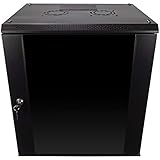
- DURABLE BUILD: Constructed from high-quality Cold Rolled Steel, the NavePoint Consumer Series 12U network cabinet boasts a sturdy, welded frame. Fitting EIA standard 19” networking equipment, this server cabinet confidently supports up to 110 lbs, providing a resilient base for your vital IT gear and equipment
- CONVENIENT DESIGN: This 12U cabinet features a reinforced, heat-treated, tempered glass front door with a security lock. Perfect for applications requiring both security and accessibility, its compact design of 17.72"L x 21.65"W x 24.42"H offers a practical solution for space-constrained settings.
- EASY & CUSTOMIZABLE EQUIPMENT SET UP - The 12U IT cabinet, with removable side panels and security locks, offers customization at its finest. Whether it's for an efficient device or cable management, this data cabinet ensures secure, adaptable configurations that suit your networking server requirements
- ENHANCED VENTILATION & SECURITY - Built-in fans and flow-through ventilation work to prevent overheating, ensuring optimal operation of your equipment. The reinforced, lockable tempered glass front door not only boosts security but also facilitates easy monitoring of installed equipment.
- SAFETY & COMPLIANCE - All NavePoint products are built to industry standards.
Cooling, water and climate
Facilities may use evaporative, chilled-water, air, direct-to-chip liquid, immersion or hybrid cooling. Water demand varies with climate, workload density, design, withdrawal versus consumption and operating conditions. Closed-loop systems can reduce withdrawals but still need initial fills, makeup water, treatment and electricity.
Crashes, No Sound, or Screen Glitches?
Random freezes, missing sound and display glitches usually trace back to one bad driver. Find and replace yours safely.Free scan · under a minutePC Slower Than It Used to Be?
A free scan shows the junk files, broken settings and background clutter dragging Windows down - then fixes them in one click.Free scan · Windows 10 & 11Site reviews should examine annual and peak water demand, drought exposure, competing agricultural or household use, wastewater capacity, discharge rules and cooling technology. Hotter conditions can increase cooling demand in Arizona, California and Nevada, according to the USGS (USGS). A cool climate helps, but cannot compensate for weak fiber, labor or power.
Why data centers cluster
Clusters share carriers, substations, contractors, suppliers, labor and customer ecosystems. Pew reports that nine in ten data centers in its analysis were within five miles of another facility (Pew Research Center). Clustering lowers costs and improves connectivity, but concentrates exposure to a regional outage, transmission bottleneck, water stress, wildfire or political backlash. Geographic separation can improve resilience even when a cluster is operationally efficient.
Why “rural” does not always mean remote
Useful categories are urban core, suburban, exurban, rural industrial corridor and truly remote. Many projects labeled rural are exurban: outside dense city boundaries but close to transmission, fiber, roads, airports, water systems and metropolitan labor. Pew found most new U.S. facilities in its dataset were being developed in rural areas, while the existing stock remains associated with metropolitan and micropolitan areas. Its count combines operating, under-construction, planned and land-banked projects, excluding canceled or uncertain ones, so it should not be read as “most operating facilities are rural.”
Community and public-finance trade-offs
Potential benefits
- Construction employment and contractor demand.
- Property or sales-tax revenue.
- New fiber, roads and utility investment.
- Industrial redevelopment and economic diversification.
- Potential support for new generation or storage.
Potential costs
- Transmission and substation upgrades.
- Water-system pressure and drought risk.
- Cooling, generator and construction noise.
- Diesel or gas emissions from backup generation.
- Farmland or open-space conversion.
- Few permanent jobs relative to capital investment.
- Foregone tax revenue and possible household rate impacts.
“Renewable-powered” also requires precision: a physical supply, power-purchase agreement, renewable-energy certificate and hourly matching are different claims. Likewise, construction jobs, permanent operations jobs and indirect employment should not be combined without project-specific evidence.
Quick wins for a faster PC:
Repair Windows errors before they cause bigger problemsFix Now →Fix the driver behind crashes, sound loss and screen glitchesFind Drivers →Clear out junk files and repair common Windows errorsFree Scan →A practical scorecard for a proposed site
- Power: Confirm megawatts today, at full buildout, firm delivery, queue position, upgrade responsibility and tariff.
- Network: Count carriers, diverse routes, dark fiber, cloud on-ramps, exchange access and cross-connect costs.
- Land: Check parcel size, ownership, zoning, flood, wildfire, seismic, soil, drainage, roads and expansion phases.
- Cooling and water: Require annual and peak use, source, drought plan, technology, wastewater capacity and discharge limits.
- Permits and incentives: Review environmental approvals, noise rules, generator limits, tax breaks, clawbacks and public disclosure.
- Operations: Assess labor, housing, airports, highways, contractors, emergency response, security and equipment logistics.
- Resilience: Test grid, network, fuel and cooling redundancy against regional hazards and cluster concentration.
Communities should also ask who pays for upgrades, whether ratepayers share costs, how many permanent jobs are guaranteed, what happens during drought, how much land is reserved for later phases and what happens if the project is abandoned.
Urban versus rural at a glance
| Factor | Urban or metropolitan | Rural or exurban |
|---|---|---|
| Customers and latency | Usually strong | Variable; exurban can be effective |
| Fiber | Dense, but capacity may be costly | Strong on strategic routes; weak elsewhere |
| Land and expansion | Scarce and expensive | More contiguous acreage |
| Power | Existing infrastructure, possible constraints | Potential headroom, but long interconnection work |
| Workforce | Deep labor and service ecosystem | Smaller pool; recruitment may be difficult |
| Water and roads | Often existing, potentially stressed | May require new systems |
| Permitting and opposition | Dense scrutiny and complex logistics | May start faster, but county opposition can grow |
| Resilience | Many providers, but cluster concentration | More separation possible, fewer alternatives |
The bottom line
Urban data centers optimize proximity, interconnection and service ecosystems. Rural campuses optimize scale, power expansion and land. Exurban corridors often combine both. The durable competitive advantage is not an “urban” or “rural” label; it is deliverable power, diverse fiber, suitable cooling and water, expansion capacity, skilled operations and predictable public rules at a cost the developer and community can sustain.
Quick Recap
Product prices and availability are accurate as of the date/time indicated and are subject to change. Any price and availability information displayed on Amazon at the time of purchase will apply.




