Crashes, No Sound, or Screen Glitches?
Random freezes, missing sound and display glitches usually trace back to one bad driver. Find and replace yours safely.Free scan · under a minuteWindows Errors? Fix Them Before They Spread
Repair common Windows errors and clear accumulated junk for a smoother, more stable PC - no reinstall needed.Free scan · no reinstallStanford Health Care’s oncology initiative is best understood as AI-assisted workflow orchestration for multidisciplinary tumor boards—not an autonomous oncologist. The proposed system would coordinate specialized agents that retrieve and synthesize records, images, pathology, genomic results, trial criteria, guidelines and literature, while clinicians retain responsibility for diagnosis and treatment decisions.
The account comes from a May 30, 2025 CIO case study. It describes an emerging production-oriented effort, not independently validated evidence that Stanford has automated oncology or improved patient outcomes.
The oncology problem is information coordination
A cancer case can involve radiology, pathology, surgery, medical oncology, radiation oncology, genetics, pharmacy, nursing and clinical-trial specialists. The relevant evidence is scattered across free-text notes, images, pathology reports, genomic findings, medication histories, guidelines and trial databases.
Tumor boards must turn that fragmented material into a defensible plan under time pressure. The administrative work includes identifying the right records, reconciling discrepancies, screening trial eligibility, reviewing evidence and preparing meeting materials. The CIO article attributes an estimate of 1.5 to 2.5 hours per patient for reviewing images, pathology, notes and genomic data to an ASCO-cited figure; that number should be treated as reported case-study evidence rather than a universally verified benchmark.
What’s actually slowing this PC down?
Pick the symptom - the matching free tool is one click away.
#1 Best Overall
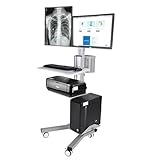
- Compact Mobile Computer Cart - Includes 2 monitor mounts, 3 platforms, and a storage basket providing ample space to place monitor, laptop, keyboard, printer, and CPU, with a cable management system to organize the cables. Space saving to small space, small business or mobile working.
- Heavy Duty Workstation - Certified industrial-grade strength, tested to meet stringent ANSI/BIFMA X5.5-2021 standards. This is more than just a home desk; it's a professional-grade workstation designed for durability and long-term security.Heavy duty aluminum that is wear and corrosion resistant. Each shelf has a maximum load capacity of 44lbs, providing you with a sturdy and stable working platform.Full SGS Test Report available upon request for institutional procurement
- Adjustable Monitor Angle - Fully motion mounts for holding 2 monitors that tilt 45° up and down & side to side rotate in 360°. Supports dual 24" horizontal monitors or one 27" horizontal + one 27" vertical monitor (VESA 75x75mm & 100x100mm compatible), easy to adjust the angle to fit your sight well. Ergonomic viewing angles help reduce eye strain and relieve tension on the neck, back, and shoulders. Note: Please make sure VESA compatible before you purchase.
- Universal Rolling Computer Stand - 4 Rolling Wheels for flexible mobility, 2 of which are lockable, making it easy to move different areas. This mobile stand can use as a rolling desktop stand, a gaming unit, a demonstrations station, a media studio, a medical workstation, a diagnostic "computer crash cart", a mobile EWI platform, a shop workstation, etc.
- DIY Installation & Highly Adjustable - All the platforms can be installed by yourself to meet different needs. Easy to adjust the height of the monitor and keyboard deck for choosing the right high to sit or stand up, meet your needs for standing up desk work, or switch to different scenes and usages.
According to the same account, Stanford handles approximately 4,000 tumor-board patients annually. Stanford physicians were also described as using summaries generated by a secure GPT Phi instance in Azure. Those figures and implementation details are claims in the 2025 case study, not current independently audited deployment statistics.
What “agentic” means here
Agentic describes a way of organizing software, not a guarantee of autonomy or safety.
| Capability | What it does | Typical boundary |
|---|---|---|
| Chatbot | Answers a user’s prompt in a conversation. | Usually depends on the user to find and provide the right context. |
| Retrieval-augmented assistant | Searches approved sources and summarizes retrieved content, ideally with citations. | Generally performs a bounded retrieval task. |
| Single-purpose agent | Receives a goal, selects permitted tools and completes a defined subtask such as chart abstraction. | Needs explicit permissions and evaluation for that task. |
| Multi-agent system | Uses separate agents for tasks such as imaging, pathology, genomics, trial matching or literature search, coordinated by an orchestrator. | More moving parts can increase latency, cost and debugging complexity. |
An orchestrator can pass intermediate results between agents and present a consolidated view to clinicians. “Agentic” does not mean the system is authorized to diagnose cancer, order treatment or communicate independently with patients.
What Stanford and Microsoft described
The CIO case study says Stanford was exploring Microsoft healthcare agent-orchestration technology for multidisciplinary oncology tumor boards. The intended system would:
- Analyze multimodal information from imaging, pathology, genomic data and EHR notes.
- Search clinical-trial eligibility criteria.
- Consult treatment guidelines and medical literature.
- Incorporate real-world evidence.
- Organize heterogeneous information for tumor-board preparation and discussion.
- Generate summaries and actionable questions for the clinical team.
- Help clinicians investigate similar patients and prior outcomes.
Microsoft’s role is described as the enterprise layer: cloud infrastructure, model access, orchestration and security capabilities. The agents use models available through Azure AI Foundry, including general reasoning models and healthcare-modality-specific models. Stanford contributes clinical workflow knowledge, data context, validation and governance. Statements about workload reduction or innovation should therefore be read as executive or vendor-positioned claims unless supported by an independent evaluation.
Rank #2

- Streamlined Mobile Workstation: The Mount-It! Computer Cart is a versatile rolling computer desk that brings the convenience of mobility to your workspace. Designed as a standing computer cart, it stands at an impressive 70" tall, perfect for those who prefer a mobile desk workstation on the go.
- Ergonomic Workspace Solution: With a full-sized, adjustable keyboard tray and a rolling monitor stand that can support a 32" screen, this computer cart on wheels is ergonomically optimized for both productivity and comfort, making it an ideal choice for busy professionals and gamers alike.
- All-In-One PC Cart: This mobile computer cart not only has a place for your monitor and keyboard but also includes a secure, adjustable CPU holder, transforming any area into an efficient mobile workstation with everything you need within reach.
- Adjustable and Secure: Stability meets flexibility in this rolling computer stand, featuring a height-adjustable monitor mount and a floating CPU holder with buckle straps. This pc cart ensures your setup is both secure and customizable to your preferences.
- Durable and Portable: Constructed with high-quality steel and a stable base, the Mount-It! Mobile Workstation Cart is designed for durability. The computer rolling stand is equipped with four caster wheels, allowing you to easily transition your work area from one space to another without compromising on stability.
How a case could move through an agent workflow
The following is an illustrative design based on the publicly described goals. It is not a published, fully verified Stanford production sequence.
- Confirm identity and scope. The system verifies the patient, cancer type, encounter and permitted user before retrieving data.
- Gather the record. A chart agent retrieves relevant notes, diagnoses, medications, prior treatments, laboratory results and outside records, preserving source and date.
- Summarize specialist evidence. Separate agents review imaging, pathology and genomic results, identifying findings, uncertainty and missing material.
- Check history and contradictions. The workflow compares sources for conflicting diagnoses, duplicated notes, stale medications, pending tests or treatment already given.
- Screen trials. A trial agent compares documented facts with current eligibility criteria and reports both possible matches and reasons for exclusion.
- Retrieve guidance. Guideline and literature agents provide versioned sources, publication dates and relevant passages rather than unsupported conclusions.
- Assemble a traceable brief. The orchestrator displays findings, citations, missing data, disagreements and confidence limits in one workspace.
- Conduct human review. Tumor-board specialists verify the evidence, correct errors and make the diagnosis and treatment recommendation.
- Document the decision. Only an authorized clinician approves what enters the medical record or triggers a downstream action.
ChatEHR is related, but not the same system
Stanford Medicine describes ChatEHR as a secure way for clinicians to converse with and summarize information in the patient record. That addresses record navigation and synthesis.
The proposed tumor-board orchestrator is broader: it coordinates multiple specialist tasks and external or structured sources such as trial criteria, guidelines and real-world evidence. ChatEHR should not automatically be treated as the same product or as proof that the multi-agent oncology workflow is in routine use.
Quick wins for a faster PC:
Clear out junk files and repair common Windows errorsFree Scan →Scan for outdated or missing drivers - takes under a minuteDriver Scan →Repair Windows errors before they cause bigger problemsFix Now →Stanford’s 2025 AI Medicine programming included sessions on agentic AI and oncology (symposium page; agenda). Stanford research postings also describe work on AI-assisted tumor boards, multimodal foundation models, clinical knowledge bases and agentic cancer-care decision support (Fries Lab; postdoctoral opportunity).
What the system can realistically improve
- Preparation time spent locating and organizing records.
- Initial screening of clinical-trial criteria.
- Longitudinal summaries of prior treatment and response.
- Evidence retrieval with source dates and citations.
- Identification of missing or contradictory information before discussion.
- Draft documentation that clinicians review and approve.
These are workflow improvements, not evidence of better survival, fewer complications, shorter hospital stays or lower burnout. The available material does not establish any of those outcomes.
Rank #3

- Compact Rolling Computer Cart - Includes monitor mount, 3 platforms, and a storage basket providing ample space to place monitor, laptop, keyboard, printer, and CPU, with a cable management system to organize the cables. Space saving to small space, small business or mobile working.
- Heavy Duty Workstation - Certified industrial-grade strength, tested to meet stringent ANSI/BIFMA X5.5-2021 standards. Heavy duty aluminum that is wear and corrosion resistant. Each shelf has a maximum load capacity of 44lbs, providing you with a sturdy and stable working platform. Ideal for companies, warehouses, factories, medical stations, schools, laboratories, etc.Full SGS Test Report available upon request for institutional procurement
- DIY Installation & Highly Adjustable - All the platforms can be installed to meet the different needs. Easy to adjust the height of the monitor and keyboard deck for choosing the right high to sit or stand up, meet your needs for standing up desk work or switching to different scenes and usages.
- Adjustable Monitor Angle - Fully motion mounts for holding monitors that tilt 45° up and down & side to side rotate in 360°. Mounts for holding monitors from 10" to 32", easy to adjust the angle to fit your sight well. Ergonomic viewing angles help reduce eye strain and relieve tension on the neck, back, and shoulders.
- Universal Medical Carts with Wheels- 4 Rolling Wheels for flexible mobility, 2 of which are lockable, making it easy to move different areas. This mobile stand can use as a rolling Iaptop computer cart, podium stand, a gaming unit, a demonstrations station, a media studio, a medical workstation, a diagnostic "computer crash cart", a mobile EWI platform, a mobile TV Cart, etc.
What it cannot safely decide alone
- Final diagnosis or staging.
- Selection or modification of a treatment regimen.
- Medication, referral or procedure orders.
- Whether a patient is suitable for a trial without clinician confirmation.
- How to resolve conflicting pathology, imaging or genomic evidence silently.
- What to tell a patient about prognosis or options.
Clinicians must confirm patient identity, assess whether records are complete and current, review citations and guideline versions, reconcile conflicts, explain uncertainty, make the final recommendation and document their reasoning.
Independent reader supportYour contribution helps us test, update, and keep practical guides available for everyone.Failure modes that matter in oncology
Fluent but incomplete summaries
A polished output can omit an outside pathology report, adverse reaction, pending test or treatment already administered. Completeness is more important than writing quality.
The Tool Desk
Outbyte Driver Updater FREEFix the driver behind crashes, sound loss and screen glitchesFind Drivers →Outbyte PC Repair FREERepair Windows errors before they cause bigger problemsFix Now →Conflicting or stale evidence
Imaging, pathology, genomics and notes may disagree. Trial criteria and guidelines change, so every result needs a source date and version. The workflow should surface disagreement rather than select a winner invisibly.
Identity, privacy and security errors
Similar names, merged charts and imported records can lead to wrong-patient retrieval. Cancer and genomic data require role-based access, encryption, retention limits, audit trails and clear vendor restrictions on reuse.
Prompt injection and automation bias
Instructions embedded in an imported note or document must be treated as data, not executable commands. Interfaces should expose uncertainty, missing information, source evidence and dissenting findings so that a comprehensive-looking answer does not receive unearned authority.
Rank #4

- MEDICAL TROLLEY: The medical cart is suitable use in hospitals, clinical, laboratories, dental office, health services, beauty salon and other work places. It is easy to adjust the height of the monitor and tabletop for keyboard and laptop (16.1"x13.4") by handle to meet your needs for standing up desk work or different scenes and usages
- ANTI-THEFT AND ANTI-SLIP DESIGN: The anti-theft laptop holder not only offers a solution for laptop using for medical purposes, but also prevents unwanted removal in corresponding public areas
- EASY HEIGHT ADJUST: With push foot pedal, you can control work surface height. The range of cart height can be from 31.4" to 47.2". It allows you to change the height of this workstation on the fly
- LOCKING CASTERS: a full-featured medical laptop rolling cart with silent locking caster wheels base (Front 2 with Locking Mechanism)
- SCANNER HOLDER - The scanner holder is made of metal material, very rugged and durable and is suitable for hospitals, dental office, office, warehouse
Unequal performance
Rare cancers, unusual presentations, underrepresented populations and incomplete records may produce weaker results. Evaluation should be stratified by disease, demographic group and data completeness.
Do these 3 things before closing this tab:
1Scan for outdated or missing drivers - takes under a minute2Repair Windows errors before they cause bigger problems3Fix the driver behind crashes, sound loss and screen glitchesHow to evaluate a similar system
Clinical usefulness
Start with a bounded bottleneck—such as tumor-board preparation, trial screening, genomic-result interpretation, prior-treatment abstraction or guideline retrieval—where a specialist can efficiently verify every output.
Data and interoperability
- Direct EHR integration rather than copy-and-paste workflows.
- Role-based permissions and patient-identity checks.
- Structured and unstructured data support, including imaging and pathology where needed.
- Provenance for every extracted fact.
- Handling for missing, duplicated, stale and contradictory data.
- Audit logs of retrievals, generated content and changes.
Safety and governance
- Human approval before any clinical action.
- No silent orders, referrals, medication changes or patient messages.
- Versioned models, prompts, guidelines and knowledge sources.
- Escalation when confidence is low or evidence conflicts.
- Red-team tests for hallucination, omission, bias, prompt injection and leakage.
- Post-deployment monitoring and a tested withdrawal or correction process.
Evaluation measures
- Sensitivity for critical facts and false-negative rates for contraindications or trial criteria.
- Citation accuracy and reproducibility after model or source updates.
- Time saved per case and number of manual corrections.
- Preparation time, documentation burden and clinician trust calibrated against actual performance.
- Equity across disease and demographic subgroups.
- Patient-safety events, near misses and cost per reviewed case.
Questions for vendors
- Which models are used, where is data processed and is it used for vendor training?
- Can the health system bring its own model or knowledge base?
- Can administrators inspect agent traces and reproduce outputs?
- What happens when an upstream model changes?
- How are guideline updates incorporated and stale content retired?
- What is the rollback process and contractual support for incident investigation?
- Which functions are production-ready versus experimental?
Where other enterprise platforms fit
Stanford says Gemini Enterprise access began June 30, 2026 as a secure institutional platform for creating and deploying agents across workflows. That establishes a general enterprise capability, not evidence that it is the oncology orchestrator described in the 2025 CIO article.
Likewise, Azure AI Foundry and Microsoft’s healthcare offerings may provide infrastructure and orchestration, but a general-purpose platform is not automatically validated clinical decision support. A hospital should assess specialty evidence controls, EHR and imaging integration, auditability, privacy terms and human-approval mechanisms before procurement.
What is established—and what is not
Public sources establish that Stanford has described oncology-related work involving ChatEHR, agentic AI and tumor-board support, and that Stanford research and events continue to address these areas. They do not establish reduced mortality, improved tumor-board accuracy, a measured treatment-start improvement, statistically significant burnout reduction, universal clinician availability, FDA authorization for the described orchestration system or a validated return on investment.
The CIO article says Stanford was excited to continue exploring a production solution. That wording distinguishes an emerging implementation from proof that the complete multi-agent workflow was already deployed across routine oncology care.
The Bottom Line
Stanford’s initiative illustrates a credible way to reduce the information-assembly burden on cancer teams: coordinate specialized retrieval and synthesis tasks, show the evidence and gaps, and keep clinical judgment with accountable specialists. The decisive test is not whether an agent can produce a persuasive summary, but whether the health system can demonstrate that it is complete, traceable, current, safe and useful in the controlled workflow where care decisions are made.
Quick Recap
Product prices and availability are accurate as of the date/time indicated and are subject to change. Any price and availability information displayed on Amazon at the time of purchase will apply.




