The Tool Desk
Outbyte Driver Updater FREEScan for outdated or missing drivers - takes under a minuteDriver Scan →Outbyte PC Repair FREEClear out junk files and repair common Windows errorsFree Scan →IoT changes business when data from physical assets becomes timely operational information—and that information changes a decision, workflow or machine setting. A useful business deployment is therefore not a gadget or a sensor project. It is a connected operating system of devices, networks, data services and integrations that can support maintenance, production, logistics, inventory, energy and customer-facing processes.
What IoT means in a business or industrial setting
The OECD’s working description of the Internet of Things is the inter-networking of physical devices and objects whose state can be altered through the Internet. In an enterprise, the scope normally extends beyond the device and network: object data is connected to operational technology and systems such as enterprise resource planning (ERP) and customer relationship management (CRM).

There is no official internationally agreed IoT definition. Surveys differ in the devices and functions they count, so adoption percentages from different countries or years are not automatically comparable. In this article, “business IoT” means connected physical assets that produce data used in an operational or commercial process; “industrial IoT” (IIoT) means the subset used in production, utilities, transport and other industrial environments.
That distinction matters. A factory control loop may require deterministic performance, strict command-and-control behavior and a defined quality of service. A consumer smart-home device may tolerate delays or a temporary connection loss. A NIST-hosted survey describes these differences in device types, network technologies and service requirements; IIoT is not simply consumer IoT moved onto a factory floor.
#1 Best Overall

- Dual-Core Performance Up to 240 MHz: Run sensor processing, wireless communication, automation logic and connected-device tasks on a 32-bit dual-core ESP32 platform designed for responsive embedded and IoT projects
- Built-in Wi-Fi and Bluetooth 4.2: Connect to 2.4 GHz Wi-Fi networks or use Bluetooth Classic and BLE for wireless sensors, smart devices, remote controls, home automation and other connected projects
- Flexible Power-Saving Modes: ESP32 power-management features support dynamic clock scaling and low-power operating modes, helping developers reduce energy use in compatible sensing, monitoring and connected-device applications, suitable for battery-powered Internet of Things (IoT) devices.
- USB-C Programming with CP2102: Connect through USB-C for power, sketch uploads and serial monitoring, while GPIO, UART, SPI and I2C interfaces support sensors, displays, motor drivers and other modules (USB-C cable not included)
- Over-the-Air Update Support: Configure OTA functionality through a compatible ESP-32 software framework to update deployed firmware over Wi-Fi without reconnecting the board by USB for every revision
How does IoT affect business and industry?
IoT affects a business through a chain: an asset is observed, data is transmitted, software interprets it, and a person or system takes an action. The value is in the action and its place in a larger process, not in connectivity by itself.
Monitor equipment and plan maintenance
Temperature, vibration, pressure, power draw and other condition signals can reveal whether equipment is operating normally. Teams can use live status for monitoring and historical patterns for failure prediction. Condition-based maintenance schedules work from the observed state of an asset rather than a fixed calendar interval.
In practice, a useful maintenance workflow specifies which signal triggers an alert, who reviews it, what work order is created, which spare parts are reserved and how the intervention is recorded. Prediction is not a guarantee that a failure will be identified in time; sensor coverage, data quality and the accuracy of the model determine whether the alert is useful.
Track materials, vehicles and shipments
Location and status sensors can show where incoming supplies, work-in-progress, vehicles and outgoing goods are. That visibility can support arrival planning, warehouse management, route decisions and customer updates. The operational question is not merely “Where is it?” but “What should the business do now that it knows where it is and in what condition?”
Rank #2

- Certified & Future-Ready: Espressif-certified ESP32-WROOM-32E ensures full hardware compatibility and lifetime firmware support. Upgraded 8MB Flash handles IoT data and OTA updates.
- Dual-Core Speed: 240MHz dual-core processor runs Wi-Fi/BLE and sensors 2x faster. 38 GPIO pins (10 RTC) support SPI/I2C/UART for LCDs, motors, and industrial sensors.
- Plug & Play Dev: USB-C driver pre-installed: upload code instantly on Windows/Mac/Linux. Works with Arduino IDE, MicroPython, and Espressif IDF.
- All-Environment Ready: Run Wi-Fi smart switches (Home Assistant) and BLE tracking on one board. Industrial-grade stability (-40°C~85°C) for outdoor/automated systems.
- Advantages: The ESP32 development board offers high performance, low power consumption, and rich wireless connectivity, making it suitable for developers of all levels, especially beginners.
Adjust production and inventory
Connected production equipment can provide a more current view of throughput, downtime, quality signals and bottlenecks. Supervisors may use that information to adjust schedules or settings while a run is under way. Inventory sensors and connected records can improve stock visibility and help set replenishment priorities, provided item identity and location data remain reliable.
Manage energy and facilities
Smart meters, thermostats and connected lighting can measure and control consumption in buildings and industrial sites. Facility systems may also connect alarms, smoke detectors, door locks and cameras. Energy data becomes more useful when it is tied to operating schedules, production volumes or maintenance records rather than viewed as an isolated dashboard.
Link physical activity to enterprise workflows
When IoT data flows into ERP, CRM or other business applications, an equipment event can affect purchasing, scheduling, service or customer communication. A low stock reading might create a replenishment process; a vehicle location update might change a delivery promise; an asset condition alert might open a service case. These integrations can extend IoT’s influence across suppliers, planning and customer service, but the outcome depends on process design and data ownership.
How is IoT used in manufacturing?
Manufacturing deployments commonly combine machine sensors, industrial networks, plant software and business systems. Typical use cases include:
Recommended Free Tools
Rank #3
- Asset monitoring: observe operating conditions and production status.
- Predictive or condition-based maintenance: prioritize work from equipment condition and risk.
- Production optimization: identify bottlenecks and make adjustments during a run.
- Material and logistics tracking: follow inputs, work-in-progress, finished goods and vehicles.
- Inventory optimization: maintain a current view of stock and replenishment needs.
Industrial design must account for control consequences. A delayed or corrupted reading can affect safety, quality or output, so engineers need to define latency, availability, fail-safe behavior, network segmentation and who is authorized to issue commands. Interoperability with existing operational technology should be demonstrated rather than assumed.
IoT and Industry 4.0: what is the difference?
IoT is one enabling layer; Industry 4.0 is a broader transformation agenda. The OECD describes Industry 4.0 as combining cyber-physical systems, IoT, big data, artificial intelligence, cloud and edge computing, and virtual and augmented reality. A company can deploy IoT without pursuing the full Industry 4.0 model, while an Industry 4.0 program normally depends on connected data from many systems.
| Question | IoT | Industry 4.0 |
|---|---|---|
| Primary scope | Connected physical objects, data services and the actions they enable | A wider model for digitally integrated production and business operations |
| Typical technologies | Sensors, actuators, networks, gateways, device and data platforms | IoT plus cyber-physical systems, analytics, AI, cloud/edge computing, virtual and augmented reality |
| Example outcome | Detect a machine condition and create a maintenance work order | Coordinate machines, planning, suppliers and people through an integrated production system |
| What must be integrated | The selected assets, operational technology and relevant applications | Multiple production, data, workforce and enterprise capabilities across the value chain |
Connected production can move an organization from isolated automation toward data flow across plants, suppliers and customers, but that requires the other technologies, governance and operating changes in the Industry 4.0 program.
What do adoption figures actually show?
Adoption depends on geography, sector, firm size and survey wording. The OECD’s 2023 report summarizes Eurostat results for European firms in 2021; these are dated regional survey findings, not a 2026 global adoption rate.
Rank #4

- 2.4GHz Dual Mode WiFi + Bluetooth Development Board
- Support LWIP protocol, Freertos
- SupportThree Modes: AP, STA, and AP+STA
- Ultra-Low power consumption, Compatible with Arduino IDE
- ESP32 is a safe, reliable, and scalable to a variety of applications
| Measure | Reported result | Qualification |
|---|---|---|
| All European firms using IoT | 29% | 2021 survey results summarized by the OECD in 2023 |
| Energy firms using IoT | 47% | European sector average, 2021 |
| Transport firms using IoT | 33% | European sector average, 2021 |
| Manufacturing firms using IoT | Close to one in three | European sector average, 2021 |
| Average large-versus-small firm gap | Up to 20 percentage points | Average across OECD countries, 2020; the underlying survey populations should be checked before comparing countries |
The OECD cautions that differences in definitions and survey design limit cross-country comparisons. A high sector average also does not show whether a particular project delivered savings or whether smaller firms face different economics.
What are the business benefits of industrial IoT?
The defensible benefit case is specific: better information can support fewer unplanned outages, more targeted maintenance, improved material visibility, tighter production control or lower energy waste. Each benefit requires a measurable baseline and a process capable of acting on the signal.
The OECD’s manufacturing discussion cites a Vodafone 2017 finding that industrial IoT adopters reduced costs by 18% on average and increased uptime and productivity. That is a reported average for the adopters studied, not a forecast for every buyer or proof that IoT alone caused the result.
Broader evidence remains uneven. The OECD notes that measures of IoT’s social and economic impact are scattered and academic research is limited partly because the technology is recent and inconsistently defined. Treat company examples and estimates as context-specific evidence. A business case should model its own installation, connectivity, integration, training, cybersecurity and ongoing data costs against a defined operational improvement.
Best Value
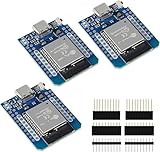
- D1 Mini NodeMCU Type-C ESP32 WLAN WiFi Bluetooth IoT Development Board 5V Compatible for Arduino
- Designed with ultra-low power technology, it offers the full range of performance and features of the ESP32 chip. The pin arrangement provides compatibility with the modules developed for the D1 Mini ESP8266 while also offering fast WLAN, enhanced GPIO, Bluetooth functionality, and with its higher performance, a wider range of applications.
- 100% compatible with Arudino IDE, Lua and Micropython, it shows robustness, versatility, and reliability in a wide variety of applications and power scenarios.
- All I/O pins have interrupt, PWM, I2C and one-wire capability, except the pin DO.
- Designed with ultra-low power technology, it offers the full range of performance and features of the ESP32 chip. The pin arrangement provides compatibility with the modules developed for the D1 Mini ESP8266 while also offering fast WLAN, enhanced GPIO, Bluetooth functionality, and with its higher performance, a wider range of applications.
How to evaluate an industrial IoT approach
Use the following questions before choosing devices, a platform or an implementation partner:
- Define the operational purpose. Choose one primary outcome—maintenance, production, logistics, inventory, energy or security—and specify the decision the data must improve.
- Check equipment and data fit. Confirm that sensors or existing controllers can observe the required asset, at the needed accuracy and cadence, in its physical environment.
- Map the integration path. Document interfaces to operational technology, ERP, CRM, maintenance and warehouse systems. Require evidence of interoperability for the versions and protocols actually in use.
- Set reliability and control requirements. Define latency, availability, offline operation, fail-safe behavior and command authorization. Industrial requirements may be materially stricter than consumer-IoT requirements.
- Design security, privacy and governance. Assign ownership for devices, identities, data retention, access, updates, incident response and any personal or commercially sensitive data.
- Plan for scale and organizational readiness. Decide how additional sites, asset types and users will be onboarded, and who will maintain models, integrations and operating procedures after the pilot.
- Measure the baseline and result. Record downtime, maintenance cost, stock accuracy, energy use or service performance before deployment, then test whether the connected workflow changed that measure.
A pilot is useful only when it tests the full path from signal to action. A dashboard that no one owns, or an alert that cannot create a work order, demonstrates connectivity rather than operational value.
Security, privacy and operational risks
Connecting an asset adds interfaces, identities and software that must be managed throughout its life. Digital security and data protection are recognized OECD concerns for IoT uptake. Risk treatment should be proportionate to the asset and consequence, not based on a universal ranking.
- Unauthorized control: separate monitoring permissions from command permissions and protect engineering interfaces.
- Weak or obsolete devices: require an update process, inventory and an end-of-support plan.
- Untrusted data: validate timestamps, units, sensor health and device identity before using a reading for automation.
- Excessive data collection: define what is needed, how long it is retained and who can access it.
- Operational disruption: design degraded-mode and manual procedures for network or platform outages.
- Vendor and integration lock-in: document data export, interface ownership and exit requirements before deployment.
Where industrial IoT is heading
The World Economic Forum’s Intelligent Industrial Operations Outlook 2026 describes operations moving from isolated pilots toward connected operating models in which people and intelligent systems work together in real time, with more adaptive systems as a longer-term direction. This is a forward-looking institutional view, not evidence that every company has reached that stage.
For historical context, the World Economic Forum’s Industrial Internet of Things report, published 20 January 2015, said: “In the next 10 years, the Internet of Things revolution will dramatically alter manufacturing, energy, agriculture, transportation and other industrial sectors of the economy.” That sentence is a dated forecast; current adoption and outcomes still vary by sector, geography, capability and investment.
The practical takeaway
IoT is a means of making physical operations observable and actionable. The strongest business cases connect a defined operational problem to suitable equipment, reliable data, secure controls and an enterprise workflow. Industrial IoT requires more stringent reliability and command considerations than consumer IoT. Adoption figures are uneven and dated, and documented benefits do not justify a universal return-on-investment promise. Industry 4.0 goes further, combining IoT with analytics, AI, cyber-physical systems, cloud or edge computing and other capabilities to create an integrated operating model.
Quick Recap
Product prices and availability are accurate as of the date/time indicated and are subject to change. Any price and availability information displayed on Amazon at the time of purchase will apply.




