Computex 2023 showed that Taiwan’s importance to artificial intelligence extends beyond semiconductor fabrication. NVIDIA’s announcements in Taipei connected its accelerator designs with Taiwanese companies that build servers, networking equipment, embedded computers and complete systems. The event demonstrated a visible manufacturing and integration role, but it did not establish Taiwan’s percentage of the world’s AI-hardware supply.
What NVIDIA announced at Computex 2023
NVIDIA founder and CEO Jensen Huang used the May 2023 keynote to present accelerated-computing systems, software and services for generative-AI workloads. NVIDIA said many of the offerings were powered by Grace Hopper superchips and positioned them for data centers and other demanding applications.
Huang described the moment in broad terms: “Accelerated computing and AI mark a reinvention of computing,” he said. He also said, “We’re now at the tipping point of a new computing era with accelerated computing and AI that’s been embraced by almost every computing and cloud company in the world.” These are statements from NVIDIA’s own keynote account, not independent market forecasts.
GH200 Grace Hopper superchip
NVIDIA’s May 28, 2023 product announcement said the GH200 combines an Arm-based Grace CPU with a Hopper GPU through the company’s NVLink-C2C interconnect. NVIDIA reported up to 900 GB/s of total bandwidth and said the product had entered full production. Those specifications and the production status are vendor claims; they are not an independent performance benchmark or proof that every system using GH200 delivers the same results.
Quick wins for a faster PC:
Clear out junk files and repair common Windows errorsFree Scan →Scan for outdated or missing drivers - takes under a minuteDriver Scan →#1 Best Overall

- System Compatibility Note: This 2-slot card measures 271 x 112 x 39 mm and requires a single 12V-2x6-pin power connector. Please verify chassis and PSU compatibility before purchase.
- Dedicated Support: Please contact us directly through Amazon for any product questions or assistance you may require.
- Professional Intel Arc Pro B70 GPU: Built on the Intel Xe2-HPG architecture, it features 32 Xe cores and 256 XMX engines, designed to accelerate AI, rendering, and complex visualization workloads.
- Massive 32GB GDDR6 VRAM: Equipped with 32GB of high-speed GDDR6 memory on a 256-bit bus, running at 19 Gbps, which allows for handling large AI models and complex datasets locally.
- High-Performance Engine Clock: Delivers an engine clock of 2540 MHz, providing the compute power needed for demanding professional applications and AI inference.
The release also referred to more than 400 system configurations powered by NVIDIA architectures. That figure describes configurations cited by NVIDIA in 2023, rather than a count of all systems available worldwide.
MGX modular server architecture
MGX was aimed at system manufacturers rather than ordinary desktop buyers. NVIDIA described it as a modular reference architecture that could support more than 100 server variations for artificial intelligence, high-performance computing and Omniverse applications. The company named ASUS, GIGABYTE, Pegatron, QCT, ASRock Rack and Supermicro as early adopters.
According to NVIDIA’s 2023 release, MGX could reduce development costs by up to three-quarters and shorten development time by two-thirds, with a six-month development period. These are projected benefits from NVIDIA, not independently verified savings. The architecture still requires decisions about the workload, budget, power delivery, thermal design and mechanical constraints.
Rank #2

- NVIDIA Volta GV100 Architecture — 4,608 CUDA Cores, 640 1st-Gen Tensor Cores delivering 14 TFLOPS FP32 and 112 TFLOPS deep learning performance for AI training, inference, HPC, and scientific computing workloads
- 32GB HBM2 ECC Memory — 900 GB/s Bandwidth — High-bandwidth memory on a 4096-bit bus with ECC error correction provides the memory capacity and throughput required for the largest AI models, simulations, and datasets
- PCIe 3.0 x16 Interface — 250W TDP — Standard PCIe Gen3 connectivity with passive cooling designed for enterprise rack server deployment in HPE ProLiant, Dell PowerEdge, and Supermicro platforms with adequate chassis airflow
- NVLink — Scale to 96GB Unified Memory — Connect two V100 GPUs via NVLink at 300 GB/s bi-directional bandwidth to scale GPU memory from 32GB to 96GB for larger AI training and HPC workloads
- Multi-Precision Computing — Supports FP64 (7 TFLOPS), FP32 (14 TFLOPS), FP16 (112 TFLOPS) and INT8 precision modes for flexible deployment across training, inference, and scientific simulation workloads
Kaustubh Sanghani, NVIDIA’s vice president of GPU products, said: “We created MGX to help organizations bootstrap enterprise AI, while saving them significant amounts of time and money.”
Why Taiwan matters in the AI hardware chain
Taiwan’s contribution described at Computex was the ability to turn chip and accelerator designs into deployable equipment. That includes server engineering, board design, assembly, cooling, power integration, networking and systems configured for a customer’s software and workload.
NVIDIA listed the following Taiwan-based system manufacturers as bringing accelerated systems to market:
Rank #3

- Professional AI & Creator Workstation: AMD Radeon AI PRO R9700 GPU with 32GB GDDR6 is engineered for AI development, professional content creation, and compute-intensive workloads.
- Massive 32GB Memory Capacity: 32GB of GDDR6 memory on a 256-bit bus provides ample bandwidth for large AI models, 8K video editing, and complex 3D rendering.
- Advanced RDNA 4 with AI Accelerators: 64 Compute Units with 3rd Gen Ray Tracing and dedicated 2nd Gen AI Accelerators for groundbreaking AI performance and visual computing.
- Professional Blower Cooling: Efficient single blower design exhausts heat directly out of the chassis, ideal for multi-GPU workstation and server configurations.
- Enterprise-Grade Thermal Solution: Vapor chamber heatsink with industrial Honeywell PTM7950 thermal interface material ensures reliable cooling under sustained professional loads.
| Company | Role established by the 2023 announcements |
|---|---|
| AAEON | System manufacturer listed by NVIDIA |
| Advantech | System manufacturer listed by NVIDIA |
| Aetina | System manufacturer listed by NVIDIA |
| ASRock Rack | System manufacturer and MGX early adopter |
| ASUS | System manufacturer and MGX early adopter |
| GIGABYTE | System manufacturer and MGX early adopter |
| Ingrasys | System manufacturer listed by NVIDIA |
| Inventec | System manufacturer listed by NVIDIA |
| Pegatron | System manufacturer and MGX early adopter |
| QCT | System manufacturer and MGX early adopter |
| Tyan | System manufacturer listed by NVIDIA |
| Wistron | System manufacturer listed by NVIDIA |
| Wiwynn | System manufacturer listed by NVIDIA |
The list shows announced participation and market presence. It does not prove that these companies supplied every NVIDIA-based system, that their relationships were exclusive, or that they represented Taiwan’s entire supply chain.
From components to complete systems
Trade reporter Nitin Dahad of EE Times described Taiwan’s established semiconductor and computer-manufacturing base as broadening into research, startups and a knowledge-driven economy. His account of Computex 2023 covered an AI ecosystem spanning chips, servers, embedded computers and applications.
That breadth matters because an accelerator is only one part of an AI deployment. A usable system also needs CPUs, memory, storage, networking, power supplies, cooling, chassis engineering and software. Taiwan’s system builders operate at the integration layer where those parts become a server or edge appliance that a cloud provider, enterprise or research organization can install.
Rank #4
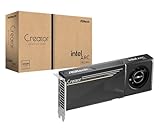
- System Compatibility Note: 2-slot card, 271x112x39mm, single 8-pin power, 200W TDP. Verify chassis clearance and PSU capacity before purchase.
- Dedicated Support: Please contact us directly through Amazon for any product questions or assistance you may require.
- 24GB GDDR6 on 192-Bit Bus: Massive 24GB memory with 456 GB/s bandwidth – ideal for LLMs, AI inference, 3D rendering, and generative design.
- Intel Xe2-HPG Architecture: Built on Intel's next-gen architecture with 20 Xe cores and 160 XMX engines for AI acceleration (197 INT8 TOPS).
- PCIe 5.0 Support: PCI Express 5.0 x16 interface for maximum bandwidth with the latest workstation platforms.
How MGX connected NVIDIA’s platform to Taiwanese builders
A conventional server project may require a manufacturer to validate many combinations of processors, accelerators, networking components, power systems and cooling. MGX supplied a common design framework that NVIDIA said could be adapted into more than 100 server variations.
- Choose the workload: training and inference, high-performance computing, graphics or simulation impose different requirements.
- Select the platform: the manufacturer combines Grace Hopper or other NVIDIA architectures with CPUs, memory, storage and networking.
- Engineer the enclosure: power delivery, thermal management and mechanical dimensions determine whether the design can run reliably in a rack or edge environment.
- Integrate software: drivers, AI frameworks, management tools and customer applications turn the hardware into a deployable service.
- Customize and ship: system makers adapt the reference design for a customer’s budget, performance target and operating environment.
This model helps explain Taiwan’s strategic role: the value is not limited to making an individual chip. It includes repeatedly producing and customizing complete accelerated-computing systems.
Independent reader supportYour contribution helps us test, update, and keep practical guides available for everyone.Data-center and cloud context
NVIDIA’s 2023 H100 cloud-partner list included AWS, Cirrascale, CoreWeave, Google Cloud, Lambda, Microsoft Azure, Oracle Cloud Infrastructure, Paperspace and Vultr. The list indicates announced cloud participation around NVIDIA’s accelerated systems. It is not evidence that any one provider used Taiwanese-made equipment exclusively or that the list covered every deployment.
Free tools Windows power users keep installed
One-click scans. No signup required.
Best Value

- PLEASE NOTE: Exporting an NVIDIA RTX Pro 6000 GPU outside the US requires strict adherence to the U.S. Export Administration Regulations (EAR) and issuance of an export license from the Bureau of Industry and Security (BIS). Compliance and Know Your Customer (KYC) screening may be required as a condition of order acceptance. [NVIDIA Blackwell Streaming Multiprocessor] The new SM features increased processing throughput, and new neural shaders that integrate neural networks inside of programmable shaders | DLSS 4: Multi Frame Generation ensures ultra-smooth frame pacing for lifelike simulations.
- [Double-Flow-Through Design] The RTX PRO 6000 Blackwell features a double-flow-through cooling design, optimizing efficiency and airflow to sustain peak performance under 600W power loads. | [5th Gen Tensor Cores] Deliver up to 3X the performance of the previous generation and support for FP4 precision for faster AI model processing times with reduced memory usage, enabling local fine-tuning of LLMs and generative AI | [4th Gen Ray Tracing Cores] Double the ray-triangle intersection rate of the previous generation to create photoreal, physically accurate scenes and immersive 3D designs with RTX Mega Geometry, which enables up to 100X more ray-traced triangles.
- [PCIe Gen 5] Support for PCIe Gen 5 provides double the bandwidth of PCIe Gen 4, improving data-transfer speeds from CPU memory and unlocking faster performance for data-intensive tasks like AI, data science, and 3D modeling. | [GDDR7 Memory] With 96 GB of GPU memory and 1.8 TB ps bandwidth, it can tackle massive 3D and AI projects, fine-tune AI models locally, explore large-scale VR environments, and drive larger multi-app workflows.
- [DisplayPort 2.1] Achieve unparalleled visual clarity and performance, driving high resolution displays at up to 8K at 240 Hz and 16K at 60 Hz. Increased bandwidth enables seamless multi-monitor setups while HDR and higher color depth support ensures superior color accuracy for precision work, such as video editing, 3D design, and live broadcasting.
- [Universal MIG] Divide a single RTX PRO 6000 Blackwell into multiple isolated instances, each with dedicated resources, allowing for concurrent execution of multiple workloads, optimized GPU utilization, and secure isolation of different applications or users. [WARRANTY] 3 YR Manufacturer's Warranty. Bulk OEM Packaging. Retail Packaging is NOT included.
For buyers and investors, the distinction between a component and a complete server is important. A product such as an H100 or GH200 accelerator is installed inside a larger platform whose cost, availability and operating economics also depend on servers, networking, electricity, cooling and software.
What Computex itself added
Computex 2023 in Taipei brought together a broad roster of Taiwanese and international information-and-communications-technology companies. The organizer said the concurrent InnoVEX startup event hosted 400 startups from 22 countries and regions and presented the show as a place to build an AI-solution supply chain.
NVIDIA said about 3,500 people attended its keynote. Attendance and exhibitor lists demonstrate strong attention and participation, but neither measures Taiwan’s share of global AI manufacturing.
What the evidence does—and does not—show
Established by the announcements
- NVIDIA used Computex 2023 to emphasize AI infrastructure, including chips, systems, networking, software and services.
- GH200 combined NVIDIA’s Grace CPU and Hopper GPU architectures through NVLink-C2C; NVIDIA reported up to 900 GB/s of total bandwidth.
- MGX was presented as a modular architecture for system makers, with more than 100 possible server variations described by NVIDIA.
- NVIDIA publicly associated numerous Taiwan manufacturers with accelerated systems, including several named MGX early adopters.
- Contemporaneous trade reporting described Taiwan’s ecosystem as extending from semiconductors into servers, embedded computers and AI applications.
Not established by these sources
- No independently validated percentage of global AI-hardware manufacturing or supply attributable to Taiwan.
- No proof that Taiwan is the exclusive or indispensable source for every NVIDIA AI system.
- No independent confirmation that MGX’s projected cost and development-time reductions were achieved in customer projects.
- No cross-vendor benchmark proving that GH200 or any named Taiwanese system outperformed alternatives.
Why the distinction matters for financial decisions
Taiwan’s role can be understood as ecosystem leverage rather than a single-company statistic. A dense network of chip, board, server and contract-manufacturing specialists may help AI companies move from a design to a scalable product. At the same time, concentration in a region, dependence on a platform vendor and the capital required for power and cooling remain material considerations for anyone evaluating AI infrastructure businesses.
Recommended Free Tools
Computex 2023 therefore offered a strong qualitative signal: Taiwan was not merely making components for the AI boom; its manufacturers were helping assemble the systems on which AI services run. The event did not, by itself, quantify how much of the global market that role represented.
Quick Recap
Product prices and availability are accurate as of the date/time indicated and are subject to change. Any price and availability information displayed on Amazon at the time of purchase will apply.




